determine the concentration of glucose in the original glucose solution. report a relative standard deviation for...
determine the concentration of glucose in the original glucose solution. report a relative standard deviation for the original concentration
Glucose solution / mL: Tube 1: 0 mL Tube 2: 2 mL Tube 3: 4 mL Tube 4: 6 mL Tube 5: 8 mL Tube 6: 9.5 mL
Absorbance at 420 nm for each solution: Tube 1: 0.617 Tube 2: 0.578 Tube 3: 0.736 Tube 4: 0.653 Tube 5: 0.843 Tube 6: 0.895
Homework Answers
Glucose cannot be measured directly in a spectrophotometer, but can be measured indirectly by coupling its consumption to the production of NADPH
we know that
Beer's Law --> A = e.c.l
Where;
A = absorption,
e = specific extinction coefficient,
c = concentration,
l = path length --> be consider as 1 cm
the initial tube will have only NADPH and glucose = 0 mL
Extinction coeffecient of NADPH = 6.22
0.617 = 6.22 X c X 1
concentration = 0.099 mM
Now initially tube will have x mL of 0.099 mM of NADPH
Add Answer to:
determine the concentration of glucose in the original glucose
solution. report a relative standard deviation for...
4. (a) Determine the experimental concentration of protein in the unknown solution in mg/mL using the...
 4. (a) Determine the experimental concentration of protein in the unknown solution in mg/mL using the Part II Data Table and the equation on page 2 for the absorbance assay at 280 nm. Hint: Convert the molar concentration (M or moles/liter) of BSA from absorbance assay at 280 nm method to mg/mL, assume that the molecular weight of BSA = 66.5 kDa [7 points 6500 g/mol Post-lab 10 Report Form: Determination the Concentration of a Protein You must show your...
Determine the equilibrium concentration of FeSCN2+ in each solution. (Page below are the initial concentrations of...
 Determine the equilibrium concentration of FeSCN2+ in each
solution. (Page below are the initial concentrations of FE3+ and
scn- for each solution )
Secondly, use stoichiometry to determine equilibrium FE3+ and
SCN -. ( concentration used for FE and KSCN are both 0.002M )
the absorbance of each standard in the same test tube used to blank the spectrophoto standards from least to most concentrated, rinsing with a small amount of the next sta tilling the test tube. Record absorbance...
Determine the equilibrium concentration of FeSCN2+ in each
solution. (Page below are the initial concentrations of FE3+ and
scn- for each solution )
Secondly, use stoichiometry to determine equilibrium FE3+ and
SCN -. ( concentration used for FE and KSCN are both 0.002M )
the absorbance of each standard in the same test tube used to blank the spectrophoto standards from least to most concentrated, rinsing with a small amount of the next sta tilling the test tube. Record absorbance...
Preparing Dilute Solutions C1 V1 C2 V2 C1 is the concentration of the original concentrated solution...
 Preparing Dilute Solutions C1 V1 C2 V2 C1 is the concentration of the original concentrated solution V1 is the volume of the original concentrated solution C2 is the concentration of the final dilute solution V2 is the volume of the final dilute solution A common solution unit is mol/L which can also be written as M. A solution that is 0.1 M NAOH has 0.1 moles Na OH for every liter of solution. Beer's Law Calibration Curve A colored solution...
using my standard curve I need to determine the concentration of glucose in the unknown Volume...
using my standard curve I need to determine the concentration of glucose in the unknown Volume of Glucose added (ml) Glucose Concentration (mol/l) % Transmittance Absorbance 0.00 2.7001 x 10⁻³ 17.6 0.754 1.00 2.7001 x 10⁻⁵ 31.2 0.506 2.00 5.4002 x 10⁻⁵ 41.5 0.382 3.00 8.1003 x 10⁻⁵ 60.9 0.215 Unknown 63.0 0.201 Using the standard determine the concentration of glucose in the unknown. The equation is y=-0.1741x+0.7254. this is all the information thats needed
If the original sodium tartrate solution had a concentration of 1.00 M instead of 0.100 M,...
 If the original sodium tartrate solution had a concentration of
1.00 M instead of 0.100 M, what would the concentration of copper
be in a solution created by combining 10 mL of it with 10 mL of the
0.100M copper (II)sulfate solution. Use the Ksp you found in the
experiment.
For the ionic solid copper tartrate, the solubility equilibrium
reaction is: CuC4H4O6 (s) Cu2+ (aq) + C4H4O6 2- (aq) Just like any
equilibrium reaction, an equilibrium expression can be created....
If the original sodium tartrate solution had a concentration of
1.00 M instead of 0.100 M, what would the concentration of copper
be in a solution created by combining 10 mL of it with 10 mL of the
0.100M copper (II)sulfate solution. Use the Ksp you found in the
experiment.
For the ionic solid copper tartrate, the solubility equilibrium
reaction is: CuC4H4O6 (s) Cu2+ (aq) + C4H4O6 2- (aq) Just like any
equilibrium reaction, an equilibrium expression can be created....
You have a standard stock containing (1.67 mM glucose + 1.67 mM fructose). Calculate the glucose...
 You
have a standard stock containing (1.67 mM glucose + 1.67 mM
fructose).
Calculate the glucose concentration and fructose
concentration. Show work.
Fructose Tube Gle-Fru Water DNS Total Glucose reagent volume l conc (μM) | conc (μM) Stock solutionm 1 mL 1 0mL 2 0.25 mL 2.75 mL ImL 4 mL 3 0.5 mL 2.5 mL1 mL4 mL 4 0.75 mL 2.25 mL 1 mL 4 m 2 mL1 mL 4 mL 1.5 mL I mL 4 mL 1 mL...
You
have a standard stock containing (1.67 mM glucose + 1.67 mM
fructose).
Calculate the glucose concentration and fructose
concentration. Show work.
Fructose Tube Gle-Fru Water DNS Total Glucose reagent volume l conc (μM) | conc (μM) Stock solutionm 1 mL 1 0mL 2 0.25 mL 2.75 mL ImL 4 mL 3 0.5 mL 2.5 mL1 mL4 mL 4 0.75 mL 2.25 mL 1 mL 4 m 2 mL1 mL 4 mL 1.5 mL I mL 4 mL 1 mL...
Table A. Preparation of Standard solutions of FeSCN2+ 1.0 M HNO3 0.002 M 0.200 M Solution...
 Table A. Preparation of Standard solutions of FeSCN2+ 1.0 M HNO3 0.002 M 0.200 M Solution KSCN (mL) Fe(NO3)3 (mL) 0.5 5 [FeSCN2+] (mol/L)* 1 4.0x10^-5 Add 1.0 M 2 1.0 5 8.0x10^-5 HNO3 3 1.5 5 1.2x10^-10 4 2.0 5 1.6x10⁻⁴ to each to adjust the volume to 25 mL. 5 2.5 5 2.0x10⁻⁴ * Calculate the concentrations of FeSCN2+ in each beaker, assuming that all SCN-ions exist as FeSCN2+. In other words, [FeSCN2+] (in Soln 1) = [SCN-]...
REPORT SHEET EXPERIMENT Colorimetric 22 Determination of an Equilibrium Constant in Aqueous Solut...
 Determination of the equilibrum constant
REPORT SHEET EXPERIMENT Colorimetric 22 Determination of an Equilibrium Constant in Aqueous Solution A. Preparation of the Calibration Curve Concentration of Fe(NO,), in 0.10 M HNO, solution Concentration of NaSCN in 0.10 M HNO, solution Y Y Flask Number 2 Volume of NaSCN, mL Solution Initial [SCN 1.M Equil. [FeNCs". M Percent T Absorbance B. Determination of the Equilibrium Constant Concentration of Fe(NO,) in 0.10 M HNO, solution Concentration of NaSCN in 0.10 M HNO,...
Determination of the equilibrum constant
REPORT SHEET EXPERIMENT Colorimetric 22 Determination of an Equilibrium Constant in Aqueous Solution A. Preparation of the Calibration Curve Concentration of Fe(NO,), in 0.10 M HNO, solution Concentration of NaSCN in 0.10 M HNO, solution Y Y Flask Number 2 Volume of NaSCN, mL Solution Initial [SCN 1.M Equil. [FeNCs". M Percent T Absorbance B. Determination of the Equilibrium Constant Concentration of Fe(NO,) in 0.10 M HNO, solution Concentration of NaSCN in 0.10 M HNO,...
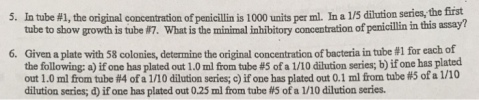
Microbiology In tube #1, the original concentration of penicillin is 1000 units per ml. In a...
 Microbiology
In tube #1, the original concentration of penicillin is 1000 units per ml. In a 1/5 dilution series, the first tube to show growth is tube #7. What is the m nmal hibitory concentration of penicillin in this assay? Given a plate with 58 colonies, determine the original concentration of bacteria in tube #1 for each of out 1.0 ml fontube #4 of a 1/10 dilution series, c) if one has plated out 0.1 ml from tube #5 of...
Microbiology
In tube #1, the original concentration of penicillin is 1000 units per ml. In a 1/5 dilution series, the first tube to show growth is tube #7. What is the m nmal hibitory concentration of penicillin in this assay? Given a plate with 58 colonies, determine the original concentration of bacteria in tube #1 for each of out 1.0 ml fontube #4 of a 1/10 dilution series, c) if one has plated out 0.1 ml from tube #5 of...
I have questions 1-5. I just need help with number 6. Thank you! Assume that the...
 I have questions 1-5. I just need help with number 6. Thank
you!
Assume that the concentration of the glucose standard sample is 1.200 mg/ml. Use the following results to perform your calculations: 1. Calculate the concentration of glucose in tubes 1 through 5 (in mu g/ml). 2. Make graphs of A_ vs. concentration and A_ vs. amount (in mu g). It is suggested that you use the program module Excel in Microsoft Office. Instructions are provided in Statistical Calculations...
I have questions 1-5. I just need help with number 6. Thank
you!
Assume that the concentration of the glucose standard sample is 1.200 mg/ml. Use the following results to perform your calculations: 1. Calculate the concentration of glucose in tubes 1 through 5 (in mu g/ml). 2. Make graphs of A_ vs. concentration and A_ vs. amount (in mu g). It is suggested that you use the program module Excel in Microsoft Office. Instructions are provided in Statistical Calculations...
 4. (a) Determine the experimental concentration of protein in the unknown solution in mg/mL using the Part II Data Table and the equation on page 2 for the absorbance assay at 280 nm. Hint: Convert the molar concentration (M or moles/liter) of BSA from absorbance assay at 280 nm method to mg/mL, assume that the molecular weight of BSA = 66.5 kDa [7 points 6500 g/mol Post-lab 10 Report Form: Determination the Concentration of a Protein You must show your...
 Determine the equilibrium concentration of FeSCN2+ in each
solution. (Page below are the initial concentrations of FE3+ and
scn- for each solution )
Secondly, use stoichiometry to determine equilibrium FE3+ and
SCN -. ( concentration used for FE and KSCN are both 0.002M )
the absorbance of each standard in the same test tube used to blank the spectrophoto standards from least to most concentrated, rinsing with a small amount of the next sta tilling the test tube. Record absorbance...
Determine the equilibrium concentration of FeSCN2+ in each
solution. (Page below are the initial concentrations of FE3+ and
scn- for each solution )
Secondly, use stoichiometry to determine equilibrium FE3+ and
SCN -. ( concentration used for FE and KSCN are both 0.002M )
the absorbance of each standard in the same test tube used to blank the spectrophoto standards from least to most concentrated, rinsing with a small amount of the next sta tilling the test tube. Record absorbance...
 Preparing Dilute Solutions C1 V1 C2 V2 C1 is the concentration of the original concentrated solution V1 is the volume of the original concentrated solution C2 is the concentration of the final dilute solution V2 is the volume of the final dilute solution A common solution unit is mol/L which can also be written as M. A solution that is 0.1 M NAOH has 0.1 moles Na OH for every liter of solution. Beer's Law Calibration Curve A colored solution...
 If the original sodium tartrate solution had a concentration of
1.00 M instead of 0.100 M, what would the concentration of copper
be in a solution created by combining 10 mL of it with 10 mL of the
0.100M copper (II)sulfate solution. Use the Ksp you found in the
experiment.
For the ionic solid copper tartrate, the solubility equilibrium
reaction is: CuC4H4O6 (s) Cu2+ (aq) + C4H4O6 2- (aq) Just like any
equilibrium reaction, an equilibrium expression can be created....
If the original sodium tartrate solution had a concentration of
1.00 M instead of 0.100 M, what would the concentration of copper
be in a solution created by combining 10 mL of it with 10 mL of the
0.100M copper (II)sulfate solution. Use the Ksp you found in the
experiment.
For the ionic solid copper tartrate, the solubility equilibrium
reaction is: CuC4H4O6 (s) Cu2+ (aq) + C4H4O6 2- (aq) Just like any
equilibrium reaction, an equilibrium expression can be created....
 You
have a standard stock containing (1.67 mM glucose + 1.67 mM
fructose).
Calculate the glucose concentration and fructose
concentration. Show work.
Fructose Tube Gle-Fru Water DNS Total Glucose reagent volume l conc (μM) | conc (μM) Stock solutionm 1 mL 1 0mL 2 0.25 mL 2.75 mL ImL 4 mL 3 0.5 mL 2.5 mL1 mL4 mL 4 0.75 mL 2.25 mL 1 mL 4 m 2 mL1 mL 4 mL 1.5 mL I mL 4 mL 1 mL...
You
have a standard stock containing (1.67 mM glucose + 1.67 mM
fructose).
Calculate the glucose concentration and fructose
concentration. Show work.
Fructose Tube Gle-Fru Water DNS Total Glucose reagent volume l conc (μM) | conc (μM) Stock solutionm 1 mL 1 0mL 2 0.25 mL 2.75 mL ImL 4 mL 3 0.5 mL 2.5 mL1 mL4 mL 4 0.75 mL 2.25 mL 1 mL 4 m 2 mL1 mL 4 mL 1.5 mL I mL 4 mL 1 mL...
 Table A. Preparation of Standard solutions of FeSCN2+ 1.0 M HNO3 0.002 M 0.200 M Solution KSCN (mL) Fe(NO3)3 (mL) 0.5 5 [FeSCN2+] (mol/L)* 1 4.0x10^-5 Add 1.0 M 2 1.0 5 8.0x10^-5 HNO3 3 1.5 5 1.2x10^-10 4 2.0 5 1.6x10⁻⁴ to each to adjust the volume to 25 mL. 5 2.5 5 2.0x10⁻⁴ * Calculate the concentrations of FeSCN2+ in each beaker, assuming that all SCN-ions exist as FeSCN2+. In other words, [FeSCN2+] (in Soln 1) = [SCN-]...
 Determination of the equilibrum constant
REPORT SHEET EXPERIMENT Colorimetric 22 Determination of an Equilibrium Constant in Aqueous Solution A. Preparation of the Calibration Curve Concentration of Fe(NO,), in 0.10 M HNO, solution Concentration of NaSCN in 0.10 M HNO, solution Y Y Flask Number 2 Volume of NaSCN, mL Solution Initial [SCN 1.M Equil. [FeNCs". M Percent T Absorbance B. Determination of the Equilibrium Constant Concentration of Fe(NO,) in 0.10 M HNO, solution Concentration of NaSCN in 0.10 M HNO,...
Determination of the equilibrum constant
REPORT SHEET EXPERIMENT Colorimetric 22 Determination of an Equilibrium Constant in Aqueous Solution A. Preparation of the Calibration Curve Concentration of Fe(NO,), in 0.10 M HNO, solution Concentration of NaSCN in 0.10 M HNO, solution Y Y Flask Number 2 Volume of NaSCN, mL Solution Initial [SCN 1.M Equil. [FeNCs". M Percent T Absorbance B. Determination of the Equilibrium Constant Concentration of Fe(NO,) in 0.10 M HNO, solution Concentration of NaSCN in 0.10 M HNO,...
 Microbiology
In tube #1, the original concentration of penicillin is 1000 units per ml. In a 1/5 dilution series, the first tube to show growth is tube #7. What is the m nmal hibitory concentration of penicillin in this assay? Given a plate with 58 colonies, determine the original concentration of bacteria in tube #1 for each of out 1.0 ml fontube #4 of a 1/10 dilution series, c) if one has plated out 0.1 ml from tube #5 of...
Microbiology
In tube #1, the original concentration of penicillin is 1000 units per ml. In a 1/5 dilution series, the first tube to show growth is tube #7. What is the m nmal hibitory concentration of penicillin in this assay? Given a plate with 58 colonies, determine the original concentration of bacteria in tube #1 for each of out 1.0 ml fontube #4 of a 1/10 dilution series, c) if one has plated out 0.1 ml from tube #5 of...
 I have questions 1-5. I just need help with number 6. Thank
you!
Assume that the concentration of the glucose standard sample is 1.200 mg/ml. Use the following results to perform your calculations: 1. Calculate the concentration of glucose in tubes 1 through 5 (in mu g/ml). 2. Make graphs of A_ vs. concentration and A_ vs. amount (in mu g). It is suggested that you use the program module Excel in Microsoft Office. Instructions are provided in Statistical Calculations...
I have questions 1-5. I just need help with number 6. Thank
you!
Assume that the concentration of the glucose standard sample is 1.200 mg/ml. Use the following results to perform your calculations: 1. Calculate the concentration of glucose in tubes 1 through 5 (in mu g/ml). 2. Make graphs of A_ vs. concentration and A_ vs. amount (in mu g). It is suggested that you use the program module Excel in Microsoft Office. Instructions are provided in Statistical Calculations...
Most questions answered within 3 hours.
-
Where is the error in this code sequence?
String s1 = "Hello";
String s2 = "ello";...
asked 11 months ago -
Financial data for Joel de Paris, Inc., for last year
follow:
Joel de Paris, Inc.
Balance...
asked 11 months ago -
Consider this reaction:
Al2(SO4)3 (aq)+ BaCl3
(aq) Al2Cl6 (aq)- +
3BaSO4(s) . What is the...
asked 11 months ago -
Suppose that Savneet is considering increasing her
recent random sample from 20 car rentals to 40...
asked 11 months ago -
Trucks arrive at an unloading terminal at an average rate of 120
per hour.
Trucks arrive...
asked 11 months ago -
Why are methanol and ethanol completely soluble in water while
octanol is not very little soluble....
asked 11 months ago -
A facilities manager at a university reads in a research report
that the mean amount of...
asked 11 months ago -
When the CuSO4 is rehydrated by adding water to the anhydrous
compound, is this an endothermic...
asked 11 months ago -
A ray of sunlight is passing from diamond into crown glass; the
angle of incidence is...
asked 11 months ago -
A block of mass 0.249 kg is placed on top of a light, vertical
spring of...
asked 11 months ago -
how do the kidneys compensate in the presences of acidosis
a) trigger hyperventilate
b) reserve acid...
asked 11 months ago -
Question 501 pts
The rental rate of capital to the firm increases. Which of the
following...
asked 11 months ago