
Homework Answers
2NO2 ----------> 2NO + O2
Kp = [PNO]2 PO2 / {PNO2]2
Substituting the given values
0.863 = [0.30]2 x P O2 / (0.52)2
solving PO2 = 2.593 atm
OPTION B
Add Answer to:
EM122_01 Consider the following equilibrated system: 2NO,(0) 2NO() +0,0). If the K value is 0.863, find...
9. The equilibrium constants for the following reactions are K, and K2 as shown, 2NO (g)...
 9. The equilibrium constants for the following reactions are K, and K2 as shown, 2NO (g) +02 (g)2NO2 (2) Ki 2S02 (g) + 02 (g)2SO3 (g) K2 the equilibrium constant for the reaction, NO2 (g)+ SO2 (g)sNO (g)+SO3 (g), is K2 c. a. K,K2 e. none of these 2 2K 14 10. The solubility product expression (Kip) for the dissolution of Group I salt KCI) in water is K+ ICI 11. A 7 L sample of a gas is confined...
(a) For the reaction 2NO2 (g) 2NO (g) + 02 (g) K # 0.50. Predict the...
 (a) For the reaction 2NO2 (g) 2NO (g) + 02 (g) K # 0.50. Predict the direction in which the system will move to reach equilibrium if the initial gas pressures are NO: 0.20 atm . NO2: 0.20 atm (answer: to the right because Q< K) .NO2: 0.0961 atm 02: 0.0589 atm NO: 0.280 atm (answer: the system is already at equilibrium because Q -K) O2: 0.20 atm NO: 0.56 atm NO2: 0.20 atm (answer: to the left because Q>...
333 241 Consider the following reaction: 22(g) +O (g) 2NO (g) A 5.00 L flask was...
 333 241 Consider the following reaction: 22(g) +O (g) 2NO (g) A 5.00 L flask was filled with 0.500 atm N0(g) and 0.500 atm He(g) at 500.0 °C. At equilibrium, the pressure of O(g) is found to be 5.0 x10 atm. What is the value of K.?
Consider the following equilibrium system at 821 K. 2NOCI(g) 2NO(g) + Cl2 (g) If an equilibrium...
 Consider the following equilibrium system at 821 K. 2NOCI(g) 2NO(g) + Cl2 (g) If an equilibrium mixture of the three gases at 821 K contains 9.34 x 10³ M NOCI 3.47 x 10² M NO, and 2.57 x 10 M Cl2, what is the value of the equilibrium constant К? К We were unable to transcribe this imageConsider the following equilibrium system at 521 K 2CH2 Cl2 (g) CH4 (g)CC4 (g) If an equilibrium mixture of the three gases at...
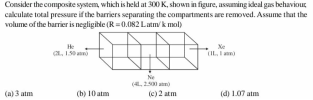
with detailed explanation. Consider the composite system, which is held at 300 K, shown in figure,...
 with detailed explanation.
Consider the composite system, which is held at 300 K, shown in figure, assuming ideal gas behaviour, calculate total pressure if the barriers separating the compartments are removed. Assume that the volume of the barrier is negligible (R = 0.082 L atm/k mol) He (2L, 1.50 atm) Xe (IL, I atm) Ne (4L, 2.500 atm) (c) 2 atm (a) 3 atm (b) 10 atm (d) 1.07 atm
with detailed explanation.
Consider the composite system, which is held at 300 K, shown in figure, assuming ideal gas behaviour, calculate total pressure if the barriers separating the compartments are removed. Assume that the volume of the barrier is negligible (R = 0.082 L atm/k mol) He (2L, 1.50 atm) Xe (IL, I atm) Ne (4L, 2.500 atm) (c) 2 atm (a) 3 atm (b) 10 atm (d) 1.07 atm
1. (20 marks) This question is about the system of differential equations Y. dt=(k 1 (a) Consider the case k = 0. i...
 1. (20 marks) This question is about the system of differential equations Y. dt=(k 1 (a) Consider the case k = 0. i. Determine the type of equilibrium at (0,0) (e.g., sink, spiral source). ii. Write down the general solution. iii. Sketch a phase portrait for the system. (b) Now consider the case k3 In this case, the matrix has an eigenvalue 2+V/2 with eigenvector i. -1+iv2 and an eigenvalue 2 iv2 with eigenvector . Determine the type of equilibrium...
. Consider the chemical system: 2NO(g) + O2(g) <---> 2NO2(g) Fill in the blanks. An increase...
. Consider the chemical system: 2NO(g) + O2(g) <---> 2NO2(g) Fill in the blanks. An increase in pressure will cause the equilibrium to shift to the ___(1)___, increasing the concentration of _____(2)____ and decreasing the concentration of _____(3)___. The reaction is endothermic. A decrease in temperature will cause the equilibrium to shift to the ____(1)_____, increasing the concentration of ___(2)____, and decreasing the concentration of ____(3)____. Removal of O2 will cause the equilibrium to shift to the____(1)_____, increasing the concentration...
1. (20 marks) This question is about the system of differential equations dY (3 1 (a) Consider the case k 0 i. Dete...
 1. (20 marks) This question is about the system of differential equations dY (3 1 (a) Consider the case k 0 i. Determine the type of equilibrium at (0,0) (e.g., sink, spiral source). i. Write down the general solution. ili Sketch a phase portrait for the system. (b) Now consider the case k -3. (-1+iv ) i. In this case, the matrix has an eigenvalue 2+i/2 with eigenvector and an eigenvalue 2-W2 with eigenvector Determine the type of equilibrium at...
1. Consider the following reaction and its equilibrium constant: N2O(8) = 2NO,(g) Kp = 0.0059 A...
 1. Consider the following reaction and its equilibrium constant: N2O(8) = 2NO,(g) Kp = 0.0059 A reaction mixture contains 0.65 atm N, O, and 2.10 atm No,. Which of the following statements is TRUE concerning this system? a. Q> Kreaction proceeds to right b. Q<k, reaction proceeds to right Q> K, reaction proceeds to left d. Q<K, reaction proceeds to left e. The system is in equilibrium 2. The above reaction (in question 1) is exothermic. Based on this, the...
1. Consider the system 2(t)--3i(t) +z2(t) +3() (a) (i) Find the linearised system at the equilibrium point (0, 0)....
 1. Consider the system 2(t)--3i(t) +z2(t) +3() (a) (i) Find the linearised system at the equilibrium point (0, 0). (ii) What type of equilibrium point is (0,0)? (State your reasons fully.) (ii) Sketch the phase portrait for the linearised system near (0,0). (b) Repeat part (a) for the equilibrium point at (1,0). (c) (i) Are there any other equilibria? (ii) Read the Grobman-Hartman theorem and confirm that it applies to the above equilibria.
1. Consider the system 2(t)--3i(t) +z2(t) +3()...
1. Consider the system 2(t)--3i(t) +z2(t) +3() (a) (i) Find the linearised system at the equilibrium point (0, 0). (ii) What type of equilibrium point is (0,0)? (State your reasons fully.) (ii) Sketch the phase portrait for the linearised system near (0,0). (b) Repeat part (a) for the equilibrium point at (1,0). (c) (i) Are there any other equilibria? (ii) Read the Grobman-Hartman theorem and confirm that it applies to the above equilibria.
1. Consider the system 2(t)--3i(t) +z2(t) +3()...
 9. The equilibrium constants for the following reactions are K, and K2 as shown, 2NO (g) +02 (g)2NO2 (2) Ki 2S02 (g) + 02 (g)2SO3 (g) K2 the equilibrium constant for the reaction, NO2 (g)+ SO2 (g)sNO (g)+SO3 (g), is K2 c. a. K,K2 e. none of these 2 2K 14 10. The solubility product expression (Kip) for the dissolution of Group I salt KCI) in water is K+ ICI 11. A 7 L sample of a gas is confined...
 (a) For the reaction 2NO2 (g) 2NO (g) + 02 (g) K # 0.50. Predict the direction in which the system will move to reach equilibrium if the initial gas pressures are NO: 0.20 atm . NO2: 0.20 atm (answer: to the right because Q< K) .NO2: 0.0961 atm 02: 0.0589 atm NO: 0.280 atm (answer: the system is already at equilibrium because Q -K) O2: 0.20 atm NO: 0.56 atm NO2: 0.20 atm (answer: to the left because Q>...
 333 241 Consider the following reaction: 22(g) +O (g) 2NO (g) A 5.00 L flask was filled with 0.500 atm N0(g) and 0.500 atm He(g) at 500.0 °C. At equilibrium, the pressure of O(g) is found to be 5.0 x10 atm. What is the value of K.?
 Consider the following equilibrium system at 821 K. 2NOCI(g) 2NO(g) + Cl2 (g) If an equilibrium mixture of the three gases at 821 K contains 9.34 x 10³ M NOCI 3.47 x 10² M NO, and 2.57 x 10 M Cl2, what is the value of the equilibrium constant К? К We were unable to transcribe this imageConsider the following equilibrium system at 521 K 2CH2 Cl2 (g) CH4 (g)CC4 (g) If an equilibrium mixture of the three gases at...
 with detailed explanation.
Consider the composite system, which is held at 300 K, shown in figure, assuming ideal gas behaviour, calculate total pressure if the barriers separating the compartments are removed. Assume that the volume of the barrier is negligible (R = 0.082 L atm/k mol) He (2L, 1.50 atm) Xe (IL, I atm) Ne (4L, 2.500 atm) (c) 2 atm (a) 3 atm (b) 10 atm (d) 1.07 atm
with detailed explanation.
Consider the composite system, which is held at 300 K, shown in figure, assuming ideal gas behaviour, calculate total pressure if the barriers separating the compartments are removed. Assume that the volume of the barrier is negligible (R = 0.082 L atm/k mol) He (2L, 1.50 atm) Xe (IL, I atm) Ne (4L, 2.500 atm) (c) 2 atm (a) 3 atm (b) 10 atm (d) 1.07 atm
 1. (20 marks) This question is about the system of differential equations Y. dt=(k 1 (a) Consider the case k = 0. i. Determine the type of equilibrium at (0,0) (e.g., sink, spiral source). ii. Write down the general solution. iii. Sketch a phase portrait for the system. (b) Now consider the case k3 In this case, the matrix has an eigenvalue 2+V/2 with eigenvector i. -1+iv2 and an eigenvalue 2 iv2 with eigenvector . Determine the type of equilibrium...
 1. (20 marks) This question is about the system of differential equations dY (3 1 (a) Consider the case k 0 i. Determine the type of equilibrium at (0,0) (e.g., sink, spiral source). i. Write down the general solution. ili Sketch a phase portrait for the system. (b) Now consider the case k -3. (-1+iv ) i. In this case, the matrix has an eigenvalue 2+i/2 with eigenvector and an eigenvalue 2-W2 with eigenvector Determine the type of equilibrium at...
 1. Consider the following reaction and its equilibrium constant: N2O(8) = 2NO,(g) Kp = 0.0059 A reaction mixture contains 0.65 atm N, O, and 2.10 atm No,. Which of the following statements is TRUE concerning this system? a. Q> Kreaction proceeds to right b. Q<k, reaction proceeds to right Q> K, reaction proceeds to left d. Q<K, reaction proceeds to left e. The system is in equilibrium 2. The above reaction (in question 1) is exothermic. Based on this, the...
 1. Consider the system 2(t)--3i(t) +z2(t) +3() (a) (i) Find the linearised system at the equilibrium point (0, 0). (ii) What type of equilibrium point is (0,0)? (State your reasons fully.) (ii) Sketch the phase portrait for the linearised system near (0,0). (b) Repeat part (a) for the equilibrium point at (1,0). (c) (i) Are there any other equilibria? (ii) Read the Grobman-Hartman theorem and confirm that it applies to the above equilibria.
1. Consider the system 2(t)--3i(t) +z2(t) +3()...
1. Consider the system 2(t)--3i(t) +z2(t) +3() (a) (i) Find the linearised system at the equilibrium point (0, 0). (ii) What type of equilibrium point is (0,0)? (State your reasons fully.) (ii) Sketch the phase portrait for the linearised system near (0,0). (b) Repeat part (a) for the equilibrium point at (1,0). (c) (i) Are there any other equilibria? (ii) Read the Grobman-Hartman theorem and confirm that it applies to the above equilibria.
1. Consider the system 2(t)--3i(t) +z2(t) +3()...
Most questions answered within 3 hours.
-
Where is the error in this code sequence?
String s1 = "Hello";
String s2 = "ello";...
asked 10 months ago -
Financial data for Joel de Paris, Inc., for last year
follow:
Joel de Paris, Inc.
Balance...
asked 10 months ago -
Consider this reaction:
Al2(SO4)3 (aq)+ BaCl3
(aq) Al2Cl6 (aq)- +
3BaSO4(s) . What is the...
asked 10 months ago -
Suppose that Savneet is considering increasing her
recent random sample from 20 car rentals to 40...
asked 10 months ago -
Trucks arrive at an unloading terminal at an average rate of 120
per hour.
Trucks arrive...
asked 10 months ago -
Why are methanol and ethanol completely soluble in water while
octanol is not very little soluble....
asked 10 months ago -
A facilities manager at a university reads in a research report
that the mean amount of...
asked 10 months ago -
When the CuSO4 is rehydrated by adding water to the anhydrous
compound, is this an endothermic...
asked 10 months ago -
A ray of sunlight is passing from diamond into crown glass; the
angle of incidence is...
asked 10 months ago -
A block of mass 0.249 kg is placed on top of a light, vertical
spring of...
asked 10 months ago -
how do the kidneys compensate in the presences of acidosis
a) trigger hyperventilate
b) reserve acid...
asked 10 months ago -
Question 501 pts
The rental rate of capital to the firm increases. Which of the
following...
asked 10 months ago