
Homework Answers
Background:
The term smelting is the metal extraction process like Tin or copper from its native ores. Most of the ores are chemical compounds of metals with other elements such as oxygen, sulphur etc. Smelting extraction process utilizes heat and reducing agents like coals to remove unwanted elements or impurities from the required metal.
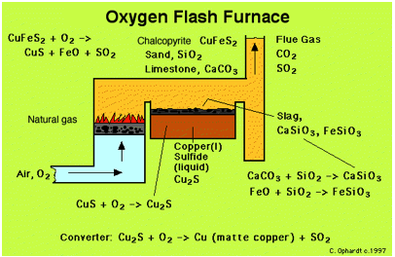
9a) Answers:
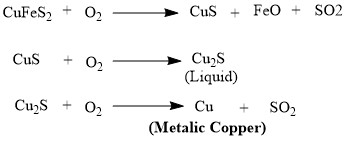
The oxygen in the air selectively reacts with the iron ore (chalcopyrite) to form the iron oxide, FeO and leaves copper in the form of the sulfide, CuS
In the second step, the excess sulfur in the ore reduces copper(II) sulfide (CuS) to copper (I) sulfide, Cu2S which melts and flows out of the bottom of the furnace.
Finally, Copper (I) sulfide reacts with oxygen produces metallic copper and sulfur dioxide.
9b) Answer:
Liquid phases are : Copper (I) sulfide Cu2S, and Slag CaSiO3 + FeSiO3
9c) Answer
The elements involved in the reaction primarily reside on Cu2S sulfide liquid phase.
Add Answer to:
9. (1.5 marks) There are typically two smelting operations and an electrolytic reduction operation in the...
The CuCu ions undergo reduction by accepting two electrons from the copper electrode (cathode) and depositing...
 The CuCu ions undergo reduction by accepting two electrons from
the copper electrode (cathode) and depositing on the electrode as
Cu(s)Cu(s). The reduction half-cell reaction that takes place at
the cathode is
Cu^2+(aq)+2e^−→Cu(s)Cu^2+(aq)+2e^-→Cu(s)
The electrons lost by the ZnZn metal are gained by the CuCu ion.
The transfer of electrons between ZnZn metal and CuCu ions is made
possible by connecting the wire between the ZnZn electrode and the
CuCu electrode. Thus, in the voltaic cell, the electrons flow
through...
The CuCu ions undergo reduction by accepting two electrons from
the copper electrode (cathode) and depositing on the electrode as
Cu(s)Cu(s). The reduction half-cell reaction that takes place at
the cathode is
Cu^2+(aq)+2e^−→Cu(s)Cu^2+(aq)+2e^-→Cu(s)
The electrons lost by the ZnZn metal are gained by the CuCu ion.
The transfer of electrons between ZnZn metal and CuCu ions is made
possible by connecting the wire between the ZnZn electrode and the
CuCu electrode. Thus, in the voltaic cell, the electrons flow
through...
Observations Record observations including appearance of solution (clear, cloudy), color(s) of liquid and s...
 Observations Record observations including appearance of solution (clear, cloudy), color(s) of liquid and solid phases, formation of gas, etc. Write a chemical equation for each to describe the reaction observed. Refer to the procedure for hints. A. Preparation of Copper(ll) Nitrate B. Preparation of Copper(1) Hydroxide C. Preparation of Copper(ll) Oxide D. Preparation of Copper(II) Chloride E. 1. Preparation of Copper Metal 2. Reaction of Aluminum with Hydrochloric acid to give Aluminum Chloride and Hydrogen gas. EXPERIMENT SA THE MANY...
2. If two different compounds have the same Rr value, how might they be identified using paper chromatography?...
 2. If two different compounds have the same Rr value, how might they be identified using paper chromatography? 3. Why is it important to keep the spots on the paper as small as possible? 4. If the solvent pool at the bottom of the beaker touched the spots on the 1.5cm line, what would happen to the spots? How would you address this error? 5. If you were teaching a student how to do paper chromatography, what three pieces of...
Pre-Laboratory Exercise: Plastics Identification I. List four properties that you will use in lab...
 can
someone help me find this information?
Pre-Laboratory Exercise: Plastics Identification I. List four properties that you will use in lab to determine the identity of the polymer samples 2. Describe the density test. What observation will help you determine the density of each polymer? What precautions should be taken in placing the sample in the solutions? 3. Write the name and abbreviation for the six recyclable polymers 2 huetn deisity polyetayene.HDpz poulene: PP 4. Given the list of wavenumber...
can
someone help me find this information?
Pre-Laboratory Exercise: Plastics Identification I. List four properties that you will use in lab to determine the identity of the polymer samples 2. Describe the density test. What observation will help you determine the density of each polymer? What precautions should be taken in placing the sample in the solutions? 3. Write the name and abbreviation for the six recyclable polymers 2 huetn deisity polyetayene.HDpz poulene: PP 4. Given the list of wavenumber...
10. Write a one-page summary of the attached paper? INTRODUCTION Many problems can develop in activated...
10. Write a one-page summary of the attached paper? INTRODUCTION Many problems can develop in activated sludge operation that adversely affect effluent quality with origins in the engineering, hydraulic and microbiological components of the process. The real "heart" of the activated sludge system is the development and maintenance of a mixed microbial culture (activated sludge) that treats wastewater and which can be managed. One definition of a wastewater treatment plant operator is a "bug farmer", one who controls the aeration...
 The CuCu ions undergo reduction by accepting two electrons from
the copper electrode (cathode) and depositing on the electrode as
Cu(s)Cu(s). The reduction half-cell reaction that takes place at
the cathode is
Cu^2+(aq)+2e^−→Cu(s)Cu^2+(aq)+2e^-→Cu(s)
The electrons lost by the ZnZn metal are gained by the CuCu ion.
The transfer of electrons between ZnZn metal and CuCu ions is made
possible by connecting the wire between the ZnZn electrode and the
CuCu electrode. Thus, in the voltaic cell, the electrons flow
through...
The CuCu ions undergo reduction by accepting two electrons from
the copper electrode (cathode) and depositing on the electrode as
Cu(s)Cu(s). The reduction half-cell reaction that takes place at
the cathode is
Cu^2+(aq)+2e^−→Cu(s)Cu^2+(aq)+2e^-→Cu(s)
The electrons lost by the ZnZn metal are gained by the CuCu ion.
The transfer of electrons between ZnZn metal and CuCu ions is made
possible by connecting the wire between the ZnZn electrode and the
CuCu electrode. Thus, in the voltaic cell, the electrons flow
through...
 Observations Record observations including appearance of solution (clear, cloudy), color(s) of liquid and solid phases, formation of gas, etc. Write a chemical equation for each to describe the reaction observed. Refer to the procedure for hints. A. Preparation of Copper(ll) Nitrate B. Preparation of Copper(1) Hydroxide C. Preparation of Copper(ll) Oxide D. Preparation of Copper(II) Chloride E. 1. Preparation of Copper Metal 2. Reaction of Aluminum with Hydrochloric acid to give Aluminum Chloride and Hydrogen gas. EXPERIMENT SA THE MANY...
 2. If two different compounds have the same Rr value, how might they be identified using paper chromatography? 3. Why is it important to keep the spots on the paper as small as possible? 4. If the solvent pool at the bottom of the beaker touched the spots on the 1.5cm line, what would happen to the spots? How would you address this error? 5. If you were teaching a student how to do paper chromatography, what three pieces of...
 can
someone help me find this information?
Pre-Laboratory Exercise: Plastics Identification I. List four properties that you will use in lab to determine the identity of the polymer samples 2. Describe the density test. What observation will help you determine the density of each polymer? What precautions should be taken in placing the sample in the solutions? 3. Write the name and abbreviation for the six recyclable polymers 2 huetn deisity polyetayene.HDpz poulene: PP 4. Given the list of wavenumber...
can
someone help me find this information?
Pre-Laboratory Exercise: Plastics Identification I. List four properties that you will use in lab to determine the identity of the polymer samples 2. Describe the density test. What observation will help you determine the density of each polymer? What precautions should be taken in placing the sample in the solutions? 3. Write the name and abbreviation for the six recyclable polymers 2 huetn deisity polyetayene.HDpz poulene: PP 4. Given the list of wavenumber...
Most questions answered within 3 hours.
-
Where is the error in this code sequence?
String s1 = "Hello";
String s2 = "ello";...
asked 10 months ago -
Financial data for Joel de Paris, Inc., for last year
follow:
Joel de Paris, Inc.
Balance...
asked 10 months ago -
Consider this reaction:
Al2(SO4)3 (aq)+ BaCl3
(aq) Al2Cl6 (aq)- +
3BaSO4(s) . What is the...
asked 10 months ago -
Suppose that Savneet is considering increasing her
recent random sample from 20 car rentals to 40...
asked 10 months ago -
Trucks arrive at an unloading terminal at an average rate of 120
per hour.
Trucks arrive...
asked 10 months ago -
Why are methanol and ethanol completely soluble in water while
octanol is not very little soluble....
asked 10 months ago -
A facilities manager at a university reads in a research report
that the mean amount of...
asked 10 months ago -
When the CuSO4 is rehydrated by adding water to the anhydrous
compound, is this an endothermic...
asked 10 months ago -
A ray of sunlight is passing from diamond into crown glass; the
angle of incidence is...
asked 10 months ago -
A block of mass 0.249 kg is placed on top of a light, vertical
spring of...
asked 10 months ago -
how do the kidneys compensate in the presences of acidosis
a) trigger hyperventilate
b) reserve acid...
asked 10 months ago -
Question 501 pts
The rental rate of capital to the firm increases. Which of the
following...
asked 10 months ago