
Homework Answers
Add Answer to:
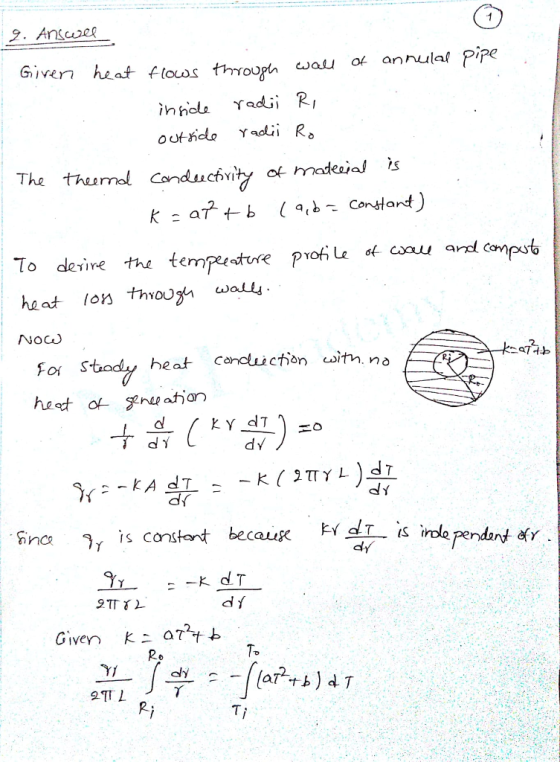
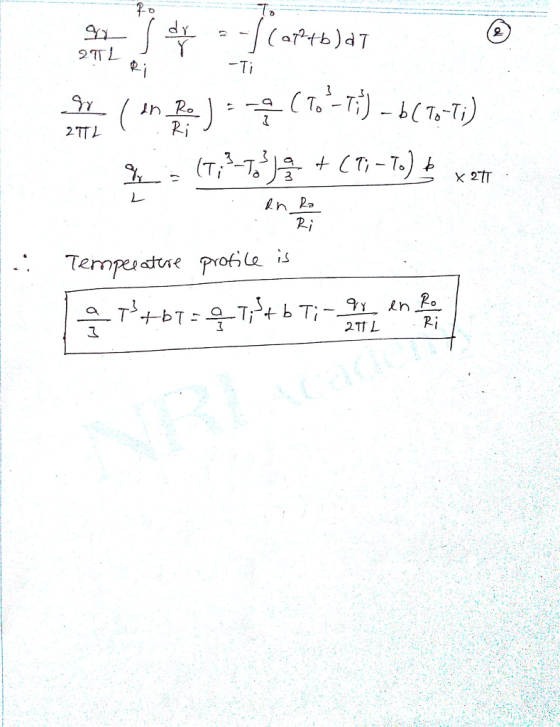
2. Heat flows through the walls of an annular pipe whose inside and outside radii are...
6 Water is heated in a pipe by exchanging heat with a warmer fluid that flows outside the pipe. Inside diameter of the pipe is dn 0.045 m and outside diameter dour0.05 m. Mean velocity of the water i...
 6 Water is heated in a pipe by exchanging heat with a warmer fluid that flows outside the pipe. Inside diameter of the pipe is dn 0.045 m and outside diameter dour0.05 m. Mean velocity of the water in the pipe is um-0.31 m/s and the bulk temperature is 323 K (density 988 kg m-3; viscosity 0.00055 kg m' sı. Pr 3.56, thermal conductivity k 0.64 W m1 Kt). The material of the pipe has thermal conductivity k 0.61 W...
Help mee!! Q1. Heat conduction & convection (38 pt). Hot water flows in a steel pipe...
 Help mee!!
Q1. Heat conduction & convection (38 pt). Hot water flows in a steel pipe of 0.1 m inside diameter at a flow rate of 0.2 m/h and at an average temperature of 70 °C. The pipe length is 2.5 m and the inside pipe wall temperature is 60 °C Assume that the pipe thickness is small and the steel heat conductivity is high enough so that the thermal resistance of the pipe wall is negligible. Calculate: (a) The...
Help mee!!
Q1. Heat conduction & convection (38 pt). Hot water flows in a steel pipe of 0.1 m inside diameter at a flow rate of 0.2 m/h and at an average temperature of 70 °C. The pipe length is 2.5 m and the inside pipe wall temperature is 60 °C Assume that the pipe thickness is small and the steel heat conductivity is high enough so that the thermal resistance of the pipe wall is negligible. Calculate: (a) The...
3. The annular pipe arrangement shown in the figure below is made of stainless steel and the oute...
 3. The annular pipe arrangement shown in the figure below is made of stainless steel and the outer surface is insulated. Air flows through the central pipe with a mass flow rate, ma0.026 kg/s. Water flows through the annular region with a mass flow rate, mw-0.58 kg/s. At the given position along the pipe the bulk temperature of the air, Ta-100°C, and the bulk temperature of the water, Tw- s 10°C. The thermal conductivity of stainless steel, kss 15 W/mK....
Steam at 150 °C flows in a stainless steel pipe which has a thermal conductivity of...
Steam at 150 °C flows in a stainless steel pipe which has a thermal conductivity of 16 W m-1 K -1 whose inner and outer diameters are 5 and 6 cm respectively. The pipe is covered with 3 cm think insulation having a thermal conductivity of 0.035 W m-1 K -1 . The combined convection and radiation heat transfer coefficient at the outside surface of the insulation is 20 W m-2 K -1 and the surroundings are at 10 °C....
I. Steam at 220°C İs transported through an AISI 101 0 carbon steel pipe. The inside...
 I. Steam at 220°C İs transported through an AISI 101 0 carbon steel pipe. The inside and outside diameters of the pip glass pipe insulation. e are 12 and 13 cm respectively. The pipe is wrapped with 5 cm thick cellular The ambient air temperature is 8°C. The inside and outside convection heat nts are 95 and 15 W/m2-K respectively. The thermal conductivity of the pipe is 60 W/m-K and for the insulation it is 0.072 W/m-K a. Construct the...
Problem : A cryogenic flui d is flowing in a 304 SS pipe. The pipe is...
 Problem
:
A cryogenic flui
d is flowing in a
304 SS
pipe.
The pipe is insulated
on its outside surface
with
6
-
mm thick,
evacuated,
aluminum foil/glass mat insulation.
(“Evacuated” means a partial vacuum is drawn on the
insulation to
remove air that would otherwise fill
pores inside the insulation.)
The pipe
inside diameter
is 127 mm; it’s outside diameter is 138 mm.
The
fluid temperature is
-
173
o
C
.
T
he
air temperature
outside the...
Problem
:
A cryogenic flui
d is flowing in a
304 SS
pipe.
The pipe is insulated
on its outside surface
with
6
-
mm thick,
evacuated,
aluminum foil/glass mat insulation.
(“Evacuated” means a partial vacuum is drawn on the
insulation to
remove air that would otherwise fill
pores inside the insulation.)
The pipe
inside diameter
is 127 mm; it’s outside diameter is 138 mm.
The
fluid temperature is
-
173
o
C
.
T
he
air temperature
outside the...
In this problem you will estimate the heat lost by a typical house, assuming that the temperature inside is T(in) = 20 degrees celcius and the temperature outside is T(out) = 0 degrees celcius
In this problem you will estimate the heat lost by a typical house, assuming that the temperature inside is T(in) = 20 degrees celcius and the temperature outside is T(out) = 0 degrees celcius. The walls have fiberglass insulation, which dominates the heat conduction properties of the wall So we can consider the wall to have a thermal conductivity of k(wall) = 0.048 W/m/K . We will take the thickness of the walls and ceiling to be L(wall) = 12...
Please provide a step-by-step solution to this problem. Heat Transfer 1. The material should be f...
 Please provide a step-by-step solution to this problem. Heat
Transfer 1. The material should be from the textbook (Fundamentals
of Heat and Mass Transfer) or similar
3. The annular pipe arrangement shown in the figure below is made of stainless steel and the outer surface is insulated. Air flows through the central pipe with a mass flow rate, ma0.026 kg/s. Water flows through the annular region with a mass flow rate, mw 0.58 kg/s. At the given position along the...
Please provide a step-by-step solution to this problem. Heat
Transfer 1. The material should be from the textbook (Fundamentals
of Heat and Mass Transfer) or similar
3. The annular pipe arrangement shown in the figure below is made of stainless steel and the outer surface is insulated. Air flows through the central pipe with a mass flow rate, ma0.026 kg/s. Water flows through the annular region with a mass flow rate, mw 0.58 kg/s. At the given position along the...
12. The temperature at the inner and outer surfaces of a hollow cylindrical pipe with wall...
 12. The temperature at the inner and outer surfaces of a hollow cylindrical pipe with wall thickness L are held at constant values of T and T, respectively, where T, <To. The wall material has thermal conductivity that varies linearly according to k = k,(1 +BT), where k, and ß are constants. Draw a schematic of the system. Define and label a coordinate system. State assumptions and boundary conditions. b. Derive the governing differential equation for the heat transport and...
P3. A 2-inch outside diameter (OD) by 1.5 -inch inside diameter (iD) wrought iron water line...
 P3. A 2-inch outside diameter (OD) by 1.5 -inch inside diameter (iD) wrought iron water line is buried into the ground. If water flow through the pipe is such that the inside surface of the pipe is 60°F and the outer surface is 50°F where it is surrounded by earth, determine the heat loss pe unit length of pipe, and the temperature distribution through the walls of the pipe. Also plot the temperature as function of the radius of the...
 6 Water is heated in a pipe by exchanging heat with a warmer fluid that flows outside the pipe. Inside diameter of the pipe is dn 0.045 m and outside diameter dour0.05 m. Mean velocity of the water in the pipe is um-0.31 m/s and the bulk temperature is 323 K (density 988 kg m-3; viscosity 0.00055 kg m' sı. Pr 3.56, thermal conductivity k 0.64 W m1 Kt). The material of the pipe has thermal conductivity k 0.61 W...
 Help mee!!
Q1. Heat conduction & convection (38 pt). Hot water flows in a steel pipe of 0.1 m inside diameter at a flow rate of 0.2 m/h and at an average temperature of 70 °C. The pipe length is 2.5 m and the inside pipe wall temperature is 60 °C Assume that the pipe thickness is small and the steel heat conductivity is high enough so that the thermal resistance of the pipe wall is negligible. Calculate: (a) The...
Help mee!!
Q1. Heat conduction & convection (38 pt). Hot water flows in a steel pipe of 0.1 m inside diameter at a flow rate of 0.2 m/h and at an average temperature of 70 °C. The pipe length is 2.5 m and the inside pipe wall temperature is 60 °C Assume that the pipe thickness is small and the steel heat conductivity is high enough so that the thermal resistance of the pipe wall is negligible. Calculate: (a) The...
 3. The annular pipe arrangement shown in the figure below is made of stainless steel and the outer surface is insulated. Air flows through the central pipe with a mass flow rate, ma0.026 kg/s. Water flows through the annular region with a mass flow rate, mw-0.58 kg/s. At the given position along the pipe the bulk temperature of the air, Ta-100°C, and the bulk temperature of the water, Tw- s 10°C. The thermal conductivity of stainless steel, kss 15 W/mK....
 I. Steam at 220°C İs transported through an AISI 101 0 carbon steel pipe. The inside and outside diameters of the pip glass pipe insulation. e are 12 and 13 cm respectively. The pipe is wrapped with 5 cm thick cellular The ambient air temperature is 8°C. The inside and outside convection heat nts are 95 and 15 W/m2-K respectively. The thermal conductivity of the pipe is 60 W/m-K and for the insulation it is 0.072 W/m-K a. Construct the...
 Problem
:
A cryogenic flui
d is flowing in a
304 SS
pipe.
The pipe is insulated
on its outside surface
with
6
-
mm thick,
evacuated,
aluminum foil/glass mat insulation.
(“Evacuated” means a partial vacuum is drawn on the
insulation to
remove air that would otherwise fill
pores inside the insulation.)
The pipe
inside diameter
is 127 mm; it’s outside diameter is 138 mm.
The
fluid temperature is
-
173
o
C
.
T
he
air temperature
outside the...
Problem
:
A cryogenic flui
d is flowing in a
304 SS
pipe.
The pipe is insulated
on its outside surface
with
6
-
mm thick,
evacuated,
aluminum foil/glass mat insulation.
(“Evacuated” means a partial vacuum is drawn on the
insulation to
remove air that would otherwise fill
pores inside the insulation.)
The pipe
inside diameter
is 127 mm; it’s outside diameter is 138 mm.
The
fluid temperature is
-
173
o
C
.
T
he
air temperature
outside the...
 Please provide a step-by-step solution to this problem. Heat
Transfer 1. The material should be from the textbook (Fundamentals
of Heat and Mass Transfer) or similar
3. The annular pipe arrangement shown in the figure below is made of stainless steel and the outer surface is insulated. Air flows through the central pipe with a mass flow rate, ma0.026 kg/s. Water flows through the annular region with a mass flow rate, mw 0.58 kg/s. At the given position along the...
Please provide a step-by-step solution to this problem. Heat
Transfer 1. The material should be from the textbook (Fundamentals
of Heat and Mass Transfer) or similar
3. The annular pipe arrangement shown in the figure below is made of stainless steel and the outer surface is insulated. Air flows through the central pipe with a mass flow rate, ma0.026 kg/s. Water flows through the annular region with a mass flow rate, mw 0.58 kg/s. At the given position along the...
 12. The temperature at the inner and outer surfaces of a hollow cylindrical pipe with wall thickness L are held at constant values of T and T, respectively, where T, <To. The wall material has thermal conductivity that varies linearly according to k = k,(1 +BT), where k, and ß are constants. Draw a schematic of the system. Define and label a coordinate system. State assumptions and boundary conditions. b. Derive the governing differential equation for the heat transport and...
 P3. A 2-inch outside diameter (OD) by 1.5 -inch inside diameter (iD) wrought iron water line is buried into the ground. If water flow through the pipe is such that the inside surface of the pipe is 60°F and the outer surface is 50°F where it is surrounded by earth, determine the heat loss pe unit length of pipe, and the temperature distribution through the walls of the pipe. Also plot the temperature as function of the radius of the...
Most questions answered within 3 hours.
-
Where is the error in this code sequence?
String s1 = "Hello";
String s2 = "ello";...
asked 11 months ago -
Financial data for Joel de Paris, Inc., for last year
follow:
Joel de Paris, Inc.
Balance...
asked 11 months ago -
Consider this reaction:
Al2(SO4)3 (aq)+ BaCl3
(aq) Al2Cl6 (aq)- +
3BaSO4(s) . What is the...
asked 11 months ago -
Suppose that Savneet is considering increasing her
recent random sample from 20 car rentals to 40...
asked 11 months ago -
Trucks arrive at an unloading terminal at an average rate of 120
per hour.
Trucks arrive...
asked 11 months ago -
Why are methanol and ethanol completely soluble in water while
octanol is not very little soluble....
asked 11 months ago -
A facilities manager at a university reads in a research report
that the mean amount of...
asked 11 months ago -
When the CuSO4 is rehydrated by adding water to the anhydrous
compound, is this an endothermic...
asked 11 months ago -
A ray of sunlight is passing from diamond into crown glass; the
angle of incidence is...
asked 11 months ago -
A block of mass 0.249 kg is placed on top of a light, vertical
spring of...
asked 11 months ago -
how do the kidneys compensate in the presences of acidosis
a) trigger hyperventilate
b) reserve acid...
asked 11 months ago -
Question 501 pts
The rental rate of capital to the firm increases. Which of the
following...
asked 11 months ago