 write the proof
Homework Answers
is some
function and
is
injection
If
is surjective then we want to prove that
must be
surjective
That is, we want to show that for every , there exists
such that
As is a
function, we have
exists
And so we have
is a surjective function means
such that
That is,
But we already have
So that
via injectivitiy of
And so
such that
Which means must be
surjective
3. Let f be a continuous function on [a, b] with f(a)0< f(b). (a) The proof of Theorem 7-1 showed that there is a smallest x in [a, bl with f(x)0. If there is more than one x in [a, b] with...
 3. Let f be a continuous function on [a, b] with f(a)0< f(b). (a) The proof of Theorem 7-1 showed that there is a smallest x in [a, bl with f(x)0. If there is more than one x in [a, b] with f(x)0, is there necessarily a second smallest? Show that there is a largest x in [a, b] with f(x) -0. (Try to give an easy proof by considering a new function closely related to f.) b) The proof...
Formal proof and state which proof style you use Let a function where f:Z5 → Z5...
 Formal proof and state which proof style you use
Let a function where f:Z5 → Z5 defined by f(x) = x3 (mod5). a. Is f an injection? Prove or provide a counter example. b. Is fa surjection? Prove or provide a counter example. c. Find the inverse relation of f. Verify that it is the inverse, as we have done in class. d. Is the inverse of f a function? Explain why it is or is not a function.
Formal proof and state which proof style you use
Let a function where f:Z5 → Z5 defined by f(x) = x3 (mod5). a. Is f an injection? Prove or provide a counter example. b. Is fa surjection? Prove or provide a counter example. c. Find the inverse relation of f. Verify that it is the inverse, as we have done in class. d. Is the inverse of f a function? Explain why it is or is not a function.
A. (Leftovers from the Proof of the Pigeonhole Principle). As before, let A and B be finite sets with A! 〉 BI 〉 0 and let f : A → B be any function Given a A. let C-A-Va) and let D-B-{ f(a)} PaRT...
 A. (Leftovers from the Proof of the Pigeonhole Principle). As before, let A and B be finite sets with A! 〉 BI 〉 0 and let f : A → B be any function Given a A. let C-A-Va) and let D-B-{ f(a)} PaRT A1. Define g: C -> D by f(x)-g(x). Briefly, if g is not injective, then explain why f is not injective either. Let j : B → { 1, 2, 3, . . . , BI}...
7. Let f be an entire function. Suppose there exists € >0 such that f(2) >...
 7. Let f be an entire function. Suppose there exists € >0 such that f(2) > € for every 2 E C. Show that f is constant. (Hint: Apply Liouville's theorem to the function g(2) = 1/f().)
7. For a function f:A B, the statement "f is surjective" is defined by the quantifier...
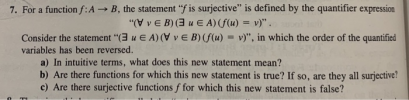 7. For a function f:A B, the statement "f is surjective" is defined by the quantifier expression Consider the statement "(E uEA)(V v E B)(f(u) variables has been reversed. v)", in which the order of the quantified a) In intuitive terms, what does this new statement mean? b) Are there functions for which this new statement is true? If so, are they all surjective? c) Are there surjective functions f for which this new statement is false?
Let X be a set with an equivalence relation ∼. Let f : X/ ∼→ Y...
Let X be a set with an equivalence relation ∼. Let f : X/ ∼→ Y be a function with domain as the quotient set X/ ∼ and codomain as some set Y . We define a function ˜f, called the lift of f, as follows: ˜f : X → Y, x 7→ f([x]). We define a function Φ : F(X/ ∼, Y ) → F(X, Y ), f 7→ ˜f. (1) Is Φ injective? Give a proof or a...
(b) ONLY! Though you can use the result from (a) without proof (a) Let F(x) =...
 (b) ONLY! Though you can use the result from (a) without
proof
(a) Let F(x) = x + x2 + x3 +... and let G(x) = x - x2 + x3 – x4.... Show that for k > 1 and n>k, (4")F(x)* = (n = 1) and if n < k then [x"]F(x)k = 0. (b) Show that G(F(x)) = x.
(b) ONLY! Though you can use the result from (a) without
proof
(a) Let F(x) = x + x2 + x3 +... and let G(x) = x - x2 + x3 – x4.... Show that for k > 1 and n>k, (4")F(x)* = (n = 1) and if n < k then [x"]F(x)k = 0. (b) Show that G(F(x)) = x.
Let f : A rightarrow D and g : B rightarrow C be functions. For each...
 Let f : A rightarrow D and g : B rightarrow C be functions. For each part, if the answer is yes, then prove it, otherwise give a counterexample. Suppose f is one-to-one (injective) and g is onto (surjective). Is go f one-to-one (injective)? Suppose f is one-to-one (injective) and g is onto (surjective). Is g f onto (surjective)? Suppose g is one-to one. Is g one-to-one? Suppose g f onto. Is g onto?
Let f(x) = { 80 -5 if < 10 - 7+ + b if : >...
 Let f(x) = { 80 -5 if < 10 - 7+ + b if : > 10 If f(x) is a function which is continuous everywhere, then we must have b = Let f(x) = 82 - 5 if x < 10 1 - 7x +b if x > 10 If f(x) is a function which is continuous everywhere, then we must have b= -6 2-5 - 2x + b if - 1 Let f(x) if 2 - 1 There...
Let f : B → A and g : A → B be functions. (a) What...
Let f : B → A and g : A → B be functions. (a) What are the domain and co domain of g ◦ f, the composition of g and f? (b) Prove or disprove the following statement: If g ◦ f is an injection, then f is also an injection.
 3. Let f be a continuous function on [a, b] with f(a)0< f(b). (a) The proof of Theorem 7-1 showed that there is a smallest x in [a, bl with f(x)0. If there is more than one x in [a, b] with f(x)0, is there necessarily a second smallest? Show that there is a largest x in [a, b] with f(x) -0. (Try to give an easy proof by considering a new function closely related to f.) b) The proof...
 Formal proof and state which proof style you use
Let a function where f:Z5 → Z5 defined by f(x) = x3 (mod5). a. Is f an injection? Prove or provide a counter example. b. Is fa surjection? Prove or provide a counter example. c. Find the inverse relation of f. Verify that it is the inverse, as we have done in class. d. Is the inverse of f a function? Explain why it is or is not a function.
Formal proof and state which proof style you use
Let a function where f:Z5 → Z5 defined by f(x) = x3 (mod5). a. Is f an injection? Prove or provide a counter example. b. Is fa surjection? Prove or provide a counter example. c. Find the inverse relation of f. Verify that it is the inverse, as we have done in class. d. Is the inverse of f a function? Explain why it is or is not a function.
 A. (Leftovers from the Proof of the Pigeonhole Principle). As before, let A and B be finite sets with A! 〉 BI 〉 0 and let f : A → B be any function Given a A. let C-A-Va) and let D-B-{ f(a)} PaRT A1. Define g: C -> D by f(x)-g(x). Briefly, if g is not injective, then explain why f is not injective either. Let j : B → { 1, 2, 3, . . . , BI}...
 7. Let f be an entire function. Suppose there exists € >0 such that f(2) > € for every 2 E C. Show that f is constant. (Hint: Apply Liouville's theorem to the function g(2) = 1/f().)
 7. For a function f:A B, the statement "f is surjective" is defined by the quantifier expression Consider the statement "(E uEA)(V v E B)(f(u) variables has been reversed. v)", in which the order of the quantified a) In intuitive terms, what does this new statement mean? b) Are there functions for which this new statement is true? If so, are they all surjective? c) Are there surjective functions f for which this new statement is false?
 (b) ONLY! Though you can use the result from (a) without
proof
(a) Let F(x) = x + x2 + x3 +... and let G(x) = x - x2 + x3 – x4.... Show that for k > 1 and n>k, (4")F(x)* = (n = 1) and if n < k then [x"]F(x)k = 0. (b) Show that G(F(x)) = x.
(b) ONLY! Though you can use the result from (a) without
proof
(a) Let F(x) = x + x2 + x3 +... and let G(x) = x - x2 + x3 – x4.... Show that for k > 1 and n>k, (4")F(x)* = (n = 1) and if n < k then [x"]F(x)k = 0. (b) Show that G(F(x)) = x.
 Let f : A rightarrow D and g : B rightarrow C be functions. For each part, if the answer is yes, then prove it, otherwise give a counterexample. Suppose f is one-to-one (injective) and g is onto (surjective). Is go f one-to-one (injective)? Suppose f is one-to-one (injective) and g is onto (surjective). Is g f onto (surjective)? Suppose g is one-to one. Is g one-to-one? Suppose g f onto. Is g onto?
 Let f(x) = { 80 -5 if < 10 - 7+ + b if : > 10 If f(x) is a function which is continuous everywhere, then we must have b = Let f(x) = 82 - 5 if x < 10 1 - 7x +b if x > 10 If f(x) is a function which is continuous everywhere, then we must have b= -6 2-5 - 2x + b if - 1 Let f(x) if 2 - 1 There...
Most questions answered within 3 hours.
-
Where is the error in this code sequence?
String s1 = "Hello";
String s2 = "ello";...
asked 11 months ago -
Financial data for Joel de Paris, Inc., for last year
follow:
Joel de Paris, Inc.
Balance...
asked 11 months ago -
Consider this reaction:
Al2(SO4)3 (aq)+ BaCl3
(aq) Al2Cl6 (aq)- +
3BaSO4(s) . What is the...
asked 11 months ago -
Suppose that Savneet is considering increasing her
recent random sample from 20 car rentals to 40...
asked 11 months ago -
Trucks arrive at an unloading terminal at an average rate of 120
per hour.
Trucks arrive...
asked 11 months ago -
Why are methanol and ethanol completely soluble in water while
octanol is not very little soluble....
asked 11 months ago -
A facilities manager at a university reads in a research report
that the mean amount of...
asked 11 months ago -
When the CuSO4 is rehydrated by adding water to the anhydrous
compound, is this an endothermic...
asked 11 months ago -
A ray of sunlight is passing from diamond into crown glass; the
angle of incidence is...
asked 11 months ago -
A block of mass 0.249 kg is placed on top of a light, vertical
spring of...
asked 11 months ago -
how do the kidneys compensate in the presences of acidosis
a) trigger hyperventilate
b) reserve acid...
asked 11 months ago -
Question 501 pts
The rental rate of capital to the firm increases. Which of the
following...
asked 11 months ago