
Homework Answers
Option (c) is correct.
- This enzyme reduces HMG-CoA to mevalonate
- This reduction takes place in the presence of NADPH
- Because of this property, this enzyme is used in pharmaceuticals.
Add Answer to:
QUESTION 4 The rate limiting enzyme for cholesterol synthesis is A Acyl-CoA-cholesterol acyl transferase (ACAT) B....
1. The key regulatory enzyme of cholesterol synthesis is A. HMG CoA synthase B. HMG CoA...
1. The key regulatory enzyme of cholesterol synthesis is A. HMG CoA synthase B. HMG CoA lyase C. HMG CoA reductase D. Mevalonate kinase
Cholesterol biosynthesis involves a stepwise increase of carbon numbers from acetyl-CoA (C2) to ______ (C5), and,...
Cholesterol biosynthesis involves a stepwise increase of carbon numbers from acetyl-CoA (C2) to ______ (C5), and, finally, to squalene (C30). But, the rate-limiting step is catalyzed by _____. Inhibition of this enzyme is adopted as a strategy for the therapeutic control of cholesterol levels. Select one: a. isoprenoid ;;; HMG CoA synthase b. isoprenoid ;;; HMG CoA reductase c. flavonoid ;;; HMG CoA synthase d. flavonoid ;;; HMG CoA reductase e. None of these
Questions #1-2 refer to Atorvastatin, which is a competitive inhibitor of the rate limiting step of...
Questions #1-2 refer to Atorvastatin, which is a competitive inhibitor of the rate limiting step of cholesterol biosynthesis. 1. What is the downstream effect of treating cells with this competitive inhibitor? A. Atorvastatin decreases the Vmax of HMG CoA synthase. B. Atorvastatin decreases the KM of HMG CoA synthase. C. Atorvastatin decreases the Vmax of HMG CoA reductase. D. Atorvastatin decreases the KM of HMG CoA reductase. E. Atorvastatin increases the KM of HMG CoA reductase. 2. Mechanistically, how does...
The enzyme _______ is important for the release of fatty acids from solid VLDL particles. The...
The enzyme _______ is important for the release of fatty acids from solid VLDL particles. The enzyme activity _______ of insulin. Answer options 1) acetyl-CoA carboxylase (9) HMG-CoA reductase (2) acyl-CoA synthetase (10) hormonsensitiv lipase (3) adrenalin (11) insulin (4) carnitin palmitoyltransferase I (12) lecithin-cholesterol acyltransferase (5) cholesteryl ester transfer protein (13) lipoprotein lipase (6) fedtsyre synthase (14) thiolase (7) glucagon (15) hæmmes/reduceres (8) HMG-CoA lyase (16) stimuleres/forøges
HMG-CoA reductase, a critical enzyme in cholesterol synthesis is the target or statin inhibitors. You are characterizin...
 HMG-CoA reductase, a critical enzyme in cholesterol synthesis is the target or statin inhibitors. You are characterizing a possible new inhibitor and want to determine its mode of binding to HMG-CoA reductase. Equilibrium dialysis measurements at 25°C, 30°C, and 37°C yielded dissociation constants (Ks) of 2.5 x 10* M, 1.5 x 10*, and 1.0 x 10* M, respectively, for the HMG- CoA reductase-inhibitor complex a. Is the binding becoming better or worse with increasing temperature? Explain. b. Using Excel or...
HMG-CoA reductase, a critical enzyme in cholesterol synthesis is the target or statin inhibitors. You are characteri...
 HMG-CoA reductase, a critical enzyme in cholesterol synthesis is the target or statin inhibitors. You are characterizing a possible new inhibitor and want to determine its mode of binding to HMG-CoA reductase. Equilibrium dialysis measurements at 25 C, 30°C, and 37 C yielded dissociation constants (K.) of 2.5 x 10" М, 1.5 x 10", and 1.0 x 10³ M, respectively, for the HMG-CoA reductase-inhibitor complex. a. Is the binding becoming better or worse with increasing temperature? Explain. b. Using Excel...
______secreted by pancreatic beta cells, the enzyme stimulates________, thereby reducing the level of plasma triglycerides. In...
______secreted by pancreatic beta cells, the enzyme stimulates________, thereby reducing the level of plasma triglycerides. In addition, stimulation of the enzyme activity means that the plasma concentration of HLD cholesterol _________. Answer options: (1) acetyl-CoA carboxylase (9) HMG-CoA reductase (2) acyl-CoA synthetase (10) hormonsensitiv lipase (3) adrenalin (11) insulin (4) carnitin palmitoyltransferase I (12) lecithin-cholesterol acyltransferase (5) cholesteryl ester transfer protein (13) lipoprotein lipase (6) fedtsyre synthase (14) thiolase (7) glucagon (15) hæmmes/reduceres (8) HMG-CoA lyase (16) stimuleres/forøges
Insert numbers from the answer list below into the sentence's blanks to correct the statement. Enzyme...
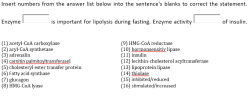 Insert numbers from the answer list below into the sentence's blanks to correct the statement. Enzyme is important for lipolysis during fasting. Enzyme activity of insulin. (1) acetyl-CoA carboxylase (2) acyl-CoA synthetase (3) adrenalin (4) carnitin palmitoyltransferasel (5) cholesteryl ester transfer protein (6) Fatty acid synthase (7) glucagon (8) HMG-CoA lyase (9) HMG-CoA reductase (10) hormonsensitiv lipase (11) insulin (12) lecithin-cholesterol acyltransferase (13) lipoprotein lipase (14) thiolase (15) inhibited/reduced (16) stimulated/increased
Give the process/pathway where each of the following enzymes is involved: a. HMG CoA lyase b....
Give the process/pathway where each of the following enzymes is involved: a. HMG CoA lyase b. HMG CoA reductase c. Acetyl CoA carboxylase d. Acyl CoA dehydrogenase
HMG-CoA reducatse is the key regulatory enzyme in the biosynthesis of cholesterol. Outline briefly the various...
HMG-CoA reducatse is the key regulatory enzyme in the biosynthesis of cholesterol. Outline briefly the various regulatory mechanisms involving HMG-CoA reductase in cholesterol biosynthesis.
 HMG-CoA reductase, a critical enzyme in cholesterol synthesis is the target or statin inhibitors. You are characterizing a possible new inhibitor and want to determine its mode of binding to HMG-CoA reductase. Equilibrium dialysis measurements at 25°C, 30°C, and 37°C yielded dissociation constants (Ks) of 2.5 x 10* M, 1.5 x 10*, and 1.0 x 10* M, respectively, for the HMG- CoA reductase-inhibitor complex a. Is the binding becoming better or worse with increasing temperature? Explain. b. Using Excel or...
 HMG-CoA reductase, a critical enzyme in cholesterol synthesis is the target or statin inhibitors. You are characterizing a possible new inhibitor and want to determine its mode of binding to HMG-CoA reductase. Equilibrium dialysis measurements at 25 C, 30°C, and 37 C yielded dissociation constants (K.) of 2.5 x 10" М, 1.5 x 10", and 1.0 x 10³ M, respectively, for the HMG-CoA reductase-inhibitor complex. a. Is the binding becoming better or worse with increasing temperature? Explain. b. Using Excel...
 Insert numbers from the answer list below into the sentence's blanks to correct the statement. Enzyme is important for lipolysis during fasting. Enzyme activity of insulin. (1) acetyl-CoA carboxylase (2) acyl-CoA synthetase (3) adrenalin (4) carnitin palmitoyltransferasel (5) cholesteryl ester transfer protein (6) Fatty acid synthase (7) glucagon (8) HMG-CoA lyase (9) HMG-CoA reductase (10) hormonsensitiv lipase (11) insulin (12) lecithin-cholesterol acyltransferase (13) lipoprotein lipase (14) thiolase (15) inhibited/reduced (16) stimulated/increased
Most questions answered within 3 hours.
-
Where is the error in this code sequence?
String s1 = "Hello";
String s2 = "ello";...
asked 10 months ago -
Financial data for Joel de Paris, Inc., for last year
follow:
Joel de Paris, Inc.
Balance...
asked 10 months ago -
Consider this reaction:
Al2(SO4)3 (aq)+ BaCl3
(aq) Al2Cl6 (aq)- +
3BaSO4(s) . What is the...
asked 10 months ago -
Suppose that Savneet is considering increasing her
recent random sample from 20 car rentals to 40...
asked 10 months ago -
Trucks arrive at an unloading terminal at an average rate of 120
per hour.
Trucks arrive...
asked 10 months ago -
Why are methanol and ethanol completely soluble in water while
octanol is not very little soluble....
asked 10 months ago -
A facilities manager at a university reads in a research report
that the mean amount of...
asked 10 months ago -
When the CuSO4 is rehydrated by adding water to the anhydrous
compound, is this an endothermic...
asked 10 months ago -
A ray of sunlight is passing from diamond into crown glass; the
angle of incidence is...
asked 10 months ago -
A block of mass 0.249 kg is placed on top of a light, vertical
spring of...
asked 10 months ago -
how do the kidneys compensate in the presences of acidosis
a) trigger hyperventilate
b) reserve acid...
asked 10 months ago -
Question 501 pts
The rental rate of capital to the firm increases. Which of the
following...
asked 10 months ago