help me with this homework,please
Homework Answers


Add Answer to:
help me with this homework,please
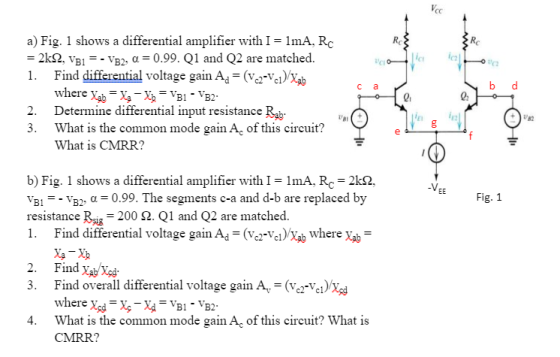
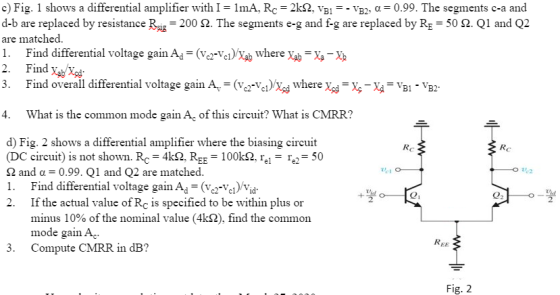
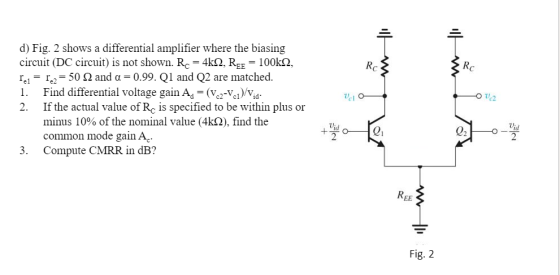
age gain Ag = (*e*ia) a) Fig. 1 shows a differential...
For the simple differential amplifier shown below, a) Calculate the differential gain, Av , of th...
 For the simple differential amplifier shown below,
a) Calculate the differential gain, Av , of the circuit
b) Calculate the common-mode gain, ACM, of the
circuit and compute CMRR
c) The common-mode gain can be reduced by replacing the resistor
RE, with a constant current source. Design a current
source that is not dependent on Beta linearly to
replace RE, transistors of the same characteristics as
Q1 and Q2, and resistors of your choice
*(Q1, Q2 = 120; ro =...
For the simple differential amplifier shown below,
a) Calculate the differential gain, Av , of the circuit
b) Calculate the common-mode gain, ACM, of the
circuit and compute CMRR
c) The common-mode gain can be reduced by replacing the resistor
RE, with a constant current source. Design a current
source that is not dependent on Beta linearly to
replace RE, transistors of the same characteristics as
Q1 and Q2, and resistors of your choice
*(Q1, Q2 = 120; ro =...
For the differential amplifier shown in Figure 6: Assume well-matched transistors and = 100 for all transistors: a) Wh...
 For the differential amplifier shown in Figure 6: Assume
well-matched transistors and = 100 for all transistors:
a) Why it is important to use well-matched transistors in
differential amplifier circuits? What is the potential influence of
mismatched transistors on the performance of the differential
amplifier?
b) Determine the resistor values (R1, R2 and R3) such that the
emitter coupled current IE = 0.5 mA and VC1 = 3 V.
c) Draw the ac equivalent circuit for the single ended...
For the differential amplifier shown in Figure 6: Assume
well-matched transistors and = 100 for all transistors:
a) Why it is important to use well-matched transistors in
differential amplifier circuits? What is the potential influence of
mismatched transistors on the performance of the differential
amplifier?
b) Determine the resistor values (R1, R2 and R3) such that the
emitter coupled current IE = 0.5 mA and VC1 = 3 V.
c) Draw the ac equivalent circuit for the single ended...
The 1 mA. V, ls -VE -15 15 V, in the following differential amplifier circuit, Vcc parameters are given as β, 100, VBE# 0.7 V, pr-25 mV, K.-100 V. transistor Rc-10 kΩ For: RE-150 Ω Rc Rc REE-200...
 The 1 mA. V, ls -VE -15 15 V, in the following differential amplifier circuit, Vcc parameters are given as β, 100, VBE# 0.7 V, pr-25 mV, K.-100 V. transistor Rc-10 kΩ For: RE-150 Ω Rc Rc REE-200 kΩ a) What is the input differential resistance, Rid b) What is the overall voltage gain vV? You c) What is input common mode resistance, d) What is the worst case common mode gain that appear across the two input terminals? (4...
please write clearly with steps. thank you Q3. (a) Derive the differential gain for the following equivalent circuit of a differential amplifier. (1o pts) iel el ie RE Ri iel Figure 6. Differentia...
 please write clearly with steps. thank you
Q3. (a) Derive the differential gain for the following equivalent circuit of a differential amplifier. (1o pts) iel el ie RE Ri iel Figure 6. Differential mode small signal equivalent circuit of basic differential amplifier. (b) Given that Ac-0.5 and Ad-9o for a differential amplifier. Find CMRR. (5 pts) (e) Design a first order low pass filter with cut-off frequency of 20 kHz. Assume that pass-band gain is 16dB. You can use Figure...
please write clearly with steps. thank you
Q3. (a) Derive the differential gain for the following equivalent circuit of a differential amplifier. (1o pts) iel el ie RE Ri iel Figure 6. Differential mode small signal equivalent circuit of basic differential amplifier. (b) Given that Ac-0.5 and Ad-9o for a differential amplifier. Find CMRR. (5 pts) (e) Design a first order low pass filter with cut-off frequency of 20 kHz. Assume that pass-band gain is 16dB. You can use Figure...
ENG 301 Electronics II Homework 2 1 Refer to Figure 1 Asame 50and Varfon)-7 V for...
 ENG 301 Electronics II Homework 2 1 Refer to Figure 1 Asame 50and Varfon)-7 V for all BITs in the circuit. Foe R, 12 k and Re 10 k. find the áfferential voltape gain A) of the difficrential amplifier taken as one sided eutput at r Figure 2 Voe+12 v Rc 10in SR 315 口 SR 67.3 kh R Ca R, R R R 250a 32 k Figure The circuit shown in Figure has transistor parameters 120 and (a) Determine...
shows two versions of a common-emitter amplifier and (i Fig. 1 (a) Find the expression for the small-signal voltage gai...
 shows two versions of a common-emitter amplifier and (i Fig. 1 (a) Find the expression for the small-signal voltage gain of Fig. 1(i) in terms of relevant small- signal parameters. (b) Over what frequency range will the gain of the Fig. 1(i) circuit be the same as that of the Fig. 1(i) circuit? (c) Which of the two circuits will show less variation in its de biasing in the presence of processing or temperature variations? Justify your answer. (d) Explain,...
SIM D *8.51 The differential amplifier in Fig. P8.51 utilizes a resistor Rss to establish a 1-mA ...
 Please solve in details and in a clear way.
SIM D *8.51 The differential amplifier in Fig. P8.51 utilizes a resistor Rss to establish a 1-mA de bias current. that this amplifier uses a single 5-V supply and thus the de common-mode voltage Vcoy cannot be zero. Transistors and Q2 have k, W/L = 2.5 mA/V2, V, Note 0.7 V, and λ = 0. in (a) Find the required value of VeM ys: (b) Find the value of Rp that...
Please solve in details and in a clear way.
SIM D *8.51 The differential amplifier in Fig. P8.51 utilizes a resistor Rss to establish a 1-mA de bias current. that this amplifier uses a single 5-V supply and thus the de common-mode voltage Vcoy cannot be zero. Transistors and Q2 have k, W/L = 2.5 mA/V2, V, Note 0.7 V, and λ = 0. in (a) Find the required value of VeM ys: (b) Find the value of Rp that...
shows two versions of a common-emitter amplifier and (i Fig. 1 (a) Find the expression for...
 shows two versions of a common-emitter amplifier and (i Fig. 1 (a) Find the expression for the small-signal voltage gain of Fig. 1(i) in terms of relevant small- signal parameters. (b) Over what frequency range will the gain of the Fig. 1(i) circuit be the same as that of the Fig. 1(i) circuit? (c) Which of the two circuits will show less variation in its de biasing in the presence of processing or temperature variations? Justify your answer. (d) Explain,...
3.1. For the BJT differential pair configuration shown below, assume the input transistor beta is very large. Then...
 3.1. For the BJT differential pair configuration shown below,
assume the input transistor beta is very large.
Then find the differential signal vd = vB1 − vB2 sufficient to
cause:
3.2. A differential amplifier resembling that below uses I =
200μA, RC = 10kohm and VCC = 3V. Assume beta is very large
3.4.For the emitter follower in the figure below, given VCC =
15 V, VEE = −15 V, RL = 1 kohm and beta = 100 for all...
3.1. For the BJT differential pair configuration shown below,
assume the input transistor beta is very large.
Then find the differential signal vd = vB1 − vB2 sufficient to
cause:
3.2. A differential amplifier resembling that below uses I =
200μA, RC = 10kohm and VCC = 3V. Assume beta is very large
3.4.For the emitter follower in the figure below, given VCC =
15 V, VEE = −15 V, RL = 1 kohm and beta = 100 for all...
1. (10 pts) Find the voltage gain for the circuit shown below, assume β-200. Vbe-0.6 and...
 1. (10 pts) Find the voltage gain for the circuit shown below, assume β-200. Vbe-0.6 and Vin(t)-1.2+0.2sin(2*pi*1k't) Rc 2k Rb V1 MW V2 40k 10 SINE(1.2.21k 0 0010) tran .01 2. Answer the following questions based on the circuit above. a. Is it possible to drive the amplifer in saturation by changing the values of B, Rb, and Rc, explain your answers. b. What ranges of Rc can be used on this amplifier without going on saturation mode? c. Can...
 For the simple differential amplifier shown below,
a) Calculate the differential gain, Av , of the circuit
b) Calculate the common-mode gain, ACM, of the
circuit and compute CMRR
c) The common-mode gain can be reduced by replacing the resistor
RE, with a constant current source. Design a current
source that is not dependent on Beta linearly to
replace RE, transistors of the same characteristics as
Q1 and Q2, and resistors of your choice
*(Q1, Q2 = 120; ro =...
For the simple differential amplifier shown below,
a) Calculate the differential gain, Av , of the circuit
b) Calculate the common-mode gain, ACM, of the
circuit and compute CMRR
c) The common-mode gain can be reduced by replacing the resistor
RE, with a constant current source. Design a current
source that is not dependent on Beta linearly to
replace RE, transistors of the same characteristics as
Q1 and Q2, and resistors of your choice
*(Q1, Q2 = 120; ro =...
 For the differential amplifier shown in Figure 6: Assume
well-matched transistors and = 100 for all transistors:
a) Why it is important to use well-matched transistors in
differential amplifier circuits? What is the potential influence of
mismatched transistors on the performance of the differential
amplifier?
b) Determine the resistor values (R1, R2 and R3) such that the
emitter coupled current IE = 0.5 mA and VC1 = 3 V.
c) Draw the ac equivalent circuit for the single ended...
For the differential amplifier shown in Figure 6: Assume
well-matched transistors and = 100 for all transistors:
a) Why it is important to use well-matched transistors in
differential amplifier circuits? What is the potential influence of
mismatched transistors on the performance of the differential
amplifier?
b) Determine the resistor values (R1, R2 and R3) such that the
emitter coupled current IE = 0.5 mA and VC1 = 3 V.
c) Draw the ac equivalent circuit for the single ended...
 The 1 mA. V, ls -VE -15 15 V, in the following differential amplifier circuit, Vcc parameters are given as β, 100, VBE# 0.7 V, pr-25 mV, K.-100 V. transistor Rc-10 kΩ For: RE-150 Ω Rc Rc REE-200 kΩ a) What is the input differential resistance, Rid b) What is the overall voltage gain vV? You c) What is input common mode resistance, d) What is the worst case common mode gain that appear across the two input terminals? (4...
 please write clearly with steps. thank you
Q3. (a) Derive the differential gain for the following equivalent circuit of a differential amplifier. (1o pts) iel el ie RE Ri iel Figure 6. Differential mode small signal equivalent circuit of basic differential amplifier. (b) Given that Ac-0.5 and Ad-9o for a differential amplifier. Find CMRR. (5 pts) (e) Design a first order low pass filter with cut-off frequency of 20 kHz. Assume that pass-band gain is 16dB. You can use Figure...
please write clearly with steps. thank you
Q3. (a) Derive the differential gain for the following equivalent circuit of a differential amplifier. (1o pts) iel el ie RE Ri iel Figure 6. Differential mode small signal equivalent circuit of basic differential amplifier. (b) Given that Ac-0.5 and Ad-9o for a differential amplifier. Find CMRR. (5 pts) (e) Design a first order low pass filter with cut-off frequency of 20 kHz. Assume that pass-band gain is 16dB. You can use Figure...
 ENG 301 Electronics II Homework 2 1 Refer to Figure 1 Asame 50and Varfon)-7 V for all BITs in the circuit. Foe R, 12 k and Re 10 k. find the áfferential voltape gain A) of the difficrential amplifier taken as one sided eutput at r Figure 2 Voe+12 v Rc 10in SR 315 口 SR 67.3 kh R Ca R, R R R 250a 32 k Figure The circuit shown in Figure has transistor parameters 120 and (a) Determine...
 shows two versions of a common-emitter amplifier and (i Fig. 1 (a) Find the expression for the small-signal voltage gain of Fig. 1(i) in terms of relevant small- signal parameters. (b) Over what frequency range will the gain of the Fig. 1(i) circuit be the same as that of the Fig. 1(i) circuit? (c) Which of the two circuits will show less variation in its de biasing in the presence of processing or temperature variations? Justify your answer. (d) Explain,...
 Please solve in details and in a clear way.
SIM D *8.51 The differential amplifier in Fig. P8.51 utilizes a resistor Rss to establish a 1-mA de bias current. that this amplifier uses a single 5-V supply and thus the de common-mode voltage Vcoy cannot be zero. Transistors and Q2 have k, W/L = 2.5 mA/V2, V, Note 0.7 V, and λ = 0. in (a) Find the required value of VeM ys: (b) Find the value of Rp that...
Please solve in details and in a clear way.
SIM D *8.51 The differential amplifier in Fig. P8.51 utilizes a resistor Rss to establish a 1-mA de bias current. that this amplifier uses a single 5-V supply and thus the de common-mode voltage Vcoy cannot be zero. Transistors and Q2 have k, W/L = 2.5 mA/V2, V, Note 0.7 V, and λ = 0. in (a) Find the required value of VeM ys: (b) Find the value of Rp that...
 shows two versions of a common-emitter amplifier and (i Fig. 1 (a) Find the expression for the small-signal voltage gain of Fig. 1(i) in terms of relevant small- signal parameters. (b) Over what frequency range will the gain of the Fig. 1(i) circuit be the same as that of the Fig. 1(i) circuit? (c) Which of the two circuits will show less variation in its de biasing in the presence of processing or temperature variations? Justify your answer. (d) Explain,...
 3.1. For the BJT differential pair configuration shown below,
assume the input transistor beta is very large.
Then find the differential signal vd = vB1 − vB2 sufficient to
cause:
3.2. A differential amplifier resembling that below uses I =
200μA, RC = 10kohm and VCC = 3V. Assume beta is very large
3.4.For the emitter follower in the figure below, given VCC =
15 V, VEE = −15 V, RL = 1 kohm and beta = 100 for all...
3.1. For the BJT differential pair configuration shown below,
assume the input transistor beta is very large.
Then find the differential signal vd = vB1 − vB2 sufficient to
cause:
3.2. A differential amplifier resembling that below uses I =
200μA, RC = 10kohm and VCC = 3V. Assume beta is very large
3.4.For the emitter follower in the figure below, given VCC =
15 V, VEE = −15 V, RL = 1 kohm and beta = 100 for all...
 1. (10 pts) Find the voltage gain for the circuit shown below, assume β-200. Vbe-0.6 and Vin(t)-1.2+0.2sin(2*pi*1k't) Rc 2k Rb V1 MW V2 40k 10 SINE(1.2.21k 0 0010) tran .01 2. Answer the following questions based on the circuit above. a. Is it possible to drive the amplifer in saturation by changing the values of B, Rb, and Rc, explain your answers. b. What ranges of Rc can be used on this amplifier without going on saturation mode? c. Can...
Most questions answered within 3 hours.
-
Where is the error in this code sequence?
String s1 = "Hello";
String s2 = "ello";...
asked 11 months ago -
Financial data for Joel de Paris, Inc., for last year
follow:
Joel de Paris, Inc.
Balance...
asked 11 months ago -
Consider this reaction:
Al2(SO4)3 (aq)+ BaCl3
(aq) Al2Cl6 (aq)- +
3BaSO4(s) . What is the...
asked 11 months ago -
Suppose that Savneet is considering increasing her
recent random sample from 20 car rentals to 40...
asked 11 months ago -
Trucks arrive at an unloading terminal at an average rate of 120
per hour.
Trucks arrive...
asked 11 months ago -
Why are methanol and ethanol completely soluble in water while
octanol is not very little soluble....
asked 11 months ago -
A facilities manager at a university reads in a research report
that the mean amount of...
asked 11 months ago -
When the CuSO4 is rehydrated by adding water to the anhydrous
compound, is this an endothermic...
asked 11 months ago -
A ray of sunlight is passing from diamond into crown glass; the
angle of incidence is...
asked 11 months ago -
A block of mass 0.249 kg is placed on top of a light, vertical
spring of...
asked 11 months ago -
how do the kidneys compensate in the presences of acidosis
a) trigger hyperventilate
b) reserve acid...
asked 11 months ago -
Question 501 pts
The rental rate of capital to the firm increases. Which of the
following...
asked 11 months ago