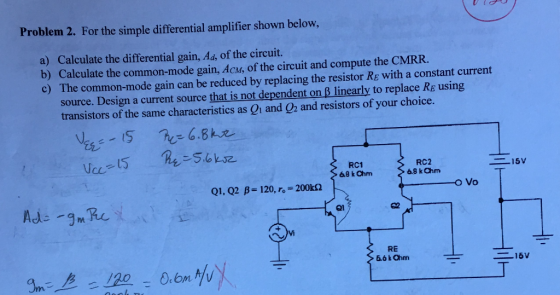
For the simple differential amplifier shown below,
a) Calculate the differential gain, Av , of the circuit
b) Calculate the common-mode gain, ACM, of the circuit and compute CMRR
c) The common-mode gain can be reduced by replacing the resistor RE, with a constant current source. Design a current source that is not dependent on Beta linearly to replace RE, transistors of the same characteristics as Q1 and Q2, and resistors of your choice
*(Q1, Q2 = 120; ro = 200Kohms)
*(Rc1, Rc2 = 6.8k ohms ; RE = 5.6k ohms, V cc = 15V )
Homework Answers


Add Answer to:
For the simple differential amplifier shown below, a) Calculate the differential gain, Av , of th...
For the differential amplifier shown in Figure 6: Assume well-matched transistors and = 100 for all transistors: a) Wh...
 For the differential amplifier shown in Figure 6: Assume
well-matched transistors and = 100 for all transistors:
a) Why it is important to use well-matched transistors in
differential amplifier circuits? What is the potential influence of
mismatched transistors on the performance of the differential
amplifier?
b) Determine the resistor values (R1, R2 and R3) such that the
emitter coupled current IE = 0.5 mA and VC1 = 3 V.
c) Draw the ac equivalent circuit for the single ended...
For the differential amplifier shown in Figure 6: Assume
well-matched transistors and = 100 for all transistors:
a) Why it is important to use well-matched transistors in
differential amplifier circuits? What is the potential influence of
mismatched transistors on the performance of the differential
amplifier?
b) Determine the resistor values (R1, R2 and R3) such that the
emitter coupled current IE = 0.5 mA and VC1 = 3 V.
c) Draw the ac equivalent circuit for the single ended...
VCC RC1 RC2 Vout+ Vout Q1 NPN Q2 NPN Vin Vin- Q3 NPN Use VA-5V for...
 VCC RC1 RC2 Vout+ Vout Q1 NPN Q2 NPN Vin Vin- Q3 NPN Use VA-5V for Q3, and VA-00 for Q1 and Q2. If IEE-1mA, Rc,-12711 Ω, and RC2-1271 2Ω, what is the common mode to differential mode conversion gain? What is the common mode rejection ratio? Use Vr = 26mV and β 100 . Assume IE=Ic tr all a ACM-DMl CMRR- dB
help me with this homework,please age gain Ag = (*e*ia) a) Fig. 1 shows a differential...
 help me with this homework,please
age gain Ag = (*e*ia) a) Fig. 1 shows a differential amplifier with I = 1mA, RO = 2k22, VB1 = - VB2, a = 0.99. Q1 and Q2 are matched. 1. Find differential voltage gain Ad = (vc2-V1) Xab where Yab = Xa - Xo = VB1 - VB2 2. Determine differential input resistance Rab 3. What is the common mode gain Ac of this circuit? What is CMRR? bd te t 0 1,...
help me with this homework,please
age gain Ag = (*e*ia) a) Fig. 1 shows a differential amplifier with I = 1mA, RO = 2k22, VB1 = - VB2, a = 0.99. Q1 and Q2 are matched. 1. Find differential voltage gain Ad = (vc2-V1) Xab where Yab = Xa - Xo = VB1 - VB2 2. Determine differential input resistance Rab 3. What is the common mode gain Ac of this circuit? What is CMRR? bd te t 0 1,...
Can someone help me derive the general equation for the Acm (when it is a single-ended...
 Can someone help me derive the general equation for the Acm
(when it is a single-ended common-mode gain) for Q1,Q2 and Q4? I
know the general formula for Q1 and Q2 are going to be the same but
Q4 is going to be different because you have to take into account
ro.
In this assignment, you will design a differential amplifier satisfying the required differential gain, input impedance, and single-ended common-mode gain; when fed by a small-signal. Then you will...
Can someone help me derive the general equation for the Acm
(when it is a single-ended common-mode gain) for Q1,Q2 and Q4? I
know the general formula for Q1 and Q2 are going to be the same but
Q4 is going to be different because you have to take into account
ro.
In this assignment, you will design a differential amplifier satisfying the required differential gain, input impedance, and single-ended common-mode gain; when fed by a small-signal. Then you will...
For the differential amplifier shown in Figure (2),
 For the differential amplifier shown in Figure (2),assume \(\mathrm{VCC}=12 \mathrm{~V}, \mathrm{VEE}=-12 \mathrm{~V}, \mathrm{Rc}=2 \mathrm{k} \Omega\), and \(\beta=100\) for all transistors.For the current source circuit (Transistor \(\left.Q_{3}\right): R_{1}=4 k \Omega, R_{2}=4 k \Omega, R_{3}=3 \mathrm{k} \Omega\), and \(r_{0}=100 \mathrm{k} \Omega\).a) In differential amplifier circuits, what do "well-matched transistors" mean?b) Why it is important to use well-matched transistors in differential amplifier circuits?c) What are the operating \(Q\) point values \(\left(I_{c Q}\right.\) and \(\left.V_{C Q}\right)\) for the transistors \(Q_{1}\) and \(Q_{2}\) ?d) Draw...
4) Consider the MOSFET differential amplifier shown below, with Io-2 mA, and RL- 10 kS2, Rss-100 ...
 4) Consider the MOSFET differential amplifier shown below, with Io-2 mA, and RL- 10 kS2, Rss-100 k2, VDD- +8V and Vss--8V. The NMOS transistors in the circuit are nominally identical, with kn 2 mA/V2, VTn 1.0 V and ro 100 k2. The PMoS transistors in the circuit are nominally identical, with kp 2 mA/V2, [VTpl 1.0 V and ro 100 kΩ M3 M4 0 M1 M2 a) First consider the DC bias point. Assuming that the current mirror requires at...
Problem 1: (4 pts) The circuit below uses current source biasing and two amplifier stages. Assume...
 Problem 1: (4 pts) The circuit below uses current source biasing and two amplifier stages. Assume the transistors are biased so they have the same 9m and ro values, and that the current sources have output resistance ro equal to the ro of the two transistors. In other words, in the small signal model you will replace the de current sources with resistors of value ro Q2 Ui Q1 U) (a) Draw a small-signal model for this amplifier. Be sure...
Problem 1: All the transistors in the circuit have β-110, VA-00 Assuming that approximately IC3-220μΑ and IC4-1.9mA, A] Evaluate Rout of the current source and the figure of merit of the current sour...
 Problem 1: All the transistors in the circuit have β-110, VA-00 Assuming that approximately IC3-220μΑ and IC4-1.9mA, A] Evaluate Rout of the current source and the figure of merit of the current source C] Find the gains of the differential pair (single-ended output), the common-emitter stage, and the overall gain , the common-emitter stage, +15V RC1 RC2 Q4 Q1 Q2 VO V2 RC4 R1 Q3 R2 R3 -15V
Problem 1: All the transistors in the circuit have β-110, VA-00 Assuming...
Problem 1: All the transistors in the circuit have β-110, VA-00 Assuming that approximately IC3-220μΑ and IC4-1.9mA, A] Evaluate Rout of the current source and the figure of merit of the current source C] Find the gains of the differential pair (single-ended output), the common-emitter stage, and the overall gain , the common-emitter stage, +15V RC1 RC2 Q4 Q1 Q2 VO V2 RC4 R1 Q3 R2 R3 -15V
Problem 1: All the transistors in the circuit have β-110, VA-00 Assuming...
please write clearly with steps. thank you Q3. (a) Derive the differential gain for the following equivalent circuit of a differential amplifier. (1o pts) iel el ie RE Ri iel Figure 6. Differentia...
 please write clearly with steps. thank you
Q3. (a) Derive the differential gain for the following equivalent circuit of a differential amplifier. (1o pts) iel el ie RE Ri iel Figure 6. Differential mode small signal equivalent circuit of basic differential amplifier. (b) Given that Ac-0.5 and Ad-9o for a differential amplifier. Find CMRR. (5 pts) (e) Design a first order low pass filter with cut-off frequency of 20 kHz. Assume that pass-band gain is 16dB. You can use Figure...
please write clearly with steps. thank you
Q3. (a) Derive the differential gain for the following equivalent circuit of a differential amplifier. (1o pts) iel el ie RE Ri iel Figure 6. Differential mode small signal equivalent circuit of basic differential amplifier. (b) Given that Ac-0.5 and Ad-9o for a differential amplifier. Find CMRR. (5 pts) (e) Design a first order low pass filter with cut-off frequency of 20 kHz. Assume that pass-band gain is 16dB. You can use Figure...
Texas Instruments asks you to build an amplifier circuit. The requested amplifier must have a high...
 Texas Instruments asks you to build an amplifier circuit. The
requested amplifier must have a
high value of CMRR, which is why it is requested that the
differential stage be a differential amplifier
with power source, see figure 1. Use transistor LM3046.
Calculate the value of the gain in common mode. Calculate the
gain value in differential mode.
+VCC - Rc LV. + Vet V2 RM RW -VEE
Texas Instruments asks you to build an amplifier circuit. The
requested amplifier must have a
high value of CMRR, which is why it is requested that the
differential stage be a differential amplifier
with power source, see figure 1. Use transistor LM3046.
Calculate the value of the gain in common mode. Calculate the
gain value in differential mode.
+VCC - Rc LV. + Vet V2 RM RW -VEE
 For the differential amplifier shown in Figure 6: Assume
well-matched transistors and = 100 for all transistors:
a) Why it is important to use well-matched transistors in
differential amplifier circuits? What is the potential influence of
mismatched transistors on the performance of the differential
amplifier?
b) Determine the resistor values (R1, R2 and R3) such that the
emitter coupled current IE = 0.5 mA and VC1 = 3 V.
c) Draw the ac equivalent circuit for the single ended...
For the differential amplifier shown in Figure 6: Assume
well-matched transistors and = 100 for all transistors:
a) Why it is important to use well-matched transistors in
differential amplifier circuits? What is the potential influence of
mismatched transistors on the performance of the differential
amplifier?
b) Determine the resistor values (R1, R2 and R3) such that the
emitter coupled current IE = 0.5 mA and VC1 = 3 V.
c) Draw the ac equivalent circuit for the single ended...
 VCC RC1 RC2 Vout+ Vout Q1 NPN Q2 NPN Vin Vin- Q3 NPN Use VA-5V for Q3, and VA-00 for Q1 and Q2. If IEE-1mA, Rc,-12711 Ω, and RC2-1271 2Ω, what is the common mode to differential mode conversion gain? What is the common mode rejection ratio? Use Vr = 26mV and β 100 . Assume IE=Ic tr all a ACM-DMl CMRR- dB
 help me with this homework,please
age gain Ag = (*e*ia) a) Fig. 1 shows a differential amplifier with I = 1mA, RO = 2k22, VB1 = - VB2, a = 0.99. Q1 and Q2 are matched. 1. Find differential voltage gain Ad = (vc2-V1) Xab where Yab = Xa - Xo = VB1 - VB2 2. Determine differential input resistance Rab 3. What is the common mode gain Ac of this circuit? What is CMRR? bd te t 0 1,...
help me with this homework,please
age gain Ag = (*e*ia) a) Fig. 1 shows a differential amplifier with I = 1mA, RO = 2k22, VB1 = - VB2, a = 0.99. Q1 and Q2 are matched. 1. Find differential voltage gain Ad = (vc2-V1) Xab where Yab = Xa - Xo = VB1 - VB2 2. Determine differential input resistance Rab 3. What is the common mode gain Ac of this circuit? What is CMRR? bd te t 0 1,...
 Can someone help me derive the general equation for the Acm
(when it is a single-ended common-mode gain) for Q1,Q2 and Q4? I
know the general formula for Q1 and Q2 are going to be the same but
Q4 is going to be different because you have to take into account
ro.
In this assignment, you will design a differential amplifier satisfying the required differential gain, input impedance, and single-ended common-mode gain; when fed by a small-signal. Then you will...
Can someone help me derive the general equation for the Acm
(when it is a single-ended common-mode gain) for Q1,Q2 and Q4? I
know the general formula for Q1 and Q2 are going to be the same but
Q4 is going to be different because you have to take into account
ro.
In this assignment, you will design a differential amplifier satisfying the required differential gain, input impedance, and single-ended common-mode gain; when fed by a small-signal. Then you will...
 4) Consider the MOSFET differential amplifier shown below, with Io-2 mA, and RL- 10 kS2, Rss-100 k2, VDD- +8V and Vss--8V. The NMOS transistors in the circuit are nominally identical, with kn 2 mA/V2, VTn 1.0 V and ro 100 k2. The PMoS transistors in the circuit are nominally identical, with kp 2 mA/V2, [VTpl 1.0 V and ro 100 kΩ M3 M4 0 M1 M2 a) First consider the DC bias point. Assuming that the current mirror requires at...
 Problem 1: (4 pts) The circuit below uses current source biasing and two amplifier stages. Assume the transistors are biased so they have the same 9m and ro values, and that the current sources have output resistance ro equal to the ro of the two transistors. In other words, in the small signal model you will replace the de current sources with resistors of value ro Q2 Ui Q1 U) (a) Draw a small-signal model for this amplifier. Be sure...
 Problem 1: All the transistors in the circuit have β-110, VA-00 Assuming that approximately IC3-220μΑ and IC4-1.9mA, A] Evaluate Rout of the current source and the figure of merit of the current source C] Find the gains of the differential pair (single-ended output), the common-emitter stage, and the overall gain , the common-emitter stage, +15V RC1 RC2 Q4 Q1 Q2 VO V2 RC4 R1 Q3 R2 R3 -15V
Problem 1: All the transistors in the circuit have β-110, VA-00 Assuming...
Problem 1: All the transistors in the circuit have β-110, VA-00 Assuming that approximately IC3-220μΑ and IC4-1.9mA, A] Evaluate Rout of the current source and the figure of merit of the current source C] Find the gains of the differential pair (single-ended output), the common-emitter stage, and the overall gain , the common-emitter stage, +15V RC1 RC2 Q4 Q1 Q2 VO V2 RC4 R1 Q3 R2 R3 -15V
Problem 1: All the transistors in the circuit have β-110, VA-00 Assuming...
 please write clearly with steps. thank you
Q3. (a) Derive the differential gain for the following equivalent circuit of a differential amplifier. (1o pts) iel el ie RE Ri iel Figure 6. Differential mode small signal equivalent circuit of basic differential amplifier. (b) Given that Ac-0.5 and Ad-9o for a differential amplifier. Find CMRR. (5 pts) (e) Design a first order low pass filter with cut-off frequency of 20 kHz. Assume that pass-band gain is 16dB. You can use Figure...
please write clearly with steps. thank you
Q3. (a) Derive the differential gain for the following equivalent circuit of a differential amplifier. (1o pts) iel el ie RE Ri iel Figure 6. Differential mode small signal equivalent circuit of basic differential amplifier. (b) Given that Ac-0.5 and Ad-9o for a differential amplifier. Find CMRR. (5 pts) (e) Design a first order low pass filter with cut-off frequency of 20 kHz. Assume that pass-band gain is 16dB. You can use Figure...
 Texas Instruments asks you to build an amplifier circuit. The
requested amplifier must have a
high value of CMRR, which is why it is requested that the
differential stage be a differential amplifier
with power source, see figure 1. Use transistor LM3046.
Calculate the value of the gain in common mode. Calculate the
gain value in differential mode.
+VCC - Rc LV. + Vet V2 RM RW -VEE
Texas Instruments asks you to build an amplifier circuit. The
requested amplifier must have a
high value of CMRR, which is why it is requested that the
differential stage be a differential amplifier
with power source, see figure 1. Use transistor LM3046.
Calculate the value of the gain in common mode. Calculate the
gain value in differential mode.
+VCC - Rc LV. + Vet V2 RM RW -VEE
Most questions answered within 3 hours.
-
Where is the error in this code sequence?
String s1 = "Hello";
String s2 = "ello";...
asked 11 months ago -
Financial data for Joel de Paris, Inc., for last year
follow:
Joel de Paris, Inc.
Balance...
asked 11 months ago -
Consider this reaction:
Al2(SO4)3 (aq)+ BaCl3
(aq) Al2Cl6 (aq)- +
3BaSO4(s) . What is the...
asked 11 months ago -
Suppose that Savneet is considering increasing her
recent random sample from 20 car rentals to 40...
asked 11 months ago -
Trucks arrive at an unloading terminal at an average rate of 120
per hour.
Trucks arrive...
asked 11 months ago -
Why are methanol and ethanol completely soluble in water while
octanol is not very little soluble....
asked 11 months ago -
A facilities manager at a university reads in a research report
that the mean amount of...
asked 11 months ago -
When the CuSO4 is rehydrated by adding water to the anhydrous
compound, is this an endothermic...
asked 11 months ago -
A ray of sunlight is passing from diamond into crown glass; the
angle of incidence is...
asked 11 months ago -
A block of mass 0.249 kg is placed on top of a light, vertical
spring of...
asked 11 months ago -
how do the kidneys compensate in the presences of acidosis
a) trigger hyperventilate
b) reserve acid...
asked 11 months ago -
Question 501 pts
The rental rate of capital to the firm increases. Which of the
following...
asked 11 months ago