
Homework Answers

Add Answer to:
l. (33 pts.) In the circuit below diode is an open circuit sure that a forward...
For the two circuits below, mark the one where the diode is: A) forward biased B)...
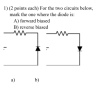 For the two circuits below, mark the one where the diode is: A) forward biased B) reverse biased
Question 1 1 pts Consider a standard diode shown below. Check all the statements that are...
 Question 1 1 pts Consider a standard diode shown below. Check all the statements that are true for diodes and diode circuits.ID ip + V- In the forward bias region, the diode current ip is positive. Diodes are made by connecting a p-doped material to an n-doped material, creating a depletion region that causes a barrier to the flow of electricity when the diode is reverse biased. In the non-conducting (or OFF) state of an ideal diode, the diode voltage,...
1. The reverse current in a diode has a value of 71.8 nA when the reverse...
 1. The reverse current in a diode has a value of 71.8 nA when the reverse voltage across the diode is 324.99 V. If the breakdown voltage of the diode is 325 V, and its saturation current is 11.0 pA, calculate the value of n for this diode. Ans. (2-12 Bogart) n 4.979 2. For the circuit below with silicon diodes, which diodes are forward-biased and which are revers- biased? Is current flowing through the resistor? If so, draw a...
nsider the circult shown on the right. a) Which diodes are forward biased and which are...
 nsider the circult shown on the right. a) Which diodes are forward biased and which are reverse biased? b) Assume 0.7 V drop across each forward- D1 -5V biased diode and find Vo. +5V D2 Vo +5VD3 -5V D4 Two ideal diodes are placed in a circuit shown on the 2. D1 120 D2 60 Va right: a) Determine which diodes conduct and which R 18 5.4V 5V ones do not b) Assume D1 and D2 both conduct. Find Va...
Shirt /10 pts 2 (10 pts) Half-wave rectifier circuit (Multiple Choice) For the rectifier circuit below,...
 Shirt /10 pts 2 (10 pts) Half-wave rectifier circuit (Multiple Choice) For the rectifier circuit below, let the input be a sine wave with a value of 120 Vrms and assume a constant voltage drop model of 0.7 V p D Select a suitable value for R so that the peak diode current does not exceed 50 mA a 2400 0 32250 A. B. 3000 0 C. 3380 0 D the diode? b. What is the greatest reverse voltage that...
For the double diode circuit shown in figure 2-1, answer the following questions. In Figure 2-1...
 For the double diode circuit shown in figure 2-1, answer the following questions. In Figure 2-1 a) (10pts) For the triangular wave input shown (Vin), sketch the output voltage (Vout) using the constant voltage drop model (CVD: Vo-0.7V). Be sure to note the voltage values on the y-axis of your Vout plot and show any equations you used to determine those values ime FEE 334: Spring 2019 Midterm b) (2pts) During the middle of the first time segment (when Vin...
l (33 PTS.) A MOSFET two-stage amplifier is shown below a) Determine gm for both MOSFETS...
 l (33 PTS.) A MOSFET two-stage amplifier is shown below a) Determine gm for both MOSFETS )ndicate the configuration (topology) of each amplifier stage raw the small-signal equivalent circuit of the entire amplifier (with transistors) d) Find Av Vou/vs, R and R Note: lo 1mA, Kn-31 6mAN2 VM-1.73 Lambda0 Mi Config. Mz Config.- RS sk R4 100 C2 OuF Ro R2 50 C1 M1 100uF 50% Ri Vs R3 50k 000uF R10 1.8k
Problem 2: For the circuit shown below: a) Determine the dynamic resistance. (12 points) Diode Forward...
 Problem 2: For the circuit shown below: a) Determine the dynamic resistance. (12 points) Diode Forward Characteristics 15 10 05 b) Determine the barrier potential Vobag c) Draw the the complete equivalent circuit of the diode.
(25 pts)For the circuit below assuming an ideal diode with a 0.7 V drop (You must...
 (25 pts)For the circuit below assuming an ideal diode with a 0.7 V drop (You must fill in the information in the boxes below): a. Sketch Vout VS. Vin- b. When Vin -5V: Determine which diode leg is conducting, the current flowing through the diode, and Vout? c. Find the values in part b when Vin 0.3V? d. Find the values in part b when Vin 3V? R 1-2k, R2 = 6k. R1 R2 D2 Vout DI R2
(PC) For the 3 diode circuit below, I have a good friend who graduated from the...
 (PC) For the 3 diode circuit below, I have a good friend who graduated from the Loachapoka University School of Engineering with a BS degree in le Engineering along with a strong minor in Enology (look it up later) e tells me the following: D1 is forward biased, D2 is reversed biased and D3 is forward biased. Is my good friend correct? Do the appropriate KVL's proving his statement one way or ahother. NO CRE GIVEN FOR GUESSINGI Your answer...
 For the two circuits below, mark the one where the diode is: A) forward biased B) reverse biased
 Question 1 1 pts Consider a standard diode shown below. Check all the statements that are true for diodes and diode circuits.ID ip + V- In the forward bias region, the diode current ip is positive. Diodes are made by connecting a p-doped material to an n-doped material, creating a depletion region that causes a barrier to the flow of electricity when the diode is reverse biased. In the non-conducting (or OFF) state of an ideal diode, the diode voltage,...
 1. The reverse current in a diode has a value of 71.8 nA when the reverse voltage across the diode is 324.99 V. If the breakdown voltage of the diode is 325 V, and its saturation current is 11.0 pA, calculate the value of n for this diode. Ans. (2-12 Bogart) n 4.979 2. For the circuit below with silicon diodes, which diodes are forward-biased and which are revers- biased? Is current flowing through the resistor? If so, draw a...
 nsider the circult shown on the right. a) Which diodes are forward biased and which are reverse biased? b) Assume 0.7 V drop across each forward- D1 -5V biased diode and find Vo. +5V D2 Vo +5VD3 -5V D4 Two ideal diodes are placed in a circuit shown on the 2. D1 120 D2 60 Va right: a) Determine which diodes conduct and which R 18 5.4V 5V ones do not b) Assume D1 and D2 both conduct. Find Va...
 Shirt /10 pts 2 (10 pts) Half-wave rectifier circuit (Multiple Choice) For the rectifier circuit below, let the input be a sine wave with a value of 120 Vrms and assume a constant voltage drop model of 0.7 V p D Select a suitable value for R so that the peak diode current does not exceed 50 mA a 2400 0 32250 A. B. 3000 0 C. 3380 0 D the diode? b. What is the greatest reverse voltage that...
 For the double diode circuit shown in figure 2-1, answer the following questions. In Figure 2-1 a) (10pts) For the triangular wave input shown (Vin), sketch the output voltage (Vout) using the constant voltage drop model (CVD: Vo-0.7V). Be sure to note the voltage values on the y-axis of your Vout plot and show any equations you used to determine those values ime FEE 334: Spring 2019 Midterm b) (2pts) During the middle of the first time segment (when Vin...
 l (33 PTS.) A MOSFET two-stage amplifier is shown below a) Determine gm for both MOSFETS )ndicate the configuration (topology) of each amplifier stage raw the small-signal equivalent circuit of the entire amplifier (with transistors) d) Find Av Vou/vs, R and R Note: lo 1mA, Kn-31 6mAN2 VM-1.73 Lambda0 Mi Config. Mz Config.- RS sk R4 100 C2 OuF Ro R2 50 C1 M1 100uF 50% Ri Vs R3 50k 000uF R10 1.8k
 Problem 2: For the circuit shown below: a) Determine the dynamic resistance. (12 points) Diode Forward Characteristics 15 10 05 b) Determine the barrier potential Vobag c) Draw the the complete equivalent circuit of the diode.
 (25 pts)For the circuit below assuming an ideal diode with a 0.7 V drop (You must fill in the information in the boxes below): a. Sketch Vout VS. Vin- b. When Vin -5V: Determine which diode leg is conducting, the current flowing through the diode, and Vout? c. Find the values in part b when Vin 0.3V? d. Find the values in part b when Vin 3V? R 1-2k, R2 = 6k. R1 R2 D2 Vout DI R2
 (PC) For the 3 diode circuit below, I have a good friend who graduated from the Loachapoka University School of Engineering with a BS degree in le Engineering along with a strong minor in Enology (look it up later) e tells me the following: D1 is forward biased, D2 is reversed biased and D3 is forward biased. Is my good friend correct? Do the appropriate KVL's proving his statement one way or ahother. NO CRE GIVEN FOR GUESSINGI Your answer...
Most questions answered within 3 hours.
-
Where is the error in this code sequence?
String s1 = "Hello";
String s2 = "ello";...
asked 10 months ago -
Financial data for Joel de Paris, Inc., for last year
follow:
Joel de Paris, Inc.
Balance...
asked 10 months ago -
Consider this reaction:
Al2(SO4)3 (aq)+ BaCl3
(aq) Al2Cl6 (aq)- +
3BaSO4(s) . What is the...
asked 10 months ago -
Suppose that Savneet is considering increasing her
recent random sample from 20 car rentals to 40...
asked 10 months ago -
Trucks arrive at an unloading terminal at an average rate of 120
per hour.
Trucks arrive...
asked 10 months ago -
Why are methanol and ethanol completely soluble in water while
octanol is not very little soluble....
asked 10 months ago -
A facilities manager at a university reads in a research report
that the mean amount of...
asked 10 months ago -
When the CuSO4 is rehydrated by adding water to the anhydrous
compound, is this an endothermic...
asked 10 months ago -
A ray of sunlight is passing from diamond into crown glass; the
angle of incidence is...
asked 10 months ago -
A block of mass 0.249 kg is placed on top of a light, vertical
spring of...
asked 10 months ago -
how do the kidneys compensate in the presences of acidosis
a) trigger hyperventilate
b) reserve acid...
asked 10 months ago -
Question 501 pts
The rental rate of capital to the firm increases. Which of the
following...
asked 10 months ago