william is building A contraption for a competition which launch is a straight up in the...
Homework Answers
Add Answer to:
william is building A contraption for a competition which launch is
a straight up in the...
Colby participates in a rocket-launch competition in her high school. The goal is to launch a...
Colby participates in a rocket-launch competition in her high school. The goal is to launch a rocket with mass m = 2.3 kg [5 lbs] to a height no less than 50-m (164 ft) above ground. a) What is the minimum momentum of the rocket as it leaves the launch pad? b) Colby figured out three possible propulsion mechanisms that differ by the generated force F (“thrust”) and the time interval ∆t during which the force acts on the rocket...
(10 marks) A small catapult is used to launch 1.5 kg water balloons straight up into...
 (10 marks) A small catapult is used to launch 1.5 kg water balloons straight up into the air. A clever student is able to measure the speed of the water balloon while it is rising up into the air. She finds that the water balloon is 8.0 m above the catapult it is moving at a speed of 20.0 m/s. (For the purposes of this question, assume that the catapult is positioned in a small hole so that the height...
(10 marks) A small catapult is used to launch 1.5 kg water balloons straight up into...
 (10 marks) A small catapult is used to launch 1.5 kg water balloons straight up into the air. A clever student is able to measure the speed of the water balloon while it is rising up into the air. She finds that the water balloon is 8.0 m above the catapult it is moving at a speed of 20.0 m/s. (For the purposes of this question, assume that the catapult is positioned in a small hole so that the height...
1) A projectile of mass 1.400 kg is shot straight up with an initial speed of...
1) A projectile of mass 1.400 kg is shot straight up with an initial speed of 27.0 m/s. (b) If the projectile rises to a maximum height of only 27.2 m, determine the magnitude of the average force due to air resistance. _______ N
A projectile of mass 1.400 kg is shot straight up with an initial speed of 27.0...
A projectile of mass 1.400 kg is shot straight up with an initial speed of 27.0 m/s. (a) How high would it go if there were no air resistance? m (b) If the projectile rises to a maximum height of only 27.2 m, determine the magnitude of the average force due to air resistance. N
A student with a mass of 50.1 kg jumps straight up in the air by using...
A student with a mass of 50.1 kg jumps straight up in the air by using her legs to apply an average force of 847 N to the ground for 0.389 s. Assume that the initial momentum of the student and the Earth are zero. (The mass of the Earth is 5.98·1024 kg.) What is the momentum of the student immediately after this impulse? (Convention: upwards is positive and downwards is negative.) What is the momentum of the Earth after...
A student with a mass of 58.1 kg jumps straight up in the air by using...
A student with a mass of 58.1 kg jumps straight up in the air by using her legs to apply an average force of 813 N to the ground for 0.265 s. Assume that the initial momentum of the student and the Earth are zero. (The mass of the Earth is 5.98·1024 kg.) a) What is the momentum of the student immediately after this impulse? (Convention: upwards is positive and downwards is negative.) b) What is the momentum of the...
A 15 meter long, vertical cannon is used to accelerate a 1.5 kg ball straight up...
 A 15 meter long, vertical cannon is used to accelerate a 1.5 kg ball straight up into the air. A constant force of 18.5 N is used to accelerate the ball up the length of the cannon. a. What is the ball's velocity as it leaves the cannon? (assume no energy loss to 9. friction) What would the ball's velocity be as it leaves the cannon if there was a 10% energy loss due to friction while the ball was...
The figure below shows the speed of a person's body as he does a chin-up. Assume...
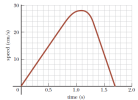 The figure below shows the speed of a person's body as he does a
chin-up. Assume the motion is vertical and the mass of the person's
body is 57.4 kg. Determine the force exerted by the chin-up bar on
his body at the following times.
(a) t = 0
N
(b) t = 0.5 s
N
(c) t = 1.1 s
N
(d) t = 1.6 s.
N
30 20 ˋ毛多 100 0.5 1.5 2.0 time (s)
The figure below shows the speed of a person's body as he does a
chin-up. Assume the motion is vertical and the mass of the person's
body is 57.4 kg. Determine the force exerted by the chin-up bar on
his body at the following times.
(a) t = 0
N
(b) t = 0.5 s
N
(c) t = 1.1 s
N
(d) t = 1.6 s.
N
30 20 ˋ毛多 100 0.5 1.5 2.0 time (s)
1. A ball is thrown straight up with an initial speed of 30 m/s. How much...
1. A ball is thrown straight up with an initial speed of 30 m/s. How much time does it take for the ball to reach the top of it's trajectory? 2. For 3.0s, Allison exerts a net force of 10.0 N on a 6.7-kg shopping cart that was initially at rest. Find the acceleration of the cart, and show that it moves a distance of 6.7m. 3. Suzie skydiver with her parachute has a mass of 50 kg. Before opening...
 (10 marks) A small catapult is used to launch 1.5 kg water balloons straight up into the air. A clever student is able to measure the speed of the water balloon while it is rising up into the air. She finds that the water balloon is 8.0 m above the catapult it is moving at a speed of 20.0 m/s. (For the purposes of this question, assume that the catapult is positioned in a small hole so that the height...
 (10 marks) A small catapult is used to launch 1.5 kg water balloons straight up into the air. A clever student is able to measure the speed of the water balloon while it is rising up into the air. She finds that the water balloon is 8.0 m above the catapult it is moving at a speed of 20.0 m/s. (For the purposes of this question, assume that the catapult is positioned in a small hole so that the height...
 A 15 meter long, vertical cannon is used to accelerate a 1.5 kg ball straight up into the air. A constant force of 18.5 N is used to accelerate the ball up the length of the cannon. a. What is the ball's velocity as it leaves the cannon? (assume no energy loss to 9. friction) What would the ball's velocity be as it leaves the cannon if there was a 10% energy loss due to friction while the ball was...
 The figure below shows the speed of a person's body as he does a
chin-up. Assume the motion is vertical and the mass of the person's
body is 57.4 kg. Determine the force exerted by the chin-up bar on
his body at the following times.
(a) t = 0
N
(b) t = 0.5 s
N
(c) t = 1.1 s
N
(d) t = 1.6 s.
N
30 20 ˋ毛多 100 0.5 1.5 2.0 time (s)
The figure below shows the speed of a person's body as he does a
chin-up. Assume the motion is vertical and the mass of the person's
body is 57.4 kg. Determine the force exerted by the chin-up bar on
his body at the following times.
(a) t = 0
N
(b) t = 0.5 s
N
(c) t = 1.1 s
N
(d) t = 1.6 s.
N
30 20 ˋ毛多 100 0.5 1.5 2.0 time (s)
Most questions answered within 3 hours.
-
Where is the error in this code sequence?
String s1 = "Hello";
String s2 = "ello";...
asked 10 months ago -
Financial data for Joel de Paris, Inc., for last year
follow:
Joel de Paris, Inc.
Balance...
asked 10 months ago -
Consider this reaction:
Al2(SO4)3 (aq)+ BaCl3
(aq) Al2Cl6 (aq)- +
3BaSO4(s) . What is the...
asked 10 months ago -
Suppose that Savneet is considering increasing her
recent random sample from 20 car rentals to 40...
asked 10 months ago -
Trucks arrive at an unloading terminal at an average rate of 120
per hour.
Trucks arrive...
asked 10 months ago -
Why are methanol and ethanol completely soluble in water while
octanol is not very little soluble....
asked 10 months ago -
A facilities manager at a university reads in a research report
that the mean amount of...
asked 10 months ago -
When the CuSO4 is rehydrated by adding water to the anhydrous
compound, is this an endothermic...
asked 10 months ago -
A ray of sunlight is passing from diamond into crown glass; the
angle of incidence is...
asked 10 months ago -
A block of mass 0.249 kg is placed on top of a light, vertical
spring of...
asked 10 months ago -
how do the kidneys compensate in the presences of acidosis
a) trigger hyperventilate
b) reserve acid...
asked 10 months ago -
Question 501 pts
The rental rate of capital to the firm increases. Which of the
following...
asked 10 months ago