
Homework Answers
Add Answer to:
8. (10 points) For the following conditions, circle whether the nucleophile adds 1,2 or 1,4 and...
6. Draw both the 1,2- and the 1,4-addition products of the following substrate. Circle the kinetic...
 6. Draw both the 1,2- and the 1,4-addition products of the following substrate. Circle the kinetic product (2 pts.). HBE (1 ) 7. Construct an inscribed polygon in the circle provided to illustrate the molecular orbitals for the cycloheptatrienyl anion. Illustrate the relative energies of all the molecular orbitals, label bonding and anti-bonding and assuming this species is planar, assess whether it is non-aromatic, aromatic, or anti-aromatic. Explain why (2 pts.).
5. a) Draw the major 1,2-addition product and the major 1,4-addition product of each of the...
 5. a) Draw the major 1,2-addition product and the major 1,4-addition product of each of the following reactions. Label each product as either the 1,2-addition product or 1,4-addition product and as either the thermodynamic or kinetic product. (12 pts) H" catalyst H catalyst b) Consider the reaction of a nucleophile with conjugated carbonyl. Provide an example of a nucleophile that would favor the 1,2-addition product and explain why. Provide an example of a nucleophile that would favor the 1,4-addition product...
ASAP 6.(8) a. The 1,2 addition product of the reaction is shown. Draw the 1,4 addition...
 ASAP
6.(8) a. The 1,2 addition product of the reaction is shown. Draw the 1,4 addition product. HBr 1,2 1,4 b. Which is more stable? Circle one: the 1,2 product, the 1.4 product. c. Which product is favored at low temperatures? Circle one: the 1.2 product, the 14 product d. "The proximity effect is used to account for the formation of which product? Circle one: the 1,2 product, the 1.4 product. 7. (5) The pesticide chlordane, sold starting in 1948,...
ASAP
6.(8) a. The 1,2 addition product of the reaction is shown. Draw the 1,4 addition product. HBr 1,2 1,4 b. Which is more stable? Circle one: the 1,2 product, the 1.4 product. c. Which product is favored at low temperatures? Circle one: the 1.2 product, the 14 product d. "The proximity effect is used to account for the formation of which product? Circle one: the 1,2 product, the 1.4 product. 7. (5) The pesticide chlordane, sold starting in 1948,...
1) The reaction below proceeds via a multistep mechanism involving several intermediate structures en route to...
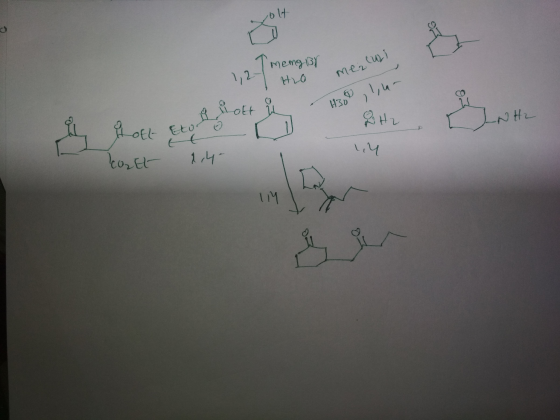
 1) The reaction below proceeds via a multistep mechanism involving several intermediate structures en route to the final product. Some possible structures for the intermediates and product have been provided below. Decide which intermediates are involved in the reaction, and what the final product is, and place them in the correct order (e.g. A +B+C where C would be the final product isolated). (4 points) 1) NaOET, Eto OEt 2) NHACI, H20 Possible intermediates/products: Eto OET Eto OET Eto OET...
4.(18 points) Using the arrow, provide the detailed reaction conditions necessary to give the following. You...
 4.(18 points) Using the arrow, provide the detailed reaction conditions necessary to give the following. You do not need to provide any starting material or product, just the reaction conditions (see example below) 1.B Example: Show reagent 'B' followed by aqueous acid: 2. H30 a. Markovnikov addition of H2O to a double bond: b. Anti-Markovnikov addition of H2O to a double bond: c. Markovnikov addition to form an alkyl bromide from an alkene: d. Reaction conditions to change 1,2-dimethylcyclohexene into...
7. One of the following is much more acidic than the other. Circle the more acidic...
 7. One of the following is much more acidic than the other. Circle the more acidic one, and explain very briefly why? (3 points) Acidity of one pf the it's shown 8. For the reaction show, a. Write "1,2" underneath and "1,4" underneath the appropriate products. (1 pt) b. Write "thermodynamic" underneath the appropriate "thermodynamic control product (1 pt) c. Draw the mechanism for the reaction, using formal arrow pushing. Draw both resonance structures for the intermediate (4 pts) Br...
7-9 please! 4 7. One of the following is much more acidic than the other. Circle...
 7-9 please!
4 7. One of the following is much more acidic than the other. Circle the more acidic one, and explain very briefly why? (3 points) H Acidity of one pf the H's shown H H 8. For the reaction show a. Write "1,2" underneath and "1,4" underneath the appropriate products. (1 pt) b. Write "thermodynamic" underneath the appropriate "thermodynamic control" product (1 pt) c. Draw the mechanism for the reaction, using formal arrow pushing. Draw both resonance structures...
7-9 please!
4 7. One of the following is much more acidic than the other. Circle the more acidic one, and explain very briefly why? (3 points) H Acidity of one pf the H's shown H H 8. For the reaction show a. Write "1,2" underneath and "1,4" underneath the appropriate products. (1 pt) b. Write "thermodynamic" underneath the appropriate "thermodynamic control" product (1 pt) c. Draw the mechanism for the reaction, using formal arrow pushing. Draw both resonance structures...
3 and 4 3) Draw the Frost circle for following structures and state whether or not...
 3 and 4
3) Draw the Frost circle for following structures and state whether or not it is aromatic. (5 points) 4) Write the reaction product and use the curved arrow notation to draw a mechanism that accounts for the formation of product upon oxymercuration/ reduction of cis-4-hexenoic acid in aqueous THF. (8 points) a) Write the reaction. rolled HO els-4-hextenoic acid 1) Hg(OC), aq. THE 2) NaBH, aq. THE b) Write a mechanism.
3 and 4
3) Draw the Frost circle for following structures and state whether or not it is aromatic. (5 points) 4) Write the reaction product and use the curved arrow notation to draw a mechanism that accounts for the formation of product upon oxymercuration/ reduction of cis-4-hexenoic acid in aqueous THF. (8 points) a) Write the reaction. rolled HO els-4-hextenoic acid 1) Hg(OC), aq. THE 2) NaBH, aq. THE b) Write a mechanism.
help Thank you 4. (10 pts) Draw all possible products for the following reaction including stereoisomers....
 help Thank you
4. (10 pts) Draw all possible products for the following reaction including stereoisomers. Note that the addition occurs through a "syn" mechanism. Is the product solution optically active (yes or no)? 1. BAHATHF 2. NaOH, HO (8 pts) Provide a complete mechanism for the reaction below and include lone-pairs of electrons and formal charges. Show all products formed including stereoisomers. Is the product solution optically active (yes or no)? Bras 11. (8 pts) Draw all four regiochemical...
help Thank you
4. (10 pts) Draw all possible products for the following reaction including stereoisomers. Note that the addition occurs through a "syn" mechanism. Is the product solution optically active (yes or no)? 1. BAHATHF 2. NaOH, HO (8 pts) Provide a complete mechanism for the reaction below and include lone-pairs of electrons and formal charges. Show all products formed including stereoisomers. Is the product solution optically active (yes or no)? Bras 11. (8 pts) Draw all four regiochemical...
2)Give reagents, solvents and adequate reaction conditions to carry out the following transformations? 3)circle the 1-chloro-3-isopropylcyclohexane...
 2)Give reagents, solvents and adequate reaction conditions to carry
out the following transformations?
3)circle the 1-chloro-3-isopropylcyclohexane starting material
that would have the highest reaction rate under the conditions
provided to prepare the indicated products and use this picture to
illustrate why it is more reactive.
2) Give reagents, solvents, and adequate reaction conditions to carry out the following transformations (4 points) - ve-eron 3) Circle the 1-chloro-3-isopropylcylohexane starting material that would have the highest reaction rate under the conditions provided...
2)Give reagents, solvents and adequate reaction conditions to carry
out the following transformations?
3)circle the 1-chloro-3-isopropylcyclohexane starting material
that would have the highest reaction rate under the conditions
provided to prepare the indicated products and use this picture to
illustrate why it is more reactive.
2) Give reagents, solvents, and adequate reaction conditions to carry out the following transformations (4 points) - ve-eron 3) Circle the 1-chloro-3-isopropylcylohexane starting material that would have the highest reaction rate under the conditions provided...
 6. Draw both the 1,2- and the 1,4-addition products of the following substrate. Circle the kinetic product (2 pts.). HBE (1 ) 7. Construct an inscribed polygon in the circle provided to illustrate the molecular orbitals for the cycloheptatrienyl anion. Illustrate the relative energies of all the molecular orbitals, label bonding and anti-bonding and assuming this species is planar, assess whether it is non-aromatic, aromatic, or anti-aromatic. Explain why (2 pts.).
 5. a) Draw the major 1,2-addition product and the major 1,4-addition product of each of the following reactions. Label each product as either the 1,2-addition product or 1,4-addition product and as either the thermodynamic or kinetic product. (12 pts) H" catalyst H catalyst b) Consider the reaction of a nucleophile with conjugated carbonyl. Provide an example of a nucleophile that would favor the 1,2-addition product and explain why. Provide an example of a nucleophile that would favor the 1,4-addition product...
 ASAP
6.(8) a. The 1,2 addition product of the reaction is shown. Draw the 1,4 addition product. HBr 1,2 1,4 b. Which is more stable? Circle one: the 1,2 product, the 1.4 product. c. Which product is favored at low temperatures? Circle one: the 1.2 product, the 14 product d. "The proximity effect is used to account for the formation of which product? Circle one: the 1,2 product, the 1.4 product. 7. (5) The pesticide chlordane, sold starting in 1948,...
ASAP
6.(8) a. The 1,2 addition product of the reaction is shown. Draw the 1,4 addition product. HBr 1,2 1,4 b. Which is more stable? Circle one: the 1,2 product, the 1.4 product. c. Which product is favored at low temperatures? Circle one: the 1.2 product, the 14 product d. "The proximity effect is used to account for the formation of which product? Circle one: the 1,2 product, the 1.4 product. 7. (5) The pesticide chlordane, sold starting in 1948,...
 1) The reaction below proceeds via a multistep mechanism involving several intermediate structures en route to the final product. Some possible structures for the intermediates and product have been provided below. Decide which intermediates are involved in the reaction, and what the final product is, and place them in the correct order (e.g. A +B+C where C would be the final product isolated). (4 points) 1) NaOET, Eto OEt 2) NHACI, H20 Possible intermediates/products: Eto OET Eto OET Eto OET...
 4.(18 points) Using the arrow, provide the detailed reaction conditions necessary to give the following. You do not need to provide any starting material or product, just the reaction conditions (see example below) 1.B Example: Show reagent 'B' followed by aqueous acid: 2. H30 a. Markovnikov addition of H2O to a double bond: b. Anti-Markovnikov addition of H2O to a double bond: c. Markovnikov addition to form an alkyl bromide from an alkene: d. Reaction conditions to change 1,2-dimethylcyclohexene into...
 7. One of the following is much more acidic than the other. Circle the more acidic one, and explain very briefly why? (3 points) Acidity of one pf the it's shown 8. For the reaction show, a. Write "1,2" underneath and "1,4" underneath the appropriate products. (1 pt) b. Write "thermodynamic" underneath the appropriate "thermodynamic control product (1 pt) c. Draw the mechanism for the reaction, using formal arrow pushing. Draw both resonance structures for the intermediate (4 pts) Br...
 7-9 please!
4 7. One of the following is much more acidic than the other. Circle the more acidic one, and explain very briefly why? (3 points) H Acidity of one pf the H's shown H H 8. For the reaction show a. Write "1,2" underneath and "1,4" underneath the appropriate products. (1 pt) b. Write "thermodynamic" underneath the appropriate "thermodynamic control" product (1 pt) c. Draw the mechanism for the reaction, using formal arrow pushing. Draw both resonance structures...
7-9 please!
4 7. One of the following is much more acidic than the other. Circle the more acidic one, and explain very briefly why? (3 points) H Acidity of one pf the H's shown H H 8. For the reaction show a. Write "1,2" underneath and "1,4" underneath the appropriate products. (1 pt) b. Write "thermodynamic" underneath the appropriate "thermodynamic control" product (1 pt) c. Draw the mechanism for the reaction, using formal arrow pushing. Draw both resonance structures...
 3 and 4
3) Draw the Frost circle for following structures and state whether or not it is aromatic. (5 points) 4) Write the reaction product and use the curved arrow notation to draw a mechanism that accounts for the formation of product upon oxymercuration/ reduction of cis-4-hexenoic acid in aqueous THF. (8 points) a) Write the reaction. rolled HO els-4-hextenoic acid 1) Hg(OC), aq. THE 2) NaBH, aq. THE b) Write a mechanism.
3 and 4
3) Draw the Frost circle for following structures and state whether or not it is aromatic. (5 points) 4) Write the reaction product and use the curved arrow notation to draw a mechanism that accounts for the formation of product upon oxymercuration/ reduction of cis-4-hexenoic acid in aqueous THF. (8 points) a) Write the reaction. rolled HO els-4-hextenoic acid 1) Hg(OC), aq. THE 2) NaBH, aq. THE b) Write a mechanism.
 help Thank you
4. (10 pts) Draw all possible products for the following reaction including stereoisomers. Note that the addition occurs through a "syn" mechanism. Is the product solution optically active (yes or no)? 1. BAHATHF 2. NaOH, HO (8 pts) Provide a complete mechanism for the reaction below and include lone-pairs of electrons and formal charges. Show all products formed including stereoisomers. Is the product solution optically active (yes or no)? Bras 11. (8 pts) Draw all four regiochemical...
help Thank you
4. (10 pts) Draw all possible products for the following reaction including stereoisomers. Note that the addition occurs through a "syn" mechanism. Is the product solution optically active (yes or no)? 1. BAHATHF 2. NaOH, HO (8 pts) Provide a complete mechanism for the reaction below and include lone-pairs of electrons and formal charges. Show all products formed including stereoisomers. Is the product solution optically active (yes or no)? Bras 11. (8 pts) Draw all four regiochemical...
 2)Give reagents, solvents and adequate reaction conditions to carry
out the following transformations?
3)circle the 1-chloro-3-isopropylcyclohexane starting material
that would have the highest reaction rate under the conditions
provided to prepare the indicated products and use this picture to
illustrate why it is more reactive.
2) Give reagents, solvents, and adequate reaction conditions to carry out the following transformations (4 points) - ve-eron 3) Circle the 1-chloro-3-isopropylcylohexane starting material that would have the highest reaction rate under the conditions provided...
2)Give reagents, solvents and adequate reaction conditions to carry
out the following transformations?
3)circle the 1-chloro-3-isopropylcyclohexane starting material
that would have the highest reaction rate under the conditions
provided to prepare the indicated products and use this picture to
illustrate why it is more reactive.
2) Give reagents, solvents, and adequate reaction conditions to carry out the following transformations (4 points) - ve-eron 3) Circle the 1-chloro-3-isopropylcylohexane starting material that would have the highest reaction rate under the conditions provided...
Most questions answered within 3 hours.
-
Where is the error in this code sequence?
String s1 = "Hello";
String s2 = "ello";...
asked 10 months ago -
Financial data for Joel de Paris, Inc., for last year
follow:
Joel de Paris, Inc.
Balance...
asked 10 months ago -
Consider this reaction:
Al2(SO4)3 (aq)+ BaCl3
(aq) Al2Cl6 (aq)- +
3BaSO4(s) . What is the...
asked 10 months ago -
Suppose that Savneet is considering increasing her
recent random sample from 20 car rentals to 40...
asked 10 months ago -
Trucks arrive at an unloading terminal at an average rate of 120
per hour.
Trucks arrive...
asked 10 months ago -
Why are methanol and ethanol completely soluble in water while
octanol is not very little soluble....
asked 10 months ago -
A facilities manager at a university reads in a research report
that the mean amount of...
asked 10 months ago -
When the CuSO4 is rehydrated by adding water to the anhydrous
compound, is this an endothermic...
asked 10 months ago -
A ray of sunlight is passing from diamond into crown glass; the
angle of incidence is...
asked 10 months ago -
A block of mass 0.249 kg is placed on top of a light, vertical
spring of...
asked 10 months ago -
how do the kidneys compensate in the presences of acidosis
a) trigger hyperventilate
b) reserve acid...
asked 10 months ago -
Question 501 pts
The rental rate of capital to the firm increases. Which of the
following...
asked 10 months ago