![(30 points) This problem is related to Problem 3.47a (page 221) in the text. Compute the convolution of the two sequences defined by r(n) 1,1,4,4], for n --1, ..., 2, and h(n) - [2, 4,3,3,2], for n 3,1 using the 1-sided z-transform. Enter the sequence as a comma separated list y(n)-z(n) *h(n)=[ 2,6,1 5,30,33,26,20,8 for the indices n4 (first and last indices of y(n).) Hint: first compute the one sided transform of x and h. Next, multiply the one sided transforms. Finally, the inverse transform should provided the desired answer](http://img.homeworklib.com/questions/de6d97e0-cc5e-11ea-a75e-df8797127769.png?x-oss-process=image/resize,w_560)
please it is asking one sided transform and answer it indetail by hand to be answered during the test.
Homework Answers
Request Answer!
We need at least 10 more requests to produce the answer.
0 / 10 have requested this problem solution
The more requests, the faster the answer.
Add Answer to:
please it is asking one sided transform and answer it indetail
by hand to be answered...
em 2: Given two sequences x[n] = 8 8[n - 8] and h[n] = (0.7)"u[n] Determine...
 em 2: Given two sequences x[n] = 8 8[n - 8] and h[n] = (0.7)"u[n] Determine the z-transform of the convolution of the two sequences using the convolution property of the Z-transform Y(z) = X(z) H(2) Determine the convolution y[n] = x[n] * h[n] by using the inverse z-transform Problem 3: Find the inverse z-transform for the functions below. 4z-1 2-4 z-8 X(Z) = + 2-5 Z - 1 2-05 X(Z) = Z 2z2 + 2.7 z + 2
Number one posted as a reference. Only need problem 6 answered. Thanks 6. using the property...
 Number one posted as a reference. Only need problem 6 answered.
Thanks
6. using the property F{f1 + f2} = F{fi} F{12} Calculate the Fourier transform of a triangular pulse. See Prob. 1 1. Determine the convolution of the following pulse h(t) with itself. That is, h(t) y(t) = h(t) * h(t) =?
Number one posted as a reference. Only need problem 6 answered.
Thanks
6. using the property F{f1 + f2} = F{fi} F{12} Calculate the Fourier transform of a triangular pulse. See Prob. 1 1. Determine the convolution of the following pulse h(t) with itself. That is, h(t) y(t) = h(t) * h(t) =?
2. (14 points) This problem shows an example of using the Fourier transform to analyze communicat...
 2. (14 points) This problem shows an example of using the Fourier transform to analyze communication systems. The system in Figure 4, where (t)-f(t)+sin(wt) and has been proposed for amplitude modulation. f(t) + sin(o) Figure 4: System proposed for amplitude modulation. (a) (7 points) The spectrum of the input f(t) is shown in Figure 1, where 2mB o/100. Sketch and label the spectrum Y(w) of the signal y(t). Hint: You will need to use the frequency convolution property of the...
5. The z transform is a very useful tool for studying difference equations. Often difference and ...
 5. The z transform is a very useful tool for studying difference equations. Often difference and differential equations are used to describe causal systems and only the causal solution is of interest. This is the "initial condition" problem of a differential equations course. But both difference and differential equations describe more than just the causal system. For instance, "backwards" solutions and "two point boundary value" solutions. One way in which to think about the problem is the ROC of the...
need help with second question, please include all steps. 2. Consider a z-transform given by 22...
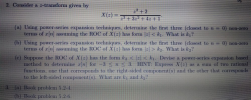 need help with second question, please include all
steps.
2. Consider a z-transform given by 22 -2 23 322 42 +1 a) Using power-series expansion techniques, determine the first three (closest to n 0 non-zero (b) Using power-series expansion techniques, determine the first three (closest to n-0) non-zero (c) Suppose the ROC of X(2) has the form k2 2 k Devise a power-series expansion based terms of r n assuming the ROC of X() has form 2l < ki. What...
need help with second question, please include all
steps.
2. Consider a z-transform given by 22 -2 23 322 42 +1 a) Using power-series expansion techniques, determine the first three (closest to n 0 non-zero (b) Using power-series expansion techniques, determine the first three (closest to n-0) non-zero (c) Suppose the ROC of X(2) has the form k2 2 k Devise a power-series expansion based terms of r n assuming the ROC of X() has form 2l < ki. What...
Problem 5. (1 point) A Bernoulli differential equation is one of the form +P()y= Q()y" (*)...
 Problem 5. (1 point) A Bernoulli differential equation is one of the form +P()y= Q()y" (*) Observe that, if n = 0 or 1, the Bernoulli equation is linear. For other values of n, the substitution u =y- transforms the Bemoulli equation into the linear equation + (1 - x)P(3)u = (1 - x)^(x). Consider the initial value problem ry' +y = -3.xy?, y(1) = 2. (a) This differential equation can be written in the form (*) with P(1) =...
Fill all Answer Blanks and show all calculations in a separate sheet of paper. Problem: Given...
 Fill all Answer Blanks and show all calculations in a separate sheet of paper. Problem: Given the Pole-Zero Plot (one pole and one zero at the origin) of a causal filter with a normalized magnitude frequency response (max |H(w)l 1): 0.8 a) It is a FIR or IIR filter? b) what is the R.O.C of the filter ? c) Is the filter stable BIBO? Answer: Answer: Izl> Arıswer: d) The magnitude frequency response has a maximum peak at w0. Answer:...
I asked a question similar to this one, which was answered perfectly. Another practice problem is...
I asked a question similar to this one, which was answered perfectly. Another practice problem is now asking me to use two classes and get user input. For this Java program, you will write two classes: GradeCalculator and GradeCalculatorDriver In the GradeCalculator class, compute the final average and letter grade for a particular student. The final average is calculated according to the following rules: 1) There are ten exams scored out of 100 points 2) The lowest exam score is...
Answer for the last box only please. Thanks Entered Answer Preview Result Y's+5°Y+2 Ys + 5Y...
 Answer for the last box only please. Thanks
Entered Answer Preview Result Y's+5°Y+2 Ys + 5Y +2 correct (5/s)*([e^(-s)]-1) correct (5*[e^(-s)]-5-2*s/[s*(s+5)] 5e : - 5 - 28 $(8 + 5) correct u(t-1)"[u(t-1)-(e^{-5* (t-1)]]]-u(t)+(e^(-5*t)]-(2/5) ult – 1)(ult – 1) – е11-1)) – u(t) +e5 incorrect At least one of the answers above is NOT correct. (1 point) In this exercise we will use the Laplace transform to solve the following initial value problem: 1 + 5y = -5, ( 0, 0<t<...
Answer for the last box only please. Thanks
Entered Answer Preview Result Y's+5°Y+2 Ys + 5Y +2 correct (5/s)*([e^(-s)]-1) correct (5*[e^(-s)]-5-2*s/[s*(s+5)] 5e : - 5 - 28 $(8 + 5) correct u(t-1)"[u(t-1)-(e^{-5* (t-1)]]]-u(t)+(e^(-5*t)]-(2/5) ult – 1)(ult – 1) – е11-1)) – u(t) +e5 incorrect At least one of the answers above is NOT correct. (1 point) In this exercise we will use the Laplace transform to solve the following initial value problem: 1 + 5y = -5, ( 0, 0<t<...
Please answer both (a) and (b) and code using Python3. Exercise 8.3 The Lorenz equations One...
 Please answer both (a) and (b) and code using Python3.
Exercise 8.3 The Lorenz equations One of the most celebrated sets of differential equations in physics is the Lorenz equations: dx dz ar=0(y-x), dr where σ r, and b are constants. (The names σ, r, and bare odd, but traditional-they are always used in these equations for historical reasons.) These equations were first studied by Edward Lorenz in 1963, who derived them from a simplified model of weather patterns. The...
Please answer both (a) and (b) and code using Python3.
Exercise 8.3 The Lorenz equations One of the most celebrated sets of differential equations in physics is the Lorenz equations: dx dz ar=0(y-x), dr where σ r, and b are constants. (The names σ, r, and bare odd, but traditional-they are always used in these equations for historical reasons.) These equations were first studied by Edward Lorenz in 1963, who derived them from a simplified model of weather patterns. The...
 em 2: Given two sequences x[n] = 8 8[n - 8] and h[n] = (0.7)"u[n] Determine the z-transform of the convolution of the two sequences using the convolution property of the Z-transform Y(z) = X(z) H(2) Determine the convolution y[n] = x[n] * h[n] by using the inverse z-transform Problem 3: Find the inverse z-transform for the functions below. 4z-1 2-4 z-8 X(Z) = + 2-5 Z - 1 2-05 X(Z) = Z 2z2 + 2.7 z + 2
 Number one posted as a reference. Only need problem 6 answered.
Thanks
6. using the property F{f1 + f2} = F{fi} F{12} Calculate the Fourier transform of a triangular pulse. See Prob. 1 1. Determine the convolution of the following pulse h(t) with itself. That is, h(t) y(t) = h(t) * h(t) =?
Number one posted as a reference. Only need problem 6 answered.
Thanks
6. using the property F{f1 + f2} = F{fi} F{12} Calculate the Fourier transform of a triangular pulse. See Prob. 1 1. Determine the convolution of the following pulse h(t) with itself. That is, h(t) y(t) = h(t) * h(t) =?
 2. (14 points) This problem shows an example of using the Fourier transform to analyze communication systems. The system in Figure 4, where (t)-f(t)+sin(wt) and has been proposed for amplitude modulation. f(t) + sin(o) Figure 4: System proposed for amplitude modulation. (a) (7 points) The spectrum of the input f(t) is shown in Figure 1, where 2mB o/100. Sketch and label the spectrum Y(w) of the signal y(t). Hint: You will need to use the frequency convolution property of the...
 5. The z transform is a very useful tool for studying difference equations. Often difference and differential equations are used to describe causal systems and only the causal solution is of interest. This is the "initial condition" problem of a differential equations course. But both difference and differential equations describe more than just the causal system. For instance, "backwards" solutions and "two point boundary value" solutions. One way in which to think about the problem is the ROC of the...
 need help with second question, please include all
steps.
2. Consider a z-transform given by 22 -2 23 322 42 +1 a) Using power-series expansion techniques, determine the first three (closest to n 0 non-zero (b) Using power-series expansion techniques, determine the first three (closest to n-0) non-zero (c) Suppose the ROC of X(2) has the form k2 2 k Devise a power-series expansion based terms of r n assuming the ROC of X() has form 2l < ki. What...
need help with second question, please include all
steps.
2. Consider a z-transform given by 22 -2 23 322 42 +1 a) Using power-series expansion techniques, determine the first three (closest to n 0 non-zero (b) Using power-series expansion techniques, determine the first three (closest to n-0) non-zero (c) Suppose the ROC of X(2) has the form k2 2 k Devise a power-series expansion based terms of r n assuming the ROC of X() has form 2l < ki. What...
 Problem 5. (1 point) A Bernoulli differential equation is one of the form +P()y= Q()y" (*) Observe that, if n = 0 or 1, the Bernoulli equation is linear. For other values of n, the substitution u =y- transforms the Bemoulli equation into the linear equation + (1 - x)P(3)u = (1 - x)^(x). Consider the initial value problem ry' +y = -3.xy?, y(1) = 2. (a) This differential equation can be written in the form (*) with P(1) =...
 Fill all Answer Blanks and show all calculations in a separate sheet of paper. Problem: Given the Pole-Zero Plot (one pole and one zero at the origin) of a causal filter with a normalized magnitude frequency response (max |H(w)l 1): 0.8 a) It is a FIR or IIR filter? b) what is the R.O.C of the filter ? c) Is the filter stable BIBO? Answer: Answer: Izl> Arıswer: d) The magnitude frequency response has a maximum peak at w0. Answer:...
 Answer for the last box only please. Thanks
Entered Answer Preview Result Y's+5°Y+2 Ys + 5Y +2 correct (5/s)*([e^(-s)]-1) correct (5*[e^(-s)]-5-2*s/[s*(s+5)] 5e : - 5 - 28 $(8 + 5) correct u(t-1)"[u(t-1)-(e^{-5* (t-1)]]]-u(t)+(e^(-5*t)]-(2/5) ult – 1)(ult – 1) – е11-1)) – u(t) +e5 incorrect At least one of the answers above is NOT correct. (1 point) In this exercise we will use the Laplace transform to solve the following initial value problem: 1 + 5y = -5, ( 0, 0<t<...
Answer for the last box only please. Thanks
Entered Answer Preview Result Y's+5°Y+2 Ys + 5Y +2 correct (5/s)*([e^(-s)]-1) correct (5*[e^(-s)]-5-2*s/[s*(s+5)] 5e : - 5 - 28 $(8 + 5) correct u(t-1)"[u(t-1)-(e^{-5* (t-1)]]]-u(t)+(e^(-5*t)]-(2/5) ult – 1)(ult – 1) – е11-1)) – u(t) +e5 incorrect At least one of the answers above is NOT correct. (1 point) In this exercise we will use the Laplace transform to solve the following initial value problem: 1 + 5y = -5, ( 0, 0<t<...
 Please answer both (a) and (b) and code using Python3.
Exercise 8.3 The Lorenz equations One of the most celebrated sets of differential equations in physics is the Lorenz equations: dx dz ar=0(y-x), dr where σ r, and b are constants. (The names σ, r, and bare odd, but traditional-they are always used in these equations for historical reasons.) These equations were first studied by Edward Lorenz in 1963, who derived them from a simplified model of weather patterns. The...
Please answer both (a) and (b) and code using Python3.
Exercise 8.3 The Lorenz equations One of the most celebrated sets of differential equations in physics is the Lorenz equations: dx dz ar=0(y-x), dr where σ r, and b are constants. (The names σ, r, and bare odd, but traditional-they are always used in these equations for historical reasons.) These equations were first studied by Edward Lorenz in 1963, who derived them from a simplified model of weather patterns. The...
Most questions answered within 3 hours.
-
Where is the error in this code sequence?
String s1 = "Hello";
String s2 = "ello";...
asked 11 months ago -
Financial data for Joel de Paris, Inc., for last year
follow:
Joel de Paris, Inc.
Balance...
asked 11 months ago -
Consider this reaction:
Al2(SO4)3 (aq)+ BaCl3
(aq) Al2Cl6 (aq)- +
3BaSO4(s) . What is the...
asked 11 months ago -
Suppose that Savneet is considering increasing her
recent random sample from 20 car rentals to 40...
asked 11 months ago -
Trucks arrive at an unloading terminal at an average rate of 120
per hour.
Trucks arrive...
asked 11 months ago -
Why are methanol and ethanol completely soluble in water while
octanol is not very little soluble....
asked 11 months ago -
A facilities manager at a university reads in a research report
that the mean amount of...
asked 11 months ago -
When the CuSO4 is rehydrated by adding water to the anhydrous
compound, is this an endothermic...
asked 11 months ago -
A ray of sunlight is passing from diamond into crown glass; the
angle of incidence is...
asked 11 months ago -
A block of mass 0.249 kg is placed on top of a light, vertical
spring of...
asked 11 months ago -
how do the kidneys compensate in the presences of acidosis
a) trigger hyperventilate
b) reserve acid...
asked 11 months ago -
Question 501 pts
The rental rate of capital to the firm increases. Which of the
following...
asked 11 months ago