
Homework Answers
Add Answer to:
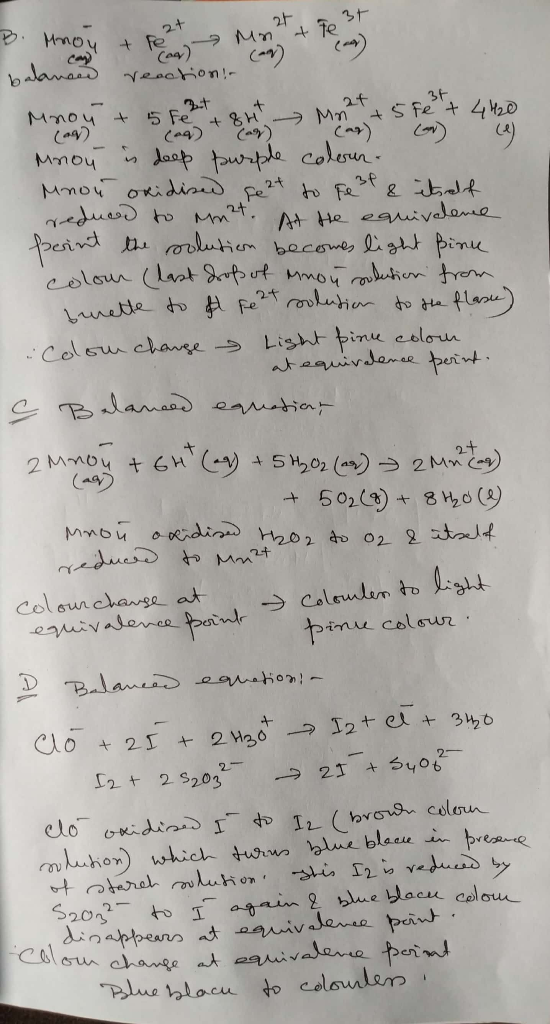
List the color change expected at the equivalence point for each of the possible titrations you...
List the color change expected at the equivalence point for each of the possible titrations you...
List the color change expected at the equivalence point for each of the possible titrations you might perform in Parts B, C, D. B. MnO41-(aq) + Fe2+ (aq) --> Mn2-(aq) + Fe3+(aq) C. MnO41-(aq) + H2O2(aq) --> Mn2+(aq) + O2 (g) D. ClO1- + I1- + H3O+ --> I2 + Cl1- + 3H2O (starch present) I2 + S2O32- --> I- + S4O62- (starch present)
Calculate the pH at the halfway point and at the equivalence point for each of the following titrations.
Calculate the pH at the halfway point and at the equivalence point for each of the following titrations. (Assume that the temperature is 25°C.) (a) 101.5 mL of 0.19 M HCO2H (Ka= 1.8 ✕ 10-4) titrated with 0.19 M KOH (b) 104.1 mL of 0.18 M (C2H5)3N (Kb = 4.0 ✕ 10-4) titrated with 0.36 M HClO4 (c) 100.9 mL of 0.47 M HClO4 titrated with 0.24 M NaOH
DATA AND CALCULATIONS Time at equivalence point (s) Time of color Trial *Equation for acid-base reaction...
 DATA AND CALCULATIONS Time at equivalence point (s) Time of color Trial *Equation for acid-base reaction change (s) NaOH+HCI - 21 0s 1 250.5 NaOH+ HC2H3O2- 2 8l.55 99s 3 NH3+ HCl- 930s 4 NH3 + HC2H3O2- 90.55 81.Os Complete the reactions above. Attach copies of all four graphs to this report. 1. 2. Examine the time data for each of the Trials 1- -4. In which trial(s) did the indicator change color at about the same time as the...
Equivalence Point for Titration #1: 24.96 mL Equivalence Point for Titration #2: 25.40 mL Equivalence Point...
 Equivalence Point for Titration #1: 24.96
mL
Equivalence Point for Titration #2: 25.40
mL
Equivalence Point for Titration #3: 25.20
mL
Midpoint pH for Titration #3: 9.80
QUESTIONS:
4) Set up the calculation required to determine
the concentration of the NaOH solution via titration of a given
amount of KHP. Include all numbers except the given mass of
KHP.
5) Set up the calculation required to determine
the concentration of the unknown strong acid via titration with a
known volume...
Equivalence Point for Titration #1: 24.96
mL
Equivalence Point for Titration #2: 25.40
mL
Equivalence Point for Titration #3: 25.20
mL
Midpoint pH for Titration #3: 9.80
QUESTIONS:
4) Set up the calculation required to determine
the concentration of the NaOH solution via titration of a given
amount of KHP. Include all numbers except the given mass of
KHP.
5) Set up the calculation required to determine
the concentration of the unknown strong acid via titration with a
known volume...
find the unknown bacteria based on this results? List of possible Bacteria • Selective Unknown Bacteria...
 find the unknown bacteria based on this results?
List of possible Bacteria • Selective Unknown Bacteria # 4. and Differential Media results for 4 Test MSA PEA Gram (+) to Bacillus cereus (bacillus) do 2. Bacillus mepeterum (becillus) 3. bacillus subtilis (bacillus) Blood 1-Starch Results Interpretation Presumptive ID red frowth Orpinism does not ferment manitol. Nonpathogenic No reochrom (-) good growth oganism is not inhibitelje gram Phenylethyl alcohol complete olipeskon 14 red blood cells on o nomeync activity B hemolytic...
find the unknown bacteria based on this results?
List of possible Bacteria • Selective Unknown Bacteria # 4. and Differential Media results for 4 Test MSA PEA Gram (+) to Bacillus cereus (bacillus) do 2. Bacillus mepeterum (becillus) 3. bacillus subtilis (bacillus) Blood 1-Starch Results Interpretation Presumptive ID red frowth Orpinism does not ferment manitol. Nonpathogenic No reochrom (-) good growth oganism is not inhibitelje gram Phenylethyl alcohol complete olipeskon 14 red blood cells on o nomeync activity B hemolytic...
Please show all work, handwritten please. Thank you. Acid-Base Equilibria; Buffers, and Titrations Be sure to...
 Please show all work, handwritten please. Thank you.
Acid-Base Equilibria; Buffers, and Titrations Be sure to show ALL YOUR WORK! 1. Consider the titration of a 35.0 mL sample of 0.105 M HBr with 0.200 M KOH. Determine each of the following quantities. a. the initial pH b. the volume of KOH solution required to reach the equivalence point c. the pH at the equivalence point 2. Use the table of indicators below to choose the best indicator for the...
Please show all work, handwritten please. Thank you.
Acid-Base Equilibria; Buffers, and Titrations Be sure to show ALL YOUR WORK! 1. Consider the titration of a 35.0 mL sample of 0.105 M HBr with 0.200 M KOH. Determine each of the following quantities. a. the initial pH b. the volume of KOH solution required to reach the equivalence point c. the pH at the equivalence point 2. Use the table of indicators below to choose the best indicator for the...
Le Chateler's principle In the chart below: • Indicate the color of each solution as darker...
 Le
Chateler's principle
In the chart below: • Indicate the color of each solution as darker or lighter than the control after the addition of the specified substance. • Indicate the direction the equilibrium shifted as "toward products" or "toward reactants" based on the color change. • Based on the direction of the shift, indicate the substance(s) that increased which will either be the two reactants present on the reactant side of the equilibrium equation or the complex present on...
Le
Chateler's principle
In the chart below: • Indicate the color of each solution as darker or lighter than the control after the addition of the specified substance. • Indicate the direction the equilibrium shifted as "toward products" or "toward reactants" based on the color change. • Based on the direction of the shift, indicate the substance(s) that increased which will either be the two reactants present on the reactant side of the equilibrium equation or the complex present on...
The process of frying food changes its quality, texture, and color, Suppose the total change in...
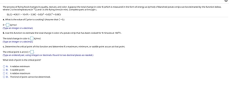 The process of frying food changes its quality, texture, and color, Suppose the total change in color E (which is measured in the form of energy as ki/mo where C is the temperature(in C) and t is the frying time (in minj. Complete parts a through c of blanched potato strips can be estimated by the function below Etc)" 430.11-1047t _ 5sec-002? +002c2 +008α a. what is the value of E prior to cooking? (Assume that C·0) (Type an integer...
Using the data below, calculate the change in energy expected for each of the following processes....
 Using the data below, calculate the change in energy expected for each of the following processes. Successive Ionization Energies (kJ/mol) Atom Li 11 | 12 520.7282 590.1145 Ca 500 UAE Electron Affinities of the Halogens Atom Electron Affinity (kJ/mol) -295.2 CI -348.7 a. Li(9) + I(9) Lit (9) +I (9) Change in energy = kJ b. Ca(g) + Cl(g) + Cat (g) + C14 (9) Change in energy = kJ c. Cat(g) + C1(g) → Ca2+(g) + CI+ (g) Change...
You are building a genetic map for pepper fruit color. In your mapping population, change in...
You are building a genetic map for pepper fruit color. In your mapping population, change in fruit color is associated with five linked genetic markers or loci: A, B, C, D, and E. Now you want to determine how large (cM) your candidate region for fruit color. You perform a series of testcrosses between red fruit (AA BB CC DD EE) and yellow fruit (aa bb cc dd ee). The following information is obtained: Loci A and B recombine with...
 DATA AND CALCULATIONS Time at equivalence point (s) Time of color Trial *Equation for acid-base reaction change (s) NaOH+HCI - 21 0s 1 250.5 NaOH+ HC2H3O2- 2 8l.55 99s 3 NH3+ HCl- 930s 4 NH3 + HC2H3O2- 90.55 81.Os Complete the reactions above. Attach copies of all four graphs to this report. 1. 2. Examine the time data for each of the Trials 1- -4. In which trial(s) did the indicator change color at about the same time as the...
 Equivalence Point for Titration #1: 24.96
mL
Equivalence Point for Titration #2: 25.40
mL
Equivalence Point for Titration #3: 25.20
mL
Midpoint pH for Titration #3: 9.80
QUESTIONS:
4) Set up the calculation required to determine
the concentration of the NaOH solution via titration of a given
amount of KHP. Include all numbers except the given mass of
KHP.
5) Set up the calculation required to determine
the concentration of the unknown strong acid via titration with a
known volume...
Equivalence Point for Titration #1: 24.96
mL
Equivalence Point for Titration #2: 25.40
mL
Equivalence Point for Titration #3: 25.20
mL
Midpoint pH for Titration #3: 9.80
QUESTIONS:
4) Set up the calculation required to determine
the concentration of the NaOH solution via titration of a given
amount of KHP. Include all numbers except the given mass of
KHP.
5) Set up the calculation required to determine
the concentration of the unknown strong acid via titration with a
known volume...
 find the unknown bacteria based on this results?
List of possible Bacteria • Selective Unknown Bacteria # 4. and Differential Media results for 4 Test MSA PEA Gram (+) to Bacillus cereus (bacillus) do 2. Bacillus mepeterum (becillus) 3. bacillus subtilis (bacillus) Blood 1-Starch Results Interpretation Presumptive ID red frowth Orpinism does not ferment manitol. Nonpathogenic No reochrom (-) good growth oganism is not inhibitelje gram Phenylethyl alcohol complete olipeskon 14 red blood cells on o nomeync activity B hemolytic...
find the unknown bacteria based on this results?
List of possible Bacteria • Selective Unknown Bacteria # 4. and Differential Media results for 4 Test MSA PEA Gram (+) to Bacillus cereus (bacillus) do 2. Bacillus mepeterum (becillus) 3. bacillus subtilis (bacillus) Blood 1-Starch Results Interpretation Presumptive ID red frowth Orpinism does not ferment manitol. Nonpathogenic No reochrom (-) good growth oganism is not inhibitelje gram Phenylethyl alcohol complete olipeskon 14 red blood cells on o nomeync activity B hemolytic...
 Please show all work, handwritten please. Thank you.
Acid-Base Equilibria; Buffers, and Titrations Be sure to show ALL YOUR WORK! 1. Consider the titration of a 35.0 mL sample of 0.105 M HBr with 0.200 M KOH. Determine each of the following quantities. a. the initial pH b. the volume of KOH solution required to reach the equivalence point c. the pH at the equivalence point 2. Use the table of indicators below to choose the best indicator for the...
Please show all work, handwritten please. Thank you.
Acid-Base Equilibria; Buffers, and Titrations Be sure to show ALL YOUR WORK! 1. Consider the titration of a 35.0 mL sample of 0.105 M HBr with 0.200 M KOH. Determine each of the following quantities. a. the initial pH b. the volume of KOH solution required to reach the equivalence point c. the pH at the equivalence point 2. Use the table of indicators below to choose the best indicator for the...
 Le
Chateler's principle
In the chart below: • Indicate the color of each solution as darker or lighter than the control after the addition of the specified substance. • Indicate the direction the equilibrium shifted as "toward products" or "toward reactants" based on the color change. • Based on the direction of the shift, indicate the substance(s) that increased which will either be the two reactants present on the reactant side of the equilibrium equation or the complex present on...
Le
Chateler's principle
In the chart below: • Indicate the color of each solution as darker or lighter than the control after the addition of the specified substance. • Indicate the direction the equilibrium shifted as "toward products" or "toward reactants" based on the color change. • Based on the direction of the shift, indicate the substance(s) that increased which will either be the two reactants present on the reactant side of the equilibrium equation or the complex present on...
 The process of frying food changes its quality, texture, and color, Suppose the total change in color E (which is measured in the form of energy as ki/mo where C is the temperature(in C) and t is the frying time (in minj. Complete parts a through c of blanched potato strips can be estimated by the function below Etc)" 430.11-1047t _ 5sec-002? +002c2 +008α a. what is the value of E prior to cooking? (Assume that C·0) (Type an integer...
 Using the data below, calculate the change in energy expected for each of the following processes. Successive Ionization Energies (kJ/mol) Atom Li 11 | 12 520.7282 590.1145 Ca 500 UAE Electron Affinities of the Halogens Atom Electron Affinity (kJ/mol) -295.2 CI -348.7 a. Li(9) + I(9) Lit (9) +I (9) Change in energy = kJ b. Ca(g) + Cl(g) + Cat (g) + C14 (9) Change in energy = kJ c. Cat(g) + C1(g) → Ca2+(g) + CI+ (g) Change...
Most questions answered within 3 hours.
-
Where is the error in this code sequence?
String s1 = "Hello";
String s2 = "ello";...
asked 10 months ago -
Financial data for Joel de Paris, Inc., for last year
follow:
Joel de Paris, Inc.
Balance...
asked 10 months ago -
Consider this reaction:
Al2(SO4)3 (aq)+ BaCl3
(aq) Al2Cl6 (aq)- +
3BaSO4(s) . What is the...
asked 10 months ago -
Suppose that Savneet is considering increasing her
recent random sample from 20 car rentals to 40...
asked 10 months ago -
Trucks arrive at an unloading terminal at an average rate of 120
per hour.
Trucks arrive...
asked 10 months ago -
Why are methanol and ethanol completely soluble in water while
octanol is not very little soluble....
asked 10 months ago -
A facilities manager at a university reads in a research report
that the mean amount of...
asked 10 months ago -
When the CuSO4 is rehydrated by adding water to the anhydrous
compound, is this an endothermic...
asked 10 months ago -
A ray of sunlight is passing from diamond into crown glass; the
angle of incidence is...
asked 10 months ago -
A block of mass 0.249 kg is placed on top of a light, vertical
spring of...
asked 10 months ago -
how do the kidneys compensate in the presences of acidosis
a) trigger hyperventilate
b) reserve acid...
asked 10 months ago -
Question 501 pts
The rental rate of capital to the firm increases. Which of the
following...
asked 10 months ago