Hello, I have a lab that we have used bending sense in our hand joint and we build a voltage decider to record voltage change as angle of hand joint change as number (4) said : I did record my values in a table1 below. However, I need help in number (5). How would I plot these values in Matlab ? can some one help me plotting what is asked in #5 ? I need help in this Matlab coding plotting part that they ask about in #5. Thank you
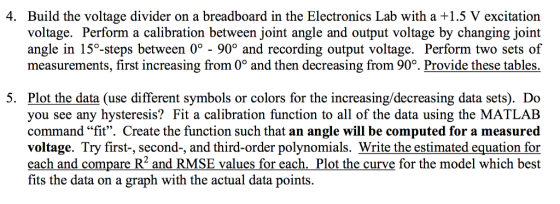
 Table (1)
Homework Answers
The code for plotting the data is
angle=[0:15:90];%means angle starts from 0,
increments by 15 until angle is 90
inc=[0.35 0.37 0.385 0.55 0.82 0.91 0.95];
dec=[0.35 0.39 0.4 0.45 0.54 0.88 0.96];
plot(angle,inc,'r',angle,dec,'g'); %plot angle on x axis and inc on
y axis with red color and dec with green
color
The plot looks like
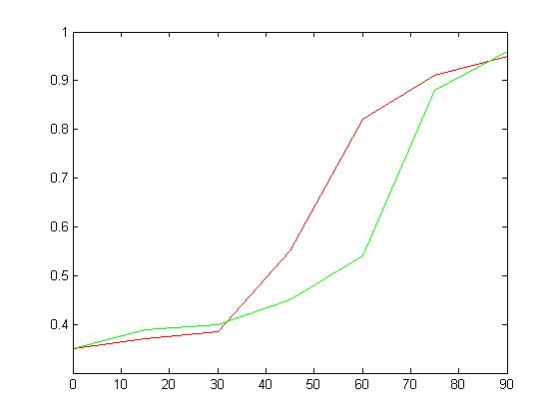
As you can see in the graph, there is hysterisis. Hysterisis means the forward and reverse path are not the same and the direction in which the values are changing (inc or dec) also effects the quantity.
To fit the curves properly, use "cftool" command in matlab and you can try fitting it to different functions, This opens a graphical window where you can see the fitted curves and it is really interesting.
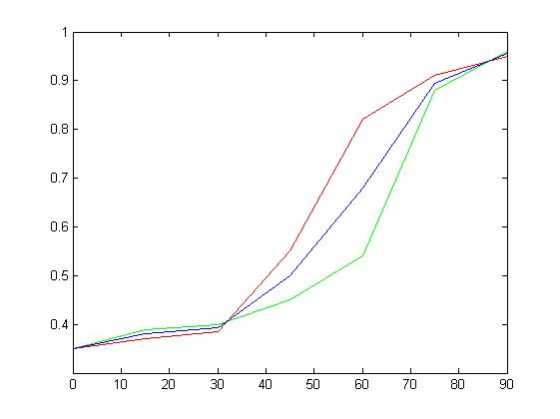
We will use the avg of both inc and dec to fit into a function
Code:
angle=[0:15:90];%means angle starts from 0,
increments by 15 until angle is 90
inc=[0.35 0.37 0.385 0.55 0.82 0.91 0.95];
dec=[0.35 0.39 0.4 0.45 0.54 0.88 0.96];
avg=(inc+dec)/2
plot(angle,inc,'r',angle,dec,'g',angle,avg,'b');
Now the blue line shows the average of inc and dec
now type the command "cftool" to open the cftool
select x and y variables as angle and avg respectively. and choose different fitting functions
All the data required is present in the screenshots
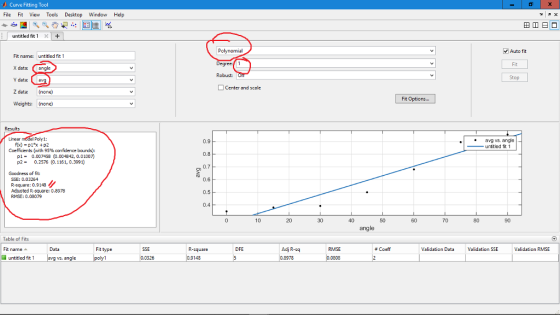
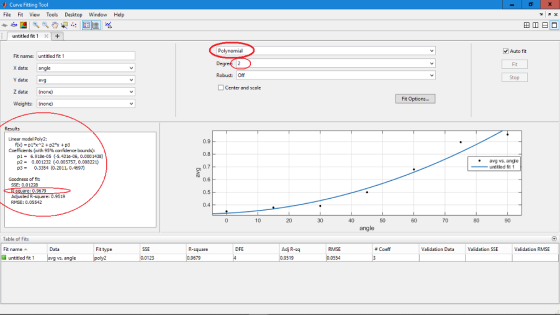
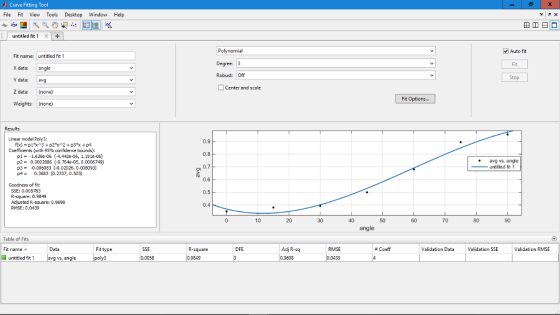
All the requested data is present in the screen shots.
Please consider giving a thumbs up
Add Answer to:
Hello, I have a lab that we have used bending sense in
our hand joint and...
Hello everyone, I have this lab that I am working on and because of the COV-19...
Hello everyone, I have this lab that I am working on and because of the COV-19 my college is now online. It is very hard to ask my professor questions and understand them. Is there anyone that could help me answer these questions please. Thank you! Suppose there was a bubble in the absorbance well when you collected data for the Beers Law Plot. This bubble blocked 5% of the light. How would your calibration be affected? Also when doing...
Hi I need help plotting this graph from my thin lenses lab. They want me to...
Hi I need help plotting this graph from my thin lenses lab. They want me to pick two sets of points from my data. The first set will become p1 and q1 and the second set will become p2 and q2. Plot q1 and p1, and q2 and p2 on the same graph. (Hint: select values of p1 and p2 such that the difference between them is at least 30cm.) I'm using this to find the the intersection of the...
I need help in MATLAB. I'm working on a circuits lab report and I want to...
I need help in MATLAB. I'm working on a circuits lab report and I want to plot the derivative of an input signal. The circuit is a differentiator OpAmp. It is receiving a triangle wave as an input and should output a square wave. (I've included my existing code.) The output formula is: Vout = -(Rf)*C*(dVin/dt) Where Rf is feedback resistance: Rf = 1*10^6; and C = 1*10^-6. EXISTING CODE: %% This section is copied, and then modified from another...
I need help with parts A B D E and F. Please show hand work for...
 I need help with parts A B D E and F. Please show hand work
for solving A and B while D and E should be matlab codes. How do i
pick the right graph for part F?
5 2 4 6 Linear spline: s fi+ (x-x) 2) Given the points 40 78 125 256 348 425 X1-x a) Write the correct linear spline equation to interpolate for x 4.72, simplifying where appropriate to get to the slope-intercept form. (4...
I need help with parts A B D E and F. Please show hand work
for solving A and B while D and E should be matlab codes. How do i
pick the right graph for part F?
5 2 4 6 Linear spline: s fi+ (x-x) 2) Given the points 40 78 125 256 348 425 X1-x a) Write the correct linear spline equation to interpolate for x 4.72, simplifying where appropriate to get to the slope-intercept form. (4...
please I need help with excel or matlab part. part 3 Lab 1 BASIC DATA PROCESSING...
 please I need help with excel or matlab part. part 3
Lab 1 BASIC DATA PROCESSING PRE-LAB ASSIGNMENT 1. Read the lab manual carefully so you know what you have to do when you walk into the lab. 2. In a lab, the resistance of a resistor was measured using 50 samples giving the following values: 119.95 (6), 121.32 (5), 119.57 (7), 117.43(1), 120.76 (15), 120.67 (1), 119.78 (8), 121.43(3), 121.82(1), and 118.47 (3) 2 Estimate the average value of...
please I need help with excel or matlab part. part 3
Lab 1 BASIC DATA PROCESSING PRE-LAB ASSIGNMENT 1. Read the lab manual carefully so you know what you have to do when you walk into the lab. 2. In a lab, the resistance of a resistor was measured using 50 samples giving the following values: 119.95 (6), 121.32 (5), 119.57 (7), 117.43(1), 120.76 (15), 120.67 (1), 119.78 (8), 121.43(3), 121.82(1), and 118.47 (3) 2 Estimate the average value of...
I need help for numbers 1 and 3. For number one I measured the height of...
 I need help for numbers 1 and 3. For number one I
measured the height of the track at angle. One of the heights was
.082m. hypotenuse 1.013m. I did sin^-1(.082/1.013) and got 4.64
degrees. I used a sensor and aquired data for change in v and t as
a glider fell down the track. I calculated the acceleration at that
height and angle as -10.18 m/s^2. final V was 1.48, initial V .687.
final t=.0675, initial t= .1454.
For...
I need help for numbers 1 and 3. For number one I
measured the height of the track at angle. One of the heights was
.082m. hypotenuse 1.013m. I did sin^-1(.082/1.013) and got 4.64
degrees. I used a sensor and aquired data for change in v and t as
a glider fell down the track. I calculated the acceleration at that
height and angle as -10.18 m/s^2. final V was 1.48, initial V .687.
final t=.0675, initial t= .1454.
For...
MATLAB HELP I need help generating random age(x) and average systolic blood pressure(y) values or data similar to the table below in matlab. i need 75 reading or data points for both and plot of age(x...
 MATLAB HELP
I need help generating random age(x) and average systolic blood
pressure(y) values or data similar to the table below in matlab. i
need 75 reading or data points for both and plot of age(x) against
blood pressure(y). The age should be a number e.g 1, 22, 13,... and
not 15 to 90, 20-24 like the chart shows for easy plotting. also
the age and blood pressure show be in increasing order like the
table below. Please attach matlab...
MATLAB HELP
I need help generating random age(x) and average systolic blood
pressure(y) values or data similar to the table below in matlab. i
need 75 reading or data points for both and plot of age(x) against
blood pressure(y). The age should be a number e.g 1, 22, 13,... and
not 15 to 90, 20-24 like the chart shows for easy plotting. also
the age and blood pressure show be in increasing order like the
table below. Please attach matlab...
I need help for this problem ! I have no time plz help me ~ It's from introduction to categorical data analysis chapter 5, exercise 9 5.9 Problem 4.1 with Table 4.8 used a labeling index (LI) to p...
 I need help for this problem ! I have no time plz help me ~ It's
from introduction to categorical data analysis chapter 5, exercise
9
5.9 Problem 4.1 with Table 4.8 used a labeling index (LI) to predict r -the probability of remission in cancer patients. a. When the data for the 27 subjects are 14 binomial observations (for the 14 distinct levels of LI), the deviance for this model is 15.7 with df 12. Is it appropriate to...
I need help for this problem ! I have no time plz help me ~ It's
from introduction to categorical data analysis chapter 5, exercise
9
5.9 Problem 4.1 with Table 4.8 used a labeling index (LI) to predict r -the probability of remission in cancer patients. a. When the data for the 27 subjects are 14 binomial observations (for the 14 distinct levels of LI), the deviance for this model is 15.7 with df 12. Is it appropriate to...
I need a help with my lab, I write all data that get. 355 SERIES SINUSOIDAL...
 I need a help with my lab, I write all data that get.
355 SERIES SINUSOIDAL CIRCU CUITS neeseed 000 10 mH 10 kHz + R E-8V(Pp) V 1 kn Channel 2 Vert: 1 Vidiv Hor: 20 us/div. Channel 1 Vert: 1 Vidiv Hor: 20 us/div. FIG. 9.1 (b) After setting E to 8 V (p-p), determine the peak-to-peak voltage for Ve from chan- nel 2 and record in the top row of Table 9.1 Determine the phase angle 8,...
I need a help with my lab, I write all data that get.
355 SERIES SINUSOIDAL CIRCU CUITS neeseed 000 10 mH 10 kHz + R E-8V(Pp) V 1 kn Channel 2 Vert: 1 Vidiv Hor: 20 us/div. Channel 1 Vert: 1 Vidiv Hor: 20 us/div. FIG. 9.1 (b) After setting E to 8 V (p-p), determine the peak-to-peak voltage for Ve from chan- nel 2 and record in the top row of Table 9.1 Determine the phase angle 8,...
A group of physics students collected data from a test of the projectile motion problem that...
 A group of physics students collected data from a test of the projectile motion problem that was analyzed in a previous lab exercise (L5). In their test, the students varied the angle and initial velocity Vo at which the projectile was launched, and then measured the resulting time of flight (tright). Note that tright was the dependent variable, while and Vo were independent variables. The results are listed below. (degrees) Time of Flight (s) Initial Velocity V. (m/s) 15 20...
 I need help with parts A B D E and F. Please show hand work
for solving A and B while D and E should be matlab codes. How do i
pick the right graph for part F?
5 2 4 6 Linear spline: s fi+ (x-x) 2) Given the points 40 78 125 256 348 425 X1-x a) Write the correct linear spline equation to interpolate for x 4.72, simplifying where appropriate to get to the slope-intercept form. (4...
I need help with parts A B D E and F. Please show hand work
for solving A and B while D and E should be matlab codes. How do i
pick the right graph for part F?
5 2 4 6 Linear spline: s fi+ (x-x) 2) Given the points 40 78 125 256 348 425 X1-x a) Write the correct linear spline equation to interpolate for x 4.72, simplifying where appropriate to get to the slope-intercept form. (4...
 please I need help with excel or matlab part. part 3
Lab 1 BASIC DATA PROCESSING PRE-LAB ASSIGNMENT 1. Read the lab manual carefully so you know what you have to do when you walk into the lab. 2. In a lab, the resistance of a resistor was measured using 50 samples giving the following values: 119.95 (6), 121.32 (5), 119.57 (7), 117.43(1), 120.76 (15), 120.67 (1), 119.78 (8), 121.43(3), 121.82(1), and 118.47 (3) 2 Estimate the average value of...
please I need help with excel or matlab part. part 3
Lab 1 BASIC DATA PROCESSING PRE-LAB ASSIGNMENT 1. Read the lab manual carefully so you know what you have to do when you walk into the lab. 2. In a lab, the resistance of a resistor was measured using 50 samples giving the following values: 119.95 (6), 121.32 (5), 119.57 (7), 117.43(1), 120.76 (15), 120.67 (1), 119.78 (8), 121.43(3), 121.82(1), and 118.47 (3) 2 Estimate the average value of...
 I need help for numbers 1 and 3. For number one I
measured the height of the track at angle. One of the heights was
.082m. hypotenuse 1.013m. I did sin^-1(.082/1.013) and got 4.64
degrees. I used a sensor and aquired data for change in v and t as
a glider fell down the track. I calculated the acceleration at that
height and angle as -10.18 m/s^2. final V was 1.48, initial V .687.
final t=.0675, initial t= .1454.
For...
I need help for numbers 1 and 3. For number one I
measured the height of the track at angle. One of the heights was
.082m. hypotenuse 1.013m. I did sin^-1(.082/1.013) and got 4.64
degrees. I used a sensor and aquired data for change in v and t as
a glider fell down the track. I calculated the acceleration at that
height and angle as -10.18 m/s^2. final V was 1.48, initial V .687.
final t=.0675, initial t= .1454.
For...
 MATLAB HELP
I need help generating random age(x) and average systolic blood
pressure(y) values or data similar to the table below in matlab. i
need 75 reading or data points for both and plot of age(x) against
blood pressure(y). The age should be a number e.g 1, 22, 13,... and
not 15 to 90, 20-24 like the chart shows for easy plotting. also
the age and blood pressure show be in increasing order like the
table below. Please attach matlab...
MATLAB HELP
I need help generating random age(x) and average systolic blood
pressure(y) values or data similar to the table below in matlab. i
need 75 reading or data points for both and plot of age(x) against
blood pressure(y). The age should be a number e.g 1, 22, 13,... and
not 15 to 90, 20-24 like the chart shows for easy plotting. also
the age and blood pressure show be in increasing order like the
table below. Please attach matlab...
 I need help for this problem ! I have no time plz help me ~ It's
from introduction to categorical data analysis chapter 5, exercise
9
5.9 Problem 4.1 with Table 4.8 used a labeling index (LI) to predict r -the probability of remission in cancer patients. a. When the data for the 27 subjects are 14 binomial observations (for the 14 distinct levels of LI), the deviance for this model is 15.7 with df 12. Is it appropriate to...
I need help for this problem ! I have no time plz help me ~ It's
from introduction to categorical data analysis chapter 5, exercise
9
5.9 Problem 4.1 with Table 4.8 used a labeling index (LI) to predict r -the probability of remission in cancer patients. a. When the data for the 27 subjects are 14 binomial observations (for the 14 distinct levels of LI), the deviance for this model is 15.7 with df 12. Is it appropriate to...
 I need a help with my lab, I write all data that get.
355 SERIES SINUSOIDAL CIRCU CUITS neeseed 000 10 mH 10 kHz + R E-8V(Pp) V 1 kn Channel 2 Vert: 1 Vidiv Hor: 20 us/div. Channel 1 Vert: 1 Vidiv Hor: 20 us/div. FIG. 9.1 (b) After setting E to 8 V (p-p), determine the peak-to-peak voltage for Ve from chan- nel 2 and record in the top row of Table 9.1 Determine the phase angle 8,...
I need a help with my lab, I write all data that get.
355 SERIES SINUSOIDAL CIRCU CUITS neeseed 000 10 mH 10 kHz + R E-8V(Pp) V 1 kn Channel 2 Vert: 1 Vidiv Hor: 20 us/div. Channel 1 Vert: 1 Vidiv Hor: 20 us/div. FIG. 9.1 (b) After setting E to 8 V (p-p), determine the peak-to-peak voltage for Ve from chan- nel 2 and record in the top row of Table 9.1 Determine the phase angle 8,...
 A group of physics students collected data from a test of the projectile motion problem that was analyzed in a previous lab exercise (L5). In their test, the students varied the angle and initial velocity Vo at which the projectile was launched, and then measured the resulting time of flight (tright). Note that tright was the dependent variable, while and Vo were independent variables. The results are listed below. (degrees) Time of Flight (s) Initial Velocity V. (m/s) 15 20...
Most questions answered within 3 hours.
-
Where is the error in this code sequence?
String s1 = "Hello";
String s2 = "ello";...
asked 10 months ago -
Financial data for Joel de Paris, Inc., for last year
follow:
Joel de Paris, Inc.
Balance...
asked 10 months ago -
Consider this reaction:
Al2(SO4)3 (aq)+ BaCl3
(aq) Al2Cl6 (aq)- +
3BaSO4(s) . What is the...
asked 10 months ago -
Suppose that Savneet is considering increasing her
recent random sample from 20 car rentals to 40...
asked 10 months ago -
Trucks arrive at an unloading terminal at an average rate of 120
per hour.
Trucks arrive...
asked 10 months ago -
Why are methanol and ethanol completely soluble in water while
octanol is not very little soluble....
asked 10 months ago -
A facilities manager at a university reads in a research report
that the mean amount of...
asked 10 months ago -
When the CuSO4 is rehydrated by adding water to the anhydrous
compound, is this an endothermic...
asked 10 months ago -
A ray of sunlight is passing from diamond into crown glass; the
angle of incidence is...
asked 10 months ago -
A block of mass 0.249 kg is placed on top of a light, vertical
spring of...
asked 10 months ago -
how do the kidneys compensate in the presences of acidosis
a) trigger hyperventilate
b) reserve acid...
asked 10 months ago -
Question 501 pts
The rental rate of capital to the firm increases. Which of the
following...
asked 10 months ago