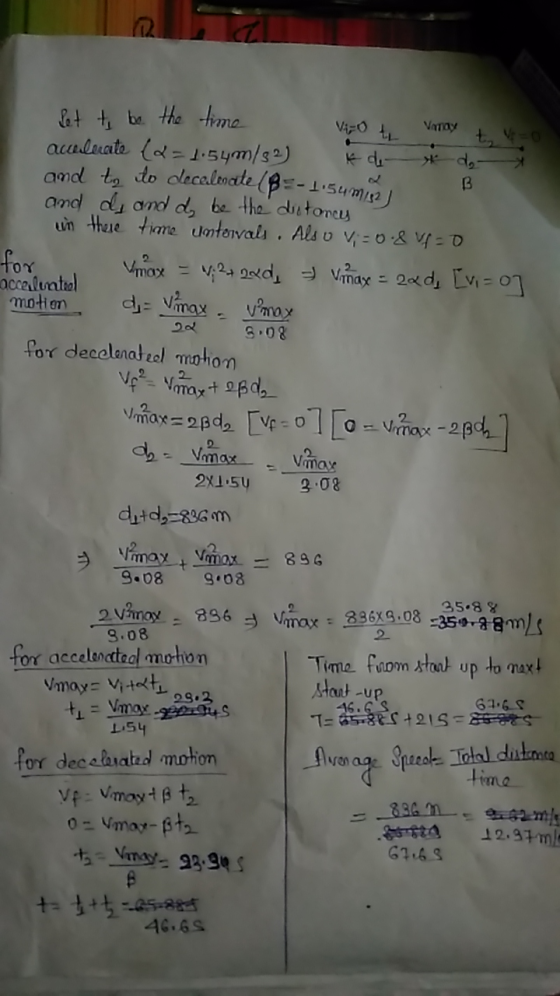
(a) If the maximum acceleration that is tolerable for passengers in a subway train is 1.54...
(a) If the maximum acceleration that is tolerable for passengers in a subway train is 1.54 m/s2 and subway stations are located 836 m apart, what is the maximum speed a subway train can attain between stations? (b) What is the travel time between stations? (c) If a subway train stops for 21.0 s at each station, what is the maximum average speed of the train, from one start-up to the next?
Homework Answers
Add Answer to:
(a) If the maximum acceleration that is tolerable for passengers
in a subway train is 1.54...
A subway train starts from rest at a station and accelerates at a rate of 1.60 m/s2 for 10.0 s
A subway train starts from rest at a station and accelerates at a rate of 1.60 m/s2 for 10.0 s. It runs at a constant speed for 50.0 s and slows down at a rate of 3.20 m/s2 until it stops at the next station. How far apart are the two subway stations? A 40 m B 80 m C 800 m D 920 m E None of the above.
1. A subway train travels between two of its station stops with the acceleration schedule shown....
 1. A subway train travels between two of its station stops with the acceleration schedule shown. a, m/s2 a) Determine the time interval At during which the train brakes to a stop. (6 points) 1.5 0.8 10 14 18 At -2 V, m/s b) Sketch the v - t graph for its motion between the two stops. (8 points) c) Determine the distance s between the two stations. (6 points)
A subway trauma accelerates from rest at one station at a rate of 1.2 m/s^2 for...
A subway trauma accelerates from rest at one station at a rate of 1.2 m/s^2 for half of the distance to the next station, then decelerates at this same rat for the final half. If the stations are 1100 m apart, find: a. The time of travel between stations b. the maximum speed of the train.
Problem 5: The greatest possible acceleration or deceleration that a train may have is a and...
 Problem 5: The greatest possible acceleration or deceleration that a train may have is a and its maximum speed is v. Find the minimum time in which the train can get from one station to the next if the total distance between the stations is s. Assume the train starts from the first station at rest and stops when it reaches the next station.
A light-rail train going from one station to the next on a straight section of track...
A light-rail train going from one station to the next on a straight section of track accelerates from rest at 1.20 m/s2 for 12.6 s . It then proceeds at constant speed for 1300 m before slowing down at 2.00 m/s2 until it stops at the station. What maximum velocity does the train achieve after leaving the station? What is the distance between the stations? How much time does it take the train to go between the stations?
A subway train starts from rest at a station and accelerates at a rate of 1.95...
A subway train starts from rest at a station and accelerates at a rate of 1.95 m/s2 for 15.0 s. It runs at constant speed for 74.0 s and slows down at a rate of 3.20 m/s2 until it stops at the next station. Find the total distance covered. 2.51 km 2.52 km 2.53 km 2.56 km
A high-speed bullet train accelerates and decelerates at the rate of 10 ft/s2.
A high-speed bullet train accelerates and decelerates at the rate of 10 ft/s2. Its maximum crusing speed is 120 mi/h.(a) What is the maximum distance the train can travel if it accelerates from rest until it reaches its cruising speed and then runs at that speed for 15 minutes? (b) Suppose that the train starts from rest and must come to a complete stop in 15 minutes. What the maximum d istance it can travel under these conditions? (c) Find the minimum...
. Movement of a train. A train starts from a station A and has a constant...
. Movement of a train. A train starts from a station A and has a constant acceleration of 0.4 for 2 minutes.for the next 75 seconds it continues with constant speed, and finally applies the brakes until it stops at station B due to a deceleration of 0. 8 m / s2. (a) Calculate the distance between stations A and B. (b) Prepare the graphs Position (x) - time (1), speed (v) - time (() and acceleration (a) - time...
In the design of a rapid transit system, it is necessary to balance the average speed...
In the design of a rapid transit system, it is necessary to balance the average speed of a train against the distance between stops. The more stops there are, the slower the train's average speed. To get an idea of this problem, calculate the time it takes a train to make a 7.0 km trip in two situations. (Assume that at each station the train accelerates at a rate of 1.1 m/s2 until it reaches 95 km/h , then stays...
rw n8.00-09:15 - HY 2053 Test #1 2019-01-30 1. A subway train starts from rest at...
 rw n8.00-09:15 - HY 2053 Test #1 2019-01-30 1. A subway train starts from rest at a stat ion and accelerates at a constant acceleration of a 2.85 m/2 for 22.3 s. It then travels at a constant speed for 62.0 s and th at a constant acceleration o f a2 = 3.75 A until it stops at the next station. Find the total distance covered by the subway train for this trip
 1. A subway train travels between two of its station stops with the acceleration schedule shown. a, m/s2 a) Determine the time interval At during which the train brakes to a stop. (6 points) 1.5 0.8 10 14 18 At -2 V, m/s b) Sketch the v - t graph for its motion between the two stops. (8 points) c) Determine the distance s between the two stations. (6 points)
 Problem 5: The greatest possible acceleration or deceleration that a train may have is a and its maximum speed is v. Find the minimum time in which the train can get from one station to the next if the total distance between the stations is s. Assume the train starts from the first station at rest and stops when it reaches the next station.
 rw n8.00-09:15 - HY 2053 Test #1 2019-01-30 1. A subway train starts from rest at a stat ion and accelerates at a constant acceleration of a 2.85 m/2 for 22.3 s. It then travels at a constant speed for 62.0 s and th at a constant acceleration o f a2 = 3.75 A until it stops at the next station. Find the total distance covered by the subway train for this trip
Most questions answered within 3 hours.
-
Where is the error in this code sequence?
String s1 = "Hello";
String s2 = "ello";...
asked 10 months ago -
Financial data for Joel de Paris, Inc., for last year
follow:
Joel de Paris, Inc.
Balance...
asked 10 months ago -
Consider this reaction:
Al2(SO4)3 (aq)+ BaCl3
(aq) Al2Cl6 (aq)- +
3BaSO4(s) . What is the...
asked 10 months ago -
Suppose that Savneet is considering increasing her
recent random sample from 20 car rentals to 40...
asked 10 months ago -
Trucks arrive at an unloading terminal at an average rate of 120
per hour.
Trucks arrive...
asked 10 months ago -
Why are methanol and ethanol completely soluble in water while
octanol is not very little soluble....
asked 10 months ago -
A facilities manager at a university reads in a research report
that the mean amount of...
asked 10 months ago -
When the CuSO4 is rehydrated by adding water to the anhydrous
compound, is this an endothermic...
asked 10 months ago -
A ray of sunlight is passing from diamond into crown glass; the
angle of incidence is...
asked 10 months ago -
A block of mass 0.249 kg is placed on top of a light, vertical
spring of...
asked 10 months ago -
how do the kidneys compensate in the presences of acidosis
a) trigger hyperventilate
b) reserve acid...
asked 10 months ago -
Question 501 pts
The rental rate of capital to the firm increases. Which of the
following...
asked 10 months ago