In the design of a rapid transit system, it is necessary to balance the average speed...
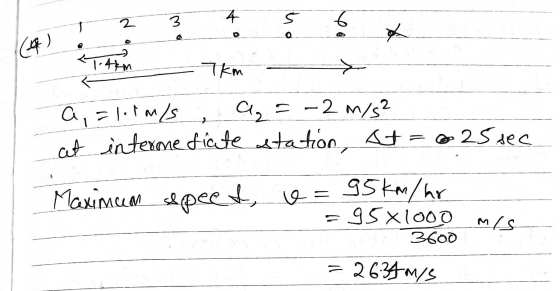
In the design of a rapid transit system, it is necessary to balance the average speed of a train against the distance between stops. The more stops there are, the slower the train's average speed. To get an idea of this problem, calculate the time it takes a train to make a 7.0 km trip in two situations. (Assume that at each station the train accelerates at a rate of 1.1 m/s2 until it reaches 95 km/h , then stays at this speed until its brakes are applied for arrival at the next station, at which time it decelerates at -2.0 m/s2 . Assume it stops at each intermediate station for 25.0 s .)
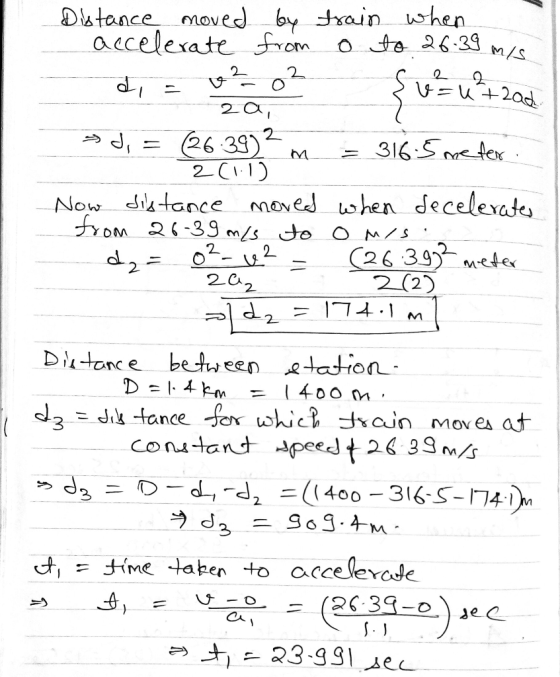
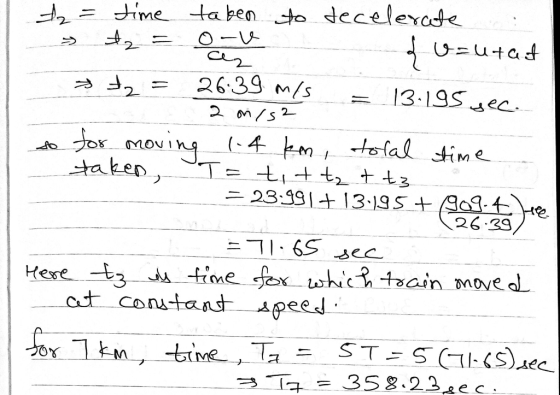
Part A: Calculate the time it takes a train to make a 7.0 km trip if the stations at which the trains must stop are 1.4 km apart (a total of 6 stations, including those at the ends).
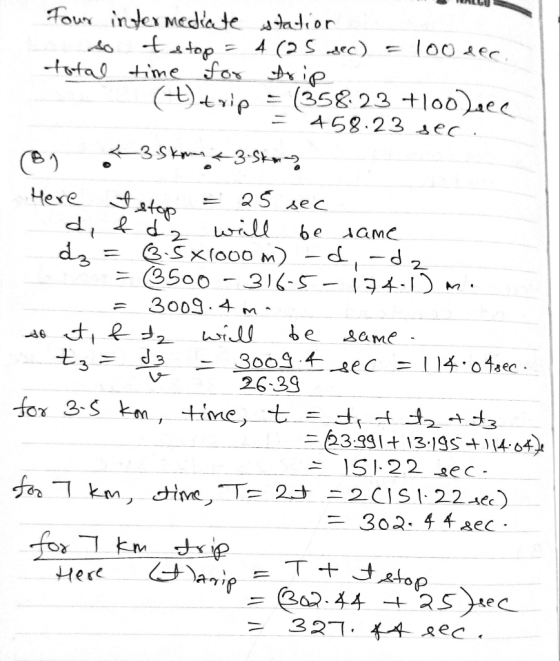
Part B: Calculate the time it takes a train to make a 7.0 km trip if the stations are 3.5 km apart (3 stations total).
Homework Answers
Here we apply concept of kinematics and equation of motion for constant acceleration.
Add Answer to:
In the design of a rapid transit system, it is
necessary to balance the average speed...
A high-speed bullet train accelerates and decelerates at the rate of 10 ft/s2.
A high-speed bullet train accelerates and decelerates at the rate of 10 ft/s2. Its maximum crusing speed is 120 mi/h.(a) What is the maximum distance the train can travel if it accelerates from rest until it reaches its cruising speed and then runs at that speed for 15 minutes? (b) Suppose that the train starts from rest and must come to a complete stop in 15 minutes. What the maximum d istance it can travel under these conditions? (c) Find the minimum...
The diagram below shows the speed time graph for a train travelling between two stations
The diagram below shows the speed time graph for a train travelling between two stations. The train starts from rest and accelerates uniformly for 150 seconds. It then travels at a constant speed for 300 seconds and finally decelerates uniformly for 200 seconds. Fig.Given that the distance between the two stations is 10 450m, calculate the:(a) maximum speed, in km/h, the train attained;(b) acceleration;(c) distance the train traveled during the last 100 seconds(d) time the train takes to travel the...
. Movement of a train. A train starts from a station A and has a constant...
. Movement of a train. A train starts from a station A and has a constant acceleration of 0.4 for 2 minutes.for the next 75 seconds it continues with constant speed, and finally applies the brakes until it stops at station B due to a deceleration of 0. 8 m / s2. (a) Calculate the distance between stations A and B. (b) Prepare the graphs Position (x) - time (1), speed (v) - time (() and acceleration (a) - time...
A light-rail train going from one station to the next on a straight section of track...
A light-rail train going from one station to the next on a straight section of track accelerates from rest at 1.20 m/s2 for 12.6 s . It then proceeds at constant speed for 1300 m before slowing down at 2.00 m/s2 until it stops at the station. What maximum velocity does the train achieve after leaving the station? What is the distance between the stations? How much time does it take the train to go between the stations?
A subway train starts from rest at a station and accelerates at a rate of 1.60 m/s2 for 10.0 s
A subway train starts from rest at a station and accelerates at a rate of 1.60 m/s2 for 10.0 s. It runs at a constant speed for 50.0 s and slows down at a rate of 3.20 m/s2 until it stops at the next station. How far apart are the two subway stations? A 40 m B 80 m C 800 m D 920 m E None of the above.
(a) If the maximum acceleration that is tolerable for passengers in a subway train is 1.54...
(a) If the maximum acceleration that is tolerable for passengers in a subway train is 1.54 m/s2 and subway stations are located 836 m apart, what is the maximum speed a subway train can attain between stations? (b) What is the travel time between stations? (c) If a subway train stops for 21.0 s at each station, what is the maximum average speed of the train, from one start-up to the next?
what is the maximum speed attained? what fraction of the total distance is traveled at constant...
 what is the maximum speed attained?
what fraction of the total distance is traveled at
constant speed?
what total time is required for the trip?
Constants Par A spaceship ferrying workers to Moon Base I takes a straight-line path from the earth to the moon, a distance of 384000 km. Suppose it accelerates at an acceleration 19.9 m/s for the first time interval 14.7 min of the trip, then travels at constant speed until the last time interval 14.7 min,...
what is the maximum speed attained?
what fraction of the total distance is traveled at
constant speed?
what total time is required for the trip?
Constants Par A spaceship ferrying workers to Moon Base I takes a straight-line path from the earth to the moon, a distance of 384000 km. Suppose it accelerates at an acceleration 19.9 m/s for the first time interval 14.7 min of the trip, then travels at constant speed until the last time interval 14.7 min,...
#1 An engineer wants to build a track to test the acceleration of a new vehicle...
#1 An engineer wants to build a track to test the acceleration of a new vehicle to 100mph and back to a complete stop. The vehicle accelerates from rest to 100mph in 5.2s, and when the brakes are engaged, its maximum deceleration is 16m/s2. (a) What is the minimum required length of the track? (b) Plot the velocity vs time of one run where the vehicle accelerates to 100mph and then immediately decelerates to a complete stop. #2. Freight trains...
QUESTION 2 Earthquakes produce several types of shock waves, two of which are called S and...
 QUESTION 2 Earthquakes produce several types of shock waves, two of which are called S and P waves. P waves travel at about 6.5 km/s, and S waves travel at about 3.5 km/s. The delay in arrival times between P waves and S waves provides from the measurement station. If a station records a delay of 33 s, how far from the station was the earthquake (ín kilometers? Use two significant figures in your answer. information about how far away...
A car travels in a straight line a distance of 8.4 km at an average speed...
A car travels in a straight line a distance of 8.4 km at an average speed of 70 km / h before stopping due to lack of fuel. Following this stop, the driver of this car walks for 30 minutes over a distance of 2.0 km to get to the nearest gas station. at. What is the total distance the driver has traveled between the beginning of the journey of her car and until he arrives at the gas station?...
 what is the maximum speed attained?
what fraction of the total distance is traveled at
constant speed?
what total time is required for the trip?
Constants Par A spaceship ferrying workers to Moon Base I takes a straight-line path from the earth to the moon, a distance of 384000 km. Suppose it accelerates at an acceleration 19.9 m/s for the first time interval 14.7 min of the trip, then travels at constant speed until the last time interval 14.7 min,...
what is the maximum speed attained?
what fraction of the total distance is traveled at
constant speed?
what total time is required for the trip?
Constants Par A spaceship ferrying workers to Moon Base I takes a straight-line path from the earth to the moon, a distance of 384000 km. Suppose it accelerates at an acceleration 19.9 m/s for the first time interval 14.7 min of the trip, then travels at constant speed until the last time interval 14.7 min,...
 QUESTION 2 Earthquakes produce several types of shock waves, two of which are called S and P waves. P waves travel at about 6.5 km/s, and S waves travel at about 3.5 km/s. The delay in arrival times between P waves and S waves provides from the measurement station. If a station records a delay of 33 s, how far from the station was the earthquake (ín kilometers? Use two significant figures in your answer. information about how far away...
Most questions answered within 3 hours.
-
Where is the error in this code sequence?
String s1 = "Hello";
String s2 = "ello";...
asked 11 months ago -
Financial data for Joel de Paris, Inc., for last year
follow:
Joel de Paris, Inc.
Balance...
asked 11 months ago -
Consider this reaction:
Al2(SO4)3 (aq)+ BaCl3
(aq) Al2Cl6 (aq)- +
3BaSO4(s) . What is the...
asked 11 months ago -
Suppose that Savneet is considering increasing her
recent random sample from 20 car rentals to 40...
asked 11 months ago -
Trucks arrive at an unloading terminal at an average rate of 120
per hour.
Trucks arrive...
asked 11 months ago -
Why are methanol and ethanol completely soluble in water while
octanol is not very little soluble....
asked 11 months ago -
A facilities manager at a university reads in a research report
that the mean amount of...
asked 11 months ago -
When the CuSO4 is rehydrated by adding water to the anhydrous
compound, is this an endothermic...
asked 11 months ago -
A ray of sunlight is passing from diamond into crown glass; the
angle of incidence is...
asked 11 months ago -
A block of mass 0.249 kg is placed on top of a light, vertical
spring of...
asked 11 months ago -
how do the kidneys compensate in the presences of acidosis
a) trigger hyperventilate
b) reserve acid...
asked 11 months ago -
Question 501 pts
The rental rate of capital to the firm increases. Which of the
following...
asked 11 months ago