An elevator mas is to be designed so that the maximum acceleration is 0.0680g what are...
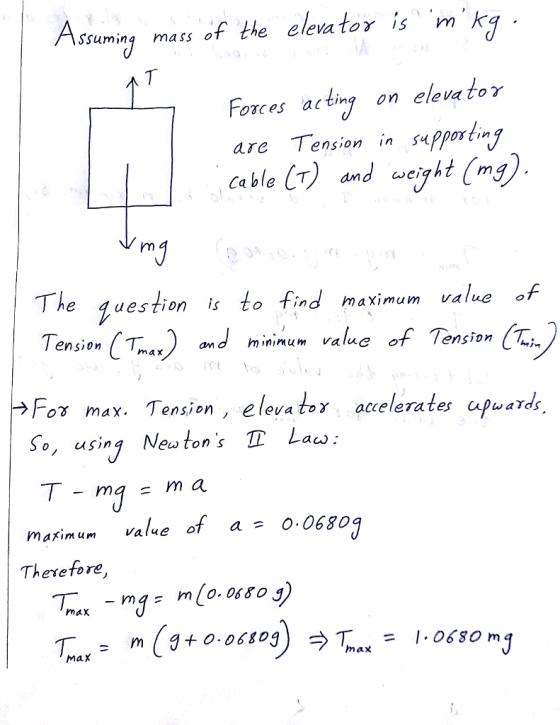
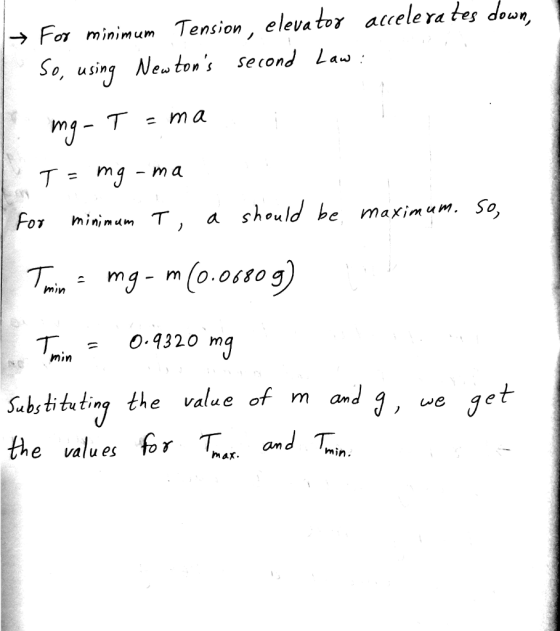
An elevator mas is to be designed so that the maximum acceleration is 0.0680g what are the maximum and minimum forces the motor should exert on the supporting cable?
Homework Answers
Add Answer to:
An elevator mas is to be designed so that the maximum
acceleration is 0.0680g what are...
An elevator (mass 4750 kg ) is to be designed so that the maximum acceleration is...
An elevator (mass 4750 kg ) is to be designed so that the maximum acceleration is 0.0660 g . What is the maximum force the motor should exert on the supporting cable? What is the minimum force the motor should exert on the supporting cable?
An elevator (mass 4650 kg ) is to be designed so that the maximum acceleration is...
 An elevator (mass 4650 kg ) is to be designed so that the maximum acceleration is 0.0680 9. Part A What is the maximum force the motor should exert on the supporting cable? 0 AS¢* * 2 ? Submit Request Answer Part B What is the minimum force the motor should exert on the supporting cable? IV ALQ * 0 2 ? (Ft) min =
The cable supporting a 2145-kg elevator has a maximum strength of 2.18×10⁴ N. a) What maximum...
The cable supporting a 2145-kg elevator has a maximum strength of 2.18×10⁴ N. a) What maximum upward acceleration can it give the elevator without breaking?
An elevator is pulled upward so it moves with increasing upward speed?the force exerted by the...
 An elevator is pulled upward so it moves with increasing upward
speed?the force exerted by the cable on the elevator is constant
and greater than the downward gravitational force exerted by Earth.
When the elevator is moving up medium-fast, the force exerted by
the cable on the elevator changes abruptly to just balance the
downward gravitational force of Earth?the sum of the forces that
the cable and Earth exert on the elevator is now zero.
An elevator is pulled upward so it moves with increasing upward
speed?the force exerted by the cable on the elevator is constant
and greater than the downward gravitational force exerted by Earth.
When the elevator is moving up medium-fast, the force exerted by
the cable on the elevator changes abruptly to just balance the
downward gravitational force of Earth?the sum of the forces that
the cable and Earth exert on the elevator is now zero.
A laboratory freight elevator, including its load, has a mass of 500 kg. It is prevented...
 A laboratory freight elevator,
including its load, has a mass of 500 kg. It is prevented from
rotating by the track and wheels mounted along its sides. The
elevator is used to carry highly sensitive equipment so it cannot
exceed an acceleration of 3 m/s2 . A geared motor is used with the
cable/pulley system shown below to raise and lower the elevator.
The motor turns gear A with a constant angular acceleration, αA.
The gears of the motor have...
A laboratory freight elevator,
including its load, has a mass of 500 kg. It is prevented from
rotating by the track and wheels mounted along its sides. The
elevator is used to carry highly sensitive equipment so it cannot
exceed an acceleration of 3 m/s2 . A geared motor is used with the
cable/pulley system shown below to raise and lower the elevator.
The motor turns gear A with a constant angular acceleration, αA.
The gears of the motor have...
One kind of elevator has the elevator car hanging from a cable, which then passes over...
 One kind of elevator has the elevator car hanging from a cable,
which then passes over a pulley and connects to a counterweight, as
shown in (Figure 1). The mass of a fully-loaded elevator (that is,
the elevator and all its passengers) is 1850 kg , the mass of the
counterweight is 1500 kg , and the pulley has a radius of 0.4 m
and a mass of 400 kg . A motor drives the motion of the elevator by...
One kind of elevator has the elevator car hanging from a cable,
which then passes over a pulley and connects to a counterweight, as
shown in (Figure 1). The mass of a fully-loaded elevator (that is,
the elevator and all its passengers) is 1850 kg , the mass of the
counterweight is 1500 kg , and the pulley has a radius of 0.4 m
and a mass of 400 kg . A motor drives the motion of the elevator by...
Consider applying Newton’s second law to a man riding an elevator (perhaps to calculate his acceleration)....
 Consider applying Newton’s second law to a man riding an elevator
(perhaps to calculate his acceleration).
Which of the following forces must be considered? Choose all that apply. The force that the man's head exerts on his neck The force that the man's feet exert on the floor of the elevator The force of gravity on the man The force that the elevator floor exerts on the man's feet The force the elevator cable exerts on the elevator car The...
Consider applying Newton’s second law to a man riding an elevator
(perhaps to calculate his acceleration).
Which of the following forces must be considered? Choose all that apply. The force that the man's head exerts on his neck The force that the man's feet exert on the floor of the elevator The force of gravity on the man The force that the elevator floor exerts on the man's feet The force the elevator cable exerts on the elevator car The...
An elevator has mass 600 kg, not including passengers. The elevator is designed to ascend, at...
An elevator has mass 600 kg, not including passengers. The elevator is designed to ascend, at constant speed, a vertical distance of 20.0 m (five floors) in 16.0 s, and it is driven by a motor that can provide up to 40 hp to the elevator. A. What is the maximum number of passengers that can ride in the elevator? Assume that an average passenger has mass 65.0 kg.
An elevator has mass 650 kg , not including passengers. The elevator is designed to ascend,...
An elevator has mass 650 kg , not including passengers. The elevator is designed to ascend, at constant speed, a vertical distance of 21.0 m(five floors) in 16.7 s , and it is driven by a motor that can provide up to 44 hp to the elevator. What is the maximum number of passengers that can ride in the elevator? Assume that an average passenger has mass 65.0 kg.
An elevator has mass 650 kg , not including passengers. The elevator is designed to ascend,...
An elevator has mass 650 kg , not including passengers. The elevator is designed to ascend, at constant speed, a vertical distance of 19.0 m (five floors) in 15.5 s , and it is driven by a motor that can provide up to 44 hp to the elevator. Part A What is the maximum number of passengers that can ride in the elevator? Assume that an average passenger has mass 65.0 kg. Express your answer in integer n = _______
 An elevator (mass 4650 kg ) is to be designed so that the maximum acceleration is 0.0680 9. Part A What is the maximum force the motor should exert on the supporting cable? 0 AS¢* * 2 ? Submit Request Answer Part B What is the minimum force the motor should exert on the supporting cable? IV ALQ * 0 2 ? (Ft) min =
 An elevator is pulled upward so it moves with increasing upward
speed?the force exerted by the cable on the elevator is constant
and greater than the downward gravitational force exerted by Earth.
When the elevator is moving up medium-fast, the force exerted by
the cable on the elevator changes abruptly to just balance the
downward gravitational force of Earth?the sum of the forces that
the cable and Earth exert on the elevator is now zero.
An elevator is pulled upward so it moves with increasing upward
speed?the force exerted by the cable on the elevator is constant
and greater than the downward gravitational force exerted by Earth.
When the elevator is moving up medium-fast, the force exerted by
the cable on the elevator changes abruptly to just balance the
downward gravitational force of Earth?the sum of the forces that
the cable and Earth exert on the elevator is now zero.
 A laboratory freight elevator,
including its load, has a mass of 500 kg. It is prevented from
rotating by the track and wheels mounted along its sides. The
elevator is used to carry highly sensitive equipment so it cannot
exceed an acceleration of 3 m/s2 . A geared motor is used with the
cable/pulley system shown below to raise and lower the elevator.
The motor turns gear A with a constant angular acceleration, αA.
The gears of the motor have...
A laboratory freight elevator,
including its load, has a mass of 500 kg. It is prevented from
rotating by the track and wheels mounted along its sides. The
elevator is used to carry highly sensitive equipment so it cannot
exceed an acceleration of 3 m/s2 . A geared motor is used with the
cable/pulley system shown below to raise and lower the elevator.
The motor turns gear A with a constant angular acceleration, αA.
The gears of the motor have...
 One kind of elevator has the elevator car hanging from a cable,
which then passes over a pulley and connects to a counterweight, as
shown in (Figure 1). The mass of a fully-loaded elevator (that is,
the elevator and all its passengers) is 1850 kg , the mass of the
counterweight is 1500 kg , and the pulley has a radius of 0.4 m
and a mass of 400 kg . A motor drives the motion of the elevator by...
One kind of elevator has the elevator car hanging from a cable,
which then passes over a pulley and connects to a counterweight, as
shown in (Figure 1). The mass of a fully-loaded elevator (that is,
the elevator and all its passengers) is 1850 kg , the mass of the
counterweight is 1500 kg , and the pulley has a radius of 0.4 m
and a mass of 400 kg . A motor drives the motion of the elevator by...
 Consider applying Newton’s second law to a man riding an elevator
(perhaps to calculate his acceleration).
Which of the following forces must be considered? Choose all that apply. The force that the man's head exerts on his neck The force that the man's feet exert on the floor of the elevator The force of gravity on the man The force that the elevator floor exerts on the man's feet The force the elevator cable exerts on the elevator car The...
Consider applying Newton’s second law to a man riding an elevator
(perhaps to calculate his acceleration).
Which of the following forces must be considered? Choose all that apply. The force that the man's head exerts on his neck The force that the man's feet exert on the floor of the elevator The force of gravity on the man The force that the elevator floor exerts on the man's feet The force the elevator cable exerts on the elevator car The...
Most questions answered within 3 hours.
-
Where is the error in this code sequence?
String s1 = "Hello";
String s2 = "ello";...
asked 10 months ago -
Financial data for Joel de Paris, Inc., for last year
follow:
Joel de Paris, Inc.
Balance...
asked 10 months ago -
Consider this reaction:
Al2(SO4)3 (aq)+ BaCl3
(aq) Al2Cl6 (aq)- +
3BaSO4(s) . What is the...
asked 10 months ago -
Suppose that Savneet is considering increasing her
recent random sample from 20 car rentals to 40...
asked 10 months ago -
Trucks arrive at an unloading terminal at an average rate of 120
per hour.
Trucks arrive...
asked 10 months ago -
Why are methanol and ethanol completely soluble in water while
octanol is not very little soluble....
asked 10 months ago -
A facilities manager at a university reads in a research report
that the mean amount of...
asked 10 months ago -
When the CuSO4 is rehydrated by adding water to the anhydrous
compound, is this an endothermic...
asked 10 months ago -
A ray of sunlight is passing from diamond into crown glass; the
angle of incidence is...
asked 10 months ago -
A block of mass 0.249 kg is placed on top of a light, vertical
spring of...
asked 10 months ago -
how do the kidneys compensate in the presences of acidosis
a) trigger hyperventilate
b) reserve acid...
asked 10 months ago -
Question 501 pts
The rental rate of capital to the firm increases. Which of the
following...
asked 10 months ago