Why does a capacitor never fully charge or discharge?
Why does a capacitor never fully charge or discharge?
Homework Answers
Charging of a capacitor is given by equation

and discharging of a capacitor is given by
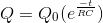
where  and
and  denote charge at any time't' and maximum charge on the
capacitor.
denote charge at any time't' and maximum charge on the
capacitor.
From first equation, we can see that charge becomes maximum when t is equal to infinity. Likewise from second equation, we can see Q becomes zero when t is equal to infinity. Therefore, to completely charge or discharge a capacitor, infinite amount of time is required, hence a capacitor is never fully charged or discharged.
Thought Experiment: Explain what is physically happening to the charge in the RC circuit during charging and discharging cycles (i.e. Why does the capacitor charge/discharge quickly at first but slow...
 Thought Experiment: Explain what is physically happening to the charge in the RC circuit during charging and discharging cycles (i.e. Why does the capacitor charge/discharge quickly at first but slows down with more time? Where is the charge going?). In the DC Electrical Circuits lab, we used the analogy of water flowing through a pipe to visualize Ohm's law can you extend that analogy to the RC circuit? *
Thought Experiment: Explain what is physically happening to the charge in...
Thought Experiment: Explain what is physically happening to the charge in the RC circuit during charging and discharging cycles (i.e. Why does the capacitor charge/discharge quickly at first but slows down with more time? Where is the charge going?). In the DC Electrical Circuits lab, we used the analogy of water flowing through a pipe to visualize Ohm's law can you extend that analogy to the RC circuit? *
Thought Experiment: Explain what is physically happening to the charge in...
21. [2] Look at Figure 30-26 and you will see a capacitor charge and discharge curve...
 21. [2] Look at Figure 30-26 and you will see a capacitor charge and discharge curve in B. for the circuit shown in A. Will the capacitor charge faster, slower or take the same time if the battery voltage in Figure 30-26A is changed from 10 volts to 20 volts and why? 1 time-constant period), the voltage act switched to DISCHARGE, the voltage Example 30-6 Assume a de voltage source of 100 Vis applied to a series RC circuit consisting...
The discharge curve for a capacitor connected in series with a resistor is shown below, If...
 The discharge curve for a capacitor connected in series with a resistor is shown below, If the capacitance of the capacitor is 22.50 farads, what is the resistance of the resistor? Please calculate the time constant for this circuit. After two time constants what is the potential across capacitor? Please calculate the amount of charge on the capacitor 25.00 minutes after discharge has started, Once capacitor is fully discharged, the charging process begun. How much time, after charging begins, is...
If you want to discharge a 8.00 μF capacitor to 55.0% of its initial charge in...
 If you want to discharge a 8.00 μF capacitor to 55.0% of its
initial charge in 9.22 ms, what value resistor will you need?
Question 2 If you want to discharge a 8.00 μ F capacitor to 55.0% of its initial charge in 9.22 ms, what value resistor will you need? Answer:
If you want to discharge a 8.00 μF capacitor to 55.0% of its
initial charge in 9.22 ms, what value resistor will you need?
Question 2 If you want to discharge a 8.00 μ F capacitor to 55.0% of its initial charge in 9.22 ms, what value resistor will you need? Answer:
How much charge does a 16 V battery have to supply to fully charge a 3.0...
How much charge does a 16 V battery have to supply to fully charge a 3.0 μF capacitor and a 5.2 μF capacitor when they’re in parallel? =130 a. How much energy does the battery have to supply in this case?
-/10 points v A fully charged capacitor with a voltage of 120 V is discharged through...
 -/10 points v A fully charged capacitor with a voltage of 120 V is discharged through a resistor. (a) What is the voltage across the capacitor at the end of three time constants? (b) At this time, what is the voltage across the resistor? Additional Materials Charge and Discharge of a Capacitor Appendix
What value resistor will discharge a 2.80μF capacitor to 10.0% of its initial charge in 3.00ms ? Part A What value r...
 What value resistor will discharge a 2.80μF capacitor to 10.0%
of its initial charge in 3.00ms ?Part A What value resistor will discharge a 2.80 MuF capacitor to 10.0% of its initial charge in 3.00ms?
What value resistor will discharge a 2.80μF capacitor to 10.0%
of its initial charge in 3.00ms ?Part A What value resistor will discharge a 2.80 MuF capacitor to 10.0% of its initial charge in 3.00ms?
What value resistor will discharge a 2.40 μF capacitor to 20.0% of its initial charge in...
What value resistor will discharge a 2.40 μF capacitor to 20.0% of its initial charge in 3.00 ms ?
What value resistor will discharge a 3.0 μF capacitor to 10 % of its initial charge...
What value resistor will discharge a 3.0 μF capacitor to 10 % of its initial charge in 2.1 ms ?
What value resistor will discharge a 2.1 μF capacitor to 20 % of its initial charge...
What value resistor will discharge a 2.1 μF capacitor to 20 % of its initial charge in 2.8 ms ?
 Thought Experiment: Explain what is physically happening to the charge in the RC circuit during charging and discharging cycles (i.e. Why does the capacitor charge/discharge quickly at first but slows down with more time? Where is the charge going?). In the DC Electrical Circuits lab, we used the analogy of water flowing through a pipe to visualize Ohm's law can you extend that analogy to the RC circuit? *
Thought Experiment: Explain what is physically happening to the charge in...
Thought Experiment: Explain what is physically happening to the charge in the RC circuit during charging and discharging cycles (i.e. Why does the capacitor charge/discharge quickly at first but slows down with more time? Where is the charge going?). In the DC Electrical Circuits lab, we used the analogy of water flowing through a pipe to visualize Ohm's law can you extend that analogy to the RC circuit? *
Thought Experiment: Explain what is physically happening to the charge in...
 21. [2] Look at Figure 30-26 and you will see a capacitor charge and discharge curve in B. for the circuit shown in A. Will the capacitor charge faster, slower or take the same time if the battery voltage in Figure 30-26A is changed from 10 volts to 20 volts and why? 1 time-constant period), the voltage act switched to DISCHARGE, the voltage Example 30-6 Assume a de voltage source of 100 Vis applied to a series RC circuit consisting...
 The discharge curve for a capacitor connected in series with a resistor is shown below, If the capacitance of the capacitor is 22.50 farads, what is the resistance of the resistor? Please calculate the time constant for this circuit. After two time constants what is the potential across capacitor? Please calculate the amount of charge on the capacitor 25.00 minutes after discharge has started, Once capacitor is fully discharged, the charging process begun. How much time, after charging begins, is...
 If you want to discharge a 8.00 μF capacitor to 55.0% of its
initial charge in 9.22 ms, what value resistor will you need?
Question 2 If you want to discharge a 8.00 μ F capacitor to 55.0% of its initial charge in 9.22 ms, what value resistor will you need? Answer:
If you want to discharge a 8.00 μF capacitor to 55.0% of its
initial charge in 9.22 ms, what value resistor will you need?
Question 2 If you want to discharge a 8.00 μ F capacitor to 55.0% of its initial charge in 9.22 ms, what value resistor will you need? Answer:
 -/10 points v A fully charged capacitor with a voltage of 120 V is discharged through a resistor. (a) What is the voltage across the capacitor at the end of three time constants? (b) At this time, what is the voltage across the resistor? Additional Materials Charge and Discharge of a Capacitor Appendix
 What value resistor will discharge a 2.80μF capacitor to 10.0%
of its initial charge in 3.00ms ?Part A What value resistor will discharge a 2.80 MuF capacitor to 10.0% of its initial charge in 3.00ms?
What value resistor will discharge a 2.80μF capacitor to 10.0%
of its initial charge in 3.00ms ?Part A What value resistor will discharge a 2.80 MuF capacitor to 10.0% of its initial charge in 3.00ms?
Most questions answered within 3 hours.
-
Where is the error in this code sequence?
String s1 = "Hello";
String s2 = "ello";...
asked 10 months ago -
Financial data for Joel de Paris, Inc., for last year
follow:
Joel de Paris, Inc.
Balance...
asked 10 months ago -
Consider this reaction:
Al2(SO4)3 (aq)+ BaCl3
(aq) Al2Cl6 (aq)- +
3BaSO4(s) . What is the...
asked 10 months ago -
Suppose that Savneet is considering increasing her
recent random sample from 20 car rentals to 40...
asked 10 months ago -
Trucks arrive at an unloading terminal at an average rate of 120
per hour.
Trucks arrive...
asked 10 months ago -
Why are methanol and ethanol completely soluble in water while
octanol is not very little soluble....
asked 10 months ago -
A facilities manager at a university reads in a research report
that the mean amount of...
asked 10 months ago -
When the CuSO4 is rehydrated by adding water to the anhydrous
compound, is this an endothermic...
asked 10 months ago -
A ray of sunlight is passing from diamond into crown glass; the
angle of incidence is...
asked 10 months ago -
A block of mass 0.249 kg is placed on top of a light, vertical
spring of...
asked 10 months ago -
how do the kidneys compensate in the presences of acidosis
a) trigger hyperventilate
b) reserve acid...
asked 10 months ago -
Question 501 pts
The rental rate of capital to the firm increases. Which of the
following...
asked 10 months ago