
Homework Answers
Request Answer!
We need at least 10 more requests to produce the answer.
0 / 10 have requested this problem solution
The more requests, the faster the answer.
Add Answer to:
Object A has a charge of uC and object B has a charge of 6C. Which...
o -5 points UCF CakcPhysEML1 1.0 001 Object A has a charge of +2 pc, and...
 o -5 points UCF CakcPhysEML1 1.0 001 Object A has a charge of +2 pc, and object B has a charge of +6 lic, which statement is true about the magnitude of the electric forces on the objects? FAS-3FEA 3FAB- FBA FAB= FBA Additional Materials Electrostatic Charging
Two objects are located on an airtrack. The magnitude of the charge on object A is...
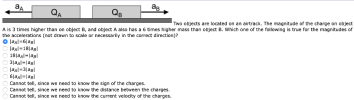 Two objects are located on an airtrack. The magnitude of the charge on object A is 3 times higher than on object B, and object A also has a 6 times higher mass than object B. Which one of the following is true for the magnitudes of the accelerations (not drawn to scale or necessarily in the correct direction)? laAl-18laBl 18laAl laBl 3laAl laBl Cannot tell, since we need to know the sign of the charges Cannot tell, since we...
Object A has a charge of -q. Object B has a charge of +2q. Which is...
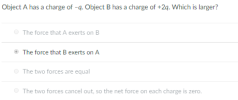 Object A has a charge of -q. Object B has a charge of +2q. Which is larger? The force that A exerts on B The force that B exerts on A The two forces are equal The two forces cancel out, so the net force on each charge is zero.
Coulomb's Law describes the force between two charged objects. Suppose Object 1 has a charge of...
Coulomb's Law describes the force between two charged objects. Suppose Object 1 has a charge of +1.50 microcoulombs and Object 2 has a charge of +14.2 coulombs. Object 2 is located a distance of 0.05810 m to the right of object 1. What is the magnitude and direction of the electrical force on object 2 due to Object 1?
At a separation distance of 0.250-m, two like-charged balloons experience a repulsive force of 0.480 N....
 At a separation distance of 0.250-m, two like-charged balloons experience a repulsive force of 0.480 N. If the distance is doubled, then the repulsive force would be 8) 9) Two objects are located along the y-axis. Object A has a charge of +25 uC and is located at the origin. Object B has a charge of -15 HC and is located a distance of 45 cm above object A. Determine the y- coordinate location where the electric field is zero.
Plz explain why. Thank you 2. E An object has a charge of -2.0 uC. How...
 Plz
explain why. Thank you
2. E An object has a charge of -2.0 uC. How many electrons must be removed so that the charge becomes +3.0 uC? 3. B Four identical metallic objects carry the following charges: +1.6, +6.2,-4.8, and-9.4 HC. The objects are brought simultaneously into con- tact, so that each touches the others. Then they are separated. (a) What is the final charge on each object? (b) How many electrons (or protons) make up the final charge...
Plz
explain why. Thank you
2. E An object has a charge of -2.0 uC. How many electrons must be removed so that the charge becomes +3.0 uC? 3. B Four identical metallic objects carry the following charges: +1.6, +6.2,-4.8, and-9.4 HC. The objects are brought simultaneously into con- tact, so that each touches the others. Then they are separated. (a) What is the final charge on each object? (b) How many electrons (or protons) make up the final charge...
1. a.) An object carries a charge of -6.1 µC, while another carries a charge of...
 1.
a.) An object carries a charge of -6.1 µC, while
another carries a charge of -2.0 µC. How many electrons
must be transferred from the first to the second object so that
both objects have the same charge?
b.) Suppose a thin conducting wire connects two conducting
spheres. A negatively charged rod is brought near one of the
spheres, the wire between them is cut, and the charged rod is taken
away. Which one of the following is true?...
1.
a.) An object carries a charge of -6.1 µC, while
another carries a charge of -2.0 µC. How many electrons
must be transferred from the first to the second object so that
both objects have the same charge?
b.) Suppose a thin conducting wire connects two conducting
spheres. A negatively charged rod is brought near one of the
spheres, the wire between them is cut, and the charged rod is taken
away. Which one of the following is true?...
Coulomb’s Law describes the force between two (and only two!) charged objects. Suppose Object 1 has...
Coulomb’s Law describes the force between two (and only two!) charged objects. Suppose Object 1 has a charge of +2.71 μC and Object 2 has a charge of +18.5 μC. Object 2 is located a distance of 0.04480 m to the right of Object 1 (Yes — please break down and draw a quick sketch!). What is the magnitude and direction of the electrical force on Object 2 due to Object 1? What is the magnitude and direction of the...
Review Ch4-8 1. An object that has zero resistance is a a. Semiconductor c. Diode b....
 Review Ch4-8 1. An object that has zero resistance is a a. Semiconductor c. Diode b. superconductor transistor d. 2. Two charged bodies separated by a distance d exert an electrical force on each other. The charge on one of the bodies is doubled. The electrical forces on each body now a. double b. decrease by 1/2 c. stay the same d. increase by a factor of four . If the length of a wire increases, its resistance increases .decreases...
Consider two point charged objects separated by a distance of 3.68 cm. The charge on the...
Consider two point charged objects separated by a distance of 3.68 cm. The charge on the left hand object is +39.0 μC. The charge on the right hand object is -39.0 μC. a.)What is the strength (magnitude) of the electric field due to the left hand object only at the location exactly halfway in between the two charged objects? b.) What is the strength (magnitude) of the electric field due to the right hand object only at the location exactly...
 o -5 points UCF CakcPhysEML1 1.0 001 Object A has a charge of +2 pc, and object B has a charge of +6 lic, which statement is true about the magnitude of the electric forces on the objects? FAS-3FEA 3FAB- FBA FAB= FBA Additional Materials Electrostatic Charging
 Two objects are located on an airtrack. The magnitude of the charge on object A is 3 times higher than on object B, and object A also has a 6 times higher mass than object B. Which one of the following is true for the magnitudes of the accelerations (not drawn to scale or necessarily in the correct direction)? laAl-18laBl 18laAl laBl 3laAl laBl Cannot tell, since we need to know the sign of the charges Cannot tell, since we...
 Object A has a charge of -q. Object B has a charge of +2q. Which is larger? The force that A exerts on B The force that B exerts on A The two forces are equal The two forces cancel out, so the net force on each charge is zero.
 At a separation distance of 0.250-m, two like-charged balloons experience a repulsive force of 0.480 N. If the distance is doubled, then the repulsive force would be 8) 9) Two objects are located along the y-axis. Object A has a charge of +25 uC and is located at the origin. Object B has a charge of -15 HC and is located a distance of 45 cm above object A. Determine the y- coordinate location where the electric field is zero.
 Plz
explain why. Thank you
2. E An object has a charge of -2.0 uC. How many electrons must be removed so that the charge becomes +3.0 uC? 3. B Four identical metallic objects carry the following charges: +1.6, +6.2,-4.8, and-9.4 HC. The objects are brought simultaneously into con- tact, so that each touches the others. Then they are separated. (a) What is the final charge on each object? (b) How many electrons (or protons) make up the final charge...
Plz
explain why. Thank you
2. E An object has a charge of -2.0 uC. How many electrons must be removed so that the charge becomes +3.0 uC? 3. B Four identical metallic objects carry the following charges: +1.6, +6.2,-4.8, and-9.4 HC. The objects are brought simultaneously into con- tact, so that each touches the others. Then they are separated. (a) What is the final charge on each object? (b) How many electrons (or protons) make up the final charge...
 1.
a.) An object carries a charge of -6.1 µC, while
another carries a charge of -2.0 µC. How many electrons
must be transferred from the first to the second object so that
both objects have the same charge?
b.) Suppose a thin conducting wire connects two conducting
spheres. A negatively charged rod is brought near one of the
spheres, the wire between them is cut, and the charged rod is taken
away. Which one of the following is true?...
1.
a.) An object carries a charge of -6.1 µC, while
another carries a charge of -2.0 µC. How many electrons
must be transferred from the first to the second object so that
both objects have the same charge?
b.) Suppose a thin conducting wire connects two conducting
spheres. A negatively charged rod is brought near one of the
spheres, the wire between them is cut, and the charged rod is taken
away. Which one of the following is true?...
 Review Ch4-8 1. An object that has zero resistance is a a. Semiconductor c. Diode b. superconductor transistor d. 2. Two charged bodies separated by a distance d exert an electrical force on each other. The charge on one of the bodies is doubled. The electrical forces on each body now a. double b. decrease by 1/2 c. stay the same d. increase by a factor of four . If the length of a wire increases, its resistance increases .decreases...
Most questions answered within 3 hours.
-
Where is the error in this code sequence?
String s1 = "Hello";
String s2 = "ello";...
asked 10 months ago -
Financial data for Joel de Paris, Inc., for last year
follow:
Joel de Paris, Inc.
Balance...
asked 10 months ago -
Consider this reaction:
Al2(SO4)3 (aq)+ BaCl3
(aq) Al2Cl6 (aq)- +
3BaSO4(s) . What is the...
asked 10 months ago -
Suppose that Savneet is considering increasing her
recent random sample from 20 car rentals to 40...
asked 10 months ago -
Trucks arrive at an unloading terminal at an average rate of 120
per hour.
Trucks arrive...
asked 10 months ago -
Why are methanol and ethanol completely soluble in water while
octanol is not very little soluble....
asked 10 months ago -
A facilities manager at a university reads in a research report
that the mean amount of...
asked 10 months ago -
When the CuSO4 is rehydrated by adding water to the anhydrous
compound, is this an endothermic...
asked 10 months ago -
A ray of sunlight is passing from diamond into crown glass; the
angle of incidence is...
asked 10 months ago -
A block of mass 0.249 kg is placed on top of a light, vertical
spring of...
asked 10 months ago -
how do the kidneys compensate in the presences of acidosis
a) trigger hyperventilate
b) reserve acid...
asked 10 months ago -
Question 501 pts
The rental rate of capital to the firm increases. Which of the
following...
asked 10 months ago