
Homework Answers
Add Answer to:
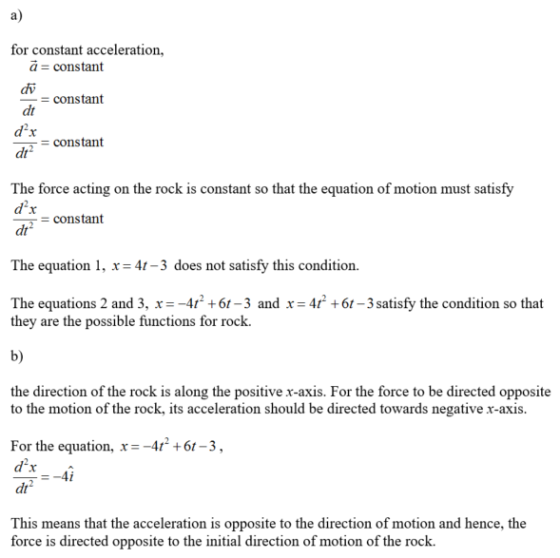
A rock moving through deep space in the +x direction, at time t = 0 a...
A student measures the velocity of an object moving along a track. At time t =...
 A student measures the velocity of an object moving along a track. At time t = 0 s, the object is moving at a constant 4.0 m/s in the positive x-direction. At time t = 3.0 s, the object begins to slow, stops at t = 5.0 s, and then moves in the opposite direction. At t = 6.0 s, the object as reached a speed of -2.0 m/s. It moves at this speed until the student quits taking data...
At time t = 0 s, a rock is thrown vertically upward from the ground. At...
At time t = 0 s, a rock is thrown vertically upward from the ground. At time t = 1.6 s, it passes the top of a tall tower. 0.80 s later, it reaches its maximum height. Q)How fast is the rock moving as it passes the top of the tower? A car moving with constant acceleration covers the distance between two points 120 m apart in a time of 8.0 s. Its speed at the second point is 12...
Imagine that we release a rock of mass m (which is initially at rest) at the...
 Imagine that we release a rock of mass m (which is initially at rest) at the surface of a lake and measure its position and velocity as functions of time while it sinks. The rock moves under the influence of three forces: gravity, buoyancy, and viscous drag. Let y represent the vertical position of the sinking rock, with the surface of the lake at y -0, and positive y upwards The net force on the rock is F =-[m-mdisplaced where...
The position vector r describes the path of an object moving in space. Position Vector Time...
 The position vector r describes the path of an object moving in space. Position Vector Time r(t) = 12; + tj + 243/2k t = 4 (a) Find the velocity vector, speed, and acceleration vector of the object. v(t) = s(t) a(t) (b) Evaluate the velocity vector and acceleration vector of the object at the given value of t. (4) = a(4) 11 Use the model for projectile motion, assuming there is no air resistance and g = 32 feet...
Question 82 A object moving in an x-y plane is first observed (time "-0") at the...
 Question 82 A object moving in an x-y plane is first observed (time "-0") at the location x 3m, where it has a velocity of magnitude 5 m's in the ty-direction. The object then experiences the following acceleration as a function of time: ãe) (12e)+ (14 32) Note that snits have been omited: assume that putting in ()-s will give (aj-m/s) Part A: Find the velocity of the object as a function of time, (). Express your answer in unit-vector...
Question 8 III Not yet answered For an object moving in uniform circular motion, the direction...
 Question 8 III Not yet answered For an object moving in uniform circular motion, the direction of the instantaneous acceleration vector is. Marked out of 2.00 Prag question Select one: O a directed radialy outward Ob tangent to the path of motion O c directed radially inward O d. equal to zero Question 9 Not yet answered Marted out of 3.00 Pag Question The crate has a mass of 80 kg and is being towed by a chain which is...
(a) Consider a particle which starts moving around from the origin in a 3-dimensional space. De- ...
 (a) Consider a particle which starts moving around from the origin in a 3-dimensional space. De- termine the velocity vector v(t) in terms of φ and θ if it is constantly moving at the speed 5m/s, along the direction (φ,0). Here, φ denotes the angle between the z-axis and the projection of the position vector r(t) on the xy-plane; meanwhile θ denotes the angle between the z-axis and r(t). You may assume that (φ, θ) are fixed over time at...
A 2Kg object is moving the positive X direction at a speed of 4 m/s. At...
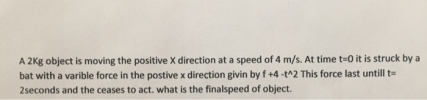 A 2Kg object is moving the positive X direction at a speed of 4 m/s. At time t=0 it is struck by a bat with a variable force in the positive x direction given by f +4 -t^2 This force last until t= 2seconds and the ceases to act. what is the finalspeed of object.
3. Consider the follo 2 lu The boundary conditions are: u(0,y, t) - u(x, 0,t) - 0, ou (a, y, t) =...
 *Note: Please answer all parts, and explain all workings. Thank
you!
3. Consider the follo 2 lu The boundary conditions are: u(0,y, t) - u(x, 0,t) - 0, ou (a, y, t) = (x, b, t) = 0 ay The initial conditions are: at t-0,11-4 (x,y)--Yo(x,y) . ot a) Assume u(x,y,t) - X(x)Y(y)T(t), derive the eigenvalue problems: a) Apply the boundary conditions and derive all the possible eigenvalues for λι, λ2 and corresponding eigen-functions, Xm,Yn b) for any combination of...
*Note: Please answer all parts, and explain all workings. Thank
you!
3. Consider the follo 2 lu The boundary conditions are: u(0,y, t) - u(x, 0,t) - 0, ou (a, y, t) = (x, b, t) = 0 ay The initial conditions are: at t-0,11-4 (x,y)--Yo(x,y) . ot a) Assume u(x,y,t) - X(x)Y(y)T(t), derive the eigenvalue problems: a) Apply the boundary conditions and derive all the possible eigenvalues for λι, λ2 and corresponding eigen-functions, Xm,Yn b) for any combination of...
7. The acceleration of a particle moving along the x-axis at time t is given by...
 7. The acceleration of a particle moving along the x-axis at time t is given by a(t) = 6t – 11. If the velocity is 10 when t = 0 and the position is 4 when t=0, then the particle is changing direction at what time(s)?
 A student measures the velocity of an object moving along a track. At time t = 0 s, the object is moving at a constant 4.0 m/s in the positive x-direction. At time t = 3.0 s, the object begins to slow, stops at t = 5.0 s, and then moves in the opposite direction. At t = 6.0 s, the object as reached a speed of -2.0 m/s. It moves at this speed until the student quits taking data...
 Imagine that we release a rock of mass m (which is initially at rest) at the surface of a lake and measure its position and velocity as functions of time while it sinks. The rock moves under the influence of three forces: gravity, buoyancy, and viscous drag. Let y represent the vertical position of the sinking rock, with the surface of the lake at y -0, and positive y upwards The net force on the rock is F =-[m-mdisplaced where...
 The position vector r describes the path of an object moving in space. Position Vector Time r(t) = 12; + tj + 243/2k t = 4 (a) Find the velocity vector, speed, and acceleration vector of the object. v(t) = s(t) a(t) (b) Evaluate the velocity vector and acceleration vector of the object at the given value of t. (4) = a(4) 11 Use the model for projectile motion, assuming there is no air resistance and g = 32 feet...
 Question 82 A object moving in an x-y plane is first observed (time "-0") at the location x 3m, where it has a velocity of magnitude 5 m's in the ty-direction. The object then experiences the following acceleration as a function of time: ãe) (12e)+ (14 32) Note that snits have been omited: assume that putting in ()-s will give (aj-m/s) Part A: Find the velocity of the object as a function of time, (). Express your answer in unit-vector...
 Question 8 III Not yet answered For an object moving in uniform circular motion, the direction of the instantaneous acceleration vector is. Marked out of 2.00 Prag question Select one: O a directed radialy outward Ob tangent to the path of motion O c directed radially inward O d. equal to zero Question 9 Not yet answered Marted out of 3.00 Pag Question The crate has a mass of 80 kg and is being towed by a chain which is...
 (a) Consider a particle which starts moving around from the origin in a 3-dimensional space. De- termine the velocity vector v(t) in terms of φ and θ if it is constantly moving at the speed 5m/s, along the direction (φ,0). Here, φ denotes the angle between the z-axis and the projection of the position vector r(t) on the xy-plane; meanwhile θ denotes the angle between the z-axis and r(t). You may assume that (φ, θ) are fixed over time at...
 A 2Kg object is moving the positive X direction at a speed of 4 m/s. At time t=0 it is struck by a bat with a variable force in the positive x direction given by f +4 -t^2 This force last until t= 2seconds and the ceases to act. what is the finalspeed of object.
 *Note: Please answer all parts, and explain all workings. Thank
you!
3. Consider the follo 2 lu The boundary conditions are: u(0,y, t) - u(x, 0,t) - 0, ou (a, y, t) = (x, b, t) = 0 ay The initial conditions are: at t-0,11-4 (x,y)--Yo(x,y) . ot a) Assume u(x,y,t) - X(x)Y(y)T(t), derive the eigenvalue problems: a) Apply the boundary conditions and derive all the possible eigenvalues for λι, λ2 and corresponding eigen-functions, Xm,Yn b) for any combination of...
*Note: Please answer all parts, and explain all workings. Thank
you!
3. Consider the follo 2 lu The boundary conditions are: u(0,y, t) - u(x, 0,t) - 0, ou (a, y, t) = (x, b, t) = 0 ay The initial conditions are: at t-0,11-4 (x,y)--Yo(x,y) . ot a) Assume u(x,y,t) - X(x)Y(y)T(t), derive the eigenvalue problems: a) Apply the boundary conditions and derive all the possible eigenvalues for λι, λ2 and corresponding eigen-functions, Xm,Yn b) for any combination of...
 7. The acceleration of a particle moving along the x-axis at time t is given by a(t) = 6t – 11. If the velocity is 10 when t = 0 and the position is 4 when t=0, then the particle is changing direction at what time(s)?
Most questions answered within 3 hours.
-
Where is the error in this code sequence?
String s1 = "Hello";
String s2 = "ello";...
asked 10 months ago -
Financial data for Joel de Paris, Inc., for last year
follow:
Joel de Paris, Inc.
Balance...
asked 10 months ago -
Consider this reaction:
Al2(SO4)3 (aq)+ BaCl3
(aq) Al2Cl6 (aq)- +
3BaSO4(s) . What is the...
asked 10 months ago -
Suppose that Savneet is considering increasing her
recent random sample from 20 car rentals to 40...
asked 10 months ago -
Trucks arrive at an unloading terminal at an average rate of 120
per hour.
Trucks arrive...
asked 10 months ago -
Why are methanol and ethanol completely soluble in water while
octanol is not very little soluble....
asked 10 months ago -
A facilities manager at a university reads in a research report
that the mean amount of...
asked 10 months ago -
When the CuSO4 is rehydrated by adding water to the anhydrous
compound, is this an endothermic...
asked 10 months ago -
A ray of sunlight is passing from diamond into crown glass; the
angle of incidence is...
asked 10 months ago -
A block of mass 0.249 kg is placed on top of a light, vertical
spring of...
asked 10 months ago -
how do the kidneys compensate in the presences of acidosis
a) trigger hyperventilate
b) reserve acid...
asked 10 months ago -
Question 501 pts
The rental rate of capital to the firm increases. Which of the
following...
asked 10 months ago