2008-2. Please provide clear justified step-by-step solutions (preferably handwritten) for the following question. The answers have been provided.
Questions:
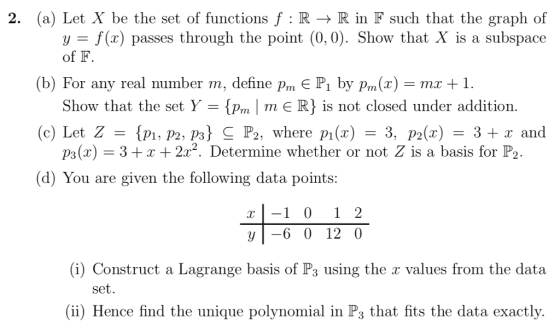
Answers:

Homework Answers
 up
upAdd Answer to:
2008-2. Please provide clear justified step-by-step solutions
(preferably handwritten) for the following question. The answers
have...
2011-3. Please provide clear justified step-by-step solutions (preferably handwritten) for the following question. The answers have...
 2011-3. Please provide clear justified step-by-step solutions
(preferably handwritten) for the following question. The answers
have been provided.
Questions:
Answers:
3 1 -3 3. Let A10 0 01 0 (a) Find the eigenvalues of A. (b) Find an eigenvector corresponding to each one of the eigenvalues c) A recurrence relation is defined by a0, a10, a2-1 and for n 20. Find a formula for an in terms of n. 3. (a) The eigenvalues are 1-1,3. (b) Corresponding eigenvectors are 1,13respectively.
2011-3. Please provide clear justified step-by-step solutions
(preferably handwritten) for the following question. The answers
have been provided.
Questions:
Answers:
3 1 -3 3. Let A10 0 01 0 (a) Find the eigenvalues of A. (b) Find an eigenvector corresponding to each one of the eigenvalues c) A recurrence relation is defined by a0, a10, a2-1 and for n 20. Find a formula for an in terms of n. 3. (a) The eigenvalues are 1-1,3. (b) Corresponding eigenvectors are 1,13respectively.
Consider the three-dimensional subspace of function space defined by the span of 1, r, and a2 the...
 Consider the three-dimensional subspace of function space defined by the span of 1, r, and a2 the first three orthogonal polynomials on -1,1. Let f(x) 21, and consider the subset G-{g(z) | 〈f,g〉 0), the set of functions orthogonal to f using the L inner product on, (This can be thought of as the plane normal to f(x) in the three-dimensional function space.) Let h(z) 2-1. Find the function g(x) є G in the plane which is closest to h(x)....
Please answer it step by step and Question 2. uniformly converge is defined by *f=0* clear...
 Please answer it step by step and Question 2. uniformly
converge is defined by *f=0* clear handwritten,
please, also, beware that for the x you have 2 conditions , such as
x>n and 0<=x<=n
1- For all n > 1 define fn: [0, 1] → R as follows: (i if n!x is an integer 10 otherwise Prove that fn + f pointwise where f:[0,1] → R is defined by ſo if x is irrational f(x) = 3 11 if x...
Please answer it step by step and Question 2. uniformly
converge is defined by *f=0* clear handwritten,
please, also, beware that for the x you have 2 conditions , such as
x>n and 0<=x<=n
1- For all n > 1 define fn: [0, 1] → R as follows: (i if n!x is an integer 10 otherwise Prove that fn + f pointwise where f:[0,1] → R is defined by ſo if x is irrational f(x) = 3 11 if x...
Can you please provide clear and step by step solution for both 3 and 4. Thanks...
 Can you please provide clear
and step by step solution for both 3 and 4. Thanks :)
Exercise 5. [A-M Ch 3 Ex 7] Let R#0 be a ring. A multiplicatively closed subset S of R is said to be saturated if XY ES #xe S and y E S. 1. Let I be the collection of all multiplicatively closed subsets of R such that 0 € S. Show that I has maximal elements, and that Se & is maximal...
Can you please provide clear
and step by step solution for both 3 and 4. Thanks :)
Exercise 5. [A-M Ch 3 Ex 7] Let R#0 be a ring. A multiplicatively closed subset S of R is said to be saturated if XY ES #xe S and y E S. 1. Let I be the collection of all multiplicatively closed subsets of R such that 0 € S. Show that I has maximal elements, and that Se & is maximal...
(1 point) Let Ps be the vector space of all polynomials of degree at most 3,...
 (1 point) Let Ps be the vector space of all polynomials of degree at most 3, and consider the subspace 11 = {r(z) e Pal p(1) = 0} of P3 a A basis for the subspace H is { 22x+12x^2-x-1 Enter your answer as a comma separated list of polynomials. b. The dimension of His 3 (1 point) Find a basis for the space of symmetric 2 x 2-matrices If you need fewer basis elements than there are blanks provided,...
Hi, could you post solutions to the following questions. Thanks. 2. (a) Let V be a vector space on R. Give the definition of a subspace W of V 2% (b) For each of the following subsets of IR3 sta...
 Hi,
could you post solutions to the following questions. Thanks.
2. (a) Let V be a vector space on R. Give the definition of a subspace W of V 2% (b) For each of the following subsets of IR3 state whether they are subepaces of R3 or not by clearly explaining your answer. 2% 2% (c) Consider the map F : R2 → R3 defined by for any z = (zi,Z2) E R2. 3% 3% 3% 3% i. Show that...
Hi,
could you post solutions to the following questions. Thanks.
2. (a) Let V be a vector space on R. Give the definition of a subspace W of V 2% (b) For each of the following subsets of IR3 state whether they are subepaces of R3 or not by clearly explaining your answer. 2% 2% (c) Consider the map F : R2 → R3 defined by for any z = (zi,Z2) E R2. 3% 3% 3% 3% i. Show that...
Question 2: For this question, consider the non-standard pairing on the space of real polynomials P...
 Question 2: For this question, consider the non-standard pairing on the space of real polynomials P given by g) = Lif(t)g(x).rº dr. (a) Prove that (,) defines an inner product on P. (b) Let O be the set of odd polynomials, i.e. f(r) € P such that f(x)= -f(-r). Show that is a subspace of P. (c) Explain why g() = 5x2 - 3 is in 0+ (the orthogonal complement of O with respect to (>). (d) Let P<2 denote...
2. For the following questions, you just need to circle one of answers. (1.5 points/each, totally...
 2. For the following questions, you just need to circle one of answers. (1.5 points/each, totally 8 points) Let , be the set of all polynomials with exact degree 2. Is this a subspace of a,17(Yes b. Given 2 by 2 matrix A. S-(BeR 1AB BA) is a subspace of vector space R7 a. No) (Yes No) 1 AB-0), is S asubspace of 2 by 2 c. Given 2 by 2 matrix A. Let s- (Be R matrix vector space?...
1. Taylor series are special power series that are defined from a function f(z) atz = a by fittin...
 1. Taylor series are special power series that are defined from a function f(z) atz = a by fitting higher and higher degree polynomials T, a(x) to the curve at the point (a, f(a)), with the goal of getting a better and better fit as we not only let the degree grow larger, but take a series whose partial sums are these so-called Taylor polynomials Tm,a(x) We will explore how this is done by determine the Taylor series of f(z)...
for these 2 theorems, pick one hypothesis, remove it from the theorem to create a new statement. then, provide a counterexample showing that the new statement is false. (a) Thim (The Lagrange...
 for these 2 theorems, pick one hypothesis, remove it
from the theorem to create a new statement. then, provide a
counterexample showing that the new statement is false.
(a) Thim (The Lagrange Remainder Theorem): Suppose f : 1 → R has n + 1 derivatives and ro e 1, Then for each r e I with r / ro there is some z strictly between ro and r with f(x) Pn (z) +Rn(x) where Rn is the remainder and ro)#1...
for these 2 theorems, pick one hypothesis, remove it
from the theorem to create a new statement. then, provide a
counterexample showing that the new statement is false.
(a) Thim (The Lagrange Remainder Theorem): Suppose f : 1 → R has n + 1 derivatives and ro e 1, Then for each r e I with r / ro there is some z strictly between ro and r with f(x) Pn (z) +Rn(x) where Rn is the remainder and ro)#1...
 2011-3. Please provide clear justified step-by-step solutions
(preferably handwritten) for the following question. The answers
have been provided.
Questions:
Answers:
3 1 -3 3. Let A10 0 01 0 (a) Find the eigenvalues of A. (b) Find an eigenvector corresponding to each one of the eigenvalues c) A recurrence relation is defined by a0, a10, a2-1 and for n 20. Find a formula for an in terms of n. 3. (a) The eigenvalues are 1-1,3. (b) Corresponding eigenvectors are 1,13respectively.
2011-3. Please provide clear justified step-by-step solutions
(preferably handwritten) for the following question. The answers
have been provided.
Questions:
Answers:
3 1 -3 3. Let A10 0 01 0 (a) Find the eigenvalues of A. (b) Find an eigenvector corresponding to each one of the eigenvalues c) A recurrence relation is defined by a0, a10, a2-1 and for n 20. Find a formula for an in terms of n. 3. (a) The eigenvalues are 1-1,3. (b) Corresponding eigenvectors are 1,13respectively.
 Consider the three-dimensional subspace of function space defined by the span of 1, r, and a2 the first three orthogonal polynomials on -1,1. Let f(x) 21, and consider the subset G-{g(z) | 〈f,g〉 0), the set of functions orthogonal to f using the L inner product on, (This can be thought of as the plane normal to f(x) in the three-dimensional function space.) Let h(z) 2-1. Find the function g(x) є G in the plane which is closest to h(x)....
 Please answer it step by step and Question 2. uniformly
converge is defined by *f=0* clear handwritten,
please, also, beware that for the x you have 2 conditions , such as
x>n and 0<=x<=n
1- For all n > 1 define fn: [0, 1] → R as follows: (i if n!x is an integer 10 otherwise Prove that fn + f pointwise where f:[0,1] → R is defined by ſo if x is irrational f(x) = 3 11 if x...
Please answer it step by step and Question 2. uniformly
converge is defined by *f=0* clear handwritten,
please, also, beware that for the x you have 2 conditions , such as
x>n and 0<=x<=n
1- For all n > 1 define fn: [0, 1] → R as follows: (i if n!x is an integer 10 otherwise Prove that fn + f pointwise where f:[0,1] → R is defined by ſo if x is irrational f(x) = 3 11 if x...
 Can you please provide clear
and step by step solution for both 3 and 4. Thanks :)
Exercise 5. [A-M Ch 3 Ex 7] Let R#0 be a ring. A multiplicatively closed subset S of R is said to be saturated if XY ES #xe S and y E S. 1. Let I be the collection of all multiplicatively closed subsets of R such that 0 € S. Show that I has maximal elements, and that Se & is maximal...
Can you please provide clear
and step by step solution for both 3 and 4. Thanks :)
Exercise 5. [A-M Ch 3 Ex 7] Let R#0 be a ring. A multiplicatively closed subset S of R is said to be saturated if XY ES #xe S and y E S. 1. Let I be the collection of all multiplicatively closed subsets of R such that 0 € S. Show that I has maximal elements, and that Se & is maximal...
 (1 point) Let Ps be the vector space of all polynomials of degree at most 3, and consider the subspace 11 = {r(z) e Pal p(1) = 0} of P3 a A basis for the subspace H is { 22x+12x^2-x-1 Enter your answer as a comma separated list of polynomials. b. The dimension of His 3 (1 point) Find a basis for the space of symmetric 2 x 2-matrices If you need fewer basis elements than there are blanks provided,...
 Hi,
could you post solutions to the following questions. Thanks.
2. (a) Let V be a vector space on R. Give the definition of a subspace W of V 2% (b) For each of the following subsets of IR3 state whether they are subepaces of R3 or not by clearly explaining your answer. 2% 2% (c) Consider the map F : R2 → R3 defined by for any z = (zi,Z2) E R2. 3% 3% 3% 3% i. Show that...
Hi,
could you post solutions to the following questions. Thanks.
2. (a) Let V be a vector space on R. Give the definition of a subspace W of V 2% (b) For each of the following subsets of IR3 state whether they are subepaces of R3 or not by clearly explaining your answer. 2% 2% (c) Consider the map F : R2 → R3 defined by for any z = (zi,Z2) E R2. 3% 3% 3% 3% i. Show that...
 Question 2: For this question, consider the non-standard pairing on the space of real polynomials P given by g) = Lif(t)g(x).rº dr. (a) Prove that (,) defines an inner product on P. (b) Let O be the set of odd polynomials, i.e. f(r) € P such that f(x)= -f(-r). Show that is a subspace of P. (c) Explain why g() = 5x2 - 3 is in 0+ (the orthogonal complement of O with respect to (>). (d) Let P<2 denote...
 2. For the following questions, you just need to circle one of answers. (1.5 points/each, totally 8 points) Let , be the set of all polynomials with exact degree 2. Is this a subspace of a,17(Yes b. Given 2 by 2 matrix A. S-(BeR 1AB BA) is a subspace of vector space R7 a. No) (Yes No) 1 AB-0), is S asubspace of 2 by 2 c. Given 2 by 2 matrix A. Let s- (Be R matrix vector space?...
 1. Taylor series are special power series that are defined from a function f(z) atz = a by fitting higher and higher degree polynomials T, a(x) to the curve at the point (a, f(a)), with the goal of getting a better and better fit as we not only let the degree grow larger, but take a series whose partial sums are these so-called Taylor polynomials Tm,a(x) We will explore how this is done by determine the Taylor series of f(z)...
 for these 2 theorems, pick one hypothesis, remove it
from the theorem to create a new statement. then, provide a
counterexample showing that the new statement is false.
(a) Thim (The Lagrange Remainder Theorem): Suppose f : 1 → R has n + 1 derivatives and ro e 1, Then for each r e I with r / ro there is some z strictly between ro and r with f(x) Pn (z) +Rn(x) where Rn is the remainder and ro)#1...
for these 2 theorems, pick one hypothesis, remove it
from the theorem to create a new statement. then, provide a
counterexample showing that the new statement is false.
(a) Thim (The Lagrange Remainder Theorem): Suppose f : 1 → R has n + 1 derivatives and ro e 1, Then for each r e I with r / ro there is some z strictly between ro and r with f(x) Pn (z) +Rn(x) where Rn is the remainder and ro)#1...
Most questions answered within 3 hours.
-
Where is the error in this code sequence?
String s1 = "Hello";
String s2 = "ello";...
asked 10 months ago -
Financial data for Joel de Paris, Inc., for last year
follow:
Joel de Paris, Inc.
Balance...
asked 10 months ago -
Consider this reaction:
Al2(SO4)3 (aq)+ BaCl3
(aq) Al2Cl6 (aq)- +
3BaSO4(s) . What is the...
asked 10 months ago -
Suppose that Savneet is considering increasing her
recent random sample from 20 car rentals to 40...
asked 10 months ago -
Trucks arrive at an unloading terminal at an average rate of 120
per hour.
Trucks arrive...
asked 10 months ago -
Why are methanol and ethanol completely soluble in water while
octanol is not very little soluble....
asked 10 months ago -
A facilities manager at a university reads in a research report
that the mean amount of...
asked 10 months ago -
When the CuSO4 is rehydrated by adding water to the anhydrous
compound, is this an endothermic...
asked 10 months ago -
A ray of sunlight is passing from diamond into crown glass; the
angle of incidence is...
asked 10 months ago -
A block of mass 0.249 kg is placed on top of a light, vertical
spring of...
asked 10 months ago -
how do the kidneys compensate in the presences of acidosis
a) trigger hyperventilate
b) reserve acid...
asked 10 months ago -
Question 501 pts
The rental rate of capital to the firm increases. Which of the
following...
asked 10 months ago