


Spring 2017/s i. What does it mean that the sum (1) is direct? iii. State the Grassmann formula for U W and explain what are the conditions 1% 4% for the formula to hold true. What does the Grassmann formula simplify to if the sum (1) is direct. (b) Consider the two vectors in R th=(1,2) t12 = (4,1). ; [5% i. Show that (m) is a subspace of R3. Similarly, (a) is also 8 subspace of R. What are (u) and (u2)? Sketch a graph of them [5%] ii. Show that (R2 is the direct sum of (u) and (ua)) 5% then list their (a) Define the Euclide n inner product and the Euclidean norm on R 4 properties. (b) Consider the three vectors in R3 ut = (1,1,1); ua = (6,4,5); u,-(3,6,9). i. Show that {ul,u2,w) does not form an orthogonal set of vectors in Ra with i. Apply the Gram-Schmidt orthogonalisation process to (us ug, ts) to find an respect to the Euclidean inner product orthogonal set (v,s for R3 (with respect to the Euclidean inner product). Check that your answer is correct, them explain why (o,, ) is a basis for R3 4% ii. Use (r,,t) you found in i. to find an orthonormal basis for R 3% (c) Give the definition of an orthogonal matriz and show that if A is orthogonal, then its determinant is either 1 or -1. Provide an example of an orthogonal matrix and justify your answer Page 3 of 4
(a) Give the definition of row rank, column rank and rank of a matrix, then find the rank of each of the following matrices by clearly explaining your answer. 0 5 1 1-(0 0 o 3 Is C invertible? Explain your answer. 0-3-6C2 0 7 0 0 (b) Consider the two bases e and b of R2 given below e={(1,0),(0, 1)); b=((-1,1), (2,2)) i. Determine the matriz of change of coordinates from basis b to basis e, Mell). 1 i. Letv(-4,-4) be a vector in R2 (the coordinates of v are here given with 3 respect to the canonical basis e). Determine the coordinates of v with respect to the basis b. Check that the result you obtained is correct. (c) Find a matrix P that diagonalises 0 0-2 A 1 2 1 1 0 3
Homework Answers
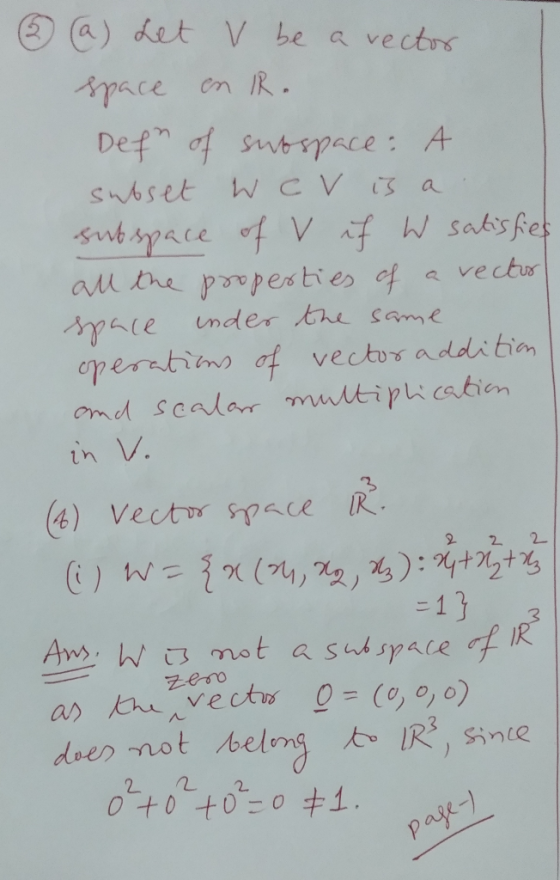
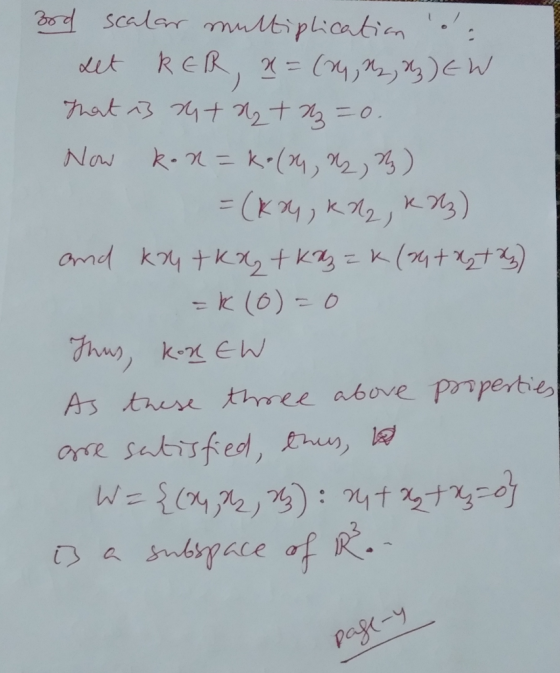
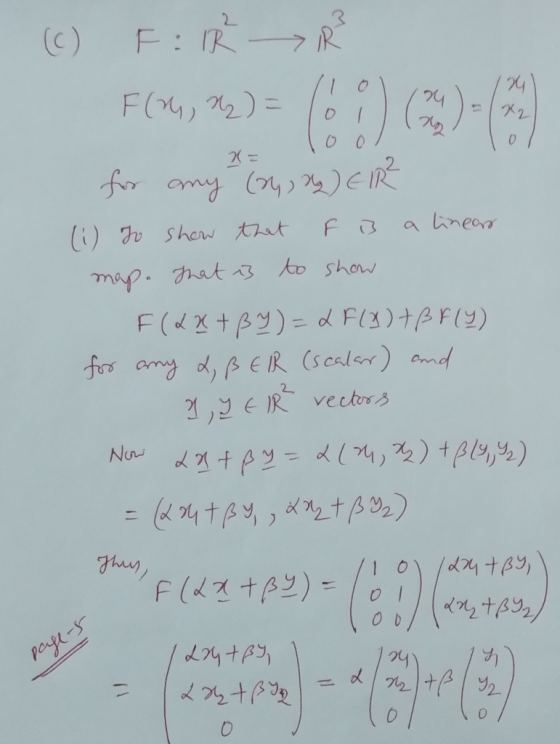
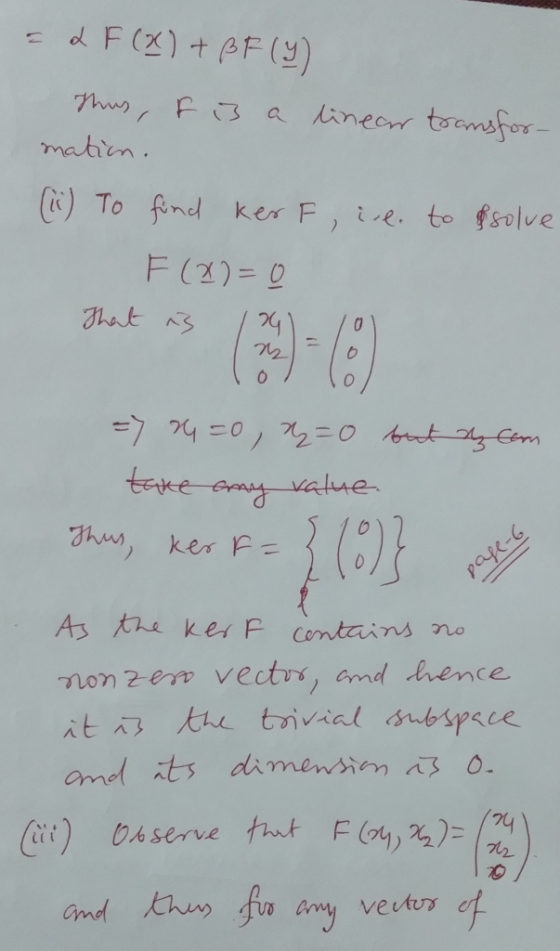
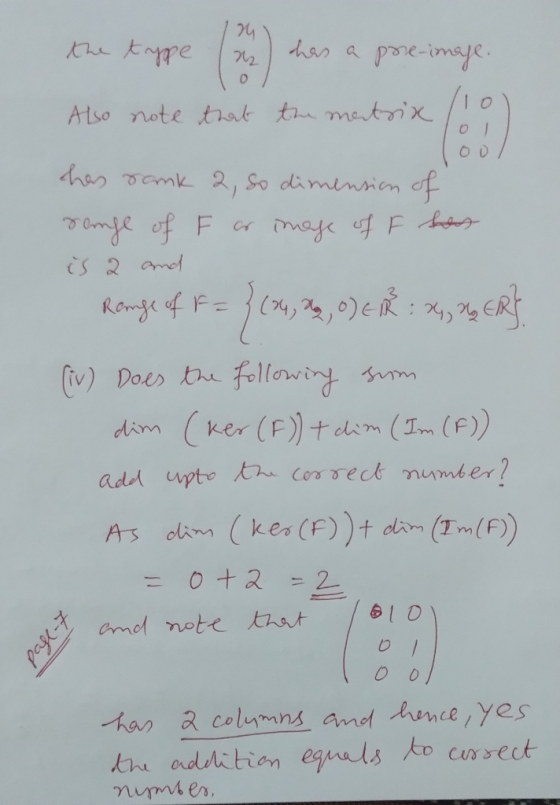
You have asked too many questions at one go. However, I have given answers to Q2, a, b (i), (ii), (iii), c) (i), (ii), (iii), (iv)


please make thumbs up
Add Answer to:
Hi, could you post solutions to the following questions. Thanks. 2. (a) Let V be a vector space on R. Give the definition of a subspace W of V 2% (b) For each of the following subsets of IR3 sta...
Let w be a subspace of R", and let wt be the set of all vectors...
 Let w be a subspace of R", and let wt be the set of all vectors orthogonal to W. Show that wt is a subspace of R" using the following steps. a. Take z in wt, and let u represent any element of W. Then zu u = 0. Take any scalar c and show that cz is orthogonal to u. (Since u was an arbitrary element of W, this will show that cz is in wt.) b. Take z,...
Problem 3. Let V and W be vector spaces, let T : V -> W be...
 Problem 3. Let V and W be vector spaces, let T : V -> W be a linear transformation, and suppose U is a subspace of W (a) Recall that the inverse image of U under T is the set T-1 U] := {VE V : T(v) E U). Prove that T-[U] is a subspace of V (b) Show that U nim(T) is a subspace of W, and then without using the Rank-Nullity Theorem, prove that dim(T-1[U]) = dim(Unin (T))...
Problem 5 (25 points). Let Mat2x2(R) be the vector space of 2 x 2 matrices with...
 Problem 5 (25 points). Let Mat2x2(R) be the vector space of 2 x 2 matrices with real entries. Recall that (1 0.0 1.000.00 "100'00' (1 001) is the standard basis of Mat2x2(R). Define a transformation T : Mat2x2(R) + R2 by the rule la-36 c+ 3d - (1) (5 points) Show that T is linear. (2) (5 points) Compute the matrix of T with respect to the standard basis in Mat2x2 (R) and R”. Show your work. An answer with...
Q6. Let W be the subspace of R' spanned by the vectors u. = 3(1, -1,1,1),...
 Q6. Let W be the subspace of R' spanned by the vectors u. = 3(1, -1,1,1), uz = 5(–1,1,1,1). (a) Check that {uj,uz) is an orthonormal set using the dot product on R. (Hence it forms an orthonormal basis for W.) (b) Let w = (-1,1,5,5) EW. Using the formula in the box above, express was a linear combination of u and u. (c) Let v = (-1,1,3,5) = R'. Find the orthogonal projection of v onto W.
Problem 4. Let V be the vector space of all infinitely differentiable functions f: [0, ]...
 Problem 4. Let V be the vector space of all infinitely differentiable functions f: [0, ] -» R, equipped with the inner product f(t)g(t)d (f,g) = (a) Let UC V be the subspace spanned by B = (sinr, cos x, 1) (you may assume without proof that B is linearly independent, and hence a basis for U). Find the B-matrix [D]93 of the "derivative linear transformation" D : U -> U given by D(f) = f'. (b) Let WC V...
-9 2. Let Vi-8.V2,andvs-2, let B -(V,V2,Vs), and let W be the subspace spanned , let B -(Vi,V2,V3...
 -9 2. Let Vi-8.V2,andvs-2, let B -(V,V2,Vs), and let W be the subspace spanned , let B -(Vi,V2,V3), and let W be the subspace spanned by B. Note that B is an orthogonal set. 17 a. 1 point] Find the coordinates of uwith respect to B, without inverting any matrices or L-2 solving any systems of linear equations. 35 16 25 b. 1 point Find the orthogonal projection of to W, without inverting any matrices or solving any systems of...
Can u please answer the question (G) 1. (15 marks total) Consider the real vector space (IR3, +,-) and let W be the sub...
 Can u please answer the question (G)
1. (15 marks total) Consider the real vector space (IR3, +,-) and let W be the subset of R3 consisting of all elements (z, y, z) of R3 for which z t y-z = 0. (Although you do not need to show this, W is a vector subspace of R3, and therefore is itsclf a rcal vector space.) Consider the following vectors in W V2 (0,2,2) V (0,0,0) (a) (2 marks) Determine whether...
Can u please answer the question (G)
1. (15 marks total) Consider the real vector space (IR3, +,-) and let W be the subset of R3 consisting of all elements (z, y, z) of R3 for which z t y-z = 0. (Although you do not need to show this, W is a vector subspace of R3, and therefore is itsclf a rcal vector space.) Consider the following vectors in W V2 (0,2,2) V (0,0,0) (a) (2 marks) Determine whether...
please answer all questions im out of questions to post. thats why i squeezed them in....
 please answer all questions im out of questions to post. thats why
i squeezed them in.
6. Let u = (0, -3,11) and v = (1, -5,0). (a) Find the distance between i and V. That is, find ||ū - v1|| (b) Find the angle between i and 0. (c) Find Proje(). (d) Find Projet) (e) Find i x i and show it is orthogonal to both u and . 6 For -~- al 7. (a) Let A -12 5-2...
please answer all questions im out of questions to post. thats why
i squeezed them in.
6. Let u = (0, -3,11) and v = (1, -5,0). (a) Find the distance between i and V. That is, find ||ū - v1|| (b) Find the angle between i and 0. (c) Find Proje(). (d) Find Projet) (e) Find i x i and show it is orthogonal to both u and . 6 For -~- al 7. (a) Let A -12 5-2...
QUESTION 2 Consider the vector space R3 (2.1) Show that (12) ((a, b, c), (x, v, z))-at +by +(b+ c)(y + z) is an inner product on R3 (2.2) Apply the Gram-Schmıdt process to the following subset of R3...
 QUESTION 2 Consider the vector space R3 (2.1) Show that (12) ((a, b, c), (x, v, z))-at +by +(b+ c)(y + z) is an inner product on R3 (2.2) Apply the Gram-Schmıdt process to the following subset of R3 (12) to find an orthogonal basis wth respect to the inner product defilned in question 2.1 for the span of this subset (2.3) Fınd all vectors (a, b, c) E R3 whuch are orthogonal to (1,0, 1) wnth respect to the...
Find the orthogonal projection of v = |8,-5,-5| onto the subspace W of R^3 spanned by...
 Find the orthogonal projection of v = |8,-5,-5| onto the
subspace W of R^3 spanned by |7,-6,1| and |0,-5,-30|.
(1 point) Find the orthogonal projection of -5 onto the subspace W of R3 spanned by 7 an 30 projw (V)
Find the orthogonal projection of v = |8,-5,-5| onto the
subspace W of R^3 spanned by |7,-6,1| and |0,-5,-30|.
(1 point) Find the orthogonal projection of -5 onto the subspace W of R3 spanned by 7 an 30 projw (V)
 Let w be a subspace of R", and let wt be the set of all vectors orthogonal to W. Show that wt is a subspace of R" using the following steps. a. Take z in wt, and let u represent any element of W. Then zu u = 0. Take any scalar c and show that cz is orthogonal to u. (Since u was an arbitrary element of W, this will show that cz is in wt.) b. Take z,...
 Problem 3. Let V and W be vector spaces, let T : V -> W be a linear transformation, and suppose U is a subspace of W (a) Recall that the inverse image of U under T is the set T-1 U] := {VE V : T(v) E U). Prove that T-[U] is a subspace of V (b) Show that U nim(T) is a subspace of W, and then without using the Rank-Nullity Theorem, prove that dim(T-1[U]) = dim(Unin (T))...
 Problem 5 (25 points). Let Mat2x2(R) be the vector space of 2 x 2 matrices with real entries. Recall that (1 0.0 1.000.00 "100'00' (1 001) is the standard basis of Mat2x2(R). Define a transformation T : Mat2x2(R) + R2 by the rule la-36 c+ 3d - (1) (5 points) Show that T is linear. (2) (5 points) Compute the matrix of T with respect to the standard basis in Mat2x2 (R) and R”. Show your work. An answer with...
 Q6. Let W be the subspace of R' spanned by the vectors u. = 3(1, -1,1,1), uz = 5(–1,1,1,1). (a) Check that {uj,uz) is an orthonormal set using the dot product on R. (Hence it forms an orthonormal basis for W.) (b) Let w = (-1,1,5,5) EW. Using the formula in the box above, express was a linear combination of u and u. (c) Let v = (-1,1,3,5) = R'. Find the orthogonal projection of v onto W.
 Problem 4. Let V be the vector space of all infinitely differentiable functions f: [0, ] -» R, equipped with the inner product f(t)g(t)d (f,g) = (a) Let UC V be the subspace spanned by B = (sinr, cos x, 1) (you may assume without proof that B is linearly independent, and hence a basis for U). Find the B-matrix [D]93 of the "derivative linear transformation" D : U -> U given by D(f) = f'. (b) Let WC V...
 -9 2. Let Vi-8.V2,andvs-2, let B -(V,V2,Vs), and let W be the subspace spanned , let B -(Vi,V2,V3), and let W be the subspace spanned by B. Note that B is an orthogonal set. 17 a. 1 point] Find the coordinates of uwith respect to B, without inverting any matrices or L-2 solving any systems of linear equations. 35 16 25 b. 1 point Find the orthogonal projection of to W, without inverting any matrices or solving any systems of...
 Can u please answer the question (G)
1. (15 marks total) Consider the real vector space (IR3, +,-) and let W be the subset of R3 consisting of all elements (z, y, z) of R3 for which z t y-z = 0. (Although you do not need to show this, W is a vector subspace of R3, and therefore is itsclf a rcal vector space.) Consider the following vectors in W V2 (0,2,2) V (0,0,0) (a) (2 marks) Determine whether...
Can u please answer the question (G)
1. (15 marks total) Consider the real vector space (IR3, +,-) and let W be the subset of R3 consisting of all elements (z, y, z) of R3 for which z t y-z = 0. (Although you do not need to show this, W is a vector subspace of R3, and therefore is itsclf a rcal vector space.) Consider the following vectors in W V2 (0,2,2) V (0,0,0) (a) (2 marks) Determine whether...
 please answer all questions im out of questions to post. thats why
i squeezed them in.
6. Let u = (0, -3,11) and v = (1, -5,0). (a) Find the distance between i and V. That is, find ||ū - v1|| (b) Find the angle between i and 0. (c) Find Proje(). (d) Find Projet) (e) Find i x i and show it is orthogonal to both u and . 6 For -~- al 7. (a) Let A -12 5-2...
please answer all questions im out of questions to post. thats why
i squeezed them in.
6. Let u = (0, -3,11) and v = (1, -5,0). (a) Find the distance between i and V. That is, find ||ū - v1|| (b) Find the angle between i and 0. (c) Find Proje(). (d) Find Projet) (e) Find i x i and show it is orthogonal to both u and . 6 For -~- al 7. (a) Let A -12 5-2...
 QUESTION 2 Consider the vector space R3 (2.1) Show that (12) ((a, b, c), (x, v, z))-at +by +(b+ c)(y + z) is an inner product on R3 (2.2) Apply the Gram-Schmıdt process to the following subset of R3 (12) to find an orthogonal basis wth respect to the inner product defilned in question 2.1 for the span of this subset (2.3) Fınd all vectors (a, b, c) E R3 whuch are orthogonal to (1,0, 1) wnth respect to the...
 Find the orthogonal projection of v = |8,-5,-5| onto the
subspace W of R^3 spanned by |7,-6,1| and |0,-5,-30|.
(1 point) Find the orthogonal projection of -5 onto the subspace W of R3 spanned by 7 an 30 projw (V)
Find the orthogonal projection of v = |8,-5,-5| onto the
subspace W of R^3 spanned by |7,-6,1| and |0,-5,-30|.
(1 point) Find the orthogonal projection of -5 onto the subspace W of R3 spanned by 7 an 30 projw (V)
Most questions answered within 3 hours.
-
Where is the error in this code sequence?
String s1 = "Hello";
String s2 = "ello";...
asked 10 months ago -
Financial data for Joel de Paris, Inc., for last year
follow:
Joel de Paris, Inc.
Balance...
asked 10 months ago -
Consider this reaction:
Al2(SO4)3 (aq)+ BaCl3
(aq) Al2Cl6 (aq)- +
3BaSO4(s) . What is the...
asked 10 months ago -
Suppose that Savneet is considering increasing her
recent random sample from 20 car rentals to 40...
asked 10 months ago -
Trucks arrive at an unloading terminal at an average rate of 120
per hour.
Trucks arrive...
asked 10 months ago -
Why are methanol and ethanol completely soluble in water while
octanol is not very little soluble....
asked 10 months ago -
A facilities manager at a university reads in a research report
that the mean amount of...
asked 10 months ago -
When the CuSO4 is rehydrated by adding water to the anhydrous
compound, is this an endothermic...
asked 10 months ago -
A ray of sunlight is passing from diamond into crown glass; the
angle of incidence is...
asked 10 months ago -
A block of mass 0.249 kg is placed on top of a light, vertical
spring of...
asked 10 months ago -
how do the kidneys compensate in the presences of acidosis
a) trigger hyperventilate
b) reserve acid...
asked 10 months ago -
Question 501 pts
The rental rate of capital to the firm increases. Which of the
following...
asked 10 months ago