
Homework Answers
Add Answer to:
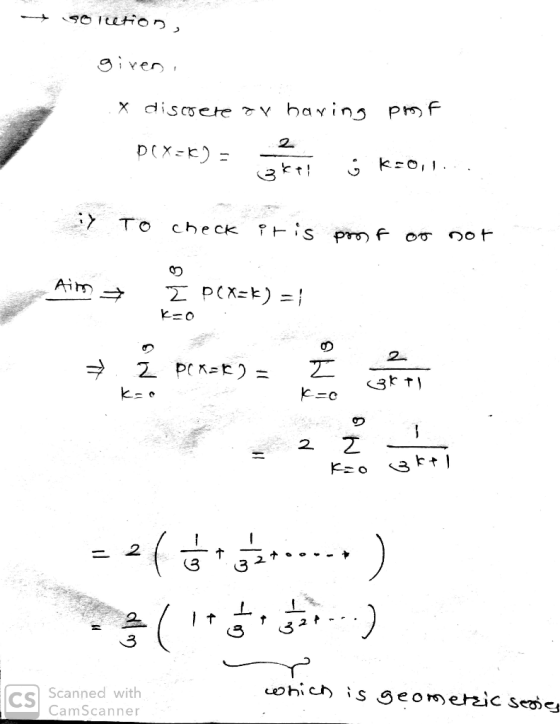
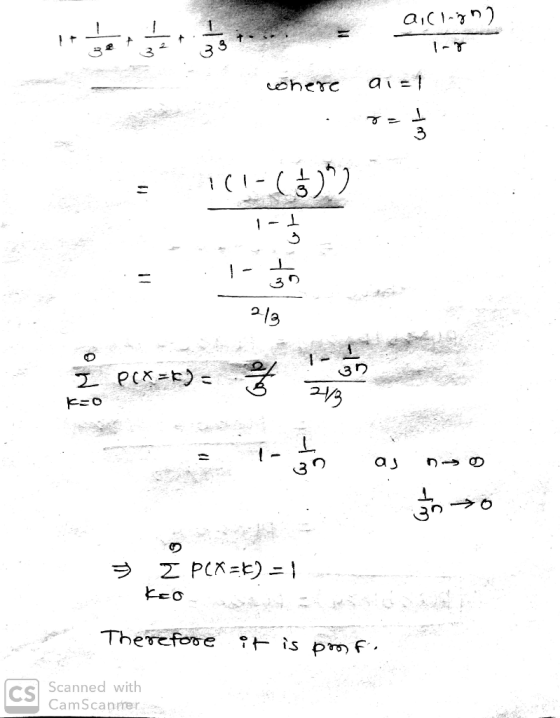
3. Let X be a (discretel) random variable having the following pmf: P(X= k) = ....
2. Let X be an exponential random variable with rate A > 0. In this problem...
 2. Let X be an exponential random variable with rate A > 0. In this problem you will show that X satisfies the memoryless property. Let s 2 0 and t > 0. Show that P(X > t + s| X > s) = e-M
Let X be the random variable with the geometric distribution with parameter 0 < p <...
Let X be the random variable with the geometric distribution with parameter 0 < p < 1. (1) For any integer n ≥ 0, find P(X > n). (2) Show that for any integers m ≥ 0 and n ≥ 0, P(X > n + m|X > m) = P(X > n) (This is called memoryless property since this conditional probability does not depend on m.)
Let X be a discrete random variable with the following PMF. Px(k) = 1/4 for k...
Let X be a discrete random variable with the following PMF. Px(k) = 1/4 for k = -2 1/8 for k = -1 1/8 for k = 0 1/4 for k = 1 1/4 for k = 2 0 otherwise Define a new random variable Y = (X + 1)2 a) Find E[X] and Var[X] b) Find the range of Y and write its PMF. c) Show that the PMF of Y is a valid PMF. d) Find P(Y ≤...
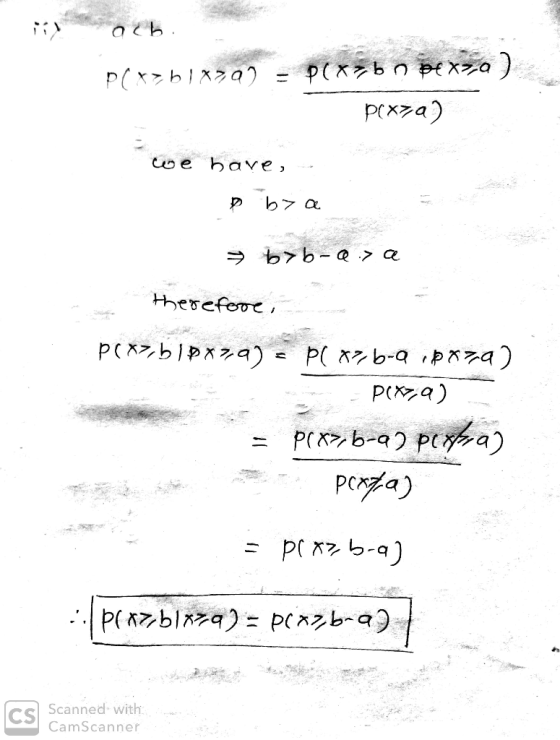
3. Let X be a geometric random variable with parameter p. Prove that P(X >k+r|X >...
 3. Let X be a geometric random variable with parameter p. Prove that P(X >k+r|X > k) = P(X > r). This is called the memoryless property of the geometric random variable.
Let X be a discrete random variable with PMF:
 Let X be a discrete random variable with PMF: a. Find the value of the constant K b. Find P(1 < X ≤ 3)
Problem 8 (10 points). Let X be the random variable with the geometric distribution with parameter...
 Problem 8 (10 points). Let X be the random variable with the geometric distribution with parameter 0 <p <1. (1) For any integer n > 0, find P(X >n). (2) Show that for any integers m > 0 and n > 0, P(X n + m X > m) = P(X>n) (This is called memoryless property since this conditional probability does not depend on m. Dobs inta T obabilita ndomlu abonn liaht bulb indofootin W
11.2 Let X have the Poisson distribution with parameter 2. a) Determine the MGF of X....
 11.2 Let X have the Poisson distribution with parameter 2. a) Determine the MGF of X. Hint: Use the exponential series, Equation (5.26) on page 222 b) Use the result of part (a) to obtain the mean and variance of X. ons, binomial probabilities can -a7k/k!. These quantities are useful The Poisson Distribution From Proposition 5.7, we know that, under certain conditions, binomial be well approximated by quantities of the form e-^1/k!. These in many other contexts. begin, we show...
5. A non-negative valued continuous random variable X satisfies P(X > x +y|X > x) =...
 5. A non-negative valued continuous random variable X satisfies P(X > x +y|X > x) = P(X > y) > 0 for any x,y > 0. (a) Show that P(X > nx) = [P(X > x)]" and P(X > x/m) = [P(X > x)]1/m for positive integers n, m. (b) Show that X~ exponential() for some A > 0.
Problem 1.33. Let X be an exponential random variable with unit rate Fix two positive numbers...
 Problem 1.33. Let X be an exponential random variable with unit rate Fix two positive numbers x and y. Prove that P(X > x+91X > x) P(X > y). This shows that conditioning the exponential clock on not having rung by time r and then restarting the count at that point gives statistically the same exponential clock! This is called the memoriless property of the exponential distribution. The same holds for the geometric distribution.
Let X be a discrete random variable, and let Y X (a) Assume that the PMF...
 Let X be a discrete random variable, and let Y X (a) Assume that the PMF of X is Ka2 0 if x- -3, -2,-1,0,1,2,3 otherwise, where K is a suitable constant. Determine the value of K. (b) For the PMF of X given in part (a) calculate the PMF of Y (c) Give a general formula for the PMF of Y in terms of the PMF of X
 2. Let X be an exponential random variable with rate A > 0. In this problem you will show that X satisfies the memoryless property. Let s 2 0 and t > 0. Show that P(X > t + s| X > s) = e-M
 3. Let X be a geometric random variable with parameter p. Prove that P(X >k+r|X > k) = P(X > r). This is called the memoryless property of the geometric random variable.
 Problem 8 (10 points). Let X be the random variable with the geometric distribution with parameter 0 <p <1. (1) For any integer n > 0, find P(X >n). (2) Show that for any integers m > 0 and n > 0, P(X n + m X > m) = P(X>n) (This is called memoryless property since this conditional probability does not depend on m. Dobs inta T obabilita ndomlu abonn liaht bulb indofootin W
 11.2 Let X have the Poisson distribution with parameter 2. a) Determine the MGF of X. Hint: Use the exponential series, Equation (5.26) on page 222 b) Use the result of part (a) to obtain the mean and variance of X. ons, binomial probabilities can -a7k/k!. These quantities are useful The Poisson Distribution From Proposition 5.7, we know that, under certain conditions, binomial be well approximated by quantities of the form e-^1/k!. These in many other contexts. begin, we show...
 5. A non-negative valued continuous random variable X satisfies P(X > x +y|X > x) = P(X > y) > 0 for any x,y > 0. (a) Show that P(X > nx) = [P(X > x)]" and P(X > x/m) = [P(X > x)]1/m for positive integers n, m. (b) Show that X~ exponential() for some A > 0.
 Problem 1.33. Let X be an exponential random variable with unit rate Fix two positive numbers x and y. Prove that P(X > x+91X > x) P(X > y). This shows that conditioning the exponential clock on not having rung by time r and then restarting the count at that point gives statistically the same exponential clock! This is called the memoriless property of the exponential distribution. The same holds for the geometric distribution.
 Let X be a discrete random variable, and let Y X (a) Assume that the PMF of X is Ka2 0 if x- -3, -2,-1,0,1,2,3 otherwise, where K is a suitable constant. Determine the value of K. (b) For the PMF of X given in part (a) calculate the PMF of Y (c) Give a general formula for the PMF of Y in terms of the PMF of X
Most questions answered within 3 hours.
-
Where is the error in this code sequence?
String s1 = "Hello";
String s2 = "ello";...
asked 10 months ago -
Financial data for Joel de Paris, Inc., for last year
follow:
Joel de Paris, Inc.
Balance...
asked 10 months ago -
Consider this reaction:
Al2(SO4)3 (aq)+ BaCl3
(aq) Al2Cl6 (aq)- +
3BaSO4(s) . What is the...
asked 10 months ago -
Suppose that Savneet is considering increasing her
recent random sample from 20 car rentals to 40...
asked 10 months ago -
Trucks arrive at an unloading terminal at an average rate of 120
per hour.
Trucks arrive...
asked 10 months ago -
Why are methanol and ethanol completely soluble in water while
octanol is not very little soluble....
asked 10 months ago -
A facilities manager at a university reads in a research report
that the mean amount of...
asked 10 months ago -
When the CuSO4 is rehydrated by adding water to the anhydrous
compound, is this an endothermic...
asked 10 months ago -
A ray of sunlight is passing from diamond into crown glass; the
angle of incidence is...
asked 10 months ago -
A block of mass 0.249 kg is placed on top of a light, vertical
spring of...
asked 10 months ago -
how do the kidneys compensate in the presences of acidosis
a) trigger hyperventilate
b) reserve acid...
asked 10 months ago -
Question 501 pts
The rental rate of capital to the firm increases. Which of the
following...
asked 10 months ago