
Homework Answers


Add Answer to:
Reaction is A-->B
is carried out adiabatically in a CSTR. The reaction is second order in...
An acid-catalyzed irreversible liquid-phase reaction A B is carried out adiabatically in a CSTR. The reaction is second...
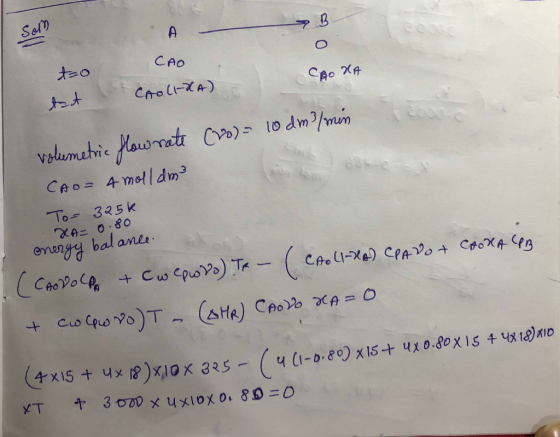
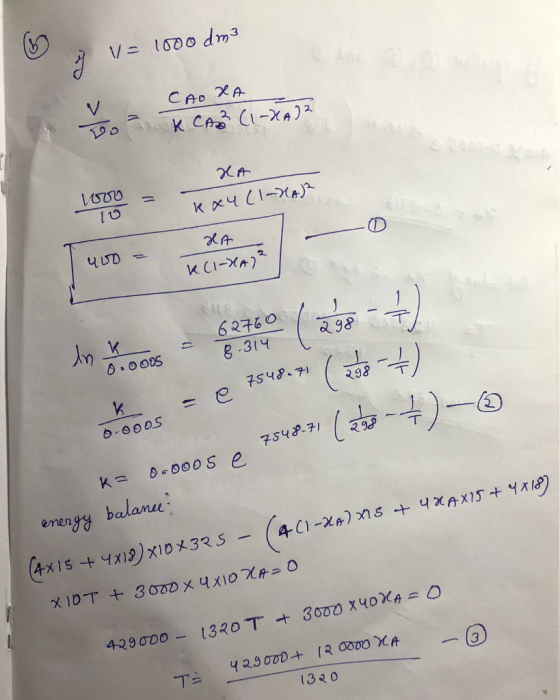
 An acid-catalyzed irreversible liquid-phase reaction A B is carried out adiabatically in a CSTR. The reaction is second order in A. The feed is equimolar A and solvent (S, which contains catalyst), and enters the reactor at a total volumetric flow rate of 10 dm3/min at a concentration of A of 4 mol/L. The feed enters at 300 K. The product and reactant heat capacities are 15 cal/(mol°C), the solvent is 18 cal/(mol°C). The reaction rate constant at 300 K...
21) The following reaction: 4NH3 +502 + 4NO + 6H20 Is carried out adiabatically in a...
 21) The following reaction: 4NH3 +502 + 4NO + 6H20 Is carried out adiabatically in a flow reactor. An equal molar feed in A and B enters at 27 °C, and the volumetric flow rate is 2 dm /s and Cao = 0.1 mol/dm. Calculate the CSTR volume necessary to achieve 85% conversion. Additional Information -41 kcal/mol HR (273) --20 kcal/mol. H (273) -- 15 kcal/mol. HE (273) C = = 15 cal/mol K C = 30 cal/mol K k...
. Question 2: The elementary, reversible, organic, liquid-phase reaction is carried out adiabatically in a CSTR...
 .
Question 2: The elementary, reversible, organic, liquid-phase reaction is carried out adiabatically in a CSTR where 65% conversion is achiewd Ated'anonn of A and 50% excess 8, enters the reactor at 27°C with a volumetric flow rate of 2 L/s and a Cos of O.1 mol/L culate the temperature inside the reactor 2. Calculate the equilibrium conversion at the operating temperature. How close (in 3. Calculate the CSTR volume percentage) the conversion is from the equilsbrium conversion? If the...
.
Question 2: The elementary, reversible, organic, liquid-phase reaction is carried out adiabatically in a CSTR where 65% conversion is achiewd Ated'anonn of A and 50% excess 8, enters the reactor at 27°C with a volumetric flow rate of 2 L/s and a Cos of O.1 mol/L culate the temperature inside the reactor 2. Calculate the equilibrium conversion at the operating temperature. How close (in 3. Calculate the CSTR volume percentage) the conversion is from the equilsbrium conversion? If the...
energy il Camor P5-30 Pressure Drop. The gas phase reaction A+B C+D is carried out isothermally...
 energy il Camor P5-30 Pressure Drop. The gas phase reaction A+B C+D is carried out isothermally at 227 C in a packed-bed reactor with 100 kg of catalyst. The reaction is first order in A and first order in B. The entering pres- sure was 20 atm and the exit pressure is 1 atm. The feed is equal molar in A onigA and B and the flow is in the turbulent regime with FA0 10 mol/min and CAO= 0.25 mol/dm3....
The elementary irreversible organic liquid-phase reaction. a+b==>c is carried out adiabatically in a flow reactor. An...
The elementary irreversible organic liquid-phase reaction. a+b==>c is carried out adiabatically in a flow reactor. An equal molar feed in A and 8 enters at 27'C, and the volumetric flow rate is 2 dm3/sa nd CAo= 0.I k molfm3 graphically.on exal
The irreversible, endothermic, elementary, liquid-phase reaction: 2A ---> B, is carried out adiabatically in a 100 li...
The irreversible, endothermic, elementary, liquid-phase reaction: 2A ---> B, is carried out adiabatically in a 100 liter PRF. Species A and inert liquid are fed to the reactor with concentrations CAo = 1.5 mol/l and CIo = 1.5 mol/l, while FAo=20 mol/min. The entering temperature is 400 K. Calculate the conversion and temperature at the exit of the reactor, given the additional information below: k = 0.0003 l/(mol*min) at 300 K E= 12000 cal/(mol* K) CpA = 10 cal/(mol*K), CpB...
An exothermic elementary reversible isomerisation reaction of A B in liquid phase is carried out adiabatically...
 An exothermic elementary reversible isomerisation reaction of A B in liquid phase is carried out adiabatically in a CSTR. Pure A is fed to the reactor at a concentration of 5 mollitre and feed rate of 500 mol/min. As a researcher you need to analyze the effect of different inlet temperature to the rate of reaction. The inlet temperature is varied at 50°C, 100°C and another two inlets temperature in between 70°C to 90°C. Perform your calculation based on energy...
Problem 2 (30 points) For the gas phase reaction below, calculate the conversion in the CSTR,...
 Problem 2 (30 points) For the gas phase reaction below, calculate the conversion in the CSTR, if weight of catalyst in PFR (Wi) is equal to the weight of the catalyst in CSTR (W2) Note the difference in reaction conditions AB+C FAO = 10mol's CAO 0.1 mol/dm3 T-325 K;E 2500 cal FAO =10mol s CAO 0.1 ol/dm3 T = 350 K What is the conversion of the CSTR?
The first order reaction A rightarrow B is carried out in an adiabatic CSTR with A_A0...
 The first order reaction A rightarrow B is carried out in an adiabatic CSTR with A_A0 = 2 mol/liter and T_0 = 300 degree K. It is found that 50% conversion is obtained with tau (=V/Q) = 4 min, and the reactor temperature is 350 degree K. The reaction rate constant k at 350 degree K is The reaction is in water with rho_C_p = 1000 cal/liter degree K. Find the heat of reaction.
Design a CSTR for the elementary consecutive gas-phase reactions A - B C. Specify the reactor...
 Design a CSTR for the elementary consecutive gas-phase reactions A - B C. Specify the reactor volume and the area of the heating coil inside the reactor for 50% conversion. a. Calculate the desired operating temperature inside the reactor. b. Calculate the volume of the reactor c. Calculate the area of the heating surface. The effluent stream should contain a ratio CB/Cc of 10. The feed is gas-phase and pure A at 400°C and 4 atm, with a molar flow...
 An acid-catalyzed irreversible liquid-phase reaction A B is carried out adiabatically in a CSTR. The reaction is second order in A. The feed is equimolar A and solvent (S, which contains catalyst), and enters the reactor at a total volumetric flow rate of 10 dm3/min at a concentration of A of 4 mol/L. The feed enters at 300 K. The product and reactant heat capacities are 15 cal/(mol°C), the solvent is 18 cal/(mol°C). The reaction rate constant at 300 K...
 21) The following reaction: 4NH3 +502 + 4NO + 6H20 Is carried out adiabatically in a flow reactor. An equal molar feed in A and B enters at 27 °C, and the volumetric flow rate is 2 dm /s and Cao = 0.1 mol/dm. Calculate the CSTR volume necessary to achieve 85% conversion. Additional Information -41 kcal/mol HR (273) --20 kcal/mol. H (273) -- 15 kcal/mol. HE (273) C = = 15 cal/mol K C = 30 cal/mol K k...
 .
Question 2: The elementary, reversible, organic, liquid-phase reaction is carried out adiabatically in a CSTR where 65% conversion is achiewd Ated'anonn of A and 50% excess 8, enters the reactor at 27°C with a volumetric flow rate of 2 L/s and a Cos of O.1 mol/L culate the temperature inside the reactor 2. Calculate the equilibrium conversion at the operating temperature. How close (in 3. Calculate the CSTR volume percentage) the conversion is from the equilsbrium conversion? If the...
.
Question 2: The elementary, reversible, organic, liquid-phase reaction is carried out adiabatically in a CSTR where 65% conversion is achiewd Ated'anonn of A and 50% excess 8, enters the reactor at 27°C with a volumetric flow rate of 2 L/s and a Cos of O.1 mol/L culate the temperature inside the reactor 2. Calculate the equilibrium conversion at the operating temperature. How close (in 3. Calculate the CSTR volume percentage) the conversion is from the equilsbrium conversion? If the...
 energy il Camor P5-30 Pressure Drop. The gas phase reaction A+B C+D is carried out isothermally at 227 C in a packed-bed reactor with 100 kg of catalyst. The reaction is first order in A and first order in B. The entering pres- sure was 20 atm and the exit pressure is 1 atm. The feed is equal molar in A onigA and B and the flow is in the turbulent regime with FA0 10 mol/min and CAO= 0.25 mol/dm3....
 An exothermic elementary reversible isomerisation reaction of A B in liquid phase is carried out adiabatically in a CSTR. Pure A is fed to the reactor at a concentration of 5 mollitre and feed rate of 500 mol/min. As a researcher you need to analyze the effect of different inlet temperature to the rate of reaction. The inlet temperature is varied at 50°C, 100°C and another two inlets temperature in between 70°C to 90°C. Perform your calculation based on energy...
 Problem 2 (30 points) For the gas phase reaction below, calculate the conversion in the CSTR, if weight of catalyst in PFR (Wi) is equal to the weight of the catalyst in CSTR (W2) Note the difference in reaction conditions AB+C FAO = 10mol's CAO 0.1 mol/dm3 T-325 K;E 2500 cal FAO =10mol s CAO 0.1 ol/dm3 T = 350 K What is the conversion of the CSTR?
 The first order reaction A rightarrow B is carried out in an adiabatic CSTR with A_A0 = 2 mol/liter and T_0 = 300 degree K. It is found that 50% conversion is obtained with tau (=V/Q) = 4 min, and the reactor temperature is 350 degree K. The reaction rate constant k at 350 degree K is The reaction is in water with rho_C_p = 1000 cal/liter degree K. Find the heat of reaction.
 Design a CSTR for the elementary consecutive gas-phase reactions A - B C. Specify the reactor volume and the area of the heating coil inside the reactor for 50% conversion. a. Calculate the desired operating temperature inside the reactor. b. Calculate the volume of the reactor c. Calculate the area of the heating surface. The effluent stream should contain a ratio CB/Cc of 10. The feed is gas-phase and pure A at 400°C and 4 atm, with a molar flow...
Most questions answered within 3 hours.
-
Where is the error in this code sequence?
String s1 = "Hello";
String s2 = "ello";...
asked 10 months ago -
Financial data for Joel de Paris, Inc., for last year
follow:
Joel de Paris, Inc.
Balance...
asked 10 months ago -
Consider this reaction:
Al2(SO4)3 (aq)+ BaCl3
(aq) Al2Cl6 (aq)- +
3BaSO4(s) . What is the...
asked 10 months ago -
Suppose that Savneet is considering increasing her
recent random sample from 20 car rentals to 40...
asked 10 months ago -
Trucks arrive at an unloading terminal at an average rate of 120
per hour.
Trucks arrive...
asked 10 months ago -
Why are methanol and ethanol completely soluble in water while
octanol is not very little soluble....
asked 10 months ago -
A facilities manager at a university reads in a research report
that the mean amount of...
asked 10 months ago -
When the CuSO4 is rehydrated by adding water to the anhydrous
compound, is this an endothermic...
asked 10 months ago -
A ray of sunlight is passing from diamond into crown glass; the
angle of incidence is...
asked 10 months ago -
A block of mass 0.249 kg is placed on top of a light, vertical
spring of...
asked 10 months ago -
how do the kidneys compensate in the presences of acidosis
a) trigger hyperventilate
b) reserve acid...
asked 10 months ago -
Question 501 pts
The rental rate of capital to the firm increases. Which of the
following...
asked 10 months ago