
Homework Answers
Add Answer to:
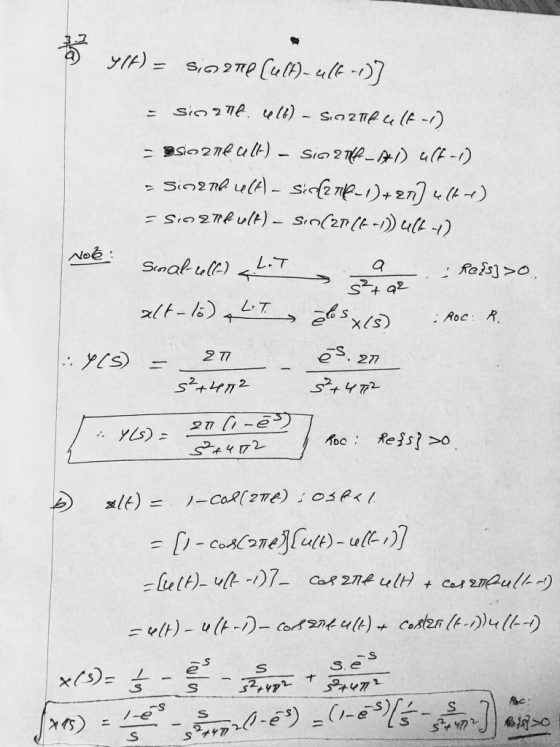
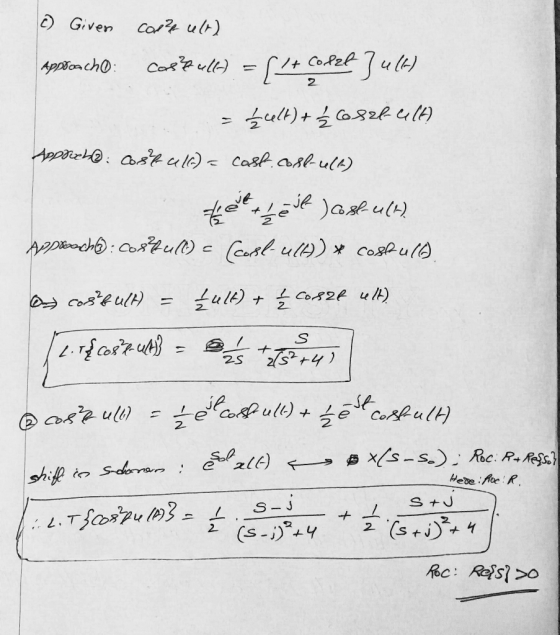
Please answer the A,b, and C in clear handwriting.
Consider the following cases involving sinusoids: (a)...
please solve this with clear answer and details Find the Laplace transform of the following signals...
 please solve this with clear answer and details
Find the Laplace transform of the following signals and in each case determine the corresponding region of convergence: 3.4 (a) (b) the signal x(t)=e-ulu(t)-eatu-t)when (i) α > 0, (ii) α→0, a sampled signal Xi (t) = e (t n) CHAPTER 3: The Laplace Transform (c) the "stairs to heaven" signal (d) the sinusoidal signal r(t) [cos(2(1-1)) + sin(2π1)]a(1-1), (e) the signal y(t)=t2e-21 u(t) using that x(t)=tathasx(s)=2/s. Answers: (a) As α → 0,x(t)...
please solve this with clear answer and details
Find the Laplace transform of the following signals and in each case determine the corresponding region of convergence: 3.4 (a) (b) the signal x(t)=e-ulu(t)-eatu-t)when (i) α > 0, (ii) α→0, a sampled signal Xi (t) = e (t n) CHAPTER 3: The Laplace Transform (c) the "stairs to heaven" signal (d) the sinusoidal signal r(t) [cos(2(1-1)) + sin(2π1)]a(1-1), (e) the signal y(t)=t2e-21 u(t) using that x(t)=tathasx(s)=2/s. Answers: (a) As α → 0,x(t)...
part c) Figure 1 5 ma Pag c) The zero-pole diagram of the Laplace transform of y(t), Y(s), is shown in fig. 2 jw Figure 2 [Please turn over] Page 2 of 9 Determine and justify the region of converg...
 part c)
Figure 1 5 ma Pag c) The zero-pole diagram of the Laplace transform of y(t), Y(s), is shown in fig. 2 jw Figure 2 [Please turn over] Page 2 of 9 Determine and justify the region of convergence (ROC) ifit is known that Y(Go), that is the Fourier transform of y(t), exists. 5 marks/
Figure 1 5 ma Pag c) The zero-pole diagram of the Laplace transform of y(t), Y(s), is shown in fig. 2 jw Figure 2...
part c)
Figure 1 5 ma Pag c) The zero-pole diagram of the Laplace transform of y(t), Y(s), is shown in fig. 2 jw Figure 2 [Please turn over] Page 2 of 9 Determine and justify the region of convergence (ROC) ifit is known that Y(Go), that is the Fourier transform of y(t), exists. 5 marks/
Figure 1 5 ma Pag c) The zero-pole diagram of the Laplace transform of y(t), Y(s), is shown in fig. 2 jw Figure 2...
**please provide a full and clear handwriting answer ** Double check your answer to make sure...
 **please provide a full and clear handwriting
answer
** Double check your answer to make sure it's %100
correct
8. [10] For the circuit shown, find y(t) using Laplace transform techniques. Assume the initial conditions to be: vel (0-) = 1V, V.2 (0-)=-3V, 112 (0-) = 1mA C1 HI 1uF R6 R4 W 1kΩ Hy(t) 1kΩ x(t) L2 1mH C2 :10F —12V
**please provide a full and clear handwriting
answer
** Double check your answer to make sure it's %100
correct
8. [10] For the circuit shown, find y(t) using Laplace transform techniques. Assume the initial conditions to be: vel (0-) = 1V, V.2 (0-)=-3V, 112 (0-) = 1mA C1 HI 1uF R6 R4 W 1kΩ Hy(t) 1kΩ x(t) L2 1mH C2 :10F —12V
Please answer all questions with math detail 3. (21 points) Laplace Transform (a) (15 points) Find...
 Please answer all questions with math detail
3. (21 points) Laplace Transform (a) (15 points) Find the Laplace transforms of the following signals and determine their region of convergence sinwot)-iu i. f(t) -i, e-2(t-3 2<t otherwise (b) (6 points) The Laplace transform of a causal signal x(t) is given by X (s) = s2 , ROC: Re{s) > -1 Which of the following Fourier transforms can be obtained from X(s) without actu- ally determining the signal x(t)? In each case,...
Please answer all questions with math detail
3. (21 points) Laplace Transform (a) (15 points) Find the Laplace transforms of the following signals and determine their region of convergence sinwot)-iu i. f(t) -i, e-2(t-3 2<t otherwise (b) (6 points) The Laplace transform of a causal signal x(t) is given by X (s) = s2 , ROC: Re{s) > -1 Which of the following Fourier transforms can be obtained from X(s) without actu- ally determining the signal x(t)? In each case,...
b) Present your answer in part (a) in closed form c) What is the region of convergence (ROC)? Please do a, b, and c and show work please! Problem 1 Consider the foll o...
 b) Present your
answer in part (a)
in closed form
c) What is the
region of convergence
(ROC)?
Please do a, b, and c and show work please!
Problem 1 Consider the foll owing waveform: rn 0 I1 TI 9 12 3 a) Find the z- transform of the following waveform. (8 points)
Problem 1 Consider the foll owing waveform: rn 0 I1 TI 9 12 3 a) Find the z- transform of the following waveform. (8 points)
b) Present your
answer in part (a)
in closed form
c) What is the
region of convergence
(ROC)?
Please do a, b, and c and show work please!
Problem 1 Consider the foll owing waveform: rn 0 I1 TI 9 12 3 a) Find the z- transform of the following waveform. (8 points)
Problem 1 Consider the foll owing waveform: rn 0 I1 TI 9 12 3 a) Find the z- transform of the following waveform. (8 points)
Q1 Write the following function in terms of unit step functions. Hence, find its Laplace transform...
 Q1 Write the following function in terms of unit step functions. Hence, find its Laplace transform 10<tsI g(t) = le-3, +1 , 1<t 2 .22 Q2 Use Laplace transform to solve the following initial value problem: yty(o)-0 and y (0)-2 A function f(x) is periodic of period 2π and is defined by Q3 Sketch the graph of f(x) from x-2t to2 and prove that 2sinh π11 f(x)- Q4 Consider the function f(x)=2x, 0<x<1 Find the a Fourier cosine series b)...
Please answer very good and with clear hand writing for signals and systems thanks Let a...
 Please answer very good and with clear hand writing for
signals and systems thanks
Let a periodic signal x(t) with a fundamental frequency ?,-2n have a period 4.6 x1(t) = t(u(t)--u(t-1)] (a) Plot x(t), and indicate its fundamental period To Compute the Fourier series coefficients of x(t) using their integral definition. (b) (c) Use the Laplace transform to compute the Fourier series coefficients (d) Suppose that y(t) = dx(t)/dt, find the Fourier transform of x(t) by Answers: x(t) is periodic...
Please answer very good and with clear hand writing for
signals and systems thanks
Let a periodic signal x(t) with a fundamental frequency ?,-2n have a period 4.6 x1(t) = t(u(t)--u(t-1)] (a) Plot x(t), and indicate its fundamental period To Compute the Fourier series coefficients of x(t) using their integral definition. (b) (c) Use the Laplace transform to compute the Fourier series coefficients (d) Suppose that y(t) = dx(t)/dt, find the Fourier transform of x(t) by Answers: x(t) is periodic...
Please answer the blamnks. Thank you. (1 point) Use the Laplace transform to solve the following...
 Please answer the blamnks.
Thank you.
(1 point) Use the Laplace transform to solve the following initial value problem: y6y9y 0,with y(0) 1, y (0) = -4 First, using Y for the Laplace transform of y(t), i.e., Y = L{y(t)} find the equation you get by taking the Laplace transform of the differential equation =0 Now solve for Y(s) = and write the above answer in its partial fraction decomposition, A Y(s) (s+a} s+a Y(s) Now by inverting the transform,...
Please answer the blamnks.
Thank you.
(1 point) Use the Laplace transform to solve the following initial value problem: y6y9y 0,with y(0) 1, y (0) = -4 First, using Y for the Laplace transform of y(t), i.e., Y = L{y(t)} find the equation you get by taking the Laplace transform of the differential equation =0 Now solve for Y(s) = and write the above answer in its partial fraction decomposition, A Y(s) (s+a} s+a Y(s) Now by inverting the transform,...
Can you please help me answer Task 2.b? Please show all work. fs=44100; no_pts=8192; t=([0:no_pts-1]')/fs; y1=sin(2...
 Can you please help me answer Task 2.b?
Please show all work.
fs=44100; no_pts=8192;
t=([0:no_pts-1]')/fs;
y1=sin(2*pi*1000*t);
figure;
plot(t,y1);
xlabel('t (second)')
ylabel('y(t)')
axis([0,.004,-1.2,1.2]) % constrain axis so you can actually see
the wave
sound(y1,fs); % play sound using windows driver.
%%
% Check the frequency domain signal. fr is the frequency vector and
f1 is the magnitude of F{y1}.
fr=([0:no_pts-1]')/no_pts*fs; %in Hz
fr=fr(1:no_pts/2); % single-sided spectrum
f1=abs(fft(y1)); % compute fft
f1=f1(1:no_pts/2)/fs;
%%
% F is the continuous time Fourier. (See derivation...
Can you please help me answer Task 2.b?
Please show all work.
fs=44100; no_pts=8192;
t=([0:no_pts-1]')/fs;
y1=sin(2*pi*1000*t);
figure;
plot(t,y1);
xlabel('t (second)')
ylabel('y(t)')
axis([0,.004,-1.2,1.2]) % constrain axis so you can actually see
the wave
sound(y1,fs); % play sound using windows driver.
%%
% Check the frequency domain signal. fr is the frequency vector and
f1 is the magnitude of F{y1}.
fr=([0:no_pts-1]')/no_pts*fs; %in Hz
fr=fr(1:no_pts/2); % single-sided spectrum
f1=abs(fft(y1)); % compute fft
f1=f1(1:no_pts/2)/fs;
%%
% F is the continuous time Fourier. (See derivation...
 please solve this with clear answer and details
Find the Laplace transform of the following signals and in each case determine the corresponding region of convergence: 3.4 (a) (b) the signal x(t)=e-ulu(t)-eatu-t)when (i) α > 0, (ii) α→0, a sampled signal Xi (t) = e (t n) CHAPTER 3: The Laplace Transform (c) the "stairs to heaven" signal (d) the sinusoidal signal r(t) [cos(2(1-1)) + sin(2π1)]a(1-1), (e) the signal y(t)=t2e-21 u(t) using that x(t)=tathasx(s)=2/s. Answers: (a) As α → 0,x(t)...
please solve this with clear answer and details
Find the Laplace transform of the following signals and in each case determine the corresponding region of convergence: 3.4 (a) (b) the signal x(t)=e-ulu(t)-eatu-t)when (i) α > 0, (ii) α→0, a sampled signal Xi (t) = e (t n) CHAPTER 3: The Laplace Transform (c) the "stairs to heaven" signal (d) the sinusoidal signal r(t) [cos(2(1-1)) + sin(2π1)]a(1-1), (e) the signal y(t)=t2e-21 u(t) using that x(t)=tathasx(s)=2/s. Answers: (a) As α → 0,x(t)...
 part c)
Figure 1 5 ma Pag c) The zero-pole diagram of the Laplace transform of y(t), Y(s), is shown in fig. 2 jw Figure 2 [Please turn over] Page 2 of 9 Determine and justify the region of convergence (ROC) ifit is known that Y(Go), that is the Fourier transform of y(t), exists. 5 marks/
Figure 1 5 ma Pag c) The zero-pole diagram of the Laplace transform of y(t), Y(s), is shown in fig. 2 jw Figure 2...
part c)
Figure 1 5 ma Pag c) The zero-pole diagram of the Laplace transform of y(t), Y(s), is shown in fig. 2 jw Figure 2 [Please turn over] Page 2 of 9 Determine and justify the region of convergence (ROC) ifit is known that Y(Go), that is the Fourier transform of y(t), exists. 5 marks/
Figure 1 5 ma Pag c) The zero-pole diagram of the Laplace transform of y(t), Y(s), is shown in fig. 2 jw Figure 2...
 **please provide a full and clear handwriting
answer
** Double check your answer to make sure it's %100
correct
8. [10] For the circuit shown, find y(t) using Laplace transform techniques. Assume the initial conditions to be: vel (0-) = 1V, V.2 (0-)=-3V, 112 (0-) = 1mA C1 HI 1uF R6 R4 W 1kΩ Hy(t) 1kΩ x(t) L2 1mH C2 :10F —12V
**please provide a full and clear handwriting
answer
** Double check your answer to make sure it's %100
correct
8. [10] For the circuit shown, find y(t) using Laplace transform techniques. Assume the initial conditions to be: vel (0-) = 1V, V.2 (0-)=-3V, 112 (0-) = 1mA C1 HI 1uF R6 R4 W 1kΩ Hy(t) 1kΩ x(t) L2 1mH C2 :10F —12V
 Please answer all questions with math detail
3. (21 points) Laplace Transform (a) (15 points) Find the Laplace transforms of the following signals and determine their region of convergence sinwot)-iu i. f(t) -i, e-2(t-3 2<t otherwise (b) (6 points) The Laplace transform of a causal signal x(t) is given by X (s) = s2 , ROC: Re{s) > -1 Which of the following Fourier transforms can be obtained from X(s) without actu- ally determining the signal x(t)? In each case,...
Please answer all questions with math detail
3. (21 points) Laplace Transform (a) (15 points) Find the Laplace transforms of the following signals and determine their region of convergence sinwot)-iu i. f(t) -i, e-2(t-3 2<t otherwise (b) (6 points) The Laplace transform of a causal signal x(t) is given by X (s) = s2 , ROC: Re{s) > -1 Which of the following Fourier transforms can be obtained from X(s) without actu- ally determining the signal x(t)? In each case,...
 b) Present your
answer in part (a)
in closed form
c) What is the
region of convergence
(ROC)?
Please do a, b, and c and show work please!
Problem 1 Consider the foll owing waveform: rn 0 I1 TI 9 12 3 a) Find the z- transform of the following waveform. (8 points)
Problem 1 Consider the foll owing waveform: rn 0 I1 TI 9 12 3 a) Find the z- transform of the following waveform. (8 points)
b) Present your
answer in part (a)
in closed form
c) What is the
region of convergence
(ROC)?
Please do a, b, and c and show work please!
Problem 1 Consider the foll owing waveform: rn 0 I1 TI 9 12 3 a) Find the z- transform of the following waveform. (8 points)
Problem 1 Consider the foll owing waveform: rn 0 I1 TI 9 12 3 a) Find the z- transform of the following waveform. (8 points)
 Q1 Write the following function in terms of unit step functions. Hence, find its Laplace transform 10<tsI g(t) = le-3, +1 , 1<t 2 .22 Q2 Use Laplace transform to solve the following initial value problem: yty(o)-0 and y (0)-2 A function f(x) is periodic of period 2π and is defined by Q3 Sketch the graph of f(x) from x-2t to2 and prove that 2sinh π11 f(x)- Q4 Consider the function f(x)=2x, 0<x<1 Find the a Fourier cosine series b)...
 Please answer very good and with clear hand writing for
signals and systems thanks
Let a periodic signal x(t) with a fundamental frequency ?,-2n have a period 4.6 x1(t) = t(u(t)--u(t-1)] (a) Plot x(t), and indicate its fundamental period To Compute the Fourier series coefficients of x(t) using their integral definition. (b) (c) Use the Laplace transform to compute the Fourier series coefficients (d) Suppose that y(t) = dx(t)/dt, find the Fourier transform of x(t) by Answers: x(t) is periodic...
Please answer very good and with clear hand writing for
signals and systems thanks
Let a periodic signal x(t) with a fundamental frequency ?,-2n have a period 4.6 x1(t) = t(u(t)--u(t-1)] (a) Plot x(t), and indicate its fundamental period To Compute the Fourier series coefficients of x(t) using their integral definition. (b) (c) Use the Laplace transform to compute the Fourier series coefficients (d) Suppose that y(t) = dx(t)/dt, find the Fourier transform of x(t) by Answers: x(t) is periodic...
 Please answer the blamnks.
Thank you.
(1 point) Use the Laplace transform to solve the following initial value problem: y6y9y 0,with y(0) 1, y (0) = -4 First, using Y for the Laplace transform of y(t), i.e., Y = L{y(t)} find the equation you get by taking the Laplace transform of the differential equation =0 Now solve for Y(s) = and write the above answer in its partial fraction decomposition, A Y(s) (s+a} s+a Y(s) Now by inverting the transform,...
Please answer the blamnks.
Thank you.
(1 point) Use the Laplace transform to solve the following initial value problem: y6y9y 0,with y(0) 1, y (0) = -4 First, using Y for the Laplace transform of y(t), i.e., Y = L{y(t)} find the equation you get by taking the Laplace transform of the differential equation =0 Now solve for Y(s) = and write the above answer in its partial fraction decomposition, A Y(s) (s+a} s+a Y(s) Now by inverting the transform,...
 Can you please help me answer Task 2.b?
Please show all work.
fs=44100; no_pts=8192;
t=([0:no_pts-1]')/fs;
y1=sin(2*pi*1000*t);
figure;
plot(t,y1);
xlabel('t (second)')
ylabel('y(t)')
axis([0,.004,-1.2,1.2]) % constrain axis so you can actually see
the wave
sound(y1,fs); % play sound using windows driver.
%%
% Check the frequency domain signal. fr is the frequency vector and
f1 is the magnitude of F{y1}.
fr=([0:no_pts-1]')/no_pts*fs; %in Hz
fr=fr(1:no_pts/2); % single-sided spectrum
f1=abs(fft(y1)); % compute fft
f1=f1(1:no_pts/2)/fs;
%%
% F is the continuous time Fourier. (See derivation...
Can you please help me answer Task 2.b?
Please show all work.
fs=44100; no_pts=8192;
t=([0:no_pts-1]')/fs;
y1=sin(2*pi*1000*t);
figure;
plot(t,y1);
xlabel('t (second)')
ylabel('y(t)')
axis([0,.004,-1.2,1.2]) % constrain axis so you can actually see
the wave
sound(y1,fs); % play sound using windows driver.
%%
% Check the frequency domain signal. fr is the frequency vector and
f1 is the magnitude of F{y1}.
fr=([0:no_pts-1]')/no_pts*fs; %in Hz
fr=fr(1:no_pts/2); % single-sided spectrum
f1=abs(fft(y1)); % compute fft
f1=f1(1:no_pts/2)/fs;
%%
% F is the continuous time Fourier. (See derivation...
Most questions answered within 3 hours.
-
Where is the error in this code sequence?
String s1 = "Hello";
String s2 = "ello";...
asked 10 months ago -
Financial data for Joel de Paris, Inc., for last year
follow:
Joel de Paris, Inc.
Balance...
asked 10 months ago -
Consider this reaction:
Al2(SO4)3 (aq)+ BaCl3
(aq) Al2Cl6 (aq)- +
3BaSO4(s) . What is the...
asked 10 months ago -
Suppose that Savneet is considering increasing her
recent random sample from 20 car rentals to 40...
asked 10 months ago -
Trucks arrive at an unloading terminal at an average rate of 120
per hour.
Trucks arrive...
asked 10 months ago -
Why are methanol and ethanol completely soluble in water while
octanol is not very little soluble....
asked 10 months ago -
A facilities manager at a university reads in a research report
that the mean amount of...
asked 10 months ago -
When the CuSO4 is rehydrated by adding water to the anhydrous
compound, is this an endothermic...
asked 10 months ago -
A ray of sunlight is passing from diamond into crown glass; the
angle of incidence is...
asked 10 months ago -
A block of mass 0.249 kg is placed on top of a light, vertical
spring of...
asked 10 months ago -
how do the kidneys compensate in the presences of acidosis
a) trigger hyperventilate
b) reserve acid...
asked 10 months ago -
Question 501 pts
The rental rate of capital to the firm increases. Which of the
following...
asked 10 months ago