
Homework Answers
Answer: This is the correct order from first step to the last.
| 1 | DNA gyrase removes the DNA supercoils |
| 2 | DNA helicase unwinds the DNA double helix |
| 3 | Binding proteins stabilize the unwound double helix |
| 4 | Primase generates a RNA primer that binds to the origin |
| 5 | DNA pol III adds complementary nucleotides |
| 6 | DNA pol I replaces the RNA primer |
| 7 | DNA ligase seals any nicks in the DNA |
| 8 | Topoisomerase IV separates linked chromosomes |
Explanation:
1.) DNA before replication is in supercoiled state. DNA gyrase removes the DNA from supercoiling state.
2.) The DNA is is double stranded helix. So, it needs to be unwound in order to initiate the replication. DNA helicase unwinds this double stranded DNA.
3.) Single stranded binding proteins does not allow the bases again to anneal and also prevents degradation. This was it stabilizes the DNA in unwinded stage.
4.) Primase lays down the RNA nucleotides so that the DNA polymerization can begin.
5.) DNA polymerase III is responsible for the addition of DNA nucleotides in the 5' to 3' direction in the growing strand.
6.) DNA polymerase I remove the RNA primer and adds the DNA nucleotides instead.
7.) DNA nucleotides added have some gaps in between. Ligase fills the gap in the DNA.
8.) As there are multiple forks during the DNA replication, the resulting chromosomes will be linked together. So an enzyme is required to separate linked chromosomes. Topoisomerase IV enzyme is responsible for this.
Add Answer to:
Place the items below in the correct order by dragging each item box and placing it...
In order Assume that an economy produces only two goods, pizza and wings. Place the events...
 In order
Assume that an economy produces only two goods, pizza and wings. Place the events in order, to show how an improvement in pizza-making technology would lead to an incre production. ase in wing Start by clicking the first item in the sequence or dragging it here Drog the items below into the box above in the correct order, storting with the first item in the sequence More workers making wings means increaSed wing production. Workers are available to...
In order
Assume that an economy produces only two goods, pizza and wings. Place the events in order, to show how an improvement in pizza-making technology would lead to an incre production. ase in wing Start by clicking the first item in the sequence or dragging it here Drog the items below into the box above in the correct order, storting with the first item in the sequence More workers making wings means increaSed wing production. Workers are available to...
my work Drag each item to the correct box. Arrange the following solutions in order of...
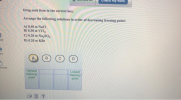 my work Drag each item to the correct box. Arrange the following solutions in order of decreasing freezing point: A) 0.40 m NaCl B) 0.30 m VCI C) 0.20 m Na, D) 0.20 m KBT ok int B ences Highest freezing point Lowest freezing point
Homework Saved Drag each item to the correct box. Arrange the following salts in order of...
 Homework Saved Drag each item to the correct box. Arrange the following salts in order of increasing molar solubility in 0.0010 M AgNO: AgBr. As.CO. AgCl, Agl, Ag, S. A) Ag! B) AgCI C) Ag, D) AgBr E) Ag2CO 34:30 © © © © © Least soluble Most soluble o ?
In each reaction box, place the best reagent and conditions from the list below. In each reaction box, place the best...
 In each reaction box, place the best reagent and conditions from
the list below.
In each reaction box, place the best reagent and conditions from the list below. In each reaction box, place the best reagent and conditions from the list below.
In each reaction box, place the best reagent and conditions from
the list below.
In each reaction box, place the best reagent and conditions from the list below. In each reaction box, place the best reagent and conditions from the list below.
Construct a multistep synthetic route from ethylbenzene to (2-bromoethyl)benzene by dragging the appropriate items into...
Construct a multistep synthetic route from ethylbenzene to (2-bromoethyl)benzene by dragging the appropriate items into the bins. Note that each bin will hold only one item, and not all reagents and structures will be used.
In each reaction box, place the best reagent and conditions from the list below. In each reaction box, place the b...
 In each reaction box, place the best reagent and conditions from
the list below.
In each reaction box, place the best reagent and conditions from the list below.
In each reaction box, place the best reagent and conditions from
the list below.
In each reaction box, place the best reagent and conditions from the list below.
In each reaction box, place the best reagent and conditions from the list below. In each reaction box, place the bes...
 In each reaction box, place the best reagent and conditions from
the list below.
In each reaction box, place the best reagent and conditions from the list below.
In each reaction box, place the best reagent and conditions from
the list below.
In each reaction box, place the best reagent and conditions from the list below.
In each reaction box, place the best reagent and conditions from the list below. In each reaction box, place the b...
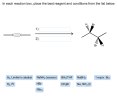 In each reaction box, place the best reagent and conditions from
the list below.
In each reaction box, place the best reagent and conditions from the list below.
In each reaction box, place the best reagent and conditions from
the list below.
In each reaction box, place the best reagent and conditions from the list below.
In each reaction box, place the best reagent and conditions from the list below. (bromine) In each reaction box, place...
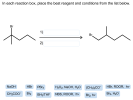 In each reaction box, place the best reagent and conditions from
the list below. (bromine)
In each reaction box, place the best reagent and conditions from the list below.
In each reaction box, place the best reagent and conditions from
the list below. (bromine)
In each reaction box, place the best reagent and conditions from the list below.
In each reaction box, place the best reagent and conditions from the list below. In each reaction box, place the best...
 In each reaction box, place
the best reagent and conditions from the list below.
In each reaction box, place the best reagent and conditions from the list below. You are correct that the third step is a reduction of 2-pentyne. But H2 with a platinum catalyst will reduce it to pentane, while you need an alkene for the next step. NaNH H3C OH HO 2) CH3CH2Br CEC H3C CH3. H3C H2, Pt HO 4) KMno 4, NaOH, H20, cold BH3...
In each reaction box, place
the best reagent and conditions from the list below.
In each reaction box, place the best reagent and conditions from the list below. You are correct that the third step is a reduction of 2-pentyne. But H2 with a platinum catalyst will reduce it to pentane, while you need an alkene for the next step. NaNH H3C OH HO 2) CH3CH2Br CEC H3C CH3. H3C H2, Pt HO 4) KMno 4, NaOH, H20, cold BH3...
 In order
Assume that an economy produces only two goods, pizza and wings. Place the events in order, to show how an improvement in pizza-making technology would lead to an incre production. ase in wing Start by clicking the first item in the sequence or dragging it here Drog the items below into the box above in the correct order, storting with the first item in the sequence More workers making wings means increaSed wing production. Workers are available to...
In order
Assume that an economy produces only two goods, pizza and wings. Place the events in order, to show how an improvement in pizza-making technology would lead to an incre production. ase in wing Start by clicking the first item in the sequence or dragging it here Drog the items below into the box above in the correct order, storting with the first item in the sequence More workers making wings means increaSed wing production. Workers are available to...
 my work Drag each item to the correct box. Arrange the following solutions in order of decreasing freezing point: A) 0.40 m NaCl B) 0.30 m VCI C) 0.20 m Na, D) 0.20 m KBT ok int B ences Highest freezing point Lowest freezing point
 Homework Saved Drag each item to the correct box. Arrange the following salts in order of increasing molar solubility in 0.0010 M AgNO: AgBr. As.CO. AgCl, Agl, Ag, S. A) Ag! B) AgCI C) Ag, D) AgBr E) Ag2CO 34:30 © © © © © Least soluble Most soluble o ?
 In each reaction box, place the best reagent and conditions from
the list below.
In each reaction box, place the best reagent and conditions from the list below. In each reaction box, place the best reagent and conditions from the list below.
In each reaction box, place the best reagent and conditions from
the list below.
In each reaction box, place the best reagent and conditions from the list below. In each reaction box, place the best reagent and conditions from the list below.
 In each reaction box, place the best reagent and conditions from
the list below.
In each reaction box, place the best reagent and conditions from the list below.
In each reaction box, place the best reagent and conditions from
the list below.
In each reaction box, place the best reagent and conditions from the list below.
 In each reaction box, place the best reagent and conditions from
the list below.
In each reaction box, place the best reagent and conditions from the list below.
In each reaction box, place the best reagent and conditions from
the list below.
In each reaction box, place the best reagent and conditions from the list below.
 In each reaction box, place the best reagent and conditions from
the list below.
In each reaction box, place the best reagent and conditions from the list below.
In each reaction box, place the best reagent and conditions from
the list below.
In each reaction box, place the best reagent and conditions from the list below.
 In each reaction box, place the best reagent and conditions from
the list below. (bromine)
In each reaction box, place the best reagent and conditions from the list below.
In each reaction box, place the best reagent and conditions from
the list below. (bromine)
In each reaction box, place the best reagent and conditions from the list below.
 In each reaction box, place
the best reagent and conditions from the list below.
In each reaction box, place the best reagent and conditions from the list below. You are correct that the third step is a reduction of 2-pentyne. But H2 with a platinum catalyst will reduce it to pentane, while you need an alkene for the next step. NaNH H3C OH HO 2) CH3CH2Br CEC H3C CH3. H3C H2, Pt HO 4) KMno 4, NaOH, H20, cold BH3...
In each reaction box, place
the best reagent and conditions from the list below.
In each reaction box, place the best reagent and conditions from the list below. You are correct that the third step is a reduction of 2-pentyne. But H2 with a platinum catalyst will reduce it to pentane, while you need an alkene for the next step. NaNH H3C OH HO 2) CH3CH2Br CEC H3C CH3. H3C H2, Pt HO 4) KMno 4, NaOH, H20, cold BH3...
Most questions answered within 3 hours.
-
Where is the error in this code sequence?
String s1 = "Hello";
String s2 = "ello";...
asked 11 months ago -
Financial data for Joel de Paris, Inc., for last year
follow:
Joel de Paris, Inc.
Balance...
asked 11 months ago -
Consider this reaction:
Al2(SO4)3 (aq)+ BaCl3
(aq) Al2Cl6 (aq)- +
3BaSO4(s) . What is the...
asked 11 months ago -
Suppose that Savneet is considering increasing her
recent random sample from 20 car rentals to 40...
asked 11 months ago -
Trucks arrive at an unloading terminal at an average rate of 120
per hour.
Trucks arrive...
asked 11 months ago -
Why are methanol and ethanol completely soluble in water while
octanol is not very little soluble....
asked 11 months ago -
A facilities manager at a university reads in a research report
that the mean amount of...
asked 11 months ago -
When the CuSO4 is rehydrated by adding water to the anhydrous
compound, is this an endothermic...
asked 11 months ago -
A ray of sunlight is passing from diamond into crown glass; the
angle of incidence is...
asked 11 months ago -
A block of mass 0.249 kg is placed on top of a light, vertical
spring of...
asked 11 months ago -
how do the kidneys compensate in the presences of acidosis
a) trigger hyperventilate
b) reserve acid...
asked 11 months ago -
Question 501 pts
The rental rate of capital to the firm increases. Which of the
following...
asked 11 months ago