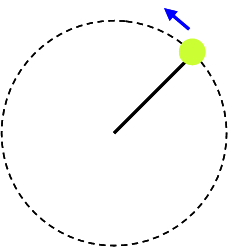
A tennis ball connected to a string is spun around in a vertical, circular path at a uniform speed. The ball has a mass m = 0.175 kg and moves at v = 5.22 m/s. The circular path has a radius of R = 1.14 m
1.What is the magnitude of the tension in the string when the ball is at the bottom of the circle?
2.What is the magnitude of the tension in the string when the ball is at the side of the circle?
3.What is the magnitude of the tension in the string when the ball is at the top of the circle?
4.What is the minimum velocity so the string will not go slack as the ball moves around the circle?
Homework Answers
Centripetal Force (C) = mv^2/r = (0.175)*(5.22)^2 * (1/1.14) =
4.18286N
Gravitational force (mg) = 0.175*9.81 = 1.71675 N
1. ball is at the bottom : Tension = C+mg = 5.899N
2. ball is at the side : Tension = C = 4.182866N
3 . At the top : Tension = C-mg = 2.46611 N
minimum velocity : v^2 / r = g or v = sqrt(rg) = sqrt ( 1.14*9.81)
= 3.3441m/s
a) T - mg = M*v*v/R
T = mg + m*v*v/R = 5.9 N
b) T = m*v*v/R = 4.18 N
c) T + mg = m*v*v/R
T = m*v*v/R - mg = 4.18 - 0.175*9.8 = 2.47 N
d) The chances of string getting slacked is at top point.
For minimum velocity, T = 0.
v = sqrt(Rg) = 3.342 m/s
SOLUTION :
1.
When the ball is at the bottom
T = mg + mv^2/r = m(g + v^2/r) = 0.175(9.8 + 5.22^2 / 1.14) = 5.90 N (ANSWER)
2.
When the ball is at the side of the circle :
T = mv^2/r = 0.175(5.22^2 / 1.14) = 4.18 N (ANSWER)
3.
When the ball is at the top of the circle :
T = mv^2/r - mg = 0.175(5.22^2 / 1.14) - 0.175*9.80= 2.47 N (ANSWER)
4.
At the top of circle for a given v, T is the least.
So,
When T = 0 when ball is at the top, will be the point after which string gets slack..
So,
T = 0
=> mv^2/r - mg = 0
=> v^2 = g r
=> v = sqrt(g r)
=> v = sqrt(9.80 * 1.14) = 3.34 m/s
So, minimum velocity is 3.34 m/s so the string will not go slack. (ANSWER).
Add Answer to:
A tennis ball connected to a string is spun around in a
vertical, circular path at...
A tennis ball connected to a string is spun around in a vertical, circular path at...
 A tennis ball connected to a string is spun around in a
vertical, circular path at a uniform speed. The ball has a mass m =
0.153 kg and moves at v = 5.08 m/s. The circular path has a radius
of R = 0.99 m
1)What is the magnitude of the
tension in the string when the ball is at the bottom of the
circle?
2)What is the magnitude of the tension in the
string when the ball is...
A tennis ball connected to a string is spun around in a
vertical, circular path at a uniform speed. The ball has a mass m =
0.153 kg and moves at v = 5.08 m/s. The circular path has a radius
of R = 0.99 m
1)What is the magnitude of the
tension in the string when the ball is at the bottom of the
circle?
2)What is the magnitude of the tension in the
string when the ball is...
A tennis ball connected to a string is spun around in a vertical, circular path at...
 A tennis ball connected to a string is spun around in a vertical, circular path at a uniform speed. The ball has a mass m = 0.178 kg and moves at v = 4.75 m/s. The circular path has a radius of R = 0.91 m 1) What is the magnitude of the tension in the string when the ball is at the bottom of the circle? N Submit + 2) What is the magnitude of the tension in the...
A physics instructor whirls a tennis ball of mass m attached to a string in a...
A physics instructor whirls a tennis ball of mass m attached to a string in a circular path of radius R in horizontal plane over his head. When the ball has a speed s the tension in the string is 10 N. B.) In what direction does the Tension point? Explain. a. tangential to the circular path b. from the center of the circle toward the ball c. from the ball toward the center of the circle
A ball attached to a string is moving in a vertical circular path at a constant...
 A ball attached to a string is moving in a vertical circular
path at a constant speed. The tension in the string is
greatest?
A) when the ball is at its highest point
B) when the ball is at its lowest point
C) when the string is horizontal
D) the tension in the string is constant
A ball attached to a string is moving in a vertical circular path at a constant speed. e tension in the string is greatest...
A ball attached to a string is moving in a vertical circular
path at a constant speed. The tension in the string is
greatest?
A) when the ball is at its highest point
B) when the ball is at its lowest point
C) when the string is horizontal
D) the tension in the string is constant
A ball attached to a string is moving in a vertical circular path at a constant speed. e tension in the string is greatest...
A physics instructor whirls a tennis ball of mass m attached to a string in a...
A physics instructor whirls a tennis ball of mass m attached to a string in a circular path of radius R in horizontal plane over his head. When the ball has a speed s the tension in the string is 10 N. A.) If the ball speed is increased by a factor of 2 and the radius of the circle is kept the same, what is the tension in the string? Explain. a. 10 N b. 20 N c. 30...
A 1.40-kg ball is tied to a 1.02-m long string is being spun in a vertical...
A 1.40-kg ball is tied to a 1.02-m long string is being spun in a vertical circle at a constant speed and with a period of 2.20 s. What is the maximum tension in the string?
A 0.7-kg ball connected to a fixed point by a taut string whirls around a circular...
A 0.7-kg ball connected to a fixed point by a taut string whirls around a circular path of radius 0.2 m at a speed of 4 m/s. Find the angular momentum of the orbiting ball. (Answer in J * S) Compare this with the intrinsic angular momentum of an electron. How many times larger is the former than the latter?
A0400 kg ball on a 0.750 m string rotates in a circular path in a vertical...
 A0400 kg ball on a 0.750 m string rotates in a circular path in a vertical plane. If the angular speed of the ball at the bottom of the circle is 9.00 rad/s, what is the force that maintains circular motion? a. 1.60 N b.24.3 N c 12.8 N d. 51.2 N
A 0.25 kg ball is attached to a string. The ball goes around in a circle...
A 0.25 kg ball is attached to a string. The ball goes around in a circle that is horizontal (parallel) to the ground. The circular path has a radius of 1.5 m. The rotation is at a constant rate of 50 rpm. a) list the given b) what is the tangential velocity of the ball? c) what is the centripetal acceleration (magnitude and direction)? d) what is the magnitude of the tangential acceleration? e) what is the soure of the...
A confused flying bird rounds a horizontal circular path. In 24s it completes 3 turns. The...
 A confused flying bird rounds a horizontal circular path. In 24s it completes 3 turns. The radius of the path is observed to be r = 12m. a) Find the bird's speed. b) Find the magnitude of the centripetal acceleration How large must the coefficient of static friction be between the tires and road, if a car rounds a level curve of radius 85 m at a speed of 23.5 m/s? A ball at the end of a string is...
 A tennis ball connected to a string is spun around in a vertical, circular path at a uniform speed. The ball has a mass m = 0.178 kg and moves at v = 4.75 m/s. The circular path has a radius of R = 0.91 m 1) What is the magnitude of the tension in the string when the ball is at the bottom of the circle? N Submit + 2) What is the magnitude of the tension in the...
 A ball attached to a string is moving in a vertical circular
path at a constant speed. The tension in the string is
greatest?
A) when the ball is at its highest point
B) when the ball is at its lowest point
C) when the string is horizontal
D) the tension in the string is constant
A ball attached to a string is moving in a vertical circular path at a constant speed. e tension in the string is greatest...
A ball attached to a string is moving in a vertical circular
path at a constant speed. The tension in the string is
greatest?
A) when the ball is at its highest point
B) when the ball is at its lowest point
C) when the string is horizontal
D) the tension in the string is constant
A ball attached to a string is moving in a vertical circular path at a constant speed. e tension in the string is greatest...
 A0400 kg ball on a 0.750 m string rotates in a circular path in a vertical plane. If the angular speed of the ball at the bottom of the circle is 9.00 rad/s, what is the force that maintains circular motion? a. 1.60 N b.24.3 N c 12.8 N d. 51.2 N
 A confused flying bird rounds a horizontal circular path. In 24s it completes 3 turns. The radius of the path is observed to be r = 12m. a) Find the bird's speed. b) Find the magnitude of the centripetal acceleration How large must the coefficient of static friction be between the tires and road, if a car rounds a level curve of radius 85 m at a speed of 23.5 m/s? A ball at the end of a string is...
Most questions answered within 3 hours.
-
Where is the error in this code sequence?
String s1 = "Hello";
String s2 = "ello";...
asked 10 months ago -
Financial data for Joel de Paris, Inc., for last year
follow:
Joel de Paris, Inc.
Balance...
asked 10 months ago -
Consider this reaction:
Al2(SO4)3 (aq)+ BaCl3
(aq) Al2Cl6 (aq)- +
3BaSO4(s) . What is the...
asked 10 months ago -
Suppose that Savneet is considering increasing her
recent random sample from 20 car rentals to 40...
asked 10 months ago -
Trucks arrive at an unloading terminal at an average rate of 120
per hour.
Trucks arrive...
asked 10 months ago -
Why are methanol and ethanol completely soluble in water while
octanol is not very little soluble....
asked 10 months ago -
A facilities manager at a university reads in a research report
that the mean amount of...
asked 10 months ago -
When the CuSO4 is rehydrated by adding water to the anhydrous
compound, is this an endothermic...
asked 10 months ago -
A ray of sunlight is passing from diamond into crown glass; the
angle of incidence is...
asked 10 months ago -
A block of mass 0.249 kg is placed on top of a light, vertical
spring of...
asked 10 months ago -
how do the kidneys compensate in the presences of acidosis
a) trigger hyperventilate
b) reserve acid...
asked 10 months ago -
Question 501 pts
The rental rate of capital to the firm increases. Which of the
following...
asked 10 months ago