One hundred cubic meters of carbon dioxide initially at 150 degrees Celsius and 50 bar is...
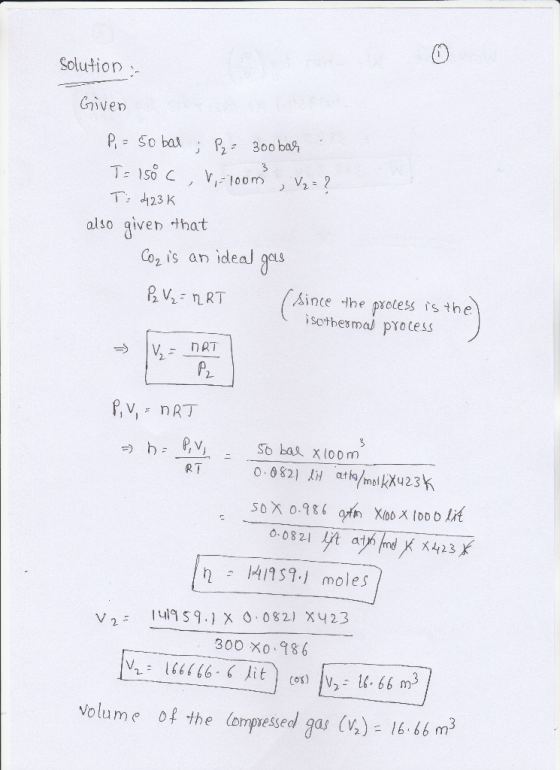
One hundred cubic meters of carbon dioxide initially at 150 degrees Celsius and 50 bar is to be isothermally compressed in a frictionless piston-and-cylinder device to a final pressure of 300 bar. Assume that this is a reversible process.
a.)
Use the ideal gas equation of state to calculate:
i. The volume of the compressed gas
ii. The work done to compress the gas
iii. The heat flow on compression
b.)
Use the van der Waals equation of state to calculate:
i. The volume of the compressed gas
ii. The work done to compress the gas
iii. The heat flow on compression
Answer to part b should be:
Q = -1,407,000kJ and W = +855,000 kJ
Homework Answers

Add Answer to:
One hundred cubic meters of carbon dioxide initially at 150
degrees Celsius and 50 bar is...
A volume of 100 m3 of a non-ideal gas is contained at 150°C and 50 bar....
A volume of 100 m3 of a non-ideal gas is contained at 150°C and 50 bar. The gas is then compressed isothermally to a pressure of 300 bar in a well-designed compressor. What is the volume of the compressed gas, how much work is done to compress it, and how much heat must be removed to maintain the temperature at 150°C during compression? You may apply the principle of corresponding states. The critical properties of the non-ideal gas are Tc...
**PLEASE ANSWER ALL SUB-QUESTIONS AND EXPLAIN STEP BY STEP. THANK YOU!** QUESTION 6 One mole of an ideal gas is compres...
 **PLEASE ANSWER ALL SUB-QUESTIONS AND EXPLAIN STEP BY STEP.
THANK YOU!**
QUESTION 6 One mole of an ideal gas is compressed isothermally but irreversibly at 130 oC from 2.5 bar to 6.5 bar in a piston/cylinder device. The work required is 30 % greater than the work of reversible, isothermal compression. The heat transferred from the gas during compression flows to a heat reservoir at 25 °C. Calculate the entropy changes of the gas, the heat reservoir, and AStotal
QUESTION...
**PLEASE ANSWER ALL SUB-QUESTIONS AND EXPLAIN STEP BY STEP.
THANK YOU!**
QUESTION 6 One mole of an ideal gas is compressed isothermally but irreversibly at 130 oC from 2.5 bar to 6.5 bar in a piston/cylinder device. The work required is 30 % greater than the work of reversible, isothermal compression. The heat transferred from the gas during compression flows to a heat reservoir at 25 °C. Calculate the entropy changes of the gas, the heat reservoir, and AStotal
QUESTION...
**PLEASE ANSWER ALL SUB-QUESTIONS AND EXPLAIN STEP BY STEP. THANK YOU!** QUESTION 6 One mole of...
 **PLEASE ANSWER ALL SUB-QUESTIONS AND EXPLAIN STEP BY STEP.
THANK YOU!**
QUESTION 6 One mole of an ideal gas is compressed isothermally but irreversibly at 130 oC from 2.5 bar to 6.5 bar in a piston/cylinder device. The work required is 30 % greater than the work of reversible, isothermal compression. The heat transferred from the gas during compression flows to a heat reservoir at 25 °C. Calculate the entropy changes of the gas, the heat reservoir, and AStotal
**PLEASE ANSWER ALL SUB-QUESTIONS AND EXPLAIN STEP BY STEP.
THANK YOU!**
QUESTION 6 One mole of an ideal gas is compressed isothermally but irreversibly at 130 oC from 2.5 bar to 6.5 bar in a piston/cylinder device. The work required is 30 % greater than the work of reversible, isothermal compression. The heat transferred from the gas during compression flows to a heat reservoir at 25 °C. Calculate the entropy changes of the gas, the heat reservoir, and AStotal
2. One mole of a monoatomic van der Waals gas obeys the equation of state and its internal energy is expressed as U-Суг...
 2. One mole of a monoatomic van der Waals gas obeys the equation of state and its internal energy is expressed as U-Суг_ _ where Cv is the molar isochoric heat capacity of an ideal gas. The gas is initially at pressure p and volume V. (i) Explain the physical meaning of the parameters a and b in the equation of state of the gas (ii) Calculate the heat transferred to the gas during reversible isothermic expansion to the volume...
Parts iii) and iv) are the ones I need help with please :) (a) One mole of a monoatomic van der Waals gas obeys the equ...
 Parts iii) and iv) are the ones I need help with please :)
(a) One mole of a monoatomic van der Waals gas obeys the equation of state and its internal energy is expressed as U where Cv is the molar apacity of an ideal gas. The gas is initially at pr isochoric heat c essure p and volume V Explain the physical meaning of the parameters a and b in the equation of state of the gas (ii) Write...
Parts iii) and iv) are the ones I need help with please :)
(a) One mole of a monoatomic van der Waals gas obeys the equation of state and its internal energy is expressed as U where Cv is the molar apacity of an ideal gas. The gas is initially at pr isochoric heat c essure p and volume V Explain the physical meaning of the parameters a and b in the equation of state of the gas (ii) Write...
The equation of state for a van der Waals fluid is ? You will look at...
 The equation of state for a van der Waals fluid is
?
You will look at the work and energy it takes to compress such a
fluid and compare it to an ideal gas.
Show that the following identity is true using thermodynamic
identity for U and Maxwell’s Relations.
Using part (a), show that for a van der Waals fluid, the
internal energy for a monatomic
Take a van der Waals fluid at 101 kPa, 300 K, and an initial...
The equation of state for a van der Waals fluid is
?
You will look at the work and energy it takes to compress such a
fluid and compare it to an ideal gas.
Show that the following identity is true using thermodynamic
identity for U and Maxwell’s Relations.
Using part (a), show that for a van der Waals fluid, the
internal energy for a monatomic
Take a van der Waals fluid at 101 kPa, 300 K, and an initial...
One mole of H20( is supercooled to-5.00°C at 1 bar pressure before freezing at that temperature....
 One mole of H20( is supercooled to-5.00°C at 1 bar pressure before freezing at that temperature. Calculate ASys, ASum, and ASeotal for this process. Is it spontaneous? CPm (H20, 1)- 75.3 J/mol.K CPm (H20, s)-37.7 J/mol.K AHfusion 6.008 kJ/mol Hint: remember that ASs is computed using q along a reversible path, while ASur is computed using the actual heat transfer during the freezing. For the following equilibrium reaction: Here is an ICE table, starting from no moles of pure 0z...
(a) One mole of a monoatomic van der Waals gas obeys the equation of state A3. ) (V-b)=RT (p+ and its internal energy is expressed as U CvT where Cv is the molar isochoric heat capacity of an ideal g...
 (a) One mole of a monoatomic van der Waals gas obeys the equation of state A3. ) (V-b)=RT (p+ and its internal energy is expressed as U CvT where Cv is the molar isochoric heat capacity of an ideal gas. The gas is initially at pressure p and volume V (i) Explain the physical meaning of the parameters a and b in the equation of state of the gas (ii) Write down the equation that defines entropy in thermodynamics. Define...
Ammonia is to be isothermally compressed in a specially designed flow turbine from 1 bar and 100℃ to 50 bar. If the comp...
Ammonia is to be isothermally compressed in a specially designed flow turbine from 1 bar and 100℃ to 50 bar. If the compression is done reversibly, compute the heat and work flows needed per mole of ammonia. a) Ammonia obeys the principle of corresponding states. b)Ammonia satisfies the Clausius equation of state P(V - b) = RT with b=3.730×10⁻² m3 /kmol.
Hydrogen gas (H2) is initially at a pressure of 20 bar and temperature of 300'C (state...
Hydrogen gas (H2) is initially at a pressure of 20 bar and temperature of 300'C (state 1), while occupying a volume of 0.5 m3 in a frictionless piston-cylinder arrangement. The gas then undergoes a reversible cycle in which it expands isothermally to a pressure of 8 bar (state 2). This is then followed by adiabatic compression to restore the pressure back to 20 bar. The cycle is then completed by a constant pressure process. Sketch the process of p-v and...
 **PLEASE ANSWER ALL SUB-QUESTIONS AND EXPLAIN STEP BY STEP.
THANK YOU!**
QUESTION 6 One mole of an ideal gas is compressed isothermally but irreversibly at 130 oC from 2.5 bar to 6.5 bar in a piston/cylinder device. The work required is 30 % greater than the work of reversible, isothermal compression. The heat transferred from the gas during compression flows to a heat reservoir at 25 °C. Calculate the entropy changes of the gas, the heat reservoir, and AStotal
QUESTION...
**PLEASE ANSWER ALL SUB-QUESTIONS AND EXPLAIN STEP BY STEP.
THANK YOU!**
QUESTION 6 One mole of an ideal gas is compressed isothermally but irreversibly at 130 oC from 2.5 bar to 6.5 bar in a piston/cylinder device. The work required is 30 % greater than the work of reversible, isothermal compression. The heat transferred from the gas during compression flows to a heat reservoir at 25 °C. Calculate the entropy changes of the gas, the heat reservoir, and AStotal
QUESTION...
 **PLEASE ANSWER ALL SUB-QUESTIONS AND EXPLAIN STEP BY STEP.
THANK YOU!**
QUESTION 6 One mole of an ideal gas is compressed isothermally but irreversibly at 130 oC from 2.5 bar to 6.5 bar in a piston/cylinder device. The work required is 30 % greater than the work of reversible, isothermal compression. The heat transferred from the gas during compression flows to a heat reservoir at 25 °C. Calculate the entropy changes of the gas, the heat reservoir, and AStotal
**PLEASE ANSWER ALL SUB-QUESTIONS AND EXPLAIN STEP BY STEP.
THANK YOU!**
QUESTION 6 One mole of an ideal gas is compressed isothermally but irreversibly at 130 oC from 2.5 bar to 6.5 bar in a piston/cylinder device. The work required is 30 % greater than the work of reversible, isothermal compression. The heat transferred from the gas during compression flows to a heat reservoir at 25 °C. Calculate the entropy changes of the gas, the heat reservoir, and AStotal
 2. One mole of a monoatomic van der Waals gas obeys the equation of state and its internal energy is expressed as U-Суг_ _ where Cv is the molar isochoric heat capacity of an ideal gas. The gas is initially at pressure p and volume V. (i) Explain the physical meaning of the parameters a and b in the equation of state of the gas (ii) Calculate the heat transferred to the gas during reversible isothermic expansion to the volume...
 Parts iii) and iv) are the ones I need help with please :)
(a) One mole of a monoatomic van der Waals gas obeys the equation of state and its internal energy is expressed as U where Cv is the molar apacity of an ideal gas. The gas is initially at pr isochoric heat c essure p and volume V Explain the physical meaning of the parameters a and b in the equation of state of the gas (ii) Write...
Parts iii) and iv) are the ones I need help with please :)
(a) One mole of a monoatomic van der Waals gas obeys the equation of state and its internal energy is expressed as U where Cv is the molar apacity of an ideal gas. The gas is initially at pr isochoric heat c essure p and volume V Explain the physical meaning of the parameters a and b in the equation of state of the gas (ii) Write...
 The equation of state for a van der Waals fluid is
?
You will look at the work and energy it takes to compress such a
fluid and compare it to an ideal gas.
Show that the following identity is true using thermodynamic
identity for U and Maxwell’s Relations.
Using part (a), show that for a van der Waals fluid, the
internal energy for a monatomic
Take a van der Waals fluid at 101 kPa, 300 K, and an initial...
The equation of state for a van der Waals fluid is
?
You will look at the work and energy it takes to compress such a
fluid and compare it to an ideal gas.
Show that the following identity is true using thermodynamic
identity for U and Maxwell’s Relations.
Using part (a), show that for a van der Waals fluid, the
internal energy for a monatomic
Take a van der Waals fluid at 101 kPa, 300 K, and an initial...
 One mole of H20( is supercooled to-5.00°C at 1 bar pressure before freezing at that temperature. Calculate ASys, ASum, and ASeotal for this process. Is it spontaneous? CPm (H20, 1)- 75.3 J/mol.K CPm (H20, s)-37.7 J/mol.K AHfusion 6.008 kJ/mol Hint: remember that ASs is computed using q along a reversible path, while ASur is computed using the actual heat transfer during the freezing. For the following equilibrium reaction: Here is an ICE table, starting from no moles of pure 0z...
 (a) One mole of a monoatomic van der Waals gas obeys the equation of state A3. ) (V-b)=RT (p+ and its internal energy is expressed as U CvT where Cv is the molar isochoric heat capacity of an ideal gas. The gas is initially at pressure p and volume V (i) Explain the physical meaning of the parameters a and b in the equation of state of the gas (ii) Write down the equation that defines entropy in thermodynamics. Define...
Most questions answered within 3 hours.
-
Where is the error in this code sequence?
String s1 = "Hello";
String s2 = "ello";...
asked 11 months ago -
Financial data for Joel de Paris, Inc., for last year
follow:
Joel de Paris, Inc.
Balance...
asked 11 months ago -
Consider this reaction:
Al2(SO4)3 (aq)+ BaCl3
(aq) Al2Cl6 (aq)- +
3BaSO4(s) . What is the...
asked 11 months ago -
Suppose that Savneet is considering increasing her
recent random sample from 20 car rentals to 40...
asked 11 months ago -
Trucks arrive at an unloading terminal at an average rate of 120
per hour.
Trucks arrive...
asked 11 months ago -
Why are methanol and ethanol completely soluble in water while
octanol is not very little soluble....
asked 11 months ago -
A facilities manager at a university reads in a research report
that the mean amount of...
asked 11 months ago -
When the CuSO4 is rehydrated by adding water to the anhydrous
compound, is this an endothermic...
asked 11 months ago -
A ray of sunlight is passing from diamond into crown glass; the
angle of incidence is...
asked 11 months ago -
A block of mass 0.249 kg is placed on top of a light, vertical
spring of...
asked 11 months ago -
how do the kidneys compensate in the presences of acidosis
a) trigger hyperventilate
b) reserve acid...
asked 11 months ago -
Question 501 pts
The rental rate of capital to the firm increases. Which of the
following...
asked 11 months ago