Which two pollutants are most relevant in photochemical smog formation? a) particulate matter and CO b)...
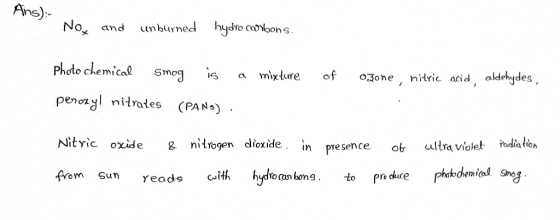
Which two pollutants are most relevant in photochemical smog formation?
a) particulate matter and CO
b) NOx and unburned hydrocarbons
c) NOx and CO
Homework Answers
Add Answer to:
Which two pollutants are most relevant in photochemical smog
formation?
a) particulate matter and CO
b)...
Which of the following is not one of the criteria air pollutants? a. particulate matter b....
Which of the following is not one of the criteria air pollutants? a. particulate matter b. lead c. ozone d. radon Which of the following possible strategies for reducing air pollution has not been employed in the United States? a. Mandates for industries to report the kinds and amounts of pollutants they discharge b. Higher taxes on gasoline c. Mandates for reducing automobile emissions d. Marketing of pollution allowances
Please answer #3 and #4 only Photochemical Smog Photochemical smog is a type of air pollution...
 Please answer #3 and #4
only
Photochemical Smog Photochemical smog is a type of air pollution produced when sunlight acts upon motor vehicle exhaust gases, such as nitrogen oxides (e.g., NO, NO:) to form harmful substances such as ozone (0). These substances participate in a reaction cycle that determines the concentration of pollutants at different times during the day. Ozone Formation: NO:(), is formed by chemical reactions involving N2(g) and O-() at the high temperatures inside internal combustion engines in...
Please answer #3 and #4
only
Photochemical Smog Photochemical smog is a type of air pollution produced when sunlight acts upon motor vehicle exhaust gases, such as nitrogen oxides (e.g., NO, NO:) to form harmful substances such as ozone (0). These substances participate in a reaction cycle that determines the concentration of pollutants at different times during the day. Ozone Formation: NO:(), is formed by chemical reactions involving N2(g) and O-() at the high temperatures inside internal combustion engines in...
the atmospheric particulate pollutants that are most damaging to health are. which of the following Co2...
the atmospheric particulate pollutants that are most damaging to health are. which of the following Co2 and N2 particles that can pass through cell membranes argon and hydrogen larger than 10 um to less than 20 um
Review l Constants i Per One of the reactions that occurs during photochemical smog formation is...
 Review l Constants i Per One of the reactions that occurs during photochemical smog formation is the following: NO,(8) +0,(8) NO(g) +0() Standard thermodynamic quantities for selected substances at 25°C Part A Use standard free energies of formation to determine AG for this reaction at 25°C Express the free energy change to four significant figures and include the appropriate units. h + ? AG- Substance AG (kJ/mol) O2(g) 0 Os(s) +163.2 CO() 1372 CO,() -3944 N. (K) 0 NO() +87.6...
When fossil fuels are burned, "particulate matter" including some small particles referred and to PM2.5s and...
 When fossil fuels are burned, "particulate matter" including some small particles referred and to PM2.5s and even smaller particles can be produced. There was a recently published study showing how these small particles get into the bloodstream and "lodge" in small blood vessels in the head and neck. (a) What would you anticipate happening? To get you thinking in the right direction, the textbook discusses plaques and thrombus formation on pg. 698-9 (ed. 2). (b) If this affects blood vessels...
1. Which of the following statements is true? Please indicate all true statements as there are...
1. Which of the following statements is true? Please indicate all true statements as there are multiple, and explain why. a) Non-precursors refer to molecules which do not absorb visible light from the sun. b) CO emissions are highest when the A/F ratio is close to the stoichiometric ratio. c) Lean A/F ratios decrease NO emissions. d) Ozone concentrations are typically higher in the summer than winter. e) Carbon monoxide levels typically would be higher during the morning hours in...
Particulate matter is a serious form of air pollution often arising from industrial production. One way...
Particulate matter is a serious form of air pollution often arising from industrial production. One way to reduce the pollution is to put a filter, or scrubber, at the end of the smokestack to trap the particulates. An experiment to determine which smokestake scrubber design is best was run by placing four scrubbers of different designs on an industrial stack in random order. Each scrubber was tested five times. For each run, the same material was produced, and the particulate...
got another evil question for ya There are two lakes, A and B, into which industrial...
got another evil question for ya There are two lakes, A and B, into which industrial wastes containing massive amounts of biodegradable hydrocarbons and arsenic pesticides were previously discharged. Arsenic is present in its oxidized form, arsenate, which has a high affinity to surfaces of particulate matter and so it normally precipitates in sediments. Before the lakes are stratified during the summer and hence their bottom zone becomes anoxic, they have almost identical water chemistry except that in Lake A,...
For the following questions, you will use the following data on particulate matter in air samples:...
For the following questions, you will use the following data on particulate matter in air samples: Site Sample Size Mean Std. Dev. 1 8 36.25 14.56 2 8 36.00 2.88 You will test for a significant difference between means at the alpha=0.05 level. Calculate the standard error of the mean difference. Calculate the test statistic. What are the degrees of freedom? Should you reject or retain the null hypothesis In a study on differences in urinary creatinine levels...
Which of the following would be included as relevant for toxicokinetics? a. Inactivation of ribosomes b....
Which of the following would be included as relevant for toxicokinetics? a. Inactivation of ribosomes b. Oxidation of DNA c. Formation of DNA adducts d. Renal clearance
 Please answer #3 and #4
only
Photochemical Smog Photochemical smog is a type of air pollution produced when sunlight acts upon motor vehicle exhaust gases, such as nitrogen oxides (e.g., NO, NO:) to form harmful substances such as ozone (0). These substances participate in a reaction cycle that determines the concentration of pollutants at different times during the day. Ozone Formation: NO:(), is formed by chemical reactions involving N2(g) and O-() at the high temperatures inside internal combustion engines in...
Please answer #3 and #4
only
Photochemical Smog Photochemical smog is a type of air pollution produced when sunlight acts upon motor vehicle exhaust gases, such as nitrogen oxides (e.g., NO, NO:) to form harmful substances such as ozone (0). These substances participate in a reaction cycle that determines the concentration of pollutants at different times during the day. Ozone Formation: NO:(), is formed by chemical reactions involving N2(g) and O-() at the high temperatures inside internal combustion engines in...
 Review l Constants i Per One of the reactions that occurs during photochemical smog formation is the following: NO,(8) +0,(8) NO(g) +0() Standard thermodynamic quantities for selected substances at 25°C Part A Use standard free energies of formation to determine AG for this reaction at 25°C Express the free energy change to four significant figures and include the appropriate units. h + ? AG- Substance AG (kJ/mol) O2(g) 0 Os(s) +163.2 CO() 1372 CO,() -3944 N. (K) 0 NO() +87.6...
 When fossil fuels are burned, "particulate matter" including some small particles referred and to PM2.5s and even smaller particles can be produced. There was a recently published study showing how these small particles get into the bloodstream and "lodge" in small blood vessels in the head and neck. (a) What would you anticipate happening? To get you thinking in the right direction, the textbook discusses plaques and thrombus formation on pg. 698-9 (ed. 2). (b) If this affects blood vessels...
Most questions answered within 3 hours.
-
Where is the error in this code sequence?
String s1 = "Hello";
String s2 = "ello";...
asked 10 months ago -
Financial data for Joel de Paris, Inc., for last year
follow:
Joel de Paris, Inc.
Balance...
asked 10 months ago -
Consider this reaction:
Al2(SO4)3 (aq)+ BaCl3
(aq) Al2Cl6 (aq)- +
3BaSO4(s) . What is the...
asked 10 months ago -
Suppose that Savneet is considering increasing her
recent random sample from 20 car rentals to 40...
asked 10 months ago -
Trucks arrive at an unloading terminal at an average rate of 120
per hour.
Trucks arrive...
asked 10 months ago -
Why are methanol and ethanol completely soluble in water while
octanol is not very little soluble....
asked 10 months ago -
A facilities manager at a university reads in a research report
that the mean amount of...
asked 10 months ago -
When the CuSO4 is rehydrated by adding water to the anhydrous
compound, is this an endothermic...
asked 10 months ago -
A ray of sunlight is passing from diamond into crown glass; the
angle of incidence is...
asked 10 months ago -
A block of mass 0.249 kg is placed on top of a light, vertical
spring of...
asked 10 months ago -
how do the kidneys compensate in the presences of acidosis
a) trigger hyperventilate
b) reserve acid...
asked 10 months ago -
Question 501 pts
The rental rate of capital to the firm increases. Which of the
following...
asked 10 months ago