 Inorganic Chemistry
Homework Answers
Add Answer to:
Inorganic Chemistry
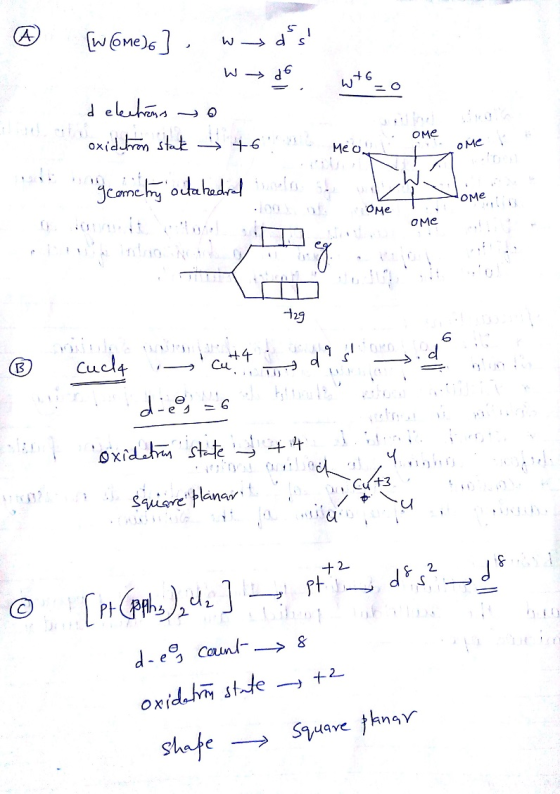
Provide the oxidation state, electron count, and geometry of the following complexes. Also provide...
inorganic chemistry 10) Determine the electron count and oxidation states of the following complexes: R2 co...
 inorganic chemistry
10) Determine the electron count and oxidation states of the following complexes: R2 co co R2 P RECOCIDO RZ O-PR2 e) [Fe(bpy)3]3+ f) TpReadppe)(CO) - Ni-H Μο ICO co O-PR2
inorganic chemistry
10) Determine the electron count and oxidation states of the following complexes: R2 co co R2 P RECOCIDO RZ O-PR2 e) [Fe(bpy)3]3+ f) TpReadppe)(CO) - Ni-H Μο ICO co O-PR2
inorganic chemistry 10) Determine the electron count and oxidation states of the following complexes: COCOR PM.,,,CI,...
 inorganic chemistry
10) Determine the electron count and oxidation states of the following complexes: COCOR PM.,,,CI, UP Lp-cp- R2 co co R2 d) O-PR2 e) [Fe(bpy)3]3+ f) TpRe(dppe)(CO) -Ni-H VO OC "CO O-PR2
inorganic chemistry
10) Determine the electron count and oxidation states of the following complexes: COCOR PM.,,,CI, UP Lp-cp- R2 co co R2 d) O-PR2 e) [Fe(bpy)3]3+ f) TpRe(dppe)(CO) -Ni-H VO OC "CO O-PR2
inorganic chemistry 10) Determine the electron count and oxidation states of the following complexes: COCOR PM.,,,CI,...
 inorganic chemistry
10) Determine the electron count and oxidation states of the following complexes: COCOR PM.,,,CI, UP Lp-cp- R2 co co R2 d) O-PR2 e) [Fe(bpy)3]3+ f) TpRe(dppe)(CO) -Ni-H VO OC "CO O-PR2
inorganic chemistry
10) Determine the electron count and oxidation states of the following complexes: COCOR PM.,,,CI, UP Lp-cp- R2 co co R2 d) O-PR2 e) [Fe(bpy)3]3+ f) TpRe(dppe)(CO) -Ni-H VO OC "CO O-PR2
inorganic chemistry 10) Determine the electron count and oxidation states of the following complexes: R2 co co R2 P...
 inorganic chemistry
10) Determine the electron count and oxidation states of the following complexes: R2 co co R2 P RECOCIDO RZ O-PR2 e) [Fe(bpy)3]3+ f) TpReadppe)(CO) - Ni-H Μο ICO co O-PR2
inorganic chemistry
10) Determine the electron count and oxidation states of the following complexes: R2 co co R2 P RECOCIDO RZ O-PR2 e) [Fe(bpy)3]3+ f) TpReadppe)(CO) - Ni-H Μο ICO co O-PR2
Inorganic Chemistry 3. What is the oxidation state and coordination number of the central cobalt in...
 Inorganic Chemistry
3. What is the oxidation state and coordination number of the central cobalt in each of the prepared complexes? What is the geometry of each one? A [Co (NH₂), CI] Cla B) [Co (NH) (ONO)] C12 C) [c ( H) (No)] Cla
Inorganic Chemistry
3. What is the oxidation state and coordination number of the central cobalt in each of the prepared complexes? What is the geometry of each one? A [Co (NH₂), CI] Cla B) [Co (NH) (ONO)] C12 C) [c ( H) (No)] Cla
Provide the metal oxidation state and dn electron configuration for the following complexes (Suggestions: add any...
Provide the metal oxidation state and dn electron configuration for the following complexes (Suggestions: add any lone pairs missing from the ligands before continuing!) a) [Co(NH3)5(NO2)]2+ b) [ReH9]2- c) [CuCl5]3- d) [Cr(SCN)4(NH3)2]-
5. For each of the following transition metal complexes, give (i) the d-electron count, (ii) the approximate shape of t...
 5. For each of the following transition metal complexes, give (i) the d-electron count, (ii) the approximate shape of the complex, and (iii) an energy level diagram showing the splitting and filling of the d-orbitals. (a) [Os(CN)6]3- (b) cis-PtCl2(NH3)2 (c) [Cu(NH3)4]*
2. For each of the complexes: [Co(H2O)6]Cl3 and [Co(NH3)6]Cl3 Give the oxidation state and the electron...
2. For each of the complexes: [Co(H2O)6]Cl3 and [Co(NH3)6]Cl3 Give the oxidation state and the electron configuration of the transition element as it is in the complex. Say whether the complex is low - spin or high - spin giving a reason for your choice. Draw the d level splitting diagram including the electrons.
5. The [NI(CN)412- ion has a square-planer geometry, whereas the INca diagrams (with d-orbital labels) for these twe complexes and determine if the compound is paramognetic or diamognet ion is...
 5. The [NI(CN)412- ion has a square-planer geometry, whereas the INca diagrams (with d-orbital labels) for these twe complexes and determine if the compound is paramognetic or diamognet ion is tetrahedral. Drow the crystal field splitting 6. The absorption maximum for the complex ion (Co( Hale ccurs at 410 m. Predict the coler of this complex.Explain your reasoning. the Lewis structure of each and state whether the following are monodentate or bide ntate ligands a. c2042 (oxalate ion, ox) b,sar...
3026 Inorganic Chemistry 1. Propose an 18e-structure for the following metal/ligand combinations. Use at least one...
 3026 Inorganic Chemistry 1. Propose an 18e-structure for the following metal/ligand combinations. Use at least one of each metal and ligand listed. Complexes must be neutral. Don't use more than 2 metal centers. Clearly show your electron counting. Ligands are shown without charges, please indicate the proper ligand charge in your electron counting. Draw a reasonable structure showing the geometry about the metal center(s). a. Ir, Cp, CENME
 inorganic chemistry
10) Determine the electron count and oxidation states of the following complexes: R2 co co R2 P RECOCIDO RZ O-PR2 e) [Fe(bpy)3]3+ f) TpReadppe)(CO) - Ni-H Μο ICO co O-PR2
inorganic chemistry
10) Determine the electron count and oxidation states of the following complexes: R2 co co R2 P RECOCIDO RZ O-PR2 e) [Fe(bpy)3]3+ f) TpReadppe)(CO) - Ni-H Μο ICO co O-PR2
 inorganic chemistry
10) Determine the electron count and oxidation states of the following complexes: COCOR PM.,,,CI, UP Lp-cp- R2 co co R2 d) O-PR2 e) [Fe(bpy)3]3+ f) TpRe(dppe)(CO) -Ni-H VO OC "CO O-PR2
inorganic chemistry
10) Determine the electron count and oxidation states of the following complexes: COCOR PM.,,,CI, UP Lp-cp- R2 co co R2 d) O-PR2 e) [Fe(bpy)3]3+ f) TpRe(dppe)(CO) -Ni-H VO OC "CO O-PR2
 inorganic chemistry
10) Determine the electron count and oxidation states of the following complexes: COCOR PM.,,,CI, UP Lp-cp- R2 co co R2 d) O-PR2 e) [Fe(bpy)3]3+ f) TpRe(dppe)(CO) -Ni-H VO OC "CO O-PR2
inorganic chemistry
10) Determine the electron count and oxidation states of the following complexes: COCOR PM.,,,CI, UP Lp-cp- R2 co co R2 d) O-PR2 e) [Fe(bpy)3]3+ f) TpRe(dppe)(CO) -Ni-H VO OC "CO O-PR2
 inorganic chemistry
10) Determine the electron count and oxidation states of the following complexes: R2 co co R2 P RECOCIDO RZ O-PR2 e) [Fe(bpy)3]3+ f) TpReadppe)(CO) - Ni-H Μο ICO co O-PR2
inorganic chemistry
10) Determine the electron count and oxidation states of the following complexes: R2 co co R2 P RECOCIDO RZ O-PR2 e) [Fe(bpy)3]3+ f) TpReadppe)(CO) - Ni-H Μο ICO co O-PR2
 Inorganic Chemistry
3. What is the oxidation state and coordination number of the central cobalt in each of the prepared complexes? What is the geometry of each one? A [Co (NH₂), CI] Cla B) [Co (NH) (ONO)] C12 C) [c ( H) (No)] Cla
Inorganic Chemistry
3. What is the oxidation state and coordination number of the central cobalt in each of the prepared complexes? What is the geometry of each one? A [Co (NH₂), CI] Cla B) [Co (NH) (ONO)] C12 C) [c ( H) (No)] Cla
 5. For each of the following transition metal complexes, give (i) the d-electron count, (ii) the approximate shape of the complex, and (iii) an energy level diagram showing the splitting and filling of the d-orbitals. (a) [Os(CN)6]3- (b) cis-PtCl2(NH3)2 (c) [Cu(NH3)4]*
 5. The [NI(CN)412- ion has a square-planer geometry, whereas the INca diagrams (with d-orbital labels) for these twe complexes and determine if the compound is paramognetic or diamognet ion is tetrahedral. Drow the crystal field splitting 6. The absorption maximum for the complex ion (Co( Hale ccurs at 410 m. Predict the coler of this complex.Explain your reasoning. the Lewis structure of each and state whether the following are monodentate or bide ntate ligands a. c2042 (oxalate ion, ox) b,sar...
 3026 Inorganic Chemistry 1. Propose an 18e-structure for the following metal/ligand combinations. Use at least one of each metal and ligand listed. Complexes must be neutral. Don't use more than 2 metal centers. Clearly show your electron counting. Ligands are shown without charges, please indicate the proper ligand charge in your electron counting. Draw a reasonable structure showing the geometry about the metal center(s). a. Ir, Cp, CENME
Most questions answered within 3 hours.
-
Where is the error in this code sequence?
String s1 = "Hello";
String s2 = "ello";...
asked 10 months ago -
Financial data for Joel de Paris, Inc., for last year
follow:
Joel de Paris, Inc.
Balance...
asked 10 months ago -
Consider this reaction:
Al2(SO4)3 (aq)+ BaCl3
(aq) Al2Cl6 (aq)- +
3BaSO4(s) . What is the...
asked 10 months ago -
Suppose that Savneet is considering increasing her
recent random sample from 20 car rentals to 40...
asked 10 months ago -
Trucks arrive at an unloading terminal at an average rate of 120
per hour.
Trucks arrive...
asked 10 months ago -
Why are methanol and ethanol completely soluble in water while
octanol is not very little soluble....
asked 10 months ago -
A facilities manager at a university reads in a research report
that the mean amount of...
asked 10 months ago -
When the CuSO4 is rehydrated by adding water to the anhydrous
compound, is this an endothermic...
asked 10 months ago -
A ray of sunlight is passing from diamond into crown glass; the
angle of incidence is...
asked 10 months ago -
A block of mass 0.249 kg is placed on top of a light, vertical
spring of...
asked 10 months ago -
how do the kidneys compensate in the presences of acidosis
a) trigger hyperventilate
b) reserve acid...
asked 10 months ago -
Question 501 pts
The rental rate of capital to the firm increases. Which of the
following...
asked 10 months ago