For the reaction A + 3B → 5C + 2D at a particular time, –ΔB/Δt =...
For the reaction A + 3B → 5C + 2D at a particular time, –ΔB/Δt = 3.93 × 10⁻²M/s. What is ΔC/Δt at the same instant? Report your answer to THREE significant figures.
Homework Answers

The rate of the reaction in terms of the "disappearance of reactant" includes the change in...
The rate of the reaction in terms of the "disappearance of reactant" includes the change in the concentration of the reactant, the time interval, and the coefficient of the reactant. Consider the following reaction: 2A+3B→3C+2D The concentrations of reactant A at three different time intervals are given. Use the following data to determine the average rate of reaction in terms of the disappearance of reactant A between time = 0 s and time = 20 s. Time (s) 0 20...
Consider the reaction 8H2S(g)+4O2(g)→8H2O(g)+S8(g) Δ[H2S]/Δt = -0.067 M/s You may want to reference (Pages 587 -...
 Consider the reaction
8H2S(g)+4O2(g)→8H2O(g)+S8(g) Δ[H2S]/Δt = -0.067 M/s You may want to
reference (Pages 587 - 592) Section 14.3 while completing this
problem. Part A Find Δ[O2]/Δt. Express your answer to two
significant figures and include the appropriate units. Δ[O2]/Δt =
StartFraction Upper M Over s EndFraction Previous AnswersRequest
Answer Incorrect; Try Again; One attempt remaining Part BPart
complete Find Δ[H2O]/Δt. Express your answer to two significant
figures and include the appropriate units. Δ[H2O]/Δt = 6.7×10⁻² Ms
Previous Answers Correct...
Consider the reaction
8H2S(g)+4O2(g)→8H2O(g)+S8(g) Δ[H2S]/Δt = -0.067 M/s You may want to
reference (Pages 587 - 592) Section 14.3 while completing this
problem. Part A Find Δ[O2]/Δt. Express your answer to two
significant figures and include the appropriate units. Δ[O2]/Δt =
StartFraction Upper M Over s EndFraction Previous AnswersRequest
Answer Incorrect; Try Again; One attempt remaining Part BPart
complete Find Δ[H2O]/Δt. Express your answer to two significant
figures and include the appropriate units. Δ[H2O]/Δt = 6.7×10⁻² Ms
Previous Answers Correct...
The rate of the reaction in terms of the "disappearance of reactant" includes the change in...
The rate of the reaction in terms of the "disappearance of reactant" includes the change in the concentration of the reactant, the time interval, and the coefficient of the reactant. Consider the following reaction: 2A+3B→3C+2D The concentrations of reactant A at three different time intervals are given. Use the following data to determine the average rate of reaction in terms of the disappearance of reactant A between time = 0 s and time = 20 s. Time (s) 0 20 40...
Consider the following reaction:2 N2O(g) → 2 N2(g)+O2(g)
Consider the following reaction:2 N2O(g) → 2 N2(g)+O2(g)Part AExpress the rate of the reaction in terms of the change in concentration of each of the reactants and products.Express the rate of the reaction in terms of the change in concentration of each of the reactants and products.Rate=12Δ[N2O]Δt=−12Δ[N2]Δt=Δ[O2]ΔtRate=Δ[N2O]Δt=12Δ[N2]Δt=−12Δ[O2]ΔtRate=−Δ[N2O]Δt=−12Δ[N2]Δt=12Δ[O2]ΔtRate=−12Δ[N2O]Δt=12Δ[N2]Δt=Δ[O2]ΔtPart BIn the first 14.0 s of the reaction, 1.9×10⁻² mol of O2 is produced in a reaction vessel with a volume of 0.460 L . What is the average rate of the reaction over this time...
Consider the reaction 8H2S(g)+4O2(g)→8H2O(g)+S8(g)8H2S(g)+4O2(g)→8H2O(g)+S8(g) Δ[H2S]/ΔtΔ[H2S]/Δt = -0.022 M/sM/s You may want to reference (Pages 587 -...
Consider the reaction 8H2S(g)+4O2(g)→8H2O(g)+S8(g)8H2S(g)+4O2(g)→8H2O(g)+S8(g) Δ[H2S]/ΔtΔ[H2S]/Δt = -0.022 M/sM/s You may want to reference (Pages 587 - 592) Section 14.3 while completing this problem. Part A Find Δ[O2]/ΔtΔ[O2]/Δt. Express your answer to two significant figures and include the appropriate units. Part B Find Δ[H2O]/ΔtΔ[H2O]/Δt. Express your answer to two significant figures and include the appropriate units. Part C Find Δ[S8]/ΔtΔ[S8]/Δt. Express your answer to two significant figures and include the appropriate units. Part D Find the rate of the reaction. Express...
quick!!!!!! Given the reaction at 300K: 2A(g) = 3B(g) + C(g) Kc = 5.5 x 10⁻⁵....
 quick!!!!!!
Given the reaction at 300K: 2A(g) = 3B(g) + C(g) Kc = 5.5 x 10⁻⁵. If 12.0 moles of A is added to a 3.0L container (hint, you need molarity not moles in your ICE table), what will the concentration of A be at equilibrium? Neglect x for this problem. Report your answer to 2 significant figures. Answer: 3.8
quick!!!!!!
Given the reaction at 300K: 2A(g) = 3B(g) + C(g) Kc = 5.5 x 10⁻⁵. If 12.0 moles of A is added to a 3.0L container (hint, you need molarity not moles in your ICE table), what will the concentration of A be at equilibrium? Neglect x for this problem. Report your answer to 2 significant figures. Answer: 3.8
Part A The rate of the reaction in terms of the "disappearance of reactant" includes the...
 Part A The rate of the reaction in terms of the "disappearance of reactant" includes the change in the concentration of the reactant, the time interval, and the coefficient of the reactant Consider the following reaction: 2A + 3B 3C + 2D The concentrations of reactant A at three different time intervals are given. Use the following data to determine the average rate of reaction in terms of the disappearance of reactant A between time=0s and time = 20 S....
Consider the equilibrium reaction: 2A (aq) + 3B (aq) <--> C (aq) (in my notation <-->...
Consider the equilibrium reaction: 2A (aq) + 3B (aq) <--> C (aq) (in my notation <--> means equilibrium arrows) Initially A is present at 6.00 M and B is present at 7.00 M. Also, initially there is no C present. At equilibrium B is present at 1.00 M. What is the Kc for this reaction? ( report your answer to 3 significant figures)
The energy required for the hypothetical reaction 2A+B=2C+2D is 283 kJ as written. How much heat...
 The energy required for the hypothetical reaction 2A+B=2C+2D is 283 kJ as written. How much heat is absorbed when 2.60 mol of A reacts? Express your answer to three significant figures and include the appropriate units. View Available Hint(s) 368 kJ Submit Previous Answers Correct Part B The energy required for the hypothetical reaction 2A+B=2C+2D is 283 kJ as written. How much heat is absorbed when 165 g of A reacts given that A has a molar mass of 46.59...
The energy required for the hypothetical reaction 2A+ B 2C+ 2D is 197 kJ as written....
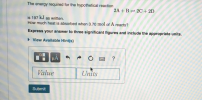 The energy required for the hypothetical reaction 2A+ B 2C+ 2D is 197 kJ as written. How much heat is absorbed when 3.70 mol of A reacts? Express your answer to three significant figures and include the appropriate units. View Available Hint(s) ? Units Value Submit
 Consider the reaction
8H2S(g)+4O2(g)→8H2O(g)+S8(g) Δ[H2S]/Δt = -0.067 M/s You may want to
reference (Pages 587 - 592) Section 14.3 while completing this
problem. Part A Find Δ[O2]/Δt. Express your answer to two
significant figures and include the appropriate units. Δ[O2]/Δt =
StartFraction Upper M Over s EndFraction Previous AnswersRequest
Answer Incorrect; Try Again; One attempt remaining Part BPart
complete Find Δ[H2O]/Δt. Express your answer to two significant
figures and include the appropriate units. Δ[H2O]/Δt = 6.7×10⁻² Ms
Previous Answers Correct...
Consider the reaction
8H2S(g)+4O2(g)→8H2O(g)+S8(g) Δ[H2S]/Δt = -0.067 M/s You may want to
reference (Pages 587 - 592) Section 14.3 while completing this
problem. Part A Find Δ[O2]/Δt. Express your answer to two
significant figures and include the appropriate units. Δ[O2]/Δt =
StartFraction Upper M Over s EndFraction Previous AnswersRequest
Answer Incorrect; Try Again; One attempt remaining Part BPart
complete Find Δ[H2O]/Δt. Express your answer to two significant
figures and include the appropriate units. Δ[H2O]/Δt = 6.7×10⁻² Ms
Previous Answers Correct...
 quick!!!!!!
Given the reaction at 300K: 2A(g) = 3B(g) + C(g) Kc = 5.5 x 10⁻⁵. If 12.0 moles of A is added to a 3.0L container (hint, you need molarity not moles in your ICE table), what will the concentration of A be at equilibrium? Neglect x for this problem. Report your answer to 2 significant figures. Answer: 3.8
quick!!!!!!
Given the reaction at 300K: 2A(g) = 3B(g) + C(g) Kc = 5.5 x 10⁻⁵. If 12.0 moles of A is added to a 3.0L container (hint, you need molarity not moles in your ICE table), what will the concentration of A be at equilibrium? Neglect x for this problem. Report your answer to 2 significant figures. Answer: 3.8
 Part A The rate of the reaction in terms of the "disappearance of reactant" includes the change in the concentration of the reactant, the time interval, and the coefficient of the reactant Consider the following reaction: 2A + 3B 3C + 2D The concentrations of reactant A at three different time intervals are given. Use the following data to determine the average rate of reaction in terms of the disappearance of reactant A between time=0s and time = 20 S....
 The energy required for the hypothetical reaction 2A+B=2C+2D is 283 kJ as written. How much heat is absorbed when 2.60 mol of A reacts? Express your answer to three significant figures and include the appropriate units. View Available Hint(s) 368 kJ Submit Previous Answers Correct Part B The energy required for the hypothetical reaction 2A+B=2C+2D is 283 kJ as written. How much heat is absorbed when 165 g of A reacts given that A has a molar mass of 46.59...
 The energy required for the hypothetical reaction 2A+ B 2C+ 2D is 197 kJ as written. How much heat is absorbed when 3.70 mol of A reacts? Express your answer to three significant figures and include the appropriate units. View Available Hint(s) ? Units Value Submit
Most questions answered within 3 hours.
-
Where is the error in this code sequence?
String s1 = "Hello";
String s2 = "ello";...
asked 11 months ago -
Financial data for Joel de Paris, Inc., for last year
follow:
Joel de Paris, Inc.
Balance...
asked 11 months ago -
Consider this reaction:
Al2(SO4)3 (aq)+ BaCl3
(aq) Al2Cl6 (aq)- +
3BaSO4(s) . What is the...
asked 11 months ago -
Suppose that Savneet is considering increasing her
recent random sample from 20 car rentals to 40...
asked 11 months ago -
Trucks arrive at an unloading terminal at an average rate of 120
per hour.
Trucks arrive...
asked 11 months ago -
Why are methanol and ethanol completely soluble in water while
octanol is not very little soluble....
asked 11 months ago -
A facilities manager at a university reads in a research report
that the mean amount of...
asked 11 months ago -
When the CuSO4 is rehydrated by adding water to the anhydrous
compound, is this an endothermic...
asked 11 months ago -
A ray of sunlight is passing from diamond into crown glass; the
angle of incidence is...
asked 11 months ago -
A block of mass 0.249 kg is placed on top of a light, vertical
spring of...
asked 11 months ago -
how do the kidneys compensate in the presences of acidosis
a) trigger hyperventilate
b) reserve acid...
asked 11 months ago -
Question 501 pts
The rental rate of capital to the firm increases. Which of the
following...
asked 11 months ago