
Homework Answers
Add Answer to:
thanks
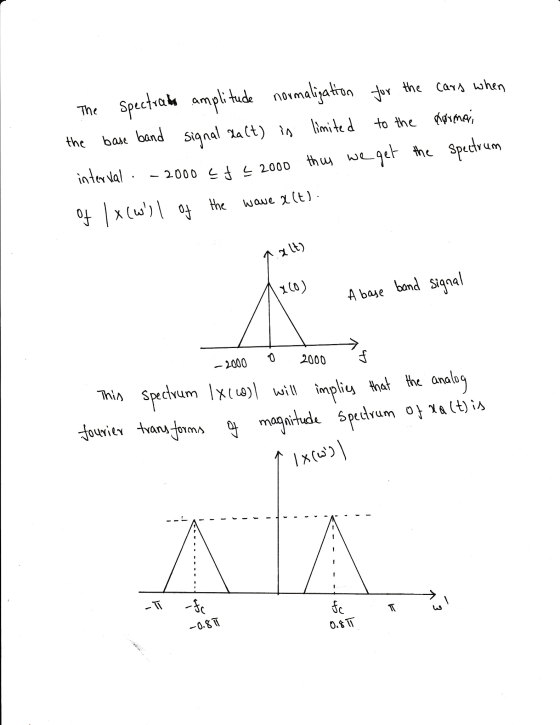
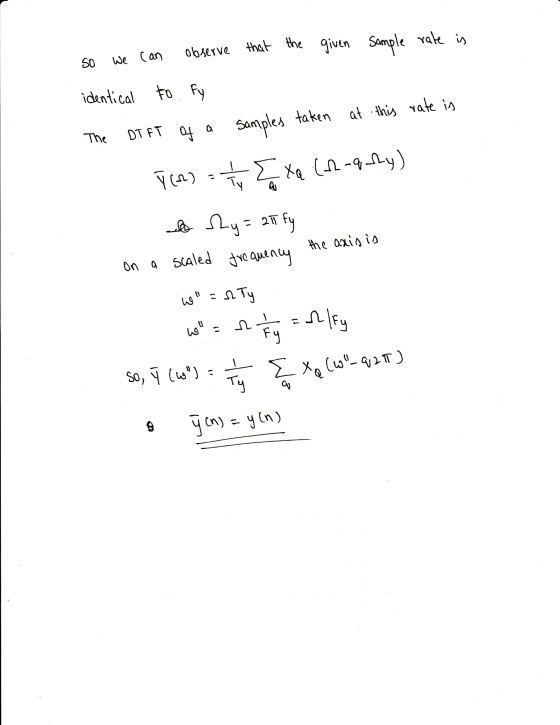
P7) An analog signal xa(t) n von converter 250 cos (0.8zrn) 2500 Show that it...
For given analog signal xa(t) what is the maximum frequency of this signal and what is...
For given analog signal xa(t) what is the maximum frequency of this signal and what is the Nyquist rate for this signal (choose the minimum one) xa(t)=5 cos(310pi t) + 8 sin(420pi t)
need problem 6.13 done. 12. The analog signal xa (t) = cos (100mt) + cos (120πt) led using natural sampling as shown in Fig. 6.18. The sampling rate used is f, -4 width of each pulse is τ = 0.5 ms...
 need problem 6.13 done.
12. The analog signal xa (t) = cos (100mt) + cos (120πt) led using natural sampling as shown in Fig. 6.18. The sampling rate used is f, -4 width of each pulse is τ = 0.5 ms. Write an analytical expression for the Fourier transform Xa (w) and sketch it. Find an analytical expression for X, () the Fourier transform of the naturally- sampled signal T, (t). a. c. Sketch the transform X, (w). 613. Repeat...
need problem 6.13 done.
12. The analog signal xa (t) = cos (100mt) + cos (120πt) led using natural sampling as shown in Fig. 6.18. The sampling rate used is f, -4 width of each pulse is τ = 0.5 ms. Write an analytical expression for the Fourier transform Xa (w) and sketch it. Find an analytical expression for X, () the Fourier transform of the naturally- sampled signal T, (t). a. c. Sketch the transform X, (w). 613. Repeat...
Problem 4.(30 pts) Given the analog signal x(t) cos(2 cos(3t)+2 sin(4mt) A.(10 pts) Find the Nyquist...
 Problem 4.(30 pts) Given the analog signal x(t) cos(2 cos(3t)+2 sin(4mt) A.(10 pts) Find the Nyquist frequency (sampling frequency) which guarantees That x() can be recovered from it's sampled version xIn] with no aliasing. B.(10 pts) If the sampling period of Ts 0.4 see is used identify all discrete frequencies Of the signal x(t), also indicate if this sampling period is adequate to recover x(t) from xn] C.(10 pts) Suppose signal x(t) is modulated by signal e(t) = cos(2000mt) what...
Q1) Given an analog signal X(t) = 3 cos (2π . 2000t) + 2 cos (2π...
Q1) Given an analog signal X(t) = 3 cos (2π . 2000t) + 2 cos (2π . 5500t) sampled at a rate of 10,000 Hz, a. Sketch the spectrum of the sampled signal up to 20 kHz; b. Sketch the recovered analog signal spectrum if an ideal lowpass filter with a cutoff frequency of 4 kHz is used to filter the sampled signal in order to recover the original signal ; c. Determine the frequency/frequencies of aliasing noise . Q2)...
pls show all work thanks 4. If the signal X(t) = cos(0) + cos(26) + cos...
 pls show all work thanks
4. If the signal X(t) = cos(0) + cos(26) + cos (46) is the input to an LTI system whose impulse response is n(t) sinc(30) sincet), what will be the output signal y() in response to this input?
pls show all work thanks
4. If the signal X(t) = cos(0) + cos(26) + cos (46) is the input to an LTI system whose impulse response is n(t) sinc(30) sincet), what will be the output signal y() in response to this input?
onsider the sampling and reconstruction system shown in the figure. x(t) IdealIdeal) D-to-C Converter Converter Assume...
 onsider the sampling and reconstruction system shown in the figure. x(t) IdealIdeal) D-to-C Converter Converter Assume that the sampling rates of the C-to-D and D-to-C converters are equal, and the input to the Ideal C-to-D converter is x(t) = 2 cos (2m(50)t +π) + cos(2π(150e) a. (5) If the output of the Ideal D-to-C converter is equal to the input x(t) i.e. ()2 cos (2m(50)t +7)+cos(2(150)) b. (5) If the sampling rate is fs = 250 samples/sec, determine the discrete-time...
Assume we have converted an analog sine wave signal of frequancy equals to 250 hz and amplitude e...
assume we have converted an analog sine wave signal of frequancy equals to 250 hz and amplitude equals to 4 volts into a PCM digital signal of zeros and ones . consider that one period of the anloge sine wave can be represented by 18 samples after sampling process ,whereas the number of quantization level is 32 show all the drawing and calculate the and calculate the time duration of the analog sine wave signal
(a) The signal x(t) 3 cos (2n404 t + π/4) + cos(2n660t-n/5) is sampled at 20kHz. How many samples...
 (a) The signal x(t) 3 cos (2n404 t + π/4) + cos(2n660t-n/5) is sampled at 20kHz. How many samples would be stored after 60 ms? (b) If x(t) = 4 cos(2π250t + 2n/7), what is the period of this signal? (c) For CDs, the sampling rate is 44,100 samples per second. How often (in seconds) must the ADC sample the signal?
(a) The signal x(t) 3 cos (2n404 t + π/4) + cos(2n660t-n/5) is sampled at 20kHz. How many samples...
(a) The signal x(t) 3 cos (2n404 t + π/4) + cos(2n660t-n/5) is sampled at 20kHz. How many samples would be stored after 60 ms? (b) If x(t) = 4 cos(2π250t + 2n/7), what is the period of this signal? (c) For CDs, the sampling rate is 44,100 samples per second. How often (in seconds) must the ADC sample the signal?
(a) The signal x(t) 3 cos (2n404 t + π/4) + cos(2n660t-n/5) is sampled at 20kHz. How many samples...
Problem 3 (30 points). Given an analog signal x(t) = 6 cos(200xt)+3 cos(600xt) + COS(1600xt) a....
 Problem 3 (30 points). Given an analog signal x(t) = 6 cos(200xt)+3 cos(600xt) + COS(1600xt) a. What is the minimum sampling frequency such that no aliasing occurs? b. Suppose sampling frequency = 1K Hz, plot the frequency spectrum range from 1 to 1 for x(n) (use for digital frequency in x-axis). Explain how to get your plots in detail. c. Repeat part b, i.e. plot the frequency spectrum range from - i tor for x(n) (use @ for digital frequency...
1. Signal f(t) : (5 + rect( )) cos(60πt) is mixed with signal cos(60πt) to produce the signal y(t...
 1. Signal f(t) : (5 + rect( )) cos(60πt) is mixed with signal cos(60πt) to produce the signal y(t). Subsequently, COS y(t) is low-pass filtered with a system having frequency response H(w) = 4recG ) to produce q(t). Sketch F(w),Y(w), Q(u), and determine q(t) 2. If signal f(t) is not band-limited, would it be possible to reconstruct f(t) exactly from its samples f(nT) taken with some finite sampling interval T> 0? Explain your reasoning
1. Signal f(t) : (5 +...
1. Signal f(t) : (5 + rect( )) cos(60πt) is mixed with signal cos(60πt) to produce the signal y(t). Subsequently, COS y(t) is low-pass filtered with a system having frequency response H(w) = 4recG ) to produce q(t). Sketch F(w),Y(w), Q(u), and determine q(t) 2. If signal f(t) is not band-limited, would it be possible to reconstruct f(t) exactly from its samples f(nT) taken with some finite sampling interval T> 0? Explain your reasoning
1. Signal f(t) : (5 +...
 need problem 6.13 done.
12. The analog signal xa (t) = cos (100mt) + cos (120πt) led using natural sampling as shown in Fig. 6.18. The sampling rate used is f, -4 width of each pulse is τ = 0.5 ms. Write an analytical expression for the Fourier transform Xa (w) and sketch it. Find an analytical expression for X, () the Fourier transform of the naturally- sampled signal T, (t). a. c. Sketch the transform X, (w). 613. Repeat...
need problem 6.13 done.
12. The analog signal xa (t) = cos (100mt) + cos (120πt) led using natural sampling as shown in Fig. 6.18. The sampling rate used is f, -4 width of each pulse is τ = 0.5 ms. Write an analytical expression for the Fourier transform Xa (w) and sketch it. Find an analytical expression for X, () the Fourier transform of the naturally- sampled signal T, (t). a. c. Sketch the transform X, (w). 613. Repeat...
 Problem 4.(30 pts) Given the analog signal x(t) cos(2 cos(3t)+2 sin(4mt) A.(10 pts) Find the Nyquist frequency (sampling frequency) which guarantees That x() can be recovered from it's sampled version xIn] with no aliasing. B.(10 pts) If the sampling period of Ts 0.4 see is used identify all discrete frequencies Of the signal x(t), also indicate if this sampling period is adequate to recover x(t) from xn] C.(10 pts) Suppose signal x(t) is modulated by signal e(t) = cos(2000mt) what...
 pls show all work thanks
4. If the signal X(t) = cos(0) + cos(26) + cos (46) is the input to an LTI system whose impulse response is n(t) sinc(30) sincet), what will be the output signal y() in response to this input?
pls show all work thanks
4. If the signal X(t) = cos(0) + cos(26) + cos (46) is the input to an LTI system whose impulse response is n(t) sinc(30) sincet), what will be the output signal y() in response to this input?
 onsider the sampling and reconstruction system shown in the figure. x(t) IdealIdeal) D-to-C Converter Converter Assume that the sampling rates of the C-to-D and D-to-C converters are equal, and the input to the Ideal C-to-D converter is x(t) = 2 cos (2m(50)t +π) + cos(2π(150e) a. (5) If the output of the Ideal D-to-C converter is equal to the input x(t) i.e. ()2 cos (2m(50)t +7)+cos(2(150)) b. (5) If the sampling rate is fs = 250 samples/sec, determine the discrete-time...
 (a) The signal x(t) 3 cos (2n404 t + π/4) + cos(2n660t-n/5) is sampled at 20kHz. How many samples would be stored after 60 ms? (b) If x(t) = 4 cos(2π250t + 2n/7), what is the period of this signal? (c) For CDs, the sampling rate is 44,100 samples per second. How often (in seconds) must the ADC sample the signal?
(a) The signal x(t) 3 cos (2n404 t + π/4) + cos(2n660t-n/5) is sampled at 20kHz. How many samples...
(a) The signal x(t) 3 cos (2n404 t + π/4) + cos(2n660t-n/5) is sampled at 20kHz. How many samples would be stored after 60 ms? (b) If x(t) = 4 cos(2π250t + 2n/7), what is the period of this signal? (c) For CDs, the sampling rate is 44,100 samples per second. How often (in seconds) must the ADC sample the signal?
(a) The signal x(t) 3 cos (2n404 t + π/4) + cos(2n660t-n/5) is sampled at 20kHz. How many samples...
 Problem 3 (30 points). Given an analog signal x(t) = 6 cos(200xt)+3 cos(600xt) + COS(1600xt) a. What is the minimum sampling frequency such that no aliasing occurs? b. Suppose sampling frequency = 1K Hz, plot the frequency spectrum range from 1 to 1 for x(n) (use for digital frequency in x-axis). Explain how to get your plots in detail. c. Repeat part b, i.e. plot the frequency spectrum range from - i tor for x(n) (use @ for digital frequency...
 1. Signal f(t) : (5 + rect( )) cos(60πt) is mixed with signal cos(60πt) to produce the signal y(t). Subsequently, COS y(t) is low-pass filtered with a system having frequency response H(w) = 4recG ) to produce q(t). Sketch F(w),Y(w), Q(u), and determine q(t) 2. If signal f(t) is not band-limited, would it be possible to reconstruct f(t) exactly from its samples f(nT) taken with some finite sampling interval T> 0? Explain your reasoning
1. Signal f(t) : (5 +...
1. Signal f(t) : (5 + rect( )) cos(60πt) is mixed with signal cos(60πt) to produce the signal y(t). Subsequently, COS y(t) is low-pass filtered with a system having frequency response H(w) = 4recG ) to produce q(t). Sketch F(w),Y(w), Q(u), and determine q(t) 2. If signal f(t) is not band-limited, would it be possible to reconstruct f(t) exactly from its samples f(nT) taken with some finite sampling interval T> 0? Explain your reasoning
1. Signal f(t) : (5 +...
Most questions answered within 3 hours.
-
Where is the error in this code sequence?
String s1 = "Hello";
String s2 = "ello";...
asked 11 months ago -
Financial data for Joel de Paris, Inc., for last year
follow:
Joel de Paris, Inc.
Balance...
asked 11 months ago -
Consider this reaction:
Al2(SO4)3 (aq)+ BaCl3
(aq) Al2Cl6 (aq)- +
3BaSO4(s) . What is the...
asked 11 months ago -
Suppose that Savneet is considering increasing her
recent random sample from 20 car rentals to 40...
asked 11 months ago -
Trucks arrive at an unloading terminal at an average rate of 120
per hour.
Trucks arrive...
asked 11 months ago -
Why are methanol and ethanol completely soluble in water while
octanol is not very little soluble....
asked 11 months ago -
A facilities manager at a university reads in a research report
that the mean amount of...
asked 11 months ago -
When the CuSO4 is rehydrated by adding water to the anhydrous
compound, is this an endothermic...
asked 11 months ago -
A ray of sunlight is passing from diamond into crown glass; the
angle of incidence is...
asked 11 months ago -
A block of mass 0.249 kg is placed on top of a light, vertical
spring of...
asked 11 months ago -
how do the kidneys compensate in the presences of acidosis
a) trigger hyperventilate
b) reserve acid...
asked 11 months ago -
Question 501 pts
The rental rate of capital to the firm increases. Which of the
following...
asked 11 months ago