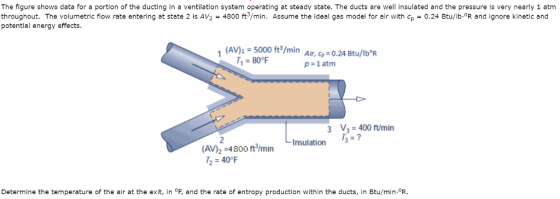
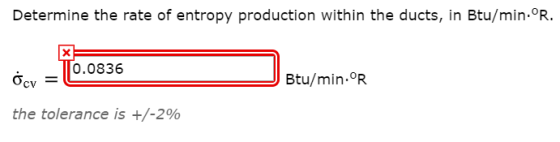
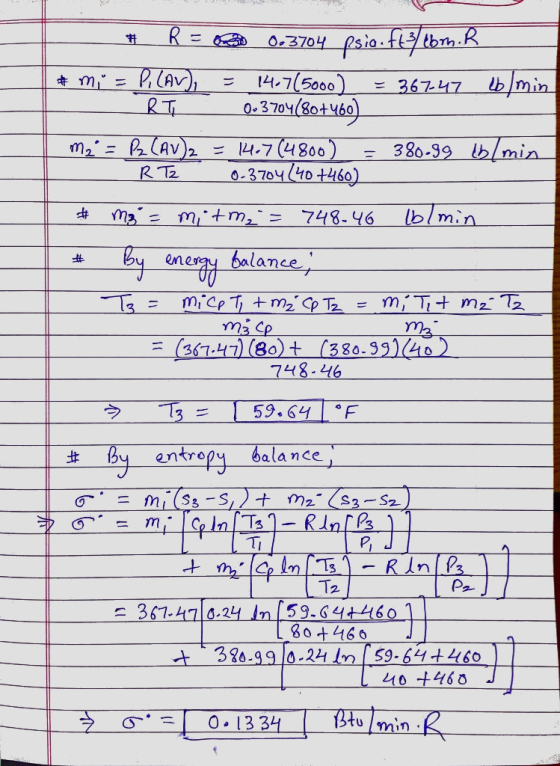
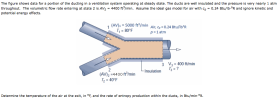
The figure shows data for a portion of the ducting in a ventilation system operating at steady state. The ducts are well insulated and the pressure is very nearly 1 atm throughout. The volumetric flow rate entering at state 2 is AV2 = 4800 ft3/min. Assume the ideal gas model for air with cp = 0.24 Btu/lb·oR and ignore kinetic and potential energy effects.
Homework Answers
Comment below in case of any trouble with the answers. I will try to respond asap.
Add Answer to:
The figure shows data for a portion of the ducting in a
ventilation system operating at...
The figure shows data for a portion of the ducting in a ventilation system operating at...
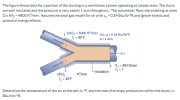 The figure shows data for a portion of the ducting in a ventilation system operating at steady state. The ducts are well insulated and the pressure is very nearly 1 atm throughout. The volumetric flow rate entering at state 2 is AV2 = 4800 ft/min. Assume the ideal gas model for air with cp = 0.24 Btu/lb-R and ignore kinetic and potential energy effects. (AV)1 = 5000 ft/min Air, Cp = 0.24 Btu/lbºR T = 80°F p = 1 atm...
I will rate The figure shows data for a portion of the ducting in a ventilation...
 I will rate
The figure shows data for a portion of the ducting in a ventilation system operating at steady state. The ducts are well insulated and the pressure is very nearly 1 atm throughout. The volumetric flow rate entering at state 2 is AV2 = 4400 ft3/min. Assume the ideal gas model for air with Cp = 0.24 Btu/lb-oR and ignore kinetic and potential energy effects. (AV) 5000 ft3/min Air, cp 0.24 Btu/lb'R T,-80°F p-1 atm V3 400 ftu/min...
I will rate
The figure shows data for a portion of the ducting in a ventilation system operating at steady state. The ducts are well insulated and the pressure is very nearly 1 atm throughout. The volumetric flow rate entering at state 2 is AV2 = 4400 ft3/min. Assume the ideal gas model for air with Cp = 0.24 Btu/lb-oR and ignore kinetic and potential energy effects. (AV) 5000 ft3/min Air, cp 0.24 Btu/lb'R T,-80°F p-1 atm V3 400 ftu/min...
Problem 4.069 The figure belows shows three components of an air-conditioning system, where T3 115°F and...
 Problem 4.069 The figure belows shows three components of an air-conditioning system, where T3 115°F and 4.5 Ib/s. Refrigerant 134a flows through a throttling valve and a heat exchanger while air flows through a fan and the same heat exchanger. Data for steady-state operation are given on the figure. There is no significant heat transfer between any of the components and the surroundings. Kinetic and potential energy effects are negligible. Air T 535 R cp = 0.240 Btu/lb-R Saturated liquid...
Air at 95°F, 1 atm, and 10% relative humidity enters an evaporative cooler operating at steady...
Air at 95°F, 1 atm, and 10% relative humidity enters an evaporative cooler operating at steady state. The volumetric flow rate of the incoming air is 895 ft3/min. Liquid water at 68°F enters the cooler and fully evaporates. Moist air exits the cooler at 70°F, 1 atm. There is no significant heat transfer between the device and its surroundings and kinetic and potential energy effects can be neglected. a)Determine the mass flow rate of the dry air in lb(dry air)/min....
A pump is used to circulate hot water in a home heating system. Water enters the...
 A pump is used to circulate hot water in a home heating system.
Water enters the well-insulated pump operating at steady state at a
rate of 0.42 gal/min. The inlet pressure and temperature are 14.7
lbf/in2, and 180F,
respectively; at the exit the pressure is 60 lbf/in2.
The pump requires 1/35 hp of power input. Water can be modeled as
an incompressible substance with constant density of 60.58
lb/ft3 and constant specific heat of 1 Btu/lb
R.
Neglecting kinetic and...
A pump is used to circulate hot water in a home heating system.
Water enters the well-insulated pump operating at steady state at a
rate of 0.42 gal/min. The inlet pressure and temperature are 14.7
lbf/in2, and 180F,
respectively; at the exit the pressure is 60 lbf/in2.
The pump requires 1/35 hp of power input. Water can be modeled as
an incompressible substance with constant density of 60.58
lb/ft3 and constant specific heat of 1 Btu/lb
R.
Neglecting kinetic and...
A pump is used to circulate hot water in a home heating system. Water enters the...
A pump is used to circulate hot water in a home heating system. Water enters the well-insulated pump operating at steady state at a rate of 0.42 gal/min. The inlet pressure and temperature are 14.7 lbf/in.2, and 180°F, respectively; at the exit the pressure is 90 lbf/in.2 The pump requires 1/15 hp of power input. Water can be modeled as an incompressible substance with constant density of 60.58 lb/ft3 and constant specific heat of 1 Btu/lb · °R. Neglecting kinetic...
Air at 95°F, 1 atm, and 10% relative humidity enters an evaporative cooler operating at steady...
 Air at 95°F, 1 atm, and 10% relative humidity enters an evaporative cooler operating at steady state. The volumetric flow rate of the incoming air is 1765 ft3/min. Liquid water at 68°F enters the cooler and fully evaporates. Moist air exits the cooler at 70°F, 1 atm. There is no significant heat transfer between the device and its surroundings and kinetic and potential energy effects can be neglected. A. Determine the mass flow rate of the dry air in lbm(dry...
Air at 95°F, 1 atm, and 10% relative humidity enters an evaporative cooler operating at steady...
 Air at 95°F, 1 atm, and 10% relative humidity enters an evaporative cooler operating at steady state. The volumetric flow rate of the incoming air is 1765 ft3/min. Liquid water at 68°F enters the cooler and fully evaporates. Moist air exits the cooler at 70°F, 1 atm. There is no significant heat transfer between the device and its surroundings and kinetic and potential energy effects can be neglected. A. Determine the mass flow rate of the dry air in Ibm(dry...
As shown in the figure, air with a volumetric flow rate of 14,000 ft/min enters an...
 As shown in the figure, air with a volumetric flow rate of 14,000 ft/min enters an air-handling unit at 80°F, 1 atm. The air-handling unit delivers air at 45°F, 1 atm to a duct system with three branches consisting of two 26-in.-diameter ducts and one 50-in. duct. The velocity in each 26-in. duct is 13 ft/s. Assume steady state operation and ideal gas behavior for the air. 4+D. - 50 in. -- -- Duct > si 72 = 73 =...
Air, modeled as an ideal gas, enters a turbine operating at steady state at 450 kPa,...
Air, modeled as an ideal gas, enters a turbine operating at steady state at 450 kPa, 800 K and exits at 100 kPa. The temperature of the exiting air is 420 K. a) If the turbine is well insulated and you can ignore kinetic and potential energy effects, determine if the exit temperature can be correct. b) What if the exit temperature is 550 K? Explain you’re your reasoning. Hint: Find the entropy generation rate first.
 The figure shows data for a portion of the ducting in a ventilation system operating at steady state. The ducts are well insulated and the pressure is very nearly 1 atm throughout. The volumetric flow rate entering at state 2 is AV2 = 4800 ft/min. Assume the ideal gas model for air with cp = 0.24 Btu/lb-R and ignore kinetic and potential energy effects. (AV)1 = 5000 ft/min Air, Cp = 0.24 Btu/lbºR T = 80°F p = 1 atm...
 I will rate
The figure shows data for a portion of the ducting in a ventilation system operating at steady state. The ducts are well insulated and the pressure is very nearly 1 atm throughout. The volumetric flow rate entering at state 2 is AV2 = 4400 ft3/min. Assume the ideal gas model for air with Cp = 0.24 Btu/lb-oR and ignore kinetic and potential energy effects. (AV) 5000 ft3/min Air, cp 0.24 Btu/lb'R T,-80°F p-1 atm V3 400 ftu/min...
I will rate
The figure shows data for a portion of the ducting in a ventilation system operating at steady state. The ducts are well insulated and the pressure is very nearly 1 atm throughout. The volumetric flow rate entering at state 2 is AV2 = 4400 ft3/min. Assume the ideal gas model for air with Cp = 0.24 Btu/lb-oR and ignore kinetic and potential energy effects. (AV) 5000 ft3/min Air, cp 0.24 Btu/lb'R T,-80°F p-1 atm V3 400 ftu/min...
 Problem 4.069 The figure belows shows three components of an air-conditioning system, where T3 115°F and 4.5 Ib/s. Refrigerant 134a flows through a throttling valve and a heat exchanger while air flows through a fan and the same heat exchanger. Data for steady-state operation are given on the figure. There is no significant heat transfer between any of the components and the surroundings. Kinetic and potential energy effects are negligible. Air T 535 R cp = 0.240 Btu/lb-R Saturated liquid...
 A pump is used to circulate hot water in a home heating system.
Water enters the well-insulated pump operating at steady state at a
rate of 0.42 gal/min. The inlet pressure and temperature are 14.7
lbf/in2, and 180F,
respectively; at the exit the pressure is 60 lbf/in2.
The pump requires 1/35 hp of power input. Water can be modeled as
an incompressible substance with constant density of 60.58
lb/ft3 and constant specific heat of 1 Btu/lb
R.
Neglecting kinetic and...
A pump is used to circulate hot water in a home heating system.
Water enters the well-insulated pump operating at steady state at a
rate of 0.42 gal/min. The inlet pressure and temperature are 14.7
lbf/in2, and 180F,
respectively; at the exit the pressure is 60 lbf/in2.
The pump requires 1/35 hp of power input. Water can be modeled as
an incompressible substance with constant density of 60.58
lb/ft3 and constant specific heat of 1 Btu/lb
R.
Neglecting kinetic and...
 Air at 95°F, 1 atm, and 10% relative humidity enters an evaporative cooler operating at steady state. The volumetric flow rate of the incoming air is 1765 ft3/min. Liquid water at 68°F enters the cooler and fully evaporates. Moist air exits the cooler at 70°F, 1 atm. There is no significant heat transfer between the device and its surroundings and kinetic and potential energy effects can be neglected. A. Determine the mass flow rate of the dry air in lbm(dry...
 Air at 95°F, 1 atm, and 10% relative humidity enters an evaporative cooler operating at steady state. The volumetric flow rate of the incoming air is 1765 ft3/min. Liquid water at 68°F enters the cooler and fully evaporates. Moist air exits the cooler at 70°F, 1 atm. There is no significant heat transfer between the device and its surroundings and kinetic and potential energy effects can be neglected. A. Determine the mass flow rate of the dry air in Ibm(dry...
 As shown in the figure, air with a volumetric flow rate of 14,000 ft/min enters an air-handling unit at 80°F, 1 atm. The air-handling unit delivers air at 45°F, 1 atm to a duct system with three branches consisting of two 26-in.-diameter ducts and one 50-in. duct. The velocity in each 26-in. duct is 13 ft/s. Assume steady state operation and ideal gas behavior for the air. 4+D. - 50 in. -- -- Duct > si 72 = 73 =...
Most questions answered within 3 hours.
-
Where is the error in this code sequence?
String s1 = "Hello";
String s2 = "ello";...
asked 10 months ago -
Financial data for Joel de Paris, Inc., for last year
follow:
Joel de Paris, Inc.
Balance...
asked 10 months ago -
Consider this reaction:
Al2(SO4)3 (aq)+ BaCl3
(aq) Al2Cl6 (aq)- +
3BaSO4(s) . What is the...
asked 10 months ago -
Suppose that Savneet is considering increasing her
recent random sample from 20 car rentals to 40...
asked 10 months ago -
Trucks arrive at an unloading terminal at an average rate of 120
per hour.
Trucks arrive...
asked 10 months ago -
Why are methanol and ethanol completely soluble in water while
octanol is not very little soluble....
asked 10 months ago -
A facilities manager at a university reads in a research report
that the mean amount of...
asked 10 months ago -
When the CuSO4 is rehydrated by adding water to the anhydrous
compound, is this an endothermic...
asked 10 months ago -
A ray of sunlight is passing from diamond into crown glass; the
angle of incidence is...
asked 10 months ago -
A block of mass 0.249 kg is placed on top of a light, vertical
spring of...
asked 10 months ago -
how do the kidneys compensate in the presences of acidosis
a) trigger hyperventilate
b) reserve acid...
asked 10 months ago -
Question 501 pts
The rental rate of capital to the firm increases. Which of the
following...
asked 10 months ago