
Homework Answers

Add Answer to:
As shown in the figure, air with a volumetric flow rate of 14,000 ft/min enters an...
Moist air enters a duct at 10 °C, 80% relative humidity, and a volumetric flow rate...
Moist air enters a duct at 10 °C, 80% relative humidity, and a volumetric flow rate of 150 m3/min. The mixture is heated as it flows through the duct and exits at 30 °C. No moisture is added or removed and the mixture stays at 1 atm. Determine the rate of heat transfer and the relative humidity at the exit.
Step 2 Your answer is correct. Determine the volumetric flow rate in each 26-in. duct, in ft3min....
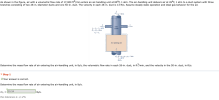 We were unable to transcribe this imageStep 2 Your answer is correct. Determine the volumetric flow rate in each 26-in. duct, in ft3min. 3/min (AV)2 = (AV)3-12858-2 the tolerance is +/-296 Click if you would like to Show Work for this question: Open Show Work SHOW HINT SHOW SOLUTION SHOW A NSWER Step 3 Your answer is incorrect. Try again. Determine the velocity in the 50-in. duct, in ft/s V4-137.9 the tolerance is +/-2%
Step 2 Your answer is correct....
We were unable to transcribe this imageStep 2 Your answer is correct. Determine the volumetric flow rate in each 26-in. duct, in ft3min. 3/min (AV)2 = (AV)3-12858-2 the tolerance is +/-296 Click if you would like to Show Work for this question: Open Show Work SHOW HINT SHOW SOLUTION SHOW A NSWER Step 3 Your answer is incorrect. Try again. Determine the velocity in the 50-in. duct, in ft/s V4-137.9 the tolerance is +/-2%
Step 2 Your answer is correct....
Air enters an air conditioning duct measuring 1 f t by 2 f t with a...
Air enters an air conditioning duct measuring 1 f t by 2 f t with a volume flow rate of 1000 f t3/min. The duct supplies three classrooms through ducts that are 8 in. by 15 in. Find the average velocity in each duct. Answer should be 8.33 f t/s; 6.67 f t/s
If the air in a 12-inch diameter duct with an air flow of 1,500 ft3/min and...
If the air in a 12-inch diameter duct with an air flow of 1,500 ft3/min and a velocity of 14 ft/min flows into a 6-inch diameter duct, what are the new flow rate and velocity? What velocity of air would be required to draw toxic vapors into a duct 24 inches away from a 12 inch round duct with an air flow rate of 1,500 ft3/min? Compare the flow rates into a hood that needs to capture a contaminant at...
I will rate The figure shows data for a portion of the ducting in a ventilation...
 I will rate
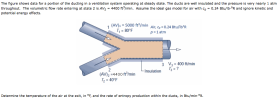
The figure shows data for a portion of the ducting in a ventilation system operating at steady state. The ducts are well insulated and the pressure is very nearly 1 atm throughout. The volumetric flow rate entering at state 2 is AV2 = 4400 ft3/min. Assume the ideal gas model for air with Cp = 0.24 Btu/lb-oR and ignore kinetic and potential energy effects. (AV) 5000 ft3/min Air, cp 0.24 Btu/lb'R T,-80°F p-1 atm V3 400 ftu/min...
I will rate
The figure shows data for a portion of the ducting in a ventilation system operating at steady state. The ducts are well insulated and the pressure is very nearly 1 atm throughout. The volumetric flow rate entering at state 2 is AV2 = 4400 ft3/min. Assume the ideal gas model for air with Cp = 0.24 Btu/lb-oR and ignore kinetic and potential energy effects. (AV) 5000 ft3/min Air, cp 0.24 Btu/lb'R T,-80°F p-1 atm V3 400 ftu/min...
The figure shows data for a portion of the ducting in a ventilation system operating at...
 The figure shows data for a portion of the ducting in a
ventilation system operating at steady state. The ducts are well
insulated and the pressure is very nearly 1 atm throughout. The
volumetric flow rate entering at state 2 is AV2
= 4800 ft3/min. Assume the ideal gas model for air with
cp = 0.24 Btu/lb·oR and ignore
kinetic and potential energy effects.
The figure shows data for a portion of the ducting in a ventilation system operating at...
The figure shows data for a portion of the ducting in a
ventilation system operating at steady state. The ducts are well
insulated and the pressure is very nearly 1 atm throughout. The
volumetric flow rate entering at state 2 is AV2
= 4800 ft3/min. Assume the ideal gas model for air with
cp = 0.24 Btu/lb·oR and ignore
kinetic and potential energy effects.
The figure shows data for a portion of the ducting in a ventilation system operating at...
The figure shows data for a portion of the ducting in a ventilation system operating at...
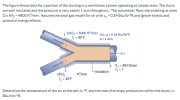 The figure shows data for a portion of the ducting in a ventilation system operating at steady state. The ducts are well insulated and the pressure is very nearly 1 atm throughout. The volumetric flow rate entering at state 2 is AV2 = 4800 ft/min. Assume the ideal gas model for air with cp = 0.24 Btu/lb-R and ignore kinetic and potential energy effects. (AV)1 = 5000 ft/min Air, Cp = 0.24 Btu/lbºR T = 80°F p = 1 atm...
1. Air at latm, 15C and 70% relative humidity and volumetric flow rate of 10m /min...
 1. Air at latm, 15C and 70% relative humidity and volumetric flow rate of 10m /min is first heated to 19C in a heating section and then humidified by introducing water vapor. The air leaves the humidifying section at 24C and 65% relative humidity. Determine: a) The mass flow rate of steam added to the air. b) The heat flow rate transferred to the air in the heating section Heating coils 100.000 1 atm T1 = 15°C T3 = 24°C...
4. Liquid water at 100°F and 200 gal/min volumetric flow rate enters a cooling tower operating...
 4. Liquid water at 100°F and 200 gal/min volumetric flow rate enters a cooling tower operating at steady state. Atmospheric air enters with a dry-bulb temperature of 80°F and a wet-bulb temperature of 60°F. Moist air exits the cooling tower at 90° and 90% relative humidity. Makeup water is provided at 80°F. Calculate the mass flow rates of the dry air and makeup water, each in lb/min, versus return water temperature at 80, 90, and 100°F. Ignore kinetic and potential...
1. A building air-condition unit is designed to cool 2500 ft3/min of outside air (95°F, 740...
1. A building air-condition unit is designed to cool 2500 ft3/min of outside air (95°F, 740 mmHG, 82% relative humidity) to 50°F, thereby condensing a portion of the water vapor. The system then heats the air and sends it to a building at 68°F a) Calculate the rate of water condensation. b) Calculate the volumetric flow rate of air delivered to the building.
 We were unable to transcribe this imageStep 2 Your answer is correct. Determine the volumetric flow rate in each 26-in. duct, in ft3min. 3/min (AV)2 = (AV)3-12858-2 the tolerance is +/-296 Click if you would like to Show Work for this question: Open Show Work SHOW HINT SHOW SOLUTION SHOW A NSWER Step 3 Your answer is incorrect. Try again. Determine the velocity in the 50-in. duct, in ft/s V4-137.9 the tolerance is +/-2%
Step 2 Your answer is correct....
We were unable to transcribe this imageStep 2 Your answer is correct. Determine the volumetric flow rate in each 26-in. duct, in ft3min. 3/min (AV)2 = (AV)3-12858-2 the tolerance is +/-296 Click if you would like to Show Work for this question: Open Show Work SHOW HINT SHOW SOLUTION SHOW A NSWER Step 3 Your answer is incorrect. Try again. Determine the velocity in the 50-in. duct, in ft/s V4-137.9 the tolerance is +/-2%
Step 2 Your answer is correct....
 I will rate
The figure shows data for a portion of the ducting in a ventilation system operating at steady state. The ducts are well insulated and the pressure is very nearly 1 atm throughout. The volumetric flow rate entering at state 2 is AV2 = 4400 ft3/min. Assume the ideal gas model for air with Cp = 0.24 Btu/lb-oR and ignore kinetic and potential energy effects. (AV) 5000 ft3/min Air, cp 0.24 Btu/lb'R T,-80°F p-1 atm V3 400 ftu/min...
I will rate
The figure shows data for a portion of the ducting in a ventilation system operating at steady state. The ducts are well insulated and the pressure is very nearly 1 atm throughout. The volumetric flow rate entering at state 2 is AV2 = 4400 ft3/min. Assume the ideal gas model for air with Cp = 0.24 Btu/lb-oR and ignore kinetic and potential energy effects. (AV) 5000 ft3/min Air, cp 0.24 Btu/lb'R T,-80°F p-1 atm V3 400 ftu/min...
 The figure shows data for a portion of the ducting in a
ventilation system operating at steady state. The ducts are well
insulated and the pressure is very nearly 1 atm throughout. The
volumetric flow rate entering at state 2 is AV2
= 4800 ft3/min. Assume the ideal gas model for air with
cp = 0.24 Btu/lb·oR and ignore
kinetic and potential energy effects.
The figure shows data for a portion of the ducting in a ventilation system operating at...
The figure shows data for a portion of the ducting in a
ventilation system operating at steady state. The ducts are well
insulated and the pressure is very nearly 1 atm throughout. The
volumetric flow rate entering at state 2 is AV2
= 4800 ft3/min. Assume the ideal gas model for air with
cp = 0.24 Btu/lb·oR and ignore
kinetic and potential energy effects.
The figure shows data for a portion of the ducting in a ventilation system operating at...
 The figure shows data for a portion of the ducting in a ventilation system operating at steady state. The ducts are well insulated and the pressure is very nearly 1 atm throughout. The volumetric flow rate entering at state 2 is AV2 = 4800 ft/min. Assume the ideal gas model for air with cp = 0.24 Btu/lb-R and ignore kinetic and potential energy effects. (AV)1 = 5000 ft/min Air, Cp = 0.24 Btu/lbºR T = 80°F p = 1 atm...
 1. Air at latm, 15C and 70% relative humidity and volumetric flow rate of 10m /min is first heated to 19C in a heating section and then humidified by introducing water vapor. The air leaves the humidifying section at 24C and 65% relative humidity. Determine: a) The mass flow rate of steam added to the air. b) The heat flow rate transferred to the air in the heating section Heating coils 100.000 1 atm T1 = 15°C T3 = 24°C...
 4. Liquid water at 100°F and 200 gal/min volumetric flow rate enters a cooling tower operating at steady state. Atmospheric air enters with a dry-bulb temperature of 80°F and a wet-bulb temperature of 60°F. Moist air exits the cooling tower at 90° and 90% relative humidity. Makeup water is provided at 80°F. Calculate the mass flow rates of the dry air and makeup water, each in lb/min, versus return water temperature at 80, 90, and 100°F. Ignore kinetic and potential...
Most questions answered within 3 hours.
-
Where is the error in this code sequence?
String s1 = "Hello";
String s2 = "ello";...
asked 11 months ago -
Financial data for Joel de Paris, Inc., for last year
follow:
Joel de Paris, Inc.
Balance...
asked 11 months ago -
Consider this reaction:
Al2(SO4)3 (aq)+ BaCl3
(aq) Al2Cl6 (aq)- +
3BaSO4(s) . What is the...
asked 11 months ago -
Suppose that Savneet is considering increasing her
recent random sample from 20 car rentals to 40...
asked 11 months ago -
Trucks arrive at an unloading terminal at an average rate of 120
per hour.
Trucks arrive...
asked 11 months ago -
Why are methanol and ethanol completely soluble in water while
octanol is not very little soluble....
asked 11 months ago -
A facilities manager at a university reads in a research report
that the mean amount of...
asked 11 months ago -
When the CuSO4 is rehydrated by adding water to the anhydrous
compound, is this an endothermic...
asked 11 months ago -
A ray of sunlight is passing from diamond into crown glass; the
angle of incidence is...
asked 11 months ago -
A block of mass 0.249 kg is placed on top of a light, vertical
spring of...
asked 11 months ago -
how do the kidneys compensate in the presences of acidosis
a) trigger hyperventilate
b) reserve acid...
asked 11 months ago -
Question 501 pts
The rental rate of capital to the firm increases. Which of the
following...
asked 11 months ago