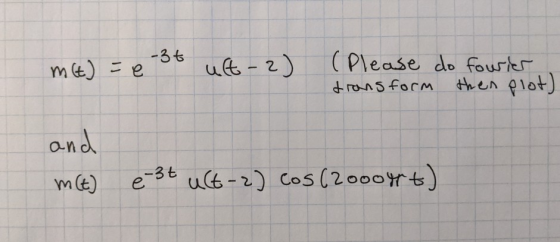
I would like to have a better understanding of how to do Fourier transformations on Matlab.
If this is possible. Please show me how to:
1. have Matlab FIND the Fourier transformation of the two functions above. They do not have to be in the same program or anything. I just want to understand the syntax and semantics better.
2. THEN plot the Fourier transform that you
found
VIA MATLAB.
The main thing that I am trying to do is to be able to check to see if my Fourier transformations solved on paper are correct to make things easier in the future. comments in the code would be greatly appreciated!
Thank you.
Homework Answers
First I am giving you basic example of Fourier Transform
1
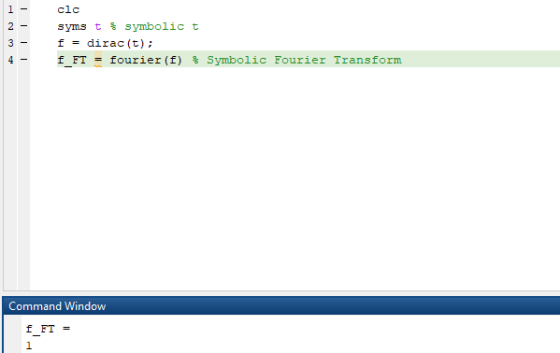
We know that Fourier Transform of dirac(t) =1
Now Using MATLAB
clc
syms t % symbolic t
f = dirac(t);
f_FT = fourier(f) % Symbolic Fourier Transform
Result:
f_FT =
1
2.
Now Check for Unit Step

Using MATLAB CODE
clc
syms t % symbolic t
f = heaviside(t); % Heaviside is unit step function
f_FT = fourier(f) % Symbolic Fourier Transform
Result:
f_FT =
pi*dirac(w) - 1i/w
Now coming to given Problems
1.
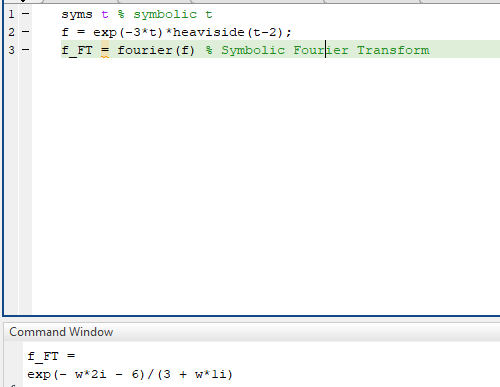
f= exp(-3*t)*u(t-2)
MATLAB CODE
syms t % symbolic t
f = exp(-3*t)*heaviside(t-2);
f_FT = fourier(f) % Symbolic Fourier Transform
RESULT:
f_FT =
exp(- w*2i - 6)/(3 + w*1i)
>>
2.
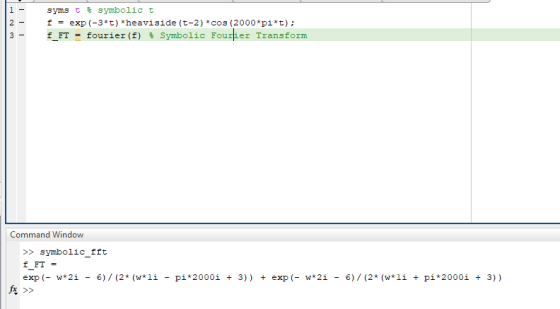
f= exp(-3*t)*u(t-2)*cos(2000*pi*t)
MATLAB CODE
syms t % symbolic t
f = exp(-3*t)*heaviside(t-2)*cos(2000*pi*t);
f_FT = fourier(f) % Symbolic Fourier Transform
RESULT:
>> symbolic_fft
f_FT =
exp(- w*2i - 6)/(2*(w*1i - pi*2000i + 3)) + exp(- w*2i -
6)/(2*(w*1i + pi*2000i + 3))
If you have any doubt ,please feel free to ask in comment section.
Please Rate my work.
Add Answer to:
I would like to have a better understanding of how to
do Fourier transformations on Matlab....
How can I do this on matlab? Steps would be greatly appreciated. Thanks . Can you...
 How can I do this on matlab? Steps would be greatly appreciated.
Thanks
. Can you draw the following functions? ·Y=x*sin(x) ·Y=x^2*sin(x) . Set x- to be from -50 to 50 What if I want to include these 2 functions in 1 window?
How can I do this on matlab? Steps would be greatly appreciated.
Thanks
. Can you draw the following functions? ·Y=x*sin(x) ·Y=x^2*sin(x) . Set x- to be from -50 to 50 What if I want to include these 2 functions in 1 window?
This is a MATLAB Question. Below is my base code for a Fourier Series of a...
 This is a MATLAB Question. Below is my base code for a Fourier
Series of a half triangle wave.
So I am being asked to isolate the first 8 components so that
only those first 8 components of the half triangle function are
calculated by MATLAB fft function, and then afterwards I am asked
to do the same thing but with the first 20 components rather than
the first 8. How do I isolate the first x number of components...
This is a MATLAB Question. Below is my base code for a Fourier
Series of a half triangle wave.
So I am being asked to isolate the first 8 components so that
only those first 8 components of the half triangle function are
calculated by MATLAB fft function, and then afterwards I am asked
to do the same thing but with the first 20 components rather than
the first 8. How do I isolate the first x number of components...
I need to solve this using Matlab please type comments in the script so I understand thank you. Create a table (similar to what we do in class) with all the parameters that you have to calculate fo...
 I need to solve this using Matlab please type comments in the
script so I understand thank you.
Create a table (similar to what we do in class) with all the
parameters that you have to calculate for every step in the
solution. Include y and dy/dx in the same plot with points from
your table joined by straight lines (and clearly indicate which
line correspond to what). You may use the MATLAB function you
created above.
Solve the following...
I need to solve this using Matlab please type comments in the
script so I understand thank you.
Create a table (similar to what we do in class) with all the
parameters that you have to calculate for every step in the
solution. Include y and dy/dx in the same plot with points from
your table joined by straight lines (and clearly indicate which
line correspond to what). You may use the MATLAB function you
created above.
Solve the following...
*** do not solve the question *** i have uploaded the data to matlab, show how do i code to run t...
 *** do not solve the question
*** i have uploaded the data to matlab, show how do i
code to run ttest for this question (provide exact
codes)
THxxxxxxxxxxxxxxxxxxxxxxxxx
stion 18 marks In a study concerned with the effects of smoking on blood pressure, the smoking status (Yes- 1, No -0) and systolic blood pressure (mmHg) were recorded for 500 randomly selected people. The purpose of the following analysis is to determine whether the systolic blood pressure of smokers is...
*** do not solve the question
*** i have uploaded the data to matlab, show how do i
code to run ttest for this question (provide exact
codes)
THxxxxxxxxxxxxxxxxxxxxxxxxx
stion 18 marks In a study concerned with the effects of smoking on blood pressure, the smoking status (Yes- 1, No -0) and systolic blood pressure (mmHg) were recorded for 500 randomly selected people. The purpose of the following analysis is to determine whether the systolic blood pressure of smokers is...
MATLAB Questions. I have a basic understanding of the tools for MATLAB, but do not know...
 MATLAB Questions. I have a basic understanding of the tools for
MATLAB, but do not know how to create the code for these questions.
Please show the entire code.
2. A paper cup shaped as a frustum of cone with R-14R1 is designed to have a volume of 25 cm Determine R1, R2 and the surface area, S, of the paper for cups with a height, h, of 1O cm. The volume of the cup, V, and the surface area...
MATLAB Questions. I have a basic understanding of the tools for
MATLAB, but do not know how to create the code for these questions.
Please show the entire code.
2. A paper cup shaped as a frustum of cone with R-14R1 is designed to have a volume of 25 cm Determine R1, R2 and the surface area, S, of the paper for cups with a height, h, of 1O cm. The volume of the cup, V, and the surface area...
I have all of the answers to this can someone just actually explain this matlab code and the results to me so i can get a better understanding? b) (c) and (d) %% Matlab code %% clc; close all; clear...
 I have all of the answers to this can someone just actually
explain this matlab code and the results to me so i can get a
better understanding?
b)
(c) and (d)
%% Matlab code %%
clc;
close all;
clear all;
format long;
f=@(t,y)y*(1-y);
y(1)=0.01;
%%%% Exact solution
[t1 y1]=ode45(f,[0 9],y(1));
figure;
plot(t1,y1,'*');
hold on
% Eular therom
M=[32 64 128];
T=9;
fprintf(' M Max error \n' );
for n=1:length(M)
k=T/M(n);
t=0:k:T;
for h=1:length(t)-1
y(h+1)=y(h)+k*f(t(h),y(h));
end
plot(t,y);
hold on
%%%...
I have all of the answers to this can someone just actually
explain this matlab code and the results to me so i can get a
better understanding?
b)
(c) and (d)
%% Matlab code %%
clc;
close all;
clear all;
format long;
f=@(t,y)y*(1-y);
y(1)=0.01;
%%%% Exact solution
[t1 y1]=ode45(f,[0 9],y(1));
figure;
plot(t1,y1,'*');
hold on
% Eular therom
M=[32 64 128];
T=9;
fprintf(' M Max error \n' );
for n=1:length(M)
k=T/M(n);
t=0:k:T;
for h=1:length(t)-1
y(h+1)=y(h)+k*f(t(h),y(h));
end
plot(t,y);
hold on
%%%...
If I could please have some guidlines on how to do this, I would greatly appreciate...
 If I could please have some
guidlines on how to do this, I would greatly appreciate it! I'm
totally lost!
1. Calculate the population size (N) at the given time (t) with either r or R below: Calculate r or R from the given R or r as well. 50 0.15 d) Generation Time Starting (t = 0) (year) (t) No a) 1000 b) 100 50 100 1000 100 100 100 100 0.25 ||| lalala 0.35 -0.15 0.45 0.35
If I could please have some
guidlines on how to do this, I would greatly appreciate it! I'm
totally lost!
1. Calculate the population size (N) at the given time (t) with either r or R below: Calculate r or R from the given R or r as well. 50 0.15 d) Generation Time Starting (t = 0) (year) (t) No a) 1000 b) 100 50 100 1000 100 100 100 100 0.25 ||| lalala 0.35 -0.15 0.45 0.35
Hey guys, I would like to solve these equations using ode45 in MATLAB QUESTION 1) QUESTION 2) where k and c are: For a better understanding of how these values came about: I deeply appreciate you...
 Hey guys,
I would like to solve these equations using ode45 in
MATLAB
QUESTION 1)
QUESTION 2)
where k and c are:
For a better understanding of how these values came
about:
I deeply appreciate your assistance to these guys.
Thanks
b2-1.ば2-('22'2-v211. 2'2(0)=220 predator 2'2 dr2 cr1 +k(t)), 12_ x2(to) =y0. := k(t) kle fes ya Building Spring/ Damper Wheel Axle Tires Street
b2-1.ば2-('22'2-v211. 2'2(0)=220 predator 2'2
dr2 cr1 +k(t)), 12_ x2(to) =y0.
:= k(t)
kle fes ya Building Spring/...
Hey guys,
I would like to solve these equations using ode45 in
MATLAB
QUESTION 1)
QUESTION 2)
where k and c are:
For a better understanding of how these values came
about:
I deeply appreciate your assistance to these guys.
Thanks
b2-1.ば2-('22'2-v211. 2'2(0)=220 predator 2'2 dr2 cr1 +k(t)), 12_ x2(to) =y0. := k(t) kle fes ya Building Spring/ Damper Wheel Axle Tires Street
b2-1.ば2-('22'2-v211. 2'2(0)=220 predator 2'2
dr2 cr1 +k(t)), 12_ x2(to) =y0.
:= k(t)
kle fes ya Building Spring/...
I'm still trying to learn how to use matlab but I'm not sure how to do this at all. I am to imple...
 I'm still trying to learn how to use matlab but I'm not sure how
to do this at all. I am to implement three different explicit
methods for approximating an IVP using Eulers, Runge-Kutta 4th
order method, and the trapezoidal method using the same parameters.
I'd much appreciate having just the Euler methods. but having all
three done would be greatly appreciated and will give a great
rating!
function y forward_euler (n, m, a, b, eta,F) % Use the forward...
I'm still trying to learn how to use matlab but I'm not sure how
to do this at all. I am to implement three different explicit
methods for approximating an IVP using Eulers, Runge-Kutta 4th
order method, and the trapezoidal method using the same parameters.
I'd much appreciate having just the Euler methods. but having all
three done would be greatly appreciated and will give a great
rating!
function y forward_euler (n, m, a, b, eta,F) % Use the forward...
// I understand what I have to do on a fundamental level however I am having...
// I understand what I have to do on a fundamental level however I am having trouble just grasping how to implement them into the program. Explanation greatly appreciated! The files section has a gutted List class for you. Just write all the methods. Easy peasy. Just remember that if your code never calls a template method, the compiler deletes it entirely. Make sure you test everything. List's big three: Destructor, Copy, Assignment. Vanilla constructor is right - don't change...
 How can I do this on matlab? Steps would be greatly appreciated.
Thanks
. Can you draw the following functions? ·Y=x*sin(x) ·Y=x^2*sin(x) . Set x- to be from -50 to 50 What if I want to include these 2 functions in 1 window?
How can I do this on matlab? Steps would be greatly appreciated.
Thanks
. Can you draw the following functions? ·Y=x*sin(x) ·Y=x^2*sin(x) . Set x- to be from -50 to 50 What if I want to include these 2 functions in 1 window?
 This is a MATLAB Question. Below is my base code for a Fourier
Series of a half triangle wave.
So I am being asked to isolate the first 8 components so that
only those first 8 components of the half triangle function are
calculated by MATLAB fft function, and then afterwards I am asked
to do the same thing but with the first 20 components rather than
the first 8. How do I isolate the first x number of components...
This is a MATLAB Question. Below is my base code for a Fourier
Series of a half triangle wave.
So I am being asked to isolate the first 8 components so that
only those first 8 components of the half triangle function are
calculated by MATLAB fft function, and then afterwards I am asked
to do the same thing but with the first 20 components rather than
the first 8. How do I isolate the first x number of components...
 I need to solve this using Matlab please type comments in the
script so I understand thank you.
Create a table (similar to what we do in class) with all the
parameters that you have to calculate for every step in the
solution. Include y and dy/dx in the same plot with points from
your table joined by straight lines (and clearly indicate which
line correspond to what). You may use the MATLAB function you
created above.
Solve the following...
I need to solve this using Matlab please type comments in the
script so I understand thank you.
Create a table (similar to what we do in class) with all the
parameters that you have to calculate for every step in the
solution. Include y and dy/dx in the same plot with points from
your table joined by straight lines (and clearly indicate which
line correspond to what). You may use the MATLAB function you
created above.
Solve the following...
 *** do not solve the question
*** i have uploaded the data to matlab, show how do i
code to run ttest for this question (provide exact
codes)
THxxxxxxxxxxxxxxxxxxxxxxxxx
stion 18 marks In a study concerned with the effects of smoking on blood pressure, the smoking status (Yes- 1, No -0) and systolic blood pressure (mmHg) were recorded for 500 randomly selected people. The purpose of the following analysis is to determine whether the systolic blood pressure of smokers is...
*** do not solve the question
*** i have uploaded the data to matlab, show how do i
code to run ttest for this question (provide exact
codes)
THxxxxxxxxxxxxxxxxxxxxxxxxx
stion 18 marks In a study concerned with the effects of smoking on blood pressure, the smoking status (Yes- 1, No -0) and systolic blood pressure (mmHg) were recorded for 500 randomly selected people. The purpose of the following analysis is to determine whether the systolic blood pressure of smokers is...
 MATLAB Questions. I have a basic understanding of the tools for
MATLAB, but do not know how to create the code for these questions.
Please show the entire code.
2. A paper cup shaped as a frustum of cone with R-14R1 is designed to have a volume of 25 cm Determine R1, R2 and the surface area, S, of the paper for cups with a height, h, of 1O cm. The volume of the cup, V, and the surface area...
MATLAB Questions. I have a basic understanding of the tools for
MATLAB, but do not know how to create the code for these questions.
Please show the entire code.
2. A paper cup shaped as a frustum of cone with R-14R1 is designed to have a volume of 25 cm Determine R1, R2 and the surface area, S, of the paper for cups with a height, h, of 1O cm. The volume of the cup, V, and the surface area...
 I have all of the answers to this can someone just actually
explain this matlab code and the results to me so i can get a
better understanding?
b)
(c) and (d)
%% Matlab code %%
clc;
close all;
clear all;
format long;
f=@(t,y)y*(1-y);
y(1)=0.01;
%%%% Exact solution
[t1 y1]=ode45(f,[0 9],y(1));
figure;
plot(t1,y1,'*');
hold on
% Eular therom
M=[32 64 128];
T=9;
fprintf(' M Max error \n' );
for n=1:length(M)
k=T/M(n);
t=0:k:T;
for h=1:length(t)-1
y(h+1)=y(h)+k*f(t(h),y(h));
end
plot(t,y);
hold on
%%%...
I have all of the answers to this can someone just actually
explain this matlab code and the results to me so i can get a
better understanding?
b)
(c) and (d)
%% Matlab code %%
clc;
close all;
clear all;
format long;
f=@(t,y)y*(1-y);
y(1)=0.01;
%%%% Exact solution
[t1 y1]=ode45(f,[0 9],y(1));
figure;
plot(t1,y1,'*');
hold on
% Eular therom
M=[32 64 128];
T=9;
fprintf(' M Max error \n' );
for n=1:length(M)
k=T/M(n);
t=0:k:T;
for h=1:length(t)-1
y(h+1)=y(h)+k*f(t(h),y(h));
end
plot(t,y);
hold on
%%%...
 If I could please have some
guidlines on how to do this, I would greatly appreciate it! I'm
totally lost!
1. Calculate the population size (N) at the given time (t) with either r or R below: Calculate r or R from the given R or r as well. 50 0.15 d) Generation Time Starting (t = 0) (year) (t) No a) 1000 b) 100 50 100 1000 100 100 100 100 0.25 ||| lalala 0.35 -0.15 0.45 0.35
If I could please have some
guidlines on how to do this, I would greatly appreciate it! I'm
totally lost!
1. Calculate the population size (N) at the given time (t) with either r or R below: Calculate r or R from the given R or r as well. 50 0.15 d) Generation Time Starting (t = 0) (year) (t) No a) 1000 b) 100 50 100 1000 100 100 100 100 0.25 ||| lalala 0.35 -0.15 0.45 0.35
 Hey guys,
I would like to solve these equations using ode45 in
MATLAB
QUESTION 1)
QUESTION 2)
where k and c are:
For a better understanding of how these values came
about:
I deeply appreciate your assistance to these guys.
Thanks
b2-1.ば2-('22'2-v211. 2'2(0)=220 predator 2'2 dr2 cr1 +k(t)), 12_ x2(to) =y0. := k(t) kle fes ya Building Spring/ Damper Wheel Axle Tires Street
b2-1.ば2-('22'2-v211. 2'2(0)=220 predator 2'2
dr2 cr1 +k(t)), 12_ x2(to) =y0.
:= k(t)
kle fes ya Building Spring/...
Hey guys,
I would like to solve these equations using ode45 in
MATLAB
QUESTION 1)
QUESTION 2)
where k and c are:
For a better understanding of how these values came
about:
I deeply appreciate your assistance to these guys.
Thanks
b2-1.ば2-('22'2-v211. 2'2(0)=220 predator 2'2 dr2 cr1 +k(t)), 12_ x2(to) =y0. := k(t) kle fes ya Building Spring/ Damper Wheel Axle Tires Street
b2-1.ば2-('22'2-v211. 2'2(0)=220 predator 2'2
dr2 cr1 +k(t)), 12_ x2(to) =y0.
:= k(t)
kle fes ya Building Spring/...
 I'm still trying to learn how to use matlab but I'm not sure how
to do this at all. I am to implement three different explicit
methods for approximating an IVP using Eulers, Runge-Kutta 4th
order method, and the trapezoidal method using the same parameters.
I'd much appreciate having just the Euler methods. but having all
three done would be greatly appreciated and will give a great
rating!
function y forward_euler (n, m, a, b, eta,F) % Use the forward...
I'm still trying to learn how to use matlab but I'm not sure how
to do this at all. I am to implement three different explicit
methods for approximating an IVP using Eulers, Runge-Kutta 4th
order method, and the trapezoidal method using the same parameters.
I'd much appreciate having just the Euler methods. but having all
three done would be greatly appreciated and will give a great
rating!
function y forward_euler (n, m, a, b, eta,F) % Use the forward...
Most questions answered within 3 hours.
-
Where is the error in this code sequence?
String s1 = "Hello";
String s2 = "ello";...
asked 10 months ago -
Financial data for Joel de Paris, Inc., for last year
follow:
Joel de Paris, Inc.
Balance...
asked 10 months ago -
Consider this reaction:
Al2(SO4)3 (aq)+ BaCl3
(aq) Al2Cl6 (aq)- +
3BaSO4(s) . What is the...
asked 10 months ago -
Suppose that Savneet is considering increasing her
recent random sample from 20 car rentals to 40...
asked 10 months ago -
Trucks arrive at an unloading terminal at an average rate of 120
per hour.
Trucks arrive...
asked 10 months ago -
Why are methanol and ethanol completely soluble in water while
octanol is not very little soluble....
asked 10 months ago -
A facilities manager at a university reads in a research report
that the mean amount of...
asked 10 months ago -
When the CuSO4 is rehydrated by adding water to the anhydrous
compound, is this an endothermic...
asked 10 months ago -
A ray of sunlight is passing from diamond into crown glass; the
angle of incidence is...
asked 10 months ago -
A block of mass 0.249 kg is placed on top of a light, vertical
spring of...
asked 10 months ago -
how do the kidneys compensate in the presences of acidosis
a) trigger hyperventilate
b) reserve acid...
asked 10 months ago -
Question 501 pts
The rental rate of capital to the firm increases. Which of the
following...
asked 10 months ago