Please do all parts. Do not touch if you won't do all parts. Thank you. I will give you a good rating if done correctly.otherwise downvote . Thank you so much.
Homework Answers
Request Answer!
We need at least 10 more requests to produce the answer.
0 / 10 have requested this problem solution
The more requests, the faster the answer.
Add Answer to:
Please do all parts. Do not touch if you won't do all
parts. Thank you. I...
need help with all of these thank you 1. Find the inverse function of f(x) =...
 need help with all of these thank you
1. Find the inverse function of f(x) = -2 a) f-'(x) = 2+2 b) f-'(x) = 2x+1 c) f-'(x) = x - 2 d) f-'(x) = 42 2. Combine 2log x - logy into a single logarithm. log 2. a) log b) Home and logy d) log 3. Find the following: log, 27 a) 3 b) If f(x) is a graph of a polynomial that has only x-intercepts of even multiplicity and...
need help with all of these thank you
1. Find the inverse function of f(x) = -2 a) f-'(x) = 2+2 b) f-'(x) = 2x+1 c) f-'(x) = x - 2 d) f-'(x) = 42 2. Combine 2log x - logy into a single logarithm. log 2. a) log b) Home and logy d) log 3. Find the following: log, 27 a) 3 b) If f(x) is a graph of a polynomial that has only x-intercepts of even multiplicity and...
All parts please. Negative Leading Coefficient 1. Use the graph of f'(x) to answer: On which...
 All parts please.
Negative Leading Coefficient 1. Use the graph of f'(x) to answer: On which interval is f(x) increasing? Even Degree Justify your answer. 28+ -50+ -1 F(x) - O 2. Given the table and information below, complete the table to describe the behavior of f(x) and justify your conclusions with reference to the derivative. Sketch a possible graph for f(x) that goes through the point (-1,4) F"(x) Fis: F is: 3. Sketch a possible graph for f(x) that...
All parts please.
Negative Leading Coefficient 1. Use the graph of f'(x) to answer: On which interval is f(x) increasing? Even Degree Justify your answer. 28+ -50+ -1 F(x) - O 2. Given the table and information below, complete the table to describe the behavior of f(x) and justify your conclusions with reference to the derivative. Sketch a possible graph for f(x) that goes through the point (-1,4) F"(x) Fis: F is: 3. Sketch a possible graph for f(x) that...
Let f be a function having derivatives of all orders for all real numbers. Selected values of f and its first four derivatives are shown in the table above.
 Let f be a function having derivatives of all orders for all real numbers. Selected values of f and its first four derivatives are shown in the table above. (a) Write the second-degree Taylor polynomial for f about x = 0 and use it to approximate f(0.2). (b) Let g be a function such that g(x) =f(x3). Write the fifth-degree Taylor polynomial for g', the derivative of g, about x = 0. (c) Write the third-degree Taylor polynomial for f about x =...
1,2,3, and 4 Here are some practice exercises for you. 1. Given f(x) e2, find the a. Maclaurin polynomial of degree 5 b. Taylor polynomial of degree 4 centered at 1 c. the Maclaurin series of f an...
 1,2,3, and 4
Here are some practice exercises for you. 1. Given f(x) e2, find the a. Maclaurin polynomial of degree 5 b. Taylor polynomial of degree 4 centered at 1 c. the Maclaurin series of f and the interval of convergence d. the Taylor series generated by f at x1 2. Find the Taylor series of g(x) at x1. 3. Given x -t2, y t 1, -2 t1, a. sketch the curve. Indicate where t 0 and the orientation...
1,2,3, and 4
Here are some practice exercises for you. 1. Given f(x) e2, find the a. Maclaurin polynomial of degree 5 b. Taylor polynomial of degree 4 centered at 1 c. the Maclaurin series of f and the interval of convergence d. the Taylor series generated by f at x1 2. Find the Taylor series of g(x) at x1. 3. Given x -t2, y t 1, -2 t1, a. sketch the curve. Indicate where t 0 and the orientation...
Please answer all or do not answer. Thank you :) The Chain Rule and Directional Derivative:...
 Please answer all or do not answer. Thank you :)
The Chain Rule and Directional Derivative: (a) Calculate by the chain rule given F(x,y) = x2 + y’, x = eu+20, y=uv. ov Use the chain rule (chain rule required!) to evaluate the partial derivative. OG where G(x,y) = x2 - y2 ,x=e"cosv, y = e"sinv. ди (c) Find the directional derivative in the direction of v=<12,-5> at (2,2) for f(x, y) = exy_y? and also the directional derivative in...
Please answer all or do not answer. Thank you :)
The Chain Rule and Directional Derivative: (a) Calculate by the chain rule given F(x,y) = x2 + y’, x = eu+20, y=uv. ov Use the chain rule (chain rule required!) to evaluate the partial derivative. OG where G(x,y) = x2 - y2 ,x=e"cosv, y = e"sinv. ди (c) Find the directional derivative in the direction of v=<12,-5> at (2,2) for f(x, y) = exy_y? and also the directional derivative in...
Please answer both questions if possible. Thank you :) Assignment5: Problem 11 Previous Problem Problem List...
 Please answer both questions if possible. Thank you :)
Assignment5: Problem 11 Previous Problem Problem List Next Problem (1 point) Find the polynomial of degree 9 (centered at zero) that best approximates f(x) = ln(x + 4). Hint: First find a Taylor polynomial for g(x) = ln(x + 4), then use this to find the Taylor polynomial you want. f(x) 1/6 Now use this polynomial to approximate Luca In(x + 4) dx. -1/6 1/6 f(x) dx Assignment5: Problem 12 Previous...
Please answer both questions if possible. Thank you :)
Assignment5: Problem 11 Previous Problem Problem List Next Problem (1 point) Find the polynomial of degree 9 (centered at zero) that best approximates f(x) = ln(x + 4). Hint: First find a Taylor polynomial for g(x) = ln(x + 4), then use this to find the Taylor polynomial you want. f(x) 1/6 Now use this polynomial to approximate Luca In(x + 4) dx. -1/6 1/6 f(x) dx Assignment5: Problem 12 Previous...
Please prove the theorems, thank you 6.1 Theorem. Let anx+an-1- +ag he a polynomial of degree...
 Please prove the theorems,
thank you
6.1 Theorem. Let anx+an-1- +ag he a polynomial of degree n0 with integer coefficients and assume an0. Then an integer r is a Poot of (x) if and only if there exists a polynomlal g(x) of degree n - with integer coeficients such that f(x) (x)g(x). This next theorem is very similar to the one above, but in this case (xr)g(x) is not quite equal to f(x), but is the same except for the...
Please prove the theorems,
thank you
6.1 Theorem. Let anx+an-1- +ag he a polynomial of degree n0 with integer coefficients and assume an0. Then an integer r is a Poot of (x) if and only if there exists a polynomlal g(x) of degree n - with integer coeficients such that f(x) (x)g(x). This next theorem is very similar to the one above, but in this case (xr)g(x) is not quite equal to f(x), but is the same except for the...
For next time, I expect you to be able to do the following. Let f(x) =...
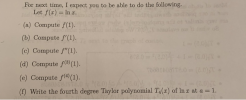 For next time, I expect you to be able to do the following. Let f(x) = ln x. (a) Compute f(1). W o o d (b) Compute f'(1). (c) Compute f"(1). (d) Compute f(3)(1). (e) Compute f(4)(1). (f) Write the fourth degree Taylor polynomial T4(x) of In x at a=1.
Please help me. these go together. if you help then i will definitely rate!:) (a) Use...
 Please help me. these go together. if you help then i will
definitely rate!:)
(a) Use the power series for 1 to prove that the Taylor series centered at x = 0 for In(1+x) is 1+1 + (-1)" 2"41 2 3 4 5 7+1 (b) The Taylor series centered at 1 = 0 for In (1+1) given in part (a) converges to In(1+1) on its interval of convergence. Let g(x) = (x - 3)2 In 1 + Write the Taylor...
Please help me. these go together. if you help then i will
definitely rate!:)
(a) Use the power series for 1 to prove that the Taylor series centered at x = 0 for In(1+x) is 1+1 + (-1)" 2"41 2 3 4 5 7+1 (b) The Taylor series centered at 1 = 0 for In (1+1) given in part (a) converges to In(1+1) on its interval of convergence. Let g(x) = (x - 3)2 In 1 + Write the Taylor...
HI, PLEASE ANSWER ALL PARTS AND PLEASE SHOW ALL WORKINGS STEP BY STEP. THANK YOU. a)...
 HI, PLEASE ANSWER ALL PARTS AND PLEASE SHOW ALL WORKINGS STEP BY STEP. THANK YOU. a) Show from first principles that the Laplace transform of the function (0)=1, a 20 is f(3) = Make a note of any conditions imposed on the transform variable "s" to ensure the transform exists. (8 Marks) b) Find, using the appropriate theorem, the Laplace transform of a function f(t): f(t) = e-3t.sin(4t) OR Find the inverse Laplace transform of the following: ses f(s) =...
 need help with all of these thank you
1. Find the inverse function of f(x) = -2 a) f-'(x) = 2+2 b) f-'(x) = 2x+1 c) f-'(x) = x - 2 d) f-'(x) = 42 2. Combine 2log x - logy into a single logarithm. log 2. a) log b) Home and logy d) log 3. Find the following: log, 27 a) 3 b) If f(x) is a graph of a polynomial that has only x-intercepts of even multiplicity and...
need help with all of these thank you
1. Find the inverse function of f(x) = -2 a) f-'(x) = 2+2 b) f-'(x) = 2x+1 c) f-'(x) = x - 2 d) f-'(x) = 42 2. Combine 2log x - logy into a single logarithm. log 2. a) log b) Home and logy d) log 3. Find the following: log, 27 a) 3 b) If f(x) is a graph of a polynomial that has only x-intercepts of even multiplicity and...
 All parts please.
Negative Leading Coefficient 1. Use the graph of f'(x) to answer: On which interval is f(x) increasing? Even Degree Justify your answer. 28+ -50+ -1 F(x) - O 2. Given the table and information below, complete the table to describe the behavior of f(x) and justify your conclusions with reference to the derivative. Sketch a possible graph for f(x) that goes through the point (-1,4) F"(x) Fis: F is: 3. Sketch a possible graph for f(x) that...
All parts please.
Negative Leading Coefficient 1. Use the graph of f'(x) to answer: On which interval is f(x) increasing? Even Degree Justify your answer. 28+ -50+ -1 F(x) - O 2. Given the table and information below, complete the table to describe the behavior of f(x) and justify your conclusions with reference to the derivative. Sketch a possible graph for f(x) that goes through the point (-1,4) F"(x) Fis: F is: 3. Sketch a possible graph for f(x) that...
 1,2,3, and 4
Here are some practice exercises for you. 1. Given f(x) e2, find the a. Maclaurin polynomial of degree 5 b. Taylor polynomial of degree 4 centered at 1 c. the Maclaurin series of f and the interval of convergence d. the Taylor series generated by f at x1 2. Find the Taylor series of g(x) at x1. 3. Given x -t2, y t 1, -2 t1, a. sketch the curve. Indicate where t 0 and the orientation...
1,2,3, and 4
Here are some practice exercises for you. 1. Given f(x) e2, find the a. Maclaurin polynomial of degree 5 b. Taylor polynomial of degree 4 centered at 1 c. the Maclaurin series of f and the interval of convergence d. the Taylor series generated by f at x1 2. Find the Taylor series of g(x) at x1. 3. Given x -t2, y t 1, -2 t1, a. sketch the curve. Indicate where t 0 and the orientation...
 Please answer all or do not answer. Thank you :)
The Chain Rule and Directional Derivative: (a) Calculate by the chain rule given F(x,y) = x2 + y’, x = eu+20, y=uv. ov Use the chain rule (chain rule required!) to evaluate the partial derivative. OG where G(x,y) = x2 - y2 ,x=e"cosv, y = e"sinv. ди (c) Find the directional derivative in the direction of v=<12,-5> at (2,2) for f(x, y) = exy_y? and also the directional derivative in...
Please answer all or do not answer. Thank you :)
The Chain Rule and Directional Derivative: (a) Calculate by the chain rule given F(x,y) = x2 + y’, x = eu+20, y=uv. ov Use the chain rule (chain rule required!) to evaluate the partial derivative. OG where G(x,y) = x2 - y2 ,x=e"cosv, y = e"sinv. ди (c) Find the directional derivative in the direction of v=<12,-5> at (2,2) for f(x, y) = exy_y? and also the directional derivative in...
 Please answer both questions if possible. Thank you :)
Assignment5: Problem 11 Previous Problem Problem List Next Problem (1 point) Find the polynomial of degree 9 (centered at zero) that best approximates f(x) = ln(x + 4). Hint: First find a Taylor polynomial for g(x) = ln(x + 4), then use this to find the Taylor polynomial you want. f(x) 1/6 Now use this polynomial to approximate Luca In(x + 4) dx. -1/6 1/6 f(x) dx Assignment5: Problem 12 Previous...
Please answer both questions if possible. Thank you :)
Assignment5: Problem 11 Previous Problem Problem List Next Problem (1 point) Find the polynomial of degree 9 (centered at zero) that best approximates f(x) = ln(x + 4). Hint: First find a Taylor polynomial for g(x) = ln(x + 4), then use this to find the Taylor polynomial you want. f(x) 1/6 Now use this polynomial to approximate Luca In(x + 4) dx. -1/6 1/6 f(x) dx Assignment5: Problem 12 Previous...
 Please prove the theorems,
thank you
6.1 Theorem. Let anx+an-1- +ag he a polynomial of degree n0 with integer coefficients and assume an0. Then an integer r is a Poot of (x) if and only if there exists a polynomlal g(x) of degree n - with integer coeficients such that f(x) (x)g(x). This next theorem is very similar to the one above, but in this case (xr)g(x) is not quite equal to f(x), but is the same except for the...
Please prove the theorems,
thank you
6.1 Theorem. Let anx+an-1- +ag he a polynomial of degree n0 with integer coefficients and assume an0. Then an integer r is a Poot of (x) if and only if there exists a polynomlal g(x) of degree n - with integer coeficients such that f(x) (x)g(x). This next theorem is very similar to the one above, but in this case (xr)g(x) is not quite equal to f(x), but is the same except for the...
 For next time, I expect you to be able to do the following. Let f(x) = ln x. (a) Compute f(1). W o o d (b) Compute f'(1). (c) Compute f"(1). (d) Compute f(3)(1). (e) Compute f(4)(1). (f) Write the fourth degree Taylor polynomial T4(x) of In x at a=1.
 Please help me. these go together. if you help then i will
definitely rate!:)
(a) Use the power series for 1 to prove that the Taylor series centered at x = 0 for In(1+x) is 1+1 + (-1)" 2"41 2 3 4 5 7+1 (b) The Taylor series centered at 1 = 0 for In (1+1) given in part (a) converges to In(1+1) on its interval of convergence. Let g(x) = (x - 3)2 In 1 + Write the Taylor...
Please help me. these go together. if you help then i will
definitely rate!:)
(a) Use the power series for 1 to prove that the Taylor series centered at x = 0 for In(1+x) is 1+1 + (-1)" 2"41 2 3 4 5 7+1 (b) The Taylor series centered at 1 = 0 for In (1+1) given in part (a) converges to In(1+1) on its interval of convergence. Let g(x) = (x - 3)2 In 1 + Write the Taylor...
 HI, PLEASE ANSWER ALL PARTS AND PLEASE SHOW ALL WORKINGS STEP BY STEP. THANK YOU. a) Show from first principles that the Laplace transform of the function (0)=1, a 20 is f(3) = Make a note of any conditions imposed on the transform variable "s" to ensure the transform exists. (8 Marks) b) Find, using the appropriate theorem, the Laplace transform of a function f(t): f(t) = e-3t.sin(4t) OR Find the inverse Laplace transform of the following: ses f(s) =...
Most questions answered within 3 hours.
-
Where is the error in this code sequence?
String s1 = "Hello";
String s2 = "ello";...
asked 10 months ago -
Financial data for Joel de Paris, Inc., for last year
follow:
Joel de Paris, Inc.
Balance...
asked 10 months ago -
Consider this reaction:
Al2(SO4)3 (aq)+ BaCl3
(aq) Al2Cl6 (aq)- +
3BaSO4(s) . What is the...
asked 10 months ago -
Suppose that Savneet is considering increasing her
recent random sample from 20 car rentals to 40...
asked 10 months ago -
Trucks arrive at an unloading terminal at an average rate of 120
per hour.
Trucks arrive...
asked 10 months ago -
Why are methanol and ethanol completely soluble in water while
octanol is not very little soluble....
asked 10 months ago -
A facilities manager at a university reads in a research report
that the mean amount of...
asked 10 months ago -
When the CuSO4 is rehydrated by adding water to the anhydrous
compound, is this an endothermic...
asked 10 months ago -
A ray of sunlight is passing from diamond into crown glass; the
angle of incidence is...
asked 10 months ago -
A block of mass 0.249 kg is placed on top of a light, vertical
spring of...
asked 10 months ago -
how do the kidneys compensate in the presences of acidosis
a) trigger hyperventilate
b) reserve acid...
asked 10 months ago -
Question 501 pts
The rental rate of capital to the firm increases. Which of the
following...
asked 10 months ago