
Homework Answers
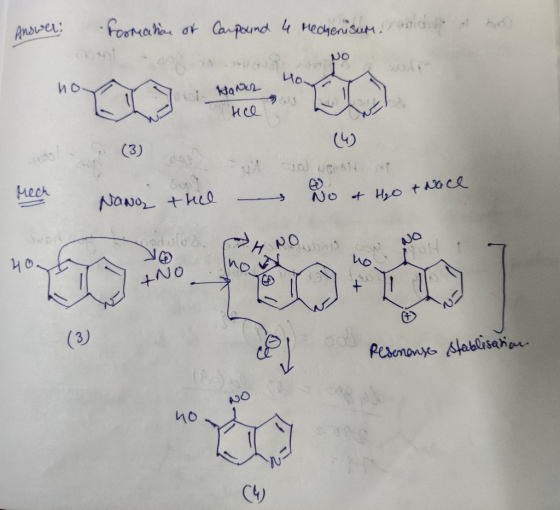
The mechanism follows is electrophilic substitution reaction where NO+ (electrophile ) replace H+
step1 is an electrophile generation step in which NaNO2 react with HCl to form NO+ ( Elctrophile )
Step 2 is the substitution step where NO+ replace H+, the rection goes through a carbocation formation step, where carbocation is stabilized by the resonance of the benzene double bond.
I hope you understand the Mechanism. let e know i you have any doubt
please rate this answer
Add Answer to:
show the mechanism responsible for the formation of compound
4.
NO НО НО. NaNO2 HCI (1...
5. Show how the following reaction would proceed. NH2 1.) NaNO2, HCI 2.) H2O Nucleophilic Substitution...
 5. Show how the following reaction would proceed. NH2 1.) NaNO2, HCI 2.) H2O Nucleophilic Substitution Product Elimination Product 1.) Fill in the missing reagents or products, and show the mechanism of formation, where applicable. (a) (b) o 1.) DIBAL-H (-78 C) 2.) H.O нон HCN ? ON
of acid ca +HCI 6. Show the complete mechanism of formation of the product below. Br...
 of acid ca +HCI 6. Show the complete mechanism of formation of the product below. Br Он Mg +1. H 2. HCI Etz0
2. (2 points) Draw the reaction mechanism for the following reaction: NH2 -N 1. NaNO2, HCI,...
 2. (2 points) Draw the reaction mechanism for the following reaction: NH2 -N 1. NaNO2, HCI, H20 2. NaOH, OH -OH then H3O+
which is the correct answer? give a mechanism 1) S: NH2 NaNO2, HCI A B -CH₃...
 which is the correct answer? give a mechanism
1) S: NH2 NaNO2, HCI A B -CH₃ SOET 2) LiAIHA 3) NaOH 1 N=N-OM MSH NH2 NH2 / CH CH CH3 Bd) NO2 NH2 -NEN NH2 CH3 CH3
which is the correct answer? give a mechanism
1) S: NH2 NaNO2, HCI A B -CH₃ SOET 2) LiAIHA 3) NaOH 1 N=N-OM MSH NH2 NH2 / CH CH CH3 Bd) NO2 NH2 -NEN NH2 CH3 CH3
1) Predict the major product in each of the following transformations. Show the mechanism. 2) Show...
 1) Predict the major product in each of the following
transformations. Show the mechanism.
2) Show how you could synthesize the products below using a
Grignard reagent and appropriate electrophile by drawing the
overall balanced equation. Include the mechanism.
Predict the major product in each of the following transformations. No mechanisms are required for this question. [3 Marks] 1. CH,сн,МgBr (еxcess) 2. HС{aq) 1. PhMgBr (1 equiv.) 2. HCI(aq) ОН HO 1. CH2MgBr (2 equiv.) 2. HCl(aq) Н Show how...
1) Predict the major product in each of the following
transformations. Show the mechanism.
2) Show how you could synthesize the products below using a
Grignard reagent and appropriate electrophile by drawing the
overall balanced equation. Include the mechanism.
Predict the major product in each of the following transformations. No mechanisms are required for this question. [3 Marks] 1. CH,сн,МgBr (еxcess) 2. HС{aq) 1. PhMgBr (1 equiv.) 2. HCI(aq) ОН HO 1. CH2MgBr (2 equiv.) 2. HCl(aq) Н Show how...
1) NaNO2.HCI 2) HEF CH, 1. Na 2 L 14. a. Provide a detailed, stepwise mechani...
 1) NaNO2.HCI 2) HEF CH, 1. Na 2 L 14. a. Provide a detailed, stepwise mechani a detailed, stepwise mechanism for the following transformation: CH3 b. Provide the product for each step: 1. HNO..SO 2. HP-C 3. NaNO, HCI 4. HBF 5. KMnO, A CH(CH3
Identify the mechanism (S_N 1, S_N2, E1, or E2) responsible for the formation of the major...
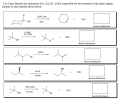 Identify the mechanism (S_N 1, S_N2, E1, or E2) responsible for the formation of the major organic product in each reaction shown below.
Write a procedure for how to make compounds 7 and 2. NO но. O NaNO2 HCI...
 Write a procedure for how to make compounds 7 and 2.
NO но. O NaNO2 HCI (1M, aq) Et EtOHN CH) NaN -OH CH SO H/CHỤC CNC 2, AQSO Acetone Synthetic Procedures To synthesize compound 4. Obtain 0.500 g of 6-hydroxyquinoline and dissolve this solid in a small test tube with 3.0 mL of aqueous 1.0 M HCl. After the entire amount of solid has dissolved cool the solution in an ice bath and add a solution of NaNO, (0.238...
Write a procedure for how to make compounds 7 and 2.
NO но. O NaNO2 HCI (1M, aq) Et EtOHN CH) NaN -OH CH SO H/CHỤC CNC 2, AQSO Acetone Synthetic Procedures To synthesize compound 4. Obtain 0.500 g of 6-hydroxyquinoline and dissolve this solid in a small test tube with 3.0 mL of aqueous 1.0 M HCl. After the entire amount of solid has dissolved cool the solution in an ice bath and add a solution of NaNO, (0.238...
Show stepwise mechanism for the formation of the 1-methylcyclohexene from 4-methylcyclohexanol. Use arrows to show the...
Show stepwise mechanism for the formation of the 1-methylcyclohexene from 4-methylcyclohexanol. Use arrows to show the electron movements.
Write the products of these reactions -NH2 1. NaNO2, HCI 2. CuCN 1. N(CH3)3 2. Ag20,...
 Write the products of these reactions
-NH2 1. NaNO2, HCI 2. CuCN 1. N(CH3)3 2. Ag20, H20 3.A 1. LAIHA 2. H20 NaN3 1. LATHA 2. H2O NaCN 1. LIAH 2. H20 Br NaCN H. Ni HNO3 H2SO4 NaOH H20 1. NaNO2 HCI 2. HBF 4 CH3 HNO3 Na Cr207 H2SO4 H2SO4 Sn HCI 1. NaNO2 HCI 2. CuCN
Write the products of these reactions
-NH2 1. NaNO2, HCI 2. CuCN 1. N(CH3)3 2. Ag20, H20 3.A 1. LAIHA 2. H20 NaN3 1. LATHA 2. H2O NaCN 1. LIAH 2. H20 Br NaCN H. Ni HNO3 H2SO4 NaOH H20 1. NaNO2 HCI 2. HBF 4 CH3 HNO3 Na Cr207 H2SO4 H2SO4 Sn HCI 1. NaNO2 HCI 2. CuCN
 5. Show how the following reaction would proceed. NH2 1.) NaNO2, HCI 2.) H2O Nucleophilic Substitution Product Elimination Product 1.) Fill in the missing reagents or products, and show the mechanism of formation, where applicable. (a) (b) o 1.) DIBAL-H (-78 C) 2.) H.O нон HCN ? ON
 of acid ca +HCI 6. Show the complete mechanism of formation of the product below. Br Он Mg +1. H 2. HCI Etz0
 2. (2 points) Draw the reaction mechanism for the following reaction: NH2 -N 1. NaNO2, HCI, H20 2. NaOH, OH -OH then H3O+
 which is the correct answer? give a mechanism
1) S: NH2 NaNO2, HCI A B -CH₃ SOET 2) LiAIHA 3) NaOH 1 N=N-OM MSH NH2 NH2 / CH CH CH3 Bd) NO2 NH2 -NEN NH2 CH3 CH3
which is the correct answer? give a mechanism
1) S: NH2 NaNO2, HCI A B -CH₃ SOET 2) LiAIHA 3) NaOH 1 N=N-OM MSH NH2 NH2 / CH CH CH3 Bd) NO2 NH2 -NEN NH2 CH3 CH3
 1) Predict the major product in each of the following
transformations. Show the mechanism.
2) Show how you could synthesize the products below using a
Grignard reagent and appropriate electrophile by drawing the
overall balanced equation. Include the mechanism.
Predict the major product in each of the following transformations. No mechanisms are required for this question. [3 Marks] 1. CH,сн,МgBr (еxcess) 2. HС{aq) 1. PhMgBr (1 equiv.) 2. HCI(aq) ОН HO 1. CH2MgBr (2 equiv.) 2. HCl(aq) Н Show how...
1) Predict the major product in each of the following
transformations. Show the mechanism.
2) Show how you could synthesize the products below using a
Grignard reagent and appropriate electrophile by drawing the
overall balanced equation. Include the mechanism.
Predict the major product in each of the following transformations. No mechanisms are required for this question. [3 Marks] 1. CH,сн,МgBr (еxcess) 2. HС{aq) 1. PhMgBr (1 equiv.) 2. HCI(aq) ОН HO 1. CH2MgBr (2 equiv.) 2. HCl(aq) Н Show how...
 1) NaNO2.HCI 2) HEF CH, 1. Na 2 L 14. a. Provide a detailed, stepwise mechani a detailed, stepwise mechanism for the following transformation: CH3 b. Provide the product for each step: 1. HNO..SO 2. HP-C 3. NaNO, HCI 4. HBF 5. KMnO, A CH(CH3
 Identify the mechanism (S_N 1, S_N2, E1, or E2) responsible for the formation of the major organic product in each reaction shown below.
 Write a procedure for how to make compounds 7 and 2.
NO но. O NaNO2 HCI (1M, aq) Et EtOHN CH) NaN -OH CH SO H/CHỤC CNC 2, AQSO Acetone Synthetic Procedures To synthesize compound 4. Obtain 0.500 g of 6-hydroxyquinoline and dissolve this solid in a small test tube with 3.0 mL of aqueous 1.0 M HCl. After the entire amount of solid has dissolved cool the solution in an ice bath and add a solution of NaNO, (0.238...
Write a procedure for how to make compounds 7 and 2.
NO но. O NaNO2 HCI (1M, aq) Et EtOHN CH) NaN -OH CH SO H/CHỤC CNC 2, AQSO Acetone Synthetic Procedures To synthesize compound 4. Obtain 0.500 g of 6-hydroxyquinoline and dissolve this solid in a small test tube with 3.0 mL of aqueous 1.0 M HCl. After the entire amount of solid has dissolved cool the solution in an ice bath and add a solution of NaNO, (0.238...
 Write the products of these reactions
-NH2 1. NaNO2, HCI 2. CuCN 1. N(CH3)3 2. Ag20, H20 3.A 1. LAIHA 2. H20 NaN3 1. LATHA 2. H2O NaCN 1. LIAH 2. H20 Br NaCN H. Ni HNO3 H2SO4 NaOH H20 1. NaNO2 HCI 2. HBF 4 CH3 HNO3 Na Cr207 H2SO4 H2SO4 Sn HCI 1. NaNO2 HCI 2. CuCN
Write the products of these reactions
-NH2 1. NaNO2, HCI 2. CuCN 1. N(CH3)3 2. Ag20, H20 3.A 1. LAIHA 2. H20 NaN3 1. LATHA 2. H2O NaCN 1. LIAH 2. H20 Br NaCN H. Ni HNO3 H2SO4 NaOH H20 1. NaNO2 HCI 2. HBF 4 CH3 HNO3 Na Cr207 H2SO4 H2SO4 Sn HCI 1. NaNO2 HCI 2. CuCN
Most questions answered within 3 hours.
-
Where is the error in this code sequence?
String s1 = "Hello";
String s2 = "ello";...
asked 10 months ago -
Financial data for Joel de Paris, Inc., for last year
follow:
Joel de Paris, Inc.
Balance...
asked 10 months ago -
Consider this reaction:
Al2(SO4)3 (aq)+ BaCl3
(aq) Al2Cl6 (aq)- +
3BaSO4(s) . What is the...
asked 10 months ago -
Suppose that Savneet is considering increasing her
recent random sample from 20 car rentals to 40...
asked 10 months ago -
Trucks arrive at an unloading terminal at an average rate of 120
per hour.
Trucks arrive...
asked 10 months ago -
Why are methanol and ethanol completely soluble in water while
octanol is not very little soluble....
asked 10 months ago -
A facilities manager at a university reads in a research report
that the mean amount of...
asked 10 months ago -
When the CuSO4 is rehydrated by adding water to the anhydrous
compound, is this an endothermic...
asked 10 months ago -
A ray of sunlight is passing from diamond into crown glass; the
angle of incidence is...
asked 10 months ago -
A block of mass 0.249 kg is placed on top of a light, vertical
spring of...
asked 10 months ago -
how do the kidneys compensate in the presences of acidosis
a) trigger hyperventilate
b) reserve acid...
asked 10 months ago -
Question 501 pts
The rental rate of capital to the firm increases. Which of the
following...
asked 10 months ago