
Homework Answers
CH3COOH --> CH3COO- + H+
when NAOH is added to this equilibrium systm , OH- will react with
H+ to form
water
OH-(aq) + H+(aq) --> H2O (l)
b)
This will reduce concentration of H+ in the solution and
equilibrium will get
disturbed .In order to attain equilibrium again , the system will
speed
up forward reaction .
Thus addition of NaOH will decrease concentration of H+ , [H+]
Increase concentration of CH3COO- , [CH3COO-]
Decrease concentration of CH3COOH , [CH3COOH]
Add Answer to:
1. Consider the following reaction at equilibrium. CH3COOH (aq) = CH3COO- (aq) + H+ (aq) a)...
The following reactions all have K<1. 1) CH3COO" (aq) + CH3COOH (aq) =CH COOH (aq) +...
 The following reactions all have K<1. 1) CH3COO" (aq) + CH3COOH (aq) =CH COOH (aq) + CH3C00" (aq) 2) NO2 (aq) + CH2COOH(aq) – CH3C00" (aq) + HNO2 (aq) 3) CHCOOH (aq) + NO2 (aq) = HNO2 (aq) + CH3COO(aq) Arrange the substances based on their relative acid strength. Clear All NO2 ΗΝΟ, strongest acid CHC00 intermediate acid CH3COOH weakest acid CH3COOH not a Bronsted-Lowry acid CH3COO
5) Calculate Kc for the reaction CH3COOH (aq) ⇌ CH3COO- (aq) + H+ (aq) from the...
5) Calculate Kc for the reaction CH3COOH (aq) ⇌ CH3COO- (aq) + H+ (aq) from the following equilibrium concentrations. [CH3COOH] = 1.65 x 10⁻² M, [CH3COO-] = 5.44 x 10⁻⁴ M, [H+] = 5.44 x 10⁻⁴ M.
Equilibrium Consider the following equilibrium: CH 3COOH(aq) + H 20(1) = CH 3COO "(aq) + H...
 Equilibrium Consider the following equilibrium: CH 3COOH(aq) + H 20(1) = CH 3COO "(aq) + H 30 +(aq) What would be the effect of adding sodium acetate (CH 3COONa) a strong electrolyte to the reaction and what would happen to the pH of the solution? a. the equilbrium will shift to the right and the pH will decrease O b. the equilibrium will shift to the left and there will be no change in pH O c. the equilbrium will...
5. Given that CH3COOH(aq) ⇌ H+(aq) + CH3COO–(aq), Ka = 1.83 × 10⁻⁵ at 25.00 °C....
5. Given that CH3COOH(aq) ⇌ H+(aq) + CH3COO–(aq), Ka = 1.83 × 10⁻⁵ at 25.00 °C. Calculate the reaction quotient Q, ΔG°, and ΔG for a solution at 25.00 °C in which the initial concentrations are: [CH3COOH]0 = 0.10 M, [H+]0 = 4.5 × 10⁻⁵ M, [CH3COO–]0 = 0.010 M
1.A 1.00 liter solution contains 0.28 M acetic acid and 0.36 M sodium acetate. If 0.180...
1.A 1.00 liter solution contains 0.28 M acetic acid and 0.36 M sodium acetate. If 0.180 moles of potassium hydroxide are added to this system, indicate whether the following statements are true or false. (Assume that the volume does not change upon the addition of potassium hydroxide.) A. The number of moles of CH3COOH will remain the same. B. The number of moles of CH3COO- will decrease. C. The equilibrium concentration of H3O+ will increase. D. The pH will increase....
Buffer action 4 A buffer solution consisting of 0.05 mol/L acetic acid (CH3COOH) and 0.05 mol/L...
 Buffer action 4 A buffer solution consisting of 0.05 mol/L acetic acid (CH3COOH) and 0.05 mol/L acetate (CH3COO-) has been used to buffer a 1 L solution at pH 4.7. A small amount of sodium hydroxide solution containing 0.0001 mol NaOH was added. Which of the following reactions best represents the buffer action? + Select one: O a. NaOH(aq) Na+(aq) + OH(aq) O b. CH3COOH(aq) + H2O(1) CH3COO(aq) H30*(aq) O c. CH3COO(aq) + H2O(0) CH3COOH(aq) OH(aq) O d. CH3COOH(aq) +...
The following equilibrium is established in water solution: CH3COOH + H20 = CH3COO +H30+ K a...
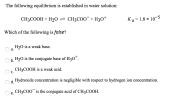 The following equilibrium is established in water solution: CH3COOH + H20 = CH3COO +H30+ K a = 1.8 x 10⁻⁵ Which of the following is false? a H20 is a weak base. b.H20 is the conjugate base of H30*. CH3COOH is a weak acid. O هنا Hydroxide concentration is negligible with respect to hydrogen ion concentration. e. CH3COO is the conjugate acid of CH3COOH.
1)A buffer solution was prepared by dissolving 3.95 g of sodium nitrite, NaNO2, in 150 mL...
1)A buffer solution was prepared by dissolving 3.95 g of sodium nitrite, NaNO2, in 150 mL of 0.200 M nitrous acid, HNO2. (Ka = 4.5 x 10⁻⁵). What is the pH of the buffer? 2) Consider a buffer CH3COOH/CH3COO–. Fill in the blank using the numbers corresponding to each species. CH3COOH CH3COO– OH– H+ Na+ H2O 1 2 3 4 5 6 Please note that choices can be used more than once. The basic component of the buffer is ....
Write the concentration equilibrium constant expression for this reaction. CH,CO,C2H3(aq)+H,0(1) - CH, CO H(aq)+C,H,OH(aq)
 Write the concentration equilibrium constant expression for this reaction. CH,CO,C2H3(aq)+H,0(1) - CH, CO H(aq)+C,H,OH(aq)
CH3COOH(aq)+NAOH(aq)=CH3COONa+H2O i just need clarification on these questions | Example CH3COOH Titration Curve Standardizing a Solution...
 CH3COOH(aq)+NAOH(aq)=CH3COONa+H2O
i just need clarification on these questions
| Example CH3COOH Titration Curve Standardizing a Solution of Sodium Hydroxide H pH=7.0 line TETROFFEN -2302392 ARXARAR ERDEREEEEEE EEEEEEEEEEEEEE Question 20 (1 point) Saved For the CH3COOH titation, given the autoionization of water, what is the impact of adding hydroxide ions on the concentration of H307? O [H3O+] increases O [H3O+] decreases [H30*) remains the same For the CH3COOH titation, given that impact on the concentration of H307, what is the shift...
CH3COOH(aq)+NAOH(aq)=CH3COONa+H2O
i just need clarification on these questions
| Example CH3COOH Titration Curve Standardizing a Solution of Sodium Hydroxide H pH=7.0 line TETROFFEN -2302392 ARXARAR ERDEREEEEEE EEEEEEEEEEEEEE Question 20 (1 point) Saved For the CH3COOH titation, given the autoionization of water, what is the impact of adding hydroxide ions on the concentration of H307? O [H3O+] increases O [H3O+] decreases [H30*) remains the same For the CH3COOH titation, given that impact on the concentration of H307, what is the shift...
 The following reactions all have K<1. 1) CH3COO" (aq) + CH3COOH (aq) =CH COOH (aq) + CH3C00" (aq) 2) NO2 (aq) + CH2COOH(aq) – CH3C00" (aq) + HNO2 (aq) 3) CHCOOH (aq) + NO2 (aq) = HNO2 (aq) + CH3COO(aq) Arrange the substances based on their relative acid strength. Clear All NO2 ΗΝΟ, strongest acid CHC00 intermediate acid CH3COOH weakest acid CH3COOH not a Bronsted-Lowry acid CH3COO
 Equilibrium Consider the following equilibrium: CH 3COOH(aq) + H 20(1) = CH 3COO "(aq) + H 30 +(aq) What would be the effect of adding sodium acetate (CH 3COONa) a strong electrolyte to the reaction and what would happen to the pH of the solution? a. the equilbrium will shift to the right and the pH will decrease O b. the equilibrium will shift to the left and there will be no change in pH O c. the equilbrium will...
 Buffer action 4 A buffer solution consisting of 0.05 mol/L acetic acid (CH3COOH) and 0.05 mol/L acetate (CH3COO-) has been used to buffer a 1 L solution at pH 4.7. A small amount of sodium hydroxide solution containing 0.0001 mol NaOH was added. Which of the following reactions best represents the buffer action? + Select one: O a. NaOH(aq) Na+(aq) + OH(aq) O b. CH3COOH(aq) + H2O(1) CH3COO(aq) H30*(aq) O c. CH3COO(aq) + H2O(0) CH3COOH(aq) OH(aq) O d. CH3COOH(aq) +...
 The following equilibrium is established in water solution: CH3COOH + H20 = CH3COO +H30+ K a = 1.8 x 10⁻⁵ Which of the following is false? a H20 is a weak base. b.H20 is the conjugate base of H30*. CH3COOH is a weak acid. O هنا Hydroxide concentration is negligible with respect to hydrogen ion concentration. e. CH3COO is the conjugate acid of CH3COOH.
 Write the concentration equilibrium constant expression for this reaction. CH,CO,C2H3(aq)+H,0(1) - CH, CO H(aq)+C,H,OH(aq)
 CH3COOH(aq)+NAOH(aq)=CH3COONa+H2O
i just need clarification on these questions
| Example CH3COOH Titration Curve Standardizing a Solution of Sodium Hydroxide H pH=7.0 line TETROFFEN -2302392 ARXARAR ERDEREEEEEE EEEEEEEEEEEEEE Question 20 (1 point) Saved For the CH3COOH titation, given the autoionization of water, what is the impact of adding hydroxide ions on the concentration of H307? O [H3O+] increases O [H3O+] decreases [H30*) remains the same For the CH3COOH titation, given that impact on the concentration of H307, what is the shift...
CH3COOH(aq)+NAOH(aq)=CH3COONa+H2O
i just need clarification on these questions
| Example CH3COOH Titration Curve Standardizing a Solution of Sodium Hydroxide H pH=7.0 line TETROFFEN -2302392 ARXARAR ERDEREEEEEE EEEEEEEEEEEEEE Question 20 (1 point) Saved For the CH3COOH titation, given the autoionization of water, what is the impact of adding hydroxide ions on the concentration of H307? O [H3O+] increases O [H3O+] decreases [H30*) remains the same For the CH3COOH titation, given that impact on the concentration of H307, what is the shift...
Most questions answered within 3 hours.
-
Where is the error in this code sequence?
String s1 = "Hello";
String s2 = "ello";...
asked 10 months ago -
Financial data for Joel de Paris, Inc., for last year
follow:
Joel de Paris, Inc.
Balance...
asked 10 months ago -
Consider this reaction:
Al2(SO4)3 (aq)+ BaCl3
(aq) Al2Cl6 (aq)- +
3BaSO4(s) . What is the...
asked 10 months ago -
Suppose that Savneet is considering increasing her
recent random sample from 20 car rentals to 40...
asked 10 months ago -
Trucks arrive at an unloading terminal at an average rate of 120
per hour.
Trucks arrive...
asked 10 months ago -
Why are methanol and ethanol completely soluble in water while
octanol is not very little soluble....
asked 10 months ago -
A facilities manager at a university reads in a research report
that the mean amount of...
asked 10 months ago -
When the CuSO4 is rehydrated by adding water to the anhydrous
compound, is this an endothermic...
asked 10 months ago -
A ray of sunlight is passing from diamond into crown glass; the
angle of incidence is...
asked 10 months ago -
A block of mass 0.249 kg is placed on top of a light, vertical
spring of...
asked 10 months ago -
how do the kidneys compensate in the presences of acidosis
a) trigger hyperventilate
b) reserve acid...
asked 10 months ago -
Question 501 pts
The rental rate of capital to the firm increases. Which of the
following...
asked 10 months ago