![utive value of Ecell t cell and not aGALVANIC cl he wire or salt bridge is clearly connected backwar CA) L, II and III only (B) I and Il only (l oly only n..nW a galvanic cell consists of a F)/(a) half cell with a Pu) d F +)-0.50 M. E- 1 b Tag) /Pb(s) half cell. Calculate 1.00 V, and the temperature= 25 =1.0M, Fb+] when F 0) 3.7 x 10? M (E) 1.6 × (C) 4.2 × 10-M (A) 2. 7 × 10⁻⁴ M (B) 3.3 × 10⁻⁴ M inE 2 To-q 2. -31 4x28](http://img.homeworklib.com/questions/4bf787e0-d1c0-11ea-9a91-79c9421952f0.png?x-oss-process=image/resize,w_560)
Homework Answers


Add Answer to:
Question 17
utive value of Ecell t cell and not aGALVANIC cl he wire or salt...
3. You are a voltaic (galvanic) cell: iven samples of AICl, and AuCls along with the following materials to construct - water - platinum wire - Aly and Aue) electrodes - a salt bridge made of an...
 3. You are a voltaic (galvanic) cell: iven samples of AICl, and AuCls along with the following materials to construct - water - platinum wire - Aly and Aue) electrodes - a salt bridge made of an appropriate material - two beakers - a voltmeter a. Draw a diagram of the cell you would construct with these materials, labeling each component. b. Write the balanced chemical equation for the spontaneous cell reaction, assuming both AICh and AuCl3 dissociate completely in...
Combine the two half reactions to form a galvanic cell. Cl2(g) + 2 e--> 2 Cl(aq)...
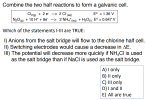 Combine the two half reactions to form a galvanic cell. Cl2(g) + 2 e--> 2 Cl(aq) E° = 1.36 V N2O(g) + 10 H+ + 8e -> 2 NH4+(aq) + H200) E° = 0.647 V Which of the statements I-III are TRUE: 1) Anions from the salt bridge will flow to the chlorine half cell. II) Switching electrodes would cause a decrease in AE. III) The potential will decrease more quickly if NH4Cl is used as the salt bridge than...
Chem 1212 Lab Report on electrochemistry Electrochemistry When electrons transfer between reaction components in a redox...
 Chem 1212 Lab Report on electrochemistry
Electrochemistry When electrons transfer between reaction components in a redox reaction, we can harness the motion of the electrons to create a potential. Electrochemistry revolves around the separation of the two half-reactions in a redox reaction and establishing two different electrodes. This might involve physically separating the half-reactions or including a separator, such as a semi-permeable membrane or plastic dividers. With the reactions separated, the electrons will need to flow through the wire connecting...
Chem 1212 Lab Report on electrochemistry
Electrochemistry When electrons transfer between reaction components in a redox reaction, we can harness the motion of the electrons to create a potential. Electrochemistry revolves around the separation of the two half-reactions in a redox reaction and establishing two different electrodes. This might involve physically separating the half-reactions or including a separator, such as a semi-permeable membrane or plastic dividers. With the reactions separated, the electrons will need to flow through the wire connecting...
Post-Laboratory Report (Page 1/1) Group Number Date: Day Time 1. The salt bridge in Goal #1 was s...
 Post-Laboratory Report (Page 1/1) Group Number Date: Day Time 1. The salt bridge in Goal #1 was soaked with a saturated ammonium nitrate solution. In which direction do the ammonium ions move when this salt bridge completed the electric circuit? Toward the zinc metal or toward the copper metal? In which direction do the nitrate ions move? 2. In a concentration cell, what would be the potential if we studied two solutions that had the same concentration? Show that the...
19 20 Question 16 Half-cell Potentials: Half Reaction: E' value + 0.80 V +0.77 V Agte...
 19 20 Question 16 Half-cell Potentials: Half Reaction: E' value + 0.80 V +0.77 V Agte → AS Fe3+ + + Fe2+ Cu2+ 2e → Cu Pb2+ + 2e → Pb +0.34 V -0.13 V Ni2+ + 2e → NI -0.25 V - 0.40 V Cd2+ +2e → ca Fe2+ + 2e → Fe Zn2+ + 2e → Zn -0.44 V - 0.76 V A13+ +3 → AI - 1.66 V Consider an electrochemical cell constructed from the following half...
please comment if need more info. no need to show work. A standard galvanic cell is constructed with Zn of the f...
 please comment if need more info. no need to show work.
A standard galvanic cell is constructed with Zn of the following statements are correct? Z n and F2 F half cell compartments connected by a salt bridge. Which Hint: Refer to a table of standard reduction potentials. (Choose all that apply.) F is reduced at the cathode. OF is oxidized at the anode. As the cell runs, anions will migrate from the ZnZn compartment to the FF compartment. The...
please comment if need more info. no need to show work.
A standard galvanic cell is constructed with Zn of the following statements are correct? Z n and F2 F half cell compartments connected by a salt bridge. Which Hint: Refer to a table of standard reduction potentials. (Choose all that apply.) F is reduced at the cathode. OF is oxidized at the anode. As the cell runs, anions will migrate from the ZnZn compartment to the FF compartment. The...
ANSWER ALL 3 QUESTIONS AND ALL PARTS Question 1 Using the standard reduction potentials on page 127, draw a compl...
 ANSWER ALL 3 QUESTIONS AND ALL PARTS
Question 1 Using the standard reduction potentials on page 127, draw a complete galvanic cell in the space below for Fe Ag a) Clearly label the electrodes, the solutions and the salt bridge. Clearly label which metal is the cathode and anode and a chemical you might use for the salt bridge. b) Give the half-reaction that occurs at the cathode and the half-reaction that occurs at the anode and indicate the direction...
ANSWER ALL 3 QUESTIONS AND ALL PARTS
Question 1 Using the standard reduction potentials on page 127, draw a complete galvanic cell in the space below for Fe Ag a) Clearly label the electrodes, the solutions and the salt bridge. Clearly label which metal is the cathode and anode and a chemical you might use for the salt bridge. b) Give the half-reaction that occurs at the cathode and the half-reaction that occurs at the anode and indicate the direction...
 3. You are a voltaic (galvanic) cell: iven samples of AICl, and AuCls along with the following materials to construct - water - platinum wire - Aly and Aue) electrodes - a salt bridge made of an appropriate material - two beakers - a voltmeter a. Draw a diagram of the cell you would construct with these materials, labeling each component. b. Write the balanced chemical equation for the spontaneous cell reaction, assuming both AICh and AuCl3 dissociate completely in...
 Combine the two half reactions to form a galvanic cell. Cl2(g) + 2 e--> 2 Cl(aq) E° = 1.36 V N2O(g) + 10 H+ + 8e -> 2 NH4+(aq) + H200) E° = 0.647 V Which of the statements I-III are TRUE: 1) Anions from the salt bridge will flow to the chlorine half cell. II) Switching electrodes would cause a decrease in AE. III) The potential will decrease more quickly if NH4Cl is used as the salt bridge than...
 Chem 1212 Lab Report on electrochemistry
Electrochemistry When electrons transfer between reaction components in a redox reaction, we can harness the motion of the electrons to create a potential. Electrochemistry revolves around the separation of the two half-reactions in a redox reaction and establishing two different electrodes. This might involve physically separating the half-reactions or including a separator, such as a semi-permeable membrane or plastic dividers. With the reactions separated, the electrons will need to flow through the wire connecting...
Chem 1212 Lab Report on electrochemistry
Electrochemistry When electrons transfer between reaction components in a redox reaction, we can harness the motion of the electrons to create a potential. Electrochemistry revolves around the separation of the two half-reactions in a redox reaction and establishing two different electrodes. This might involve physically separating the half-reactions or including a separator, such as a semi-permeable membrane or plastic dividers. With the reactions separated, the electrons will need to flow through the wire connecting...
 Post-Laboratory Report (Page 1/1) Group Number Date: Day Time 1. The salt bridge in Goal #1 was soaked with a saturated ammonium nitrate solution. In which direction do the ammonium ions move when this salt bridge completed the electric circuit? Toward the zinc metal or toward the copper metal? In which direction do the nitrate ions move? 2. In a concentration cell, what would be the potential if we studied two solutions that had the same concentration? Show that the...
 19 20 Question 16 Half-cell Potentials: Half Reaction: E' value + 0.80 V +0.77 V Agte → AS Fe3+ + + Fe2+ Cu2+ 2e → Cu Pb2+ + 2e → Pb +0.34 V -0.13 V Ni2+ + 2e → NI -0.25 V - 0.40 V Cd2+ +2e → ca Fe2+ + 2e → Fe Zn2+ + 2e → Zn -0.44 V - 0.76 V A13+ +3 → AI - 1.66 V Consider an electrochemical cell constructed from the following half...
 please comment if need more info. no need to show work.
A standard galvanic cell is constructed with Zn of the following statements are correct? Z n and F2 F half cell compartments connected by a salt bridge. Which Hint: Refer to a table of standard reduction potentials. (Choose all that apply.) F is reduced at the cathode. OF is oxidized at the anode. As the cell runs, anions will migrate from the ZnZn compartment to the FF compartment. The...
please comment if need more info. no need to show work.
A standard galvanic cell is constructed with Zn of the following statements are correct? Z n and F2 F half cell compartments connected by a salt bridge. Which Hint: Refer to a table of standard reduction potentials. (Choose all that apply.) F is reduced at the cathode. OF is oxidized at the anode. As the cell runs, anions will migrate from the ZnZn compartment to the FF compartment. The...
 ANSWER ALL 3 QUESTIONS AND ALL PARTS
Question 1 Using the standard reduction potentials on page 127, draw a complete galvanic cell in the space below for Fe Ag a) Clearly label the electrodes, the solutions and the salt bridge. Clearly label which metal is the cathode and anode and a chemical you might use for the salt bridge. b) Give the half-reaction that occurs at the cathode and the half-reaction that occurs at the anode and indicate the direction...
ANSWER ALL 3 QUESTIONS AND ALL PARTS
Question 1 Using the standard reduction potentials on page 127, draw a complete galvanic cell in the space below for Fe Ag a) Clearly label the electrodes, the solutions and the salt bridge. Clearly label which metal is the cathode and anode and a chemical you might use for the salt bridge. b) Give the half-reaction that occurs at the cathode and the half-reaction that occurs at the anode and indicate the direction...
Most questions answered within 3 hours.
-
Where is the error in this code sequence?
String s1 = "Hello";
String s2 = "ello";...
asked 10 months ago -
Financial data for Joel de Paris, Inc., for last year
follow:
Joel de Paris, Inc.
Balance...
asked 10 months ago -
Consider this reaction:
Al2(SO4)3 (aq)+ BaCl3
(aq) Al2Cl6 (aq)- +
3BaSO4(s) . What is the...
asked 10 months ago -
Suppose that Savneet is considering increasing her
recent random sample from 20 car rentals to 40...
asked 10 months ago -
Trucks arrive at an unloading terminal at an average rate of 120
per hour.
Trucks arrive...
asked 10 months ago -
Why are methanol and ethanol completely soluble in water while
octanol is not very little soluble....
asked 10 months ago -
A facilities manager at a university reads in a research report
that the mean amount of...
asked 10 months ago -
When the CuSO4 is rehydrated by adding water to the anhydrous
compound, is this an endothermic...
asked 10 months ago -
A ray of sunlight is passing from diamond into crown glass; the
angle of incidence is...
asked 10 months ago -
A block of mass 0.249 kg is placed on top of a light, vertical
spring of...
asked 10 months ago -
how do the kidneys compensate in the presences of acidosis
a) trigger hyperventilate
b) reserve acid...
asked 10 months ago -
Question 501 pts
The rental rate of capital to the firm increases. Which of the
following...
asked 10 months ago