Why is the United States considered to not have any real value added in its manufacturing...
Why is the United States considered to not have any real value added in its manufacturing sector?
Homework Answers
The manufacturing sector of United States is not as it was a generation ago. The contraction of manufacturing sector has been felt by suppliers, workers, firms, and entire communities. The manufacturing erosion contributed nearly two-thirds of the decline in labor’s share of US GDP. Although the decline has unevenly played-out. In the past two decades, the growth of output in manufacturing has been concentrated by only few industries, including electronics, pharmaceuticals, and aerospace. Majority of other manufacturing industries have faced slower growth or real fall in value added
The manufacturing by year-2007 had already undergone major changes. Over the prior ten years, the real value added by this sector has decreased from 16.1 percent of GDP (Year-1997) to 12.8 percent (Year-2007) and total employment's share had decreased from 14.2 percent to 10.1 percent. The manufacturing sector role during the recession further eroded and into the recovery and, by 2018, it comprised 8.5 percent of total employment and11.4 percent of GDP (increased from 11.2 percent in Year-2016 and Year-2017). The shrink of the role of manufacturing output relative to the economy's size continued to shrink post-recession, the US manufacturing sector real value added also slowly recovered and, as of 2018, the United States finally surpassed its 2007 pre-recession peak; and produces now more manufactured products than ever in its history when the impact of quality improvement, price changes, and functionality enhancements, and intermediate purchases are excluded. However today the employment in manufacturing sector has not had a similarly positive fate; and still considered to not contributed any real value added
Add Answer to:
Why is the United States considered to not have any real value
added in its manufacturing...
Is the growth in health care costs a real concern for the United States? Why or why not?
Is the growth in health care costs a real concern for the United States? Why or why not?
Suppose that real GDP per capita of the United States is $32,000 and its growth rate...
Suppose that real GDP per capita of the United States is $32,000 and its growth rate is 2% per year and that real GDP per capita of China is $4,000, and its annual growth rate is 7%. How many years will it take for China's real GDP per capita to be larger than real GDP per capita in the United States? a. 70 to 75 years b. 15 to 20 years c. 5 to 10 years d. 40 to 45...
11. Which of the following taxes is NOT used in the United States? Value-added tax...
11. Which of the following taxes is NOT used in the United States? Value-added tax Sales tax Profits tax Property tax
What item/items does Switzerland have that the United States does not have? Why won't Switzerland export...
What item/items does Switzerland have that the United States does not have? Why won't Switzerland export this item to the United States? What item/items does the United States have that Switzerland does not have? Why won't the United States export this item/items to Switzerland?
Real GDP in the United States is roughly 4 times as large as the next largest...
Real GDP in the United States is roughly 4 times as large as the next largest economy in the world, yet in a survey conducted by the Gallup Organization between 2005 and 2009, the United States ranked 14th in the proportion of survey respondents reporting that they were "thriving." In light of results like this, is real GDP a useful measure of a nation's well-being? Why or why not?
Do you believe we have a true meritocracy in the United States? Why, or why not?
Do you believe we have a true meritocracy in the United States? Why, or why not?
UHA ne United States was s 1996. real copin the United States was $6,5001BIM the sileconomiderowth...
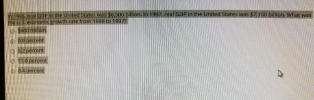 UHA ne United States was s 1996. real copin the United States was $6,5001BIM the sileconomiderowth rate from 1996 to 5600 million | 0.9 percent 92 percent 1110 percent 8.4 percent
5. Japanese labor productivity is on average about the same as that of the United States...
 5. Japanese labor productivity
is on average about the same as that of the United States in the
manufacturing sector (higher in some industries, lower in others).
On the other hand, the United States is considerably more
productive in the service sector than Japan. Unfortunately, most
services are nontraded. American comparative advantage lies in
things that they cannot sell to Japan. Some analysts have argued
that this poses a disadvantage for the United States. There are two
types of arguments:...
5. Japanese labor productivity
is on average about the same as that of the United States in the
manufacturing sector (higher in some industries, lower in others).
On the other hand, the United States is considerably more
productive in the service sector than Japan. Unfortunately, most
services are nontraded. American comparative advantage lies in
things that they cannot sell to Japan. Some analysts have argued
that this poses a disadvantage for the United States. There are two
types of arguments:...
Bitcoin and other cryptocurrencies have recently gained increasing prominence and popularity in the United States and...
Bitcoin and other cryptocurrencies have recently gained increasing prominence and popularity in the United States and across the globe. Do you think bitcoin currently works well as a currency? Why or why not? Does bitcoin satisfy the textbook requirements to be considered "money?" Do you own any bitcoin? Are you using or have you used bitcoin to make purchases? Finally, do you think bitcoin will increase in popularity and use in the future?
Bitcoin and other cryptocurrencies have recently gained increasing prominence and popularity in the United States a...
 Bitcoin and other cryptocurrencies have recently gained increasing prominence and popularity in the United States and across the globe. Do you think bitcoin currently works well as a currency? Why or why not? Does bitcoin satisfy the textbook requirements to be considered "money?" Do you own any bitcoin? Are you using or have you used bitcoin to make purchases? Finally, do you think bitcoin will increase in popularity and use in the future?
 UHA ne United States was s 1996. real copin the United States was $6,5001BIM the sileconomiderowth rate from 1996 to 5600 million | 0.9 percent 92 percent 1110 percent 8.4 percent
 5. Japanese labor productivity
is on average about the same as that of the United States in the
manufacturing sector (higher in some industries, lower in others).
On the other hand, the United States is considerably more
productive in the service sector than Japan. Unfortunately, most
services are nontraded. American comparative advantage lies in
things that they cannot sell to Japan. Some analysts have argued
that this poses a disadvantage for the United States. There are two
types of arguments:...
5. Japanese labor productivity
is on average about the same as that of the United States in the
manufacturing sector (higher in some industries, lower in others).
On the other hand, the United States is considerably more
productive in the service sector than Japan. Unfortunately, most
services are nontraded. American comparative advantage lies in
things that they cannot sell to Japan. Some analysts have argued
that this poses a disadvantage for the United States. There are two
types of arguments:...
 Bitcoin and other cryptocurrencies have recently gained increasing prominence and popularity in the United States and across the globe. Do you think bitcoin currently works well as a currency? Why or why not? Does bitcoin satisfy the textbook requirements to be considered "money?" Do you own any bitcoin? Are you using or have you used bitcoin to make purchases? Finally, do you think bitcoin will increase in popularity and use in the future?
Most questions answered within 3 hours.
-
Where is the error in this code sequence?
String s1 = "Hello";
String s2 = "ello";...
asked 11 months ago -
Financial data for Joel de Paris, Inc., for last year
follow:
Joel de Paris, Inc.
Balance...
asked 11 months ago -
Consider this reaction:
Al2(SO4)3 (aq)+ BaCl3
(aq) Al2Cl6 (aq)- +
3BaSO4(s) . What is the...
asked 11 months ago -
Suppose that Savneet is considering increasing her
recent random sample from 20 car rentals to 40...
asked 11 months ago -
Trucks arrive at an unloading terminal at an average rate of 120
per hour.
Trucks arrive...
asked 11 months ago -
Why are methanol and ethanol completely soluble in water while
octanol is not very little soluble....
asked 11 months ago -
A facilities manager at a university reads in a research report
that the mean amount of...
asked 11 months ago -
When the CuSO4 is rehydrated by adding water to the anhydrous
compound, is this an endothermic...
asked 11 months ago -
A ray of sunlight is passing from diamond into crown glass; the
angle of incidence is...
asked 11 months ago -
A block of mass 0.249 kg is placed on top of a light, vertical
spring of...
asked 11 months ago -
how do the kidneys compensate in the presences of acidosis
a) trigger hyperventilate
b) reserve acid...
asked 11 months ago -
Question 501 pts
The rental rate of capital to the firm increases. Which of the
following...
asked 11 months ago