
Homework Answers
Co-polymer has 2 moles of styrene for every 6 moles of buta-diene
6 moles of Polybutadiene X 54g/mol = 324 g
2 moles of polystrene X 105 g/mol = 210 g
Copolymer total mass = 534 g
now, as only the butadiene can participate in the cross-linking with sulfur. We thus need the mass fraction of butadiene: 324/534 =0.606
moles of Butadiene in 100 g of Copolymer = 100 X 0.606/54 g/mol = 1.12
Mass of S required for 22 % cross linking = 0.22 x 1.12 x 32 g/mol = 7.88 g
wt % = (7.88/ 100+7.88) = 7.30%
Add Answer to:
A butadiene-styrene is made by polymerizing 2 monomers of styrene with 6 monomers of butadiene. If...
8.a) A random poly(styrene-butadiene) copolymer has a weight-average molecular weight of 467,500 g/mol and a weight-average...
 8.a) A random poly(styrene-butadiene) copolymer has a weight-average molecular weight of 467,500 g/mol and a weight-average degree of polymerization of 5500. Calculate the fraction of styrene (C:Hg) and butadiene (C4H6) mers in this copolymer. Atomic weights: C-12, H-1 b) What weight % sulphur must be added to vulcanize polyisoprene (mer weight = 68) by crosslinking one half the possible sites. In this elastomer, each pair of mers has two possible crosslink sites. Assume three sulphur atoms are involved in each...
3 8.a) A random poly(styrene-butadiene) copolymer has a weight-average molecular weight of 467,500 g/mol and a...
 3 8.a) A random poly(styrene-butadiene) copolymer has a weight-average molecular weight of 467,500 g/mol and a weight-average degree of polymerization of 5500. Calculate the fraction of styrene (CsHg) and butadiene (C4H6) mers in this copolymer. Atomic weights: C-12, H-1 b) What weight % sulphur must be added to vulcanize polyisoprene (mer weight = 68) by crosslinking one half the possible sites. In this elastomer, each pair of mers has two possible crosslink sites. Assume three sulphur atoms are involved in...
Part D Choose the monomer(s) from which styrene-butadiene rubber is made. Check all that apply. isoprene...
 Part D Choose the monomer(s) from which styrene-butadiene rubber is made. Check all that apply. isoprene vinyl chloride butadiene vinyliden chloride propylene styrene ethylene Request Answer Submit Provide Feedback Request Answer Submit Part C Choose the monomer(s) from which poly(vinyl chloride) is made. Check all that apply. isoprene vinyl chloride butadiene vinyliden chloride propylene styrene ethylene Submit Request Answer Part B Choose the monomer(s) from which polypropylene is made. Check all that apply. isoprene vinyl chloride butadiene vinyliden chloride propylene...
Consider the following two polymeric systems: A. Poly(styrene-butadiene) amorphous copolymer having a number-average molecular weight of...
 Consider the following two polymeric systems: A. Poly(styrene-butadiene) amorphous copolymer having a number-average molecular weight of 50,000 g/mol, and 8% of the available sites crosslinked. B. Poly(styrene-butadiene) amorphous copolymer having a number-average molecular weight of 200,000 g/mol, and 20% of the available sites crosslinked. Respond to the following questions and justify your answer. a) Which polymer will display the highest stiffness? Why? (2 points) b) Which polymer will display the highest tensile strength? Why? (2 points) c) Consider that polymer...
6. Consider the two monomers styrene (phenylethene) and propylene (propene), draw the structure resulting from the...
 6. Consider the two monomers styrene (phenylethene) and propylene (propene), draw the structure resulting from the alternating copolymer of these materials.
Predict the order of reactivity (and justify your prediction) of the given monomers. a. Styrene, 2-vinylpyridine,...
 Predict the order of reactivity (and justify your prediction) of the given monomers. a. Styrene, 2-vinylpyridine, and 4-vinyl pyridine in anionic polymerization. and p-methylstyrene in cationic polymerizati Styrene, p-methoxystyrene, p-chlorostyrene, b.
6) Nitropolystyrene could also be made by polymerizing nitrostyrene. What problems can you foresee with this...
 6) Nitropolystyrene could also be made by polymerizing nitrostyrene. What problems can you foresee with this alternative approach, both in the preparation of nitrostyrene from styrene and in the acid-catalyzed polymerization reaction?
4,5,&6 please Connect the 4 monomers you made into a polymer, however you must lose a...
 4,5,&6 please
Connect the 4 monomers you made into a polymer, however you must lose a colored paperclip with each connection as you hook the monomers together. Each colored paperclip lost in the process represents a mole of water molecules. 3. What is the molar mass of the 'lost' molecule? 2 x 18.02 - 36.04 x3 = 108.12 g /mol 4. How many 'moles' of polymer paperclip chain did you form? How many 'moles' of water colored paperclips did you...
4,5,&6 please
Connect the 4 monomers you made into a polymer, however you must lose a colored paperclip with each connection as you hook the monomers together. Each colored paperclip lost in the process represents a mole of water molecules. 3. What is the molar mass of the 'lost' molecule? 2 x 18.02 - 36.04 x3 = 108.12 g /mol 4. How many 'moles' of polymer paperclip chain did you form? How many 'moles' of water colored paperclips did you...
6. The polymerization of butadiene produces three isomeric polymers, but the polymerization of isoprene - 2-methyl-1,3-butadiene...
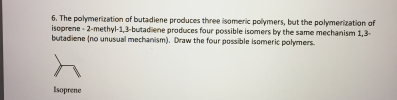 6. The polymerization of butadiene produces three isomeric polymers, but the polymerization of isoprene - 2-methyl-1,3-butadiene produces four possible isomers by the same mechanism 1,3- butadiene (no unusual mechanism). Draw the four possible isomeric polymers. Isoprene
3. A Nucleic acid is a polymer made up of which kind of monomers? a) modified...
 3. A Nucleic acid is a polymer made up of which kind of monomers? a) modified glucose and phosphate. b) a modified sugar, a phosphate and an amino acids, c), a 5-C sugar and phosphate groups, d) fatty acids and glycerol, e) a nucleotides. 4. WhenCV and H' react to form CH, the number of electrons involved in bonding is? a) 1, b) 2, c) 6. d) 8. e) 4. 5. Serine is an amino acid in which the elements...
 8.a) A random poly(styrene-butadiene) copolymer has a weight-average molecular weight of 467,500 g/mol and a weight-average degree of polymerization of 5500. Calculate the fraction of styrene (C:Hg) and butadiene (C4H6) mers in this copolymer. Atomic weights: C-12, H-1 b) What weight % sulphur must be added to vulcanize polyisoprene (mer weight = 68) by crosslinking one half the possible sites. In this elastomer, each pair of mers has two possible crosslink sites. Assume three sulphur atoms are involved in each...
 3 8.a) A random poly(styrene-butadiene) copolymer has a weight-average molecular weight of 467,500 g/mol and a weight-average degree of polymerization of 5500. Calculate the fraction of styrene (CsHg) and butadiene (C4H6) mers in this copolymer. Atomic weights: C-12, H-1 b) What weight % sulphur must be added to vulcanize polyisoprene (mer weight = 68) by crosslinking one half the possible sites. In this elastomer, each pair of mers has two possible crosslink sites. Assume three sulphur atoms are involved in...
 Part D Choose the monomer(s) from which styrene-butadiene rubber is made. Check all that apply. isoprene vinyl chloride butadiene vinyliden chloride propylene styrene ethylene Request Answer Submit Provide Feedback Request Answer Submit Part C Choose the monomer(s) from which poly(vinyl chloride) is made. Check all that apply. isoprene vinyl chloride butadiene vinyliden chloride propylene styrene ethylene Submit Request Answer Part B Choose the monomer(s) from which polypropylene is made. Check all that apply. isoprene vinyl chloride butadiene vinyliden chloride propylene...
 Consider the following two polymeric systems: A. Poly(styrene-butadiene) amorphous copolymer having a number-average molecular weight of 50,000 g/mol, and 8% of the available sites crosslinked. B. Poly(styrene-butadiene) amorphous copolymer having a number-average molecular weight of 200,000 g/mol, and 20% of the available sites crosslinked. Respond to the following questions and justify your answer. a) Which polymer will display the highest stiffness? Why? (2 points) b) Which polymer will display the highest tensile strength? Why? (2 points) c) Consider that polymer...
 6. Consider the two monomers styrene (phenylethene) and propylene (propene), draw the structure resulting from the alternating copolymer of these materials.
 Predict the order of reactivity (and justify your prediction) of the given monomers. a. Styrene, 2-vinylpyridine, and 4-vinyl pyridine in anionic polymerization. and p-methylstyrene in cationic polymerizati Styrene, p-methoxystyrene, p-chlorostyrene, b.
 6) Nitropolystyrene could also be made by polymerizing nitrostyrene. What problems can you foresee with this alternative approach, both in the preparation of nitrostyrene from styrene and in the acid-catalyzed polymerization reaction?
 4,5,&6 please
Connect the 4 monomers you made into a polymer, however you must lose a colored paperclip with each connection as you hook the monomers together. Each colored paperclip lost in the process represents a mole of water molecules. 3. What is the molar mass of the 'lost' molecule? 2 x 18.02 - 36.04 x3 = 108.12 g /mol 4. How many 'moles' of polymer paperclip chain did you form? How many 'moles' of water colored paperclips did you...
4,5,&6 please
Connect the 4 monomers you made into a polymer, however you must lose a colored paperclip with each connection as you hook the monomers together. Each colored paperclip lost in the process represents a mole of water molecules. 3. What is the molar mass of the 'lost' molecule? 2 x 18.02 - 36.04 x3 = 108.12 g /mol 4. How many 'moles' of polymer paperclip chain did you form? How many 'moles' of water colored paperclips did you...
 6. The polymerization of butadiene produces three isomeric polymers, but the polymerization of isoprene - 2-methyl-1,3-butadiene produces four possible isomers by the same mechanism 1,3- butadiene (no unusual mechanism). Draw the four possible isomeric polymers. Isoprene
 3. A Nucleic acid is a polymer made up of which kind of monomers? a) modified glucose and phosphate. b) a modified sugar, a phosphate and an amino acids, c), a 5-C sugar and phosphate groups, d) fatty acids and glycerol, e) a nucleotides. 4. WhenCV and H' react to form CH, the number of electrons involved in bonding is? a) 1, b) 2, c) 6. d) 8. e) 4. 5. Serine is an amino acid in which the elements...
Most questions answered within 3 hours.
-
Where is the error in this code sequence?
String s1 = "Hello";
String s2 = "ello";...
asked 10 months ago -
Financial data for Joel de Paris, Inc., for last year
follow:
Joel de Paris, Inc.
Balance...
asked 10 months ago -
Consider this reaction:
Al2(SO4)3 (aq)+ BaCl3
(aq) Al2Cl6 (aq)- +
3BaSO4(s) . What is the...
asked 10 months ago -
Suppose that Savneet is considering increasing her
recent random sample from 20 car rentals to 40...
asked 10 months ago -
Trucks arrive at an unloading terminal at an average rate of 120
per hour.
Trucks arrive...
asked 10 months ago -
Why are methanol and ethanol completely soluble in water while
octanol is not very little soluble....
asked 10 months ago -
A facilities manager at a university reads in a research report
that the mean amount of...
asked 10 months ago -
When the CuSO4 is rehydrated by adding water to the anhydrous
compound, is this an endothermic...
asked 10 months ago -
A ray of sunlight is passing from diamond into crown glass; the
angle of incidence is...
asked 10 months ago -
A block of mass 0.249 kg is placed on top of a light, vertical
spring of...
asked 10 months ago -
how do the kidneys compensate in the presences of acidosis
a) trigger hyperventilate
b) reserve acid...
asked 10 months ago -
Question 501 pts
The rental rate of capital to the firm increases. Which of the
following...
asked 10 months ago