
Homework Answers
Add Answer to:
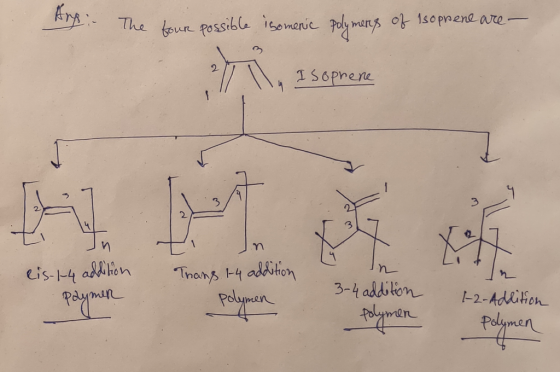
6. The polymerization of butadiene produces three isomeric polymers, but the polymerization of isoprene - 2-methyl-1,3-butadiene...
What is the mechanism behind the polymerization of 2-chloro-1,3-butadiene to make neoprene? What kind of polymer...
What is the mechanism behind the polymerization of 2-chloro-1,3-butadiene to make neoprene? What kind of polymer is neoprene, and what is its structure?
Show a mechanism to explain why treatment of 1,3-butadiene with 1 mole of HBr produces a...
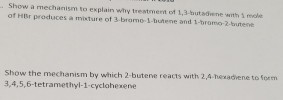 Show a mechanism to explain why treatment of 1,3-butadiene with 1 mole of HBr produces a mixture of 3-bromo-1-butene and 1-bromo-2-butene Show the mechanism by which 2-butene reacts with 2,4-hexadiene to form 3,4,5,6-tetramethyl-1-cyclohexene
Write structures for the various Diels-Alder adduct(s) that could result in the reaction of 2-methyl-1,3-butadiene with...
 Write structures for the various Diels-Alder adduct(s) that
could result in the reaction of 2-methyl-1,3-butadiene with this
compound:
Please explain
CH
Write structures for the various Diels-Alder adduct(s) that
could result in the reaction of 2-methyl-1,3-butadiene with this
compound:
Please explain
CH
CHA CH₂ + H₂C Mai H₂C • treating 1,3-butadiene w/ one mole of HCl give a mixture ok 2 isometric products. Draw curv...
 CHA CH₂ + H₂C Mai H₂C • treating 1,3-butadiene w/ one mole of HCl give a mixture ok 2 isometric products. Draw curved arrows to show the movement of electrons in this step of the rxn mechanism. ci: CH2 : > cha
6 6) Starting from 1,3-cyclohexadiene and (E)-methyl but-2-enoate, draw a reasonable synthesis for the product shown...
 6
6) Starting from 1,3-cyclohexadiene and (E)-methyl but-2-enoate, draw a reasonable synthesis for the product shown below. (12 points) он CH3 + enantiomer 0 CO Me
6
6) Starting from 1,3-cyclohexadiene and (E)-methyl but-2-enoate, draw a reasonable synthesis for the product shown below. (12 points) он CH3 + enantiomer 0 CO Me
1. Write the structural formula for: 4-methyl- 1,3-pentandiol 2.What does this experiment suggest about the mechanism...
1. Write the structural formula for: 4-methyl- 1,3-pentandiol 2.What does this experiment suggest about the mechanism of addition of hydrogen to a double bond? m.p.(oC) b.p(oC) cis-1,2-dimethylcyclohexane -50 130 trans-1,2-dimethylcyclohexane -89 123 3.Draw and name (including R,S) the stereochemical isomers of: (Use Fischer projections) a. CH3-CHCl-CHCl-CH3 b. CH3-CHBr-CHCl-CH3 . 4. In the following SN2 reactions, identify the nucleophile and the substrate. Which nucleophile is stronger? Explain. ...
7. Draw the possible products resulting from addition of 1 equivalent of HBr to 2-Methyl-1,3-pentadiene. Which...
 7. Draw the possible products resulting from addition of 1 equivalent of HBr to 2-Methyl-1,3-pentadiene. Which would you expect to predominate, and why?
7. Draw the possible products resulting from addition of 1 equivalent of HBr to 2-Methyl-1,3-pentadiene. Which...
 7. Draw the possible products resulting from addition of 1 equivalent of HBr to 2-Methyl-1,3-pentadiene. Which would you expect to predominate, and why?
1. Draw the structures of: a) (Z) 2-iodo-3-methyl-2-heptene b) cis non-3-en-5 yne Give the IUPAC name...
 1. Draw the structures of: a) (Z) 2-iodo-3-methyl-2-heptene b) cis non-3-en-5 yne Give the IUPAC name of the following compounds, including steochemistry. a) F CH2CH2Br CH3CE 2. a) Draw the most stable chair conformation of cis 1,3-difluorocyclohexane. b) Draw a Newman projection of 2-iodo-3-methylpentane looking down the 3. Compound X has the formula CoHB2Br4. Compound X reacts with excess H2/Pd to give CATHa6Bra. How many does compound X have? Show how you got your answer. rings 4. For each pair...
When 2-methyl-3-hexene is treated with Cl2 in methanol, three products are formed (neglecting stereoisomers).
 When 2-methyl-3-hexene is treated with Cl2 in methanol, three products are formed (neglecting stereoisomers). Draw curved arrows to show the movement of electrons in this step of the reaction mechanism.
 Show a mechanism to explain why treatment of 1,3-butadiene with 1 mole of HBr produces a mixture of 3-bromo-1-butene and 1-bromo-2-butene Show the mechanism by which 2-butene reacts with 2,4-hexadiene to form 3,4,5,6-tetramethyl-1-cyclohexene
 Write structures for the various Diels-Alder adduct(s) that
could result in the reaction of 2-methyl-1,3-butadiene with this
compound:
Please explain
CH
Write structures for the various Diels-Alder adduct(s) that
could result in the reaction of 2-methyl-1,3-butadiene with this
compound:
Please explain
CH
 CHA CH₂ + H₂C Mai H₂C • treating 1,3-butadiene w/ one mole of HCl give a mixture ok 2 isometric products. Draw curved arrows to show the movement of electrons in this step of the rxn mechanism. ci: CH2 : > cha
 6
6) Starting from 1,3-cyclohexadiene and (E)-methyl but-2-enoate, draw a reasonable synthesis for the product shown below. (12 points) он CH3 + enantiomer 0 CO Me
6
6) Starting from 1,3-cyclohexadiene and (E)-methyl but-2-enoate, draw a reasonable synthesis for the product shown below. (12 points) он CH3 + enantiomer 0 CO Me
 7. Draw the possible products resulting from addition of 1 equivalent of HBr to 2-Methyl-1,3-pentadiene. Which would you expect to predominate, and why?
 7. Draw the possible products resulting from addition of 1 equivalent of HBr to 2-Methyl-1,3-pentadiene. Which would you expect to predominate, and why?
 1. Draw the structures of: a) (Z) 2-iodo-3-methyl-2-heptene b) cis non-3-en-5 yne Give the IUPAC name of the following compounds, including steochemistry. a) F CH2CH2Br CH3CE 2. a) Draw the most stable chair conformation of cis 1,3-difluorocyclohexane. b) Draw a Newman projection of 2-iodo-3-methylpentane looking down the 3. Compound X has the formula CoHB2Br4. Compound X reacts with excess H2/Pd to give CATHa6Bra. How many does compound X have? Show how you got your answer. rings 4. For each pair...
 When 2-methyl-3-hexene is treated with Cl2 in methanol, three products are formed (neglecting stereoisomers). Draw curved arrows to show the movement of electrons in this step of the reaction mechanism.
Most questions answered within 3 hours.
-
Where is the error in this code sequence?
String s1 = "Hello";
String s2 = "ello";...
asked 11 months ago -
Financial data for Joel de Paris, Inc., for last year
follow:
Joel de Paris, Inc.
Balance...
asked 11 months ago -
Consider this reaction:
Al2(SO4)3 (aq)+ BaCl3
(aq) Al2Cl6 (aq)- +
3BaSO4(s) . What is the...
asked 11 months ago -
Suppose that Savneet is considering increasing her
recent random sample from 20 car rentals to 40...
asked 11 months ago -
Trucks arrive at an unloading terminal at an average rate of 120
per hour.
Trucks arrive...
asked 11 months ago -
Why are methanol and ethanol completely soluble in water while
octanol is not very little soluble....
asked 11 months ago -
A facilities manager at a university reads in a research report
that the mean amount of...
asked 11 months ago -
When the CuSO4 is rehydrated by adding water to the anhydrous
compound, is this an endothermic...
asked 11 months ago -
A ray of sunlight is passing from diamond into crown glass; the
angle of incidence is...
asked 11 months ago -
A block of mass 0.249 kg is placed on top of a light, vertical
spring of...
asked 11 months ago -
how do the kidneys compensate in the presences of acidosis
a) trigger hyperventilate
b) reserve acid...
asked 11 months ago -
Question 501 pts
The rental rate of capital to the firm increases. Which of the
following...
asked 11 months ago