What is the mechanism behind the polymerization of 2-chloro-1,3-butadiene to make neoprene? What kind of polymer...
What is the mechanism behind the polymerization of 2-chloro-1,3-butadiene to make neoprene? What kind of polymer is neoprene, and what is its structure?
Homework Answers
Request Answer!
We need at least 10 more requests to produce the answer.
0 / 10 have requested this problem solution
The more requests, the faster the answer.
Add Answer to:
What is the mechanism behind the polymerization of
2-chloro-1,3-butadiene to make neoprene? What kind of polymer...
6. The polymerization of butadiene produces three isomeric polymers, but the polymerization of isoprene - 2-methyl-1,3-butadiene...
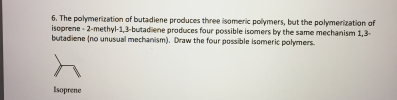 6. The polymerization of butadiene produces three isomeric polymers, but the polymerization of isoprene - 2-methyl-1,3-butadiene produces four possible isomers by the same mechanism 1,3- butadiene (no unusual mechanism). Draw the four possible isomeric polymers. Isoprene
Polymer Chemistry Show mechanism for the following cationic polymerization and provide the polymer structure. Show all...
 Polymer Chemistry
Show mechanism for the following cationic polymerization and provide the polymer structure. Show all steps in mechanism.
Polymer Chemistry
Show mechanism for the following cationic polymerization and provide the polymer structure. Show all steps in mechanism.
0 2. Draw the structure for a) (2)-1-chloro-2-ethyl-1,3-butadiene b) glycerol c) (Z)-2-ethyl-2-buten-1-ol
 0 2. Draw the structure for a) (2)-1-chloro-2-ethyl-1,3-butadiene b) glycerol c) (Z)-2-ethyl-2-buten-1-ol
2. What is a polymer/polymerization? Write the structure for one link of the polymer 6-6 Nylon...
 2. What is a polymer/polymerization? Write the structure for one link of the polymer 6-6 Nylon (4pts)
(10 points) In the Diels-Alder experiment the 3-sulfolene was used and converted to 1,3-butadiene. Why didn't we just start with 1,3-butadiene and what diene conformation is best for this e...
 (10 points) In the Diels-Alder experiment the 3-sulfolene was used and converted to 1,3-butadiene. Why didn't we just start with 1,3-butadiene and what diene conformation is best for this experiment? (Write the two step mechanism for this reaction)
(10 points) In the Diels-Alder experiment the 3-sulfolene was used and converted to 1,3-butadiene. Why didn't we just start with 1,3-butadiene and what diene conformation is best for this experiment? (Write the two step mechanism for this reaction)
(10 points) In the Diels-Alder experiment the 3-sulfolene was used and converted to 1,3-butadiene. Why didn't we just start with 1,3-butadiene and what diene conformation is best for this experiment? (Write the two step mechanism for this reaction)
Show a mechanism to explain why treatment of 1,3-butadiene with 1 mole of HBr produces a...
 Show a mechanism to explain why treatment of 1,3-butadiene with 1 mole of HBr produces a mixture of 3-bromo-1-butene and 1-bromo-2-butene Show the mechanism by which 2-butene reacts with 2,4-hexadiene to form 3,4,5,6-tetramethyl-1-cyclohexene
1,3-Butadiene undergoes an electrophilic addition with HBr. Complete the steps in the mechanism to produce the...
 1,3-Butadiene undergoes an electrophilic addition with HBr.
Complete the steps in the mechanism to produce the product
shown1) Add curved arrows for the first step. 2) Draw both the organic and inorganic intermediate species. Include all nonbonding electrons and charges. Draw a curved arrow to convert the intermediate into the product shown.
1,3-Butadiene undergoes an electrophilic addition with HBr.
Complete the steps in the mechanism to produce the product
shown1) Add curved arrows for the first step. 2) Draw both the organic and inorganic intermediate species. Include all nonbonding electrons and charges. Draw a curved arrow to convert the intermediate into the product shown.
The purpose of this experiment is to synthesize a polymer using a Gilch polymerization of 2,5-...
 The purpose of this experiment is to synthesize a polymer using a Gilch polymerization of 2,5- bis(bromomethyl) - 1 -methoxy-4-(2-ethylhexyloxy) benzene, to investigate the polymer's photophysical properties, and to understand the mechanism of the polymerization reaction. Introduction Poly(p-phenylene vinylenes), or PPVS, are highly luminescent polymers that are used for a variety of commercial applications. Their general structure is shown in Figure . PPVS can be synthesized via a number of routes, including a Gilch polymerization reaction, which will be used...
need help on polymer chemistry question Determine which polymerization mechanism(s), i.e. radical, anionic, and cationic...
 need help on polymer chemistry question
Determine which polymerization mechanism(s), i.e. radical,
anionic, and cationic, can be used for the following monomers.
Briefly explain your answer.
H2C= CHCEH H2C= C(CH3)2 H3CHC=CHCH
need help on polymer chemistry question
Determine which polymerization mechanism(s), i.e. radical,
anionic, and cationic, can be used for the following monomers.
Briefly explain your answer.
H2C= CHCEH H2C= C(CH3)2 H3CHC=CHCH
4. What monomer would you start with to make the polymer shown? Would the polymer be...
 4. What monomer would you start with to make the polymer shown?
Would the polymer be made more effectively using a cationic or an
anionic polymerization?
CN CN CN
4. What monomer would you start with to make the polymer shown?
Would the polymer be made more effectively using a cationic or an
anionic polymerization?
CN CN CN
 6. The polymerization of butadiene produces three isomeric polymers, but the polymerization of isoprene - 2-methyl-1,3-butadiene produces four possible isomers by the same mechanism 1,3- butadiene (no unusual mechanism). Draw the four possible isomeric polymers. Isoprene
 Polymer Chemistry
Show mechanism for the following cationic polymerization and provide the polymer structure. Show all steps in mechanism.
Polymer Chemistry
Show mechanism for the following cationic polymerization and provide the polymer structure. Show all steps in mechanism.
 0 2. Draw the structure for a) (2)-1-chloro-2-ethyl-1,3-butadiene b) glycerol c) (Z)-2-ethyl-2-buten-1-ol
 2. What is a polymer/polymerization? Write the structure for one link of the polymer 6-6 Nylon (4pts)
 (10 points) In the Diels-Alder experiment the 3-sulfolene was used and converted to 1,3-butadiene. Why didn't we just start with 1,3-butadiene and what diene conformation is best for this experiment? (Write the two step mechanism for this reaction)
(10 points) In the Diels-Alder experiment the 3-sulfolene was used and converted to 1,3-butadiene. Why didn't we just start with 1,3-butadiene and what diene conformation is best for this experiment? (Write the two step mechanism for this reaction)
(10 points) In the Diels-Alder experiment the 3-sulfolene was used and converted to 1,3-butadiene. Why didn't we just start with 1,3-butadiene and what diene conformation is best for this experiment? (Write the two step mechanism for this reaction)
 Show a mechanism to explain why treatment of 1,3-butadiene with 1 mole of HBr produces a mixture of 3-bromo-1-butene and 1-bromo-2-butene Show the mechanism by which 2-butene reacts with 2,4-hexadiene to form 3,4,5,6-tetramethyl-1-cyclohexene
 The purpose of this experiment is to synthesize a polymer using a Gilch polymerization of 2,5- bis(bromomethyl) - 1 -methoxy-4-(2-ethylhexyloxy) benzene, to investigate the polymer's photophysical properties, and to understand the mechanism of the polymerization reaction. Introduction Poly(p-phenylene vinylenes), or PPVS, are highly luminescent polymers that are used for a variety of commercial applications. Their general structure is shown in Figure . PPVS can be synthesized via a number of routes, including a Gilch polymerization reaction, which will be used...
 need help on polymer chemistry question
Determine which polymerization mechanism(s), i.e. radical,
anionic, and cationic, can be used for the following monomers.
Briefly explain your answer.
H2C= CHCEH H2C= C(CH3)2 H3CHC=CHCH
need help on polymer chemistry question
Determine which polymerization mechanism(s), i.e. radical,
anionic, and cationic, can be used for the following monomers.
Briefly explain your answer.
H2C= CHCEH H2C= C(CH3)2 H3CHC=CHCH
 4. What monomer would you start with to make the polymer shown?
Would the polymer be made more effectively using a cationic or an
anionic polymerization?
CN CN CN
4. What monomer would you start with to make the polymer shown?
Would the polymer be made more effectively using a cationic or an
anionic polymerization?
CN CN CN
Most questions answered within 3 hours.
-
Where is the error in this code sequence?
String s1 = "Hello";
String s2 = "ello";...
asked 10 months ago -
Financial data for Joel de Paris, Inc., for last year
follow:
Joel de Paris, Inc.
Balance...
asked 10 months ago -
Consider this reaction:
Al2(SO4)3 (aq)+ BaCl3
(aq) Al2Cl6 (aq)- +
3BaSO4(s) . What is the...
asked 10 months ago -
Suppose that Savneet is considering increasing her
recent random sample from 20 car rentals to 40...
asked 10 months ago -
Trucks arrive at an unloading terminal at an average rate of 120
per hour.
Trucks arrive...
asked 10 months ago -
Why are methanol and ethanol completely soluble in water while
octanol is not very little soluble....
asked 10 months ago -
A facilities manager at a university reads in a research report
that the mean amount of...
asked 10 months ago -
When the CuSO4 is rehydrated by adding water to the anhydrous
compound, is this an endothermic...
asked 10 months ago -
A ray of sunlight is passing from diamond into crown glass; the
angle of incidence is...
asked 10 months ago -
A block of mass 0.249 kg is placed on top of a light, vertical
spring of...
asked 10 months ago -
how do the kidneys compensate in the presences of acidosis
a) trigger hyperventilate
b) reserve acid...
asked 10 months ago -
Question 501 pts
The rental rate of capital to the firm increases. Which of the
following...
asked 10 months ago