 THIS QUESTION MUST BE ANSWER
USING TAYLOR SERIES
THIS QUESTION MUST BE ANSWER
USING TAYLOR SERIES
Homework Answers
Add Answer to:
THIS QUESTION MUST BE ANSWER
USING TAYLOR SERIES
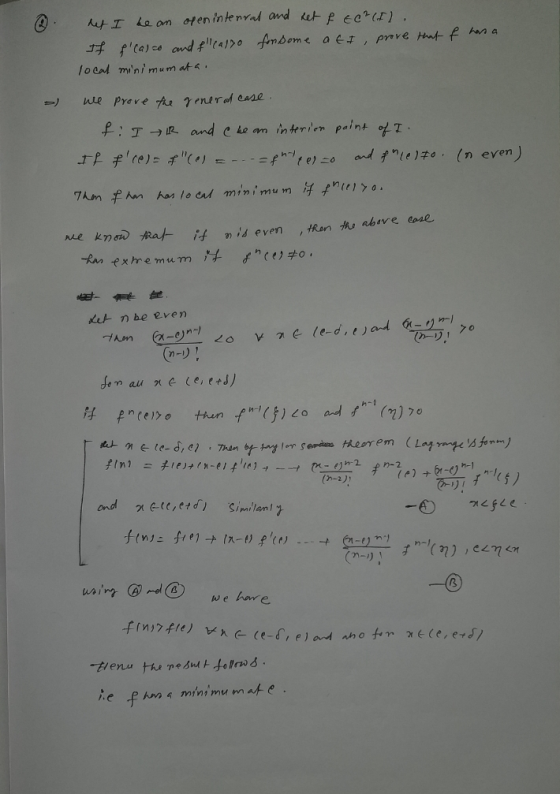
2. (10 pts) Let I be an open...
Let U be an open subset of R". Let f: UCR" ->Rm. (a) Prove that f...
 Let U be an open subset of R". Let f: UCR" ->Rm. (a) Prove that f is continuously differentiable if and only if for each a e U, for eache > 0, there exists o > 0 such that for each xe U, if ||x - a| << ô, then |Df (x) Df(a)| < e.
please i need the question 8.(a)(b) for the detailed proof and explaination ! thanks ! Let...
 please i need the question 8.(a)(b) for the detailed proof and
explaination ! thanks !
Let B fE C (R, R) | f(x)> 0 for all E R (a) Is B open? If not, what is B°? (b) What is B?
please i need the question 8.(a)(b) for the detailed proof and
explaination ! thanks !
Let B fE C (R, R) | f(x)> 0 for all E R (a) Is B open? If not, what is B°? (b) What is B?
Suppose that UCC is open and connected and a E U. Let F:= {f € H(U)|...
 Suppose that UCC is open and connected and a E U. Let F:= {f € H(U)| Re(f)> 0, f(a) 1} Show that Fis normal.
Exercise 7. Let X be a standard normal random variable. Prove that for any integer n...
 Exercise 7. Let X be a standard normal random variable. Prove that for any integer n > 0, ELY?"] = 1207) and E[x2n+] = 0.
Evaluate the following limit using Taylor series. 3 lim 2x2 zle x2 1 X>00
 Evaluate the following limit using Taylor series. 3 lim 2x2 zle x2 1 X>00
Prove or Disprove: Let p E P(F) and suppose that deg p > 1 and p...
 Prove or Disprove:
Let p E P(F) and suppose that deg p > 1 and p is irreducible. Then p(a)メ0 for all a E F.
Prove or Disprove:
Let p E P(F) and suppose that deg p > 1 and p is irreducible. Then p(a)メ0 for all a E F.
Let z=5 where x, y, z E R. Prove that z? +z2+z?>
 Let z=5 where x, y, z E R. Prove that z? +z2+z?>
For all n E N prove that 0 <e- > < 2 k!“ (n + 1)!...
 For all n E N prove that 0 <e- > < 2 k!“ (n + 1)! k=0 Hint: Think about Taylor approximations of the function e".
(2) Prove that the following are equivalent for x ER and A CR. (a) X E...
 (2) Prove that the following are equivalent for x ER and A CR. (a) X E A. Here A denotes the closure of A. (b) For every e > 0, N(x; e) n A +0. (c) For every open set U, if r EU then UNA+.
Use Definition 7.1.1. DEFINITION 7.1.1 Laplace Transform Let f be a function defined for t >...
 Use Definition 7.1.1. DEFINITION 7.1.1 Laplace Transform Let f be a function defined for t > 0. Then the integral Kf(t)} = [e-stf(t) dt is said to be the Laplace transform of f, provided that the integral converges. Find L{f(t)}. (Write your answer as a function of s.) f(t) = {6. Ost<3 PROI} = (s > 0)
 Let U be an open subset of R". Let f: UCR" ->Rm. (a) Prove that f is continuously differentiable if and only if for each a e U, for eache > 0, there exists o > 0 such that for each xe U, if ||x - a| << ô, then |Df (x) Df(a)| < e.
 please i need the question 8.(a)(b) for the detailed proof and
explaination ! thanks !
Let B fE C (R, R) | f(x)> 0 for all E R (a) Is B open? If not, what is B°? (b) What is B?
please i need the question 8.(a)(b) for the detailed proof and
explaination ! thanks !
Let B fE C (R, R) | f(x)> 0 for all E R (a) Is B open? If not, what is B°? (b) What is B?
 Suppose that UCC is open and connected and a E U. Let F:= {f € H(U)| Re(f)> 0, f(a) 1} Show that Fis normal.
 Exercise 7. Let X be a standard normal random variable. Prove that for any integer n > 0, ELY?"] = 1207) and E[x2n+] = 0.
 Evaluate the following limit using Taylor series. 3 lim 2x2 zle x2 1 X>00
 Prove or Disprove:
Let p E P(F) and suppose that deg p > 1 and p is irreducible. Then p(a)メ0 for all a E F.
Prove or Disprove:
Let p E P(F) and suppose that deg p > 1 and p is irreducible. Then p(a)メ0 for all a E F.
 Let z=5 where x, y, z E R. Prove that z? +z2+z?>
 For all n E N prove that 0 <e- > < 2 k!“ (n + 1)! k=0 Hint: Think about Taylor approximations of the function e".
 (2) Prove that the following are equivalent for x ER and A CR. (a) X E A. Here A denotes the closure of A. (b) For every e > 0, N(x; e) n A +0. (c) For every open set U, if r EU then UNA+.
 Use Definition 7.1.1. DEFINITION 7.1.1 Laplace Transform Let f be a function defined for t > 0. Then the integral Kf(t)} = [e-stf(t) dt is said to be the Laplace transform of f, provided that the integral converges. Find L{f(t)}. (Write your answer as a function of s.) f(t) = {6. Ost<3 PROI} = (s > 0)
Most questions answered within 3 hours.
-
Where is the error in this code sequence?
String s1 = "Hello";
String s2 = "ello";...
asked 10 months ago -
Financial data for Joel de Paris, Inc., for last year
follow:
Joel de Paris, Inc.
Balance...
asked 10 months ago -
Consider this reaction:
Al2(SO4)3 (aq)+ BaCl3
(aq) Al2Cl6 (aq)- +
3BaSO4(s) . What is the...
asked 10 months ago -
Suppose that Savneet is considering increasing her
recent random sample from 20 car rentals to 40...
asked 10 months ago -
Trucks arrive at an unloading terminal at an average rate of 120
per hour.
Trucks arrive...
asked 10 months ago -
Why are methanol and ethanol completely soluble in water while
octanol is not very little soluble....
asked 10 months ago -
A facilities manager at a university reads in a research report
that the mean amount of...
asked 10 months ago -
When the CuSO4 is rehydrated by adding water to the anhydrous
compound, is this an endothermic...
asked 10 months ago -
A ray of sunlight is passing from diamond into crown glass; the
angle of incidence is...
asked 10 months ago -
A block of mass 0.249 kg is placed on top of a light, vertical
spring of...
asked 10 months ago -
how do the kidneys compensate in the presences of acidosis
a) trigger hyperventilate
b) reserve acid...
asked 10 months ago -
Question 501 pts
The rental rate of capital to the firm increases. Which of the
following...
asked 10 months ago