Problem 3 (Lift and Drag Problems) Answer the following questions regarding lift and drag: a. Consider...
Problem 3 (Lift and Drag Problems)
Answer the following questions regarding lift and drag:
a. Consider the motion of a kayak on a relatively still lake:
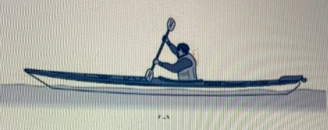
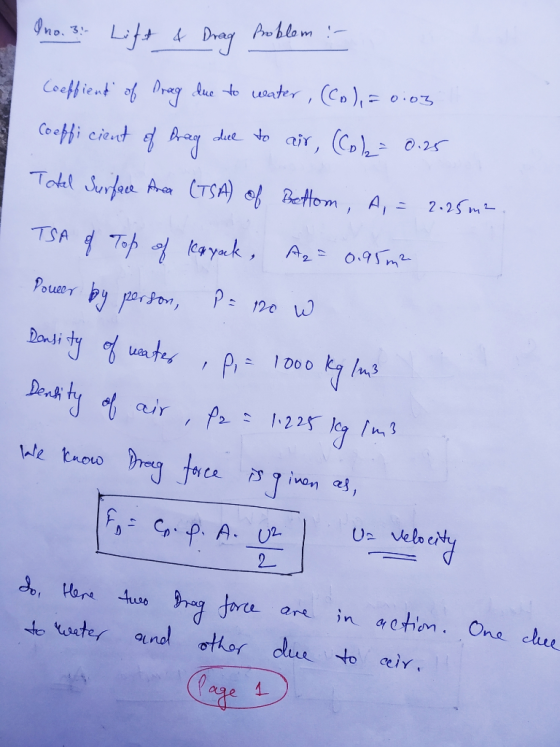
From a fluid mechanics perspective, this presents an interesting situation since the kayaker is moving through two different fluids (air and water), both of which will impart a drag force on the kayak. The bottom of the kayak is relatively streamlined, with a drag coefficient of 0.03. while the top of the kayak (which includes the person has a larger drag coefficient of 0.25. Since the bottom of the kayak is relatively streamlined, we will use the total surface area in determining the drag force, which we will take to be 2.25 m². The top of the kayak is a blunt body, so we will use its frontal area of 0.95 m2. Determine the terminal speed of the kayak, if the person can output 120 Watts worth of power in rowing the kayak. Assume the water has a density of Pwater = 1000 kg/m and the air has a density of Pair = 1.225 kg/m3.
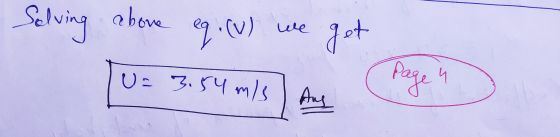
Ans: 3.54 m/s
Homework Answers
Here two different drag forces are in action.
One due to water and other due to air.
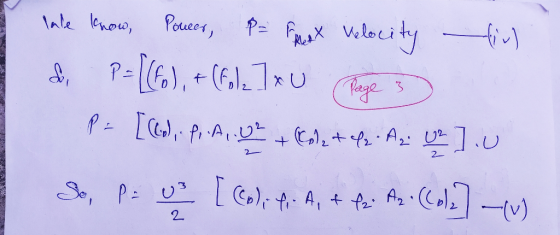
So final net force is a sum of these two drag forces.
So u get velocity of kayak as 3.54 m/s.

Add Answer to:
Problem 3 (Lift and Drag Problems) Answer the following questions regarding lift and drag: a. Consider...
A kayak is a relatively streamlined object. As a first approximation calculate the drag force under...
 A kayak is a relatively streamlined object. As a first approximation calculate the drag force under the assumption that it acts as a 4-m long flat plate and 0.55-m wide. Determine: a) The drag force when the speed is 5 m / s, b) The power required to maintain speed. c) The drag coefficient. Note: For this problem you can only use the experimental information reported to below, and assuming that the water density is 997 kg / m3 v...
What is the initial drag force for a golf ball with the following conditions? Frontal area:...
What is the initial drag force for a golf ball with the following conditions? Frontal area: 14 cm2 (remember to convert to m2), air density: 1.204 kg/m3, initial velocity: 50 m/s2, coefficient of drag: 0.3? Less than 0.25 N Between 0.25 and 0.50 N Between 0.50 and 0.75 N More than 0.75 N
Problem 2 (40%). While driving, some of a car's kinetic energy is lost to air drag....
 Problem 2 (40%). While driving, some of a car's kinetic energy is lost to air drag. We would like to estimate the importance of air drag using dimensional analysis and the Buck- ingham a theorem. The relevant parameters are the drag force (FD), the frontal surface area (A) and velocity of the car (v), as well as the density of air (Pair = 1 kg/m3). Answer the following questions: 1. Derive the expression of the drag force as a function...
Consider a Porsche 911 sports car with a mass of 1900 kg. The air drag force...
 Consider a Porsche 911 sports car with a mass of 1900 kg. The air drag force at highway speeds can be approximately calculated as: F_drag = 1/2 C p Av^2 where p = 1.2 kg/m^3 is the density of air, A is the front area of the car, C is the drag coefficient and v is the velocity. For the Porsche 911, we can take A - 2.3 m^2 and C = 0.28. What is the power necessary to overcome...
(40 pts) The drag force exerted on an automobile running at a constant speed of 30...
 (40 pts) The drag force exerted on an automobile running at a constant speed of 30 m/s is to be determined by running flow tests on a 1/6 scale model in a water tunnel. The drag force is known to be a function of the characteristic length, L, describing the vehicle frontal section, the vehicle speed relative to the fluid, V, and the fluid density and viscosity. Dimensional analysis has shown the following dimensionless relationship: Cp = º(Re), where FD...
A Matlab introductory class Problem. The book for my class is "Introduction to MATLAB For Engineers,...
 A Matlab introductory class Problem.
The book for my class is "Introduction to MATLAB For
Engineers, Third edition by William J. Palm
I have solved the top speed, the time to reach top
speed, and the speed the plane takes off at.
this is what I have.
I need help on the graphing portion of the
problem
I will give you a Thumbs Up if you solve this part for me. Thank
You.
LOOPING THE PLANE EGME 205, Fall 2018...
A Matlab introductory class Problem.
The book for my class is "Introduction to MATLAB For
Engineers, Third edition by William J. Palm
I have solved the top speed, the time to reach top
speed, and the speed the plane takes off at.
this is what I have.
I need help on the graphing portion of the
problem
I will give you a Thumbs Up if you solve this part for me. Thank
You.
LOOPING THE PLANE EGME 205, Fall 2018...
9 Required information An airplane has a mass of 48,000 kg, a wing area of 340 m*, a maximum lift coefficient of 3.2, and a cruising drag coefficient of O.03 at an altitude of 12.000 m. Take the dens...
 9 Required information An airplane has a mass of 48,000 kg, a wing area of 340 m*, a maximum lift coefficient of 3.2, and a cruising drag coefficient of O.03 at an altitude of 12.000 m. Take the density of standard air as p1-1225 kg/m3 at sea level and p2 0.312 kg/m at 12,000 m altitude. Determine the safe takeoff speed at sea level, assuming it is 20 percent over the stall speed The safe takeoff speed at sea level...
Problem 2 (35%): Consider an airplane with the following characteristics: Weight, W Zero-lift moment coefficient, Go...
 Problem 2 (35%): Consider an airplane with the following characteristics: Weight, W Zero-lift moment coefficient, Go 22700 N 0.06 ốc Moment coeff. Curve slope, Mg0.0133 deg -0.08 deg Lift curve slope, a Wing plan form area, S Tail volume ratio, VH 19 m2 - 0.34 Elevator control effectiveness, 0.04 deg! do Determine the elevator deflection required for this airplane to cruise at sea level with 50 m/sec and with 100 m/sec, respectively. (sea level density 1.225 kg/m')
The drag force on falling box is described by FD=(1/2)ρACDv2, where ρ is the density of...
The drag force on falling box is described by FD=(1/2)ρACDv2, where ρ is the density of air, 1.2 kg/m3. The mass of the box is 12.0 g, and the effective area of the bottom of the box is 109 cm2. Assume a drag coefficient of 1.10 a) Determine the drag force on the box when it is falling at a speed of 1.21 m/s. b) The box will reach terminal speed when the drag force on it is equal to...
Experiment (7) Drag Force TASK DETAILS Students must use the following equation in order to calculate...
 Experiment (7) Drag Force TASK DETAILS Students must use the following equation in order to calculate the drag force on a cylindrical sample placed inside a wind tunnel at varying velocities 1 For CopAV Where: Cp is the drag coefficient p is the density of the fluid through which the body is moving (Pair = 1.225 kg/m?) v is the velocity of the body relative to the fluid A is the projected cross-sectional area of the body perpendicular to the...
 A kayak is a relatively streamlined object. As a first approximation calculate the drag force under the assumption that it acts as a 4-m long flat plate and 0.55-m wide. Determine: a) The drag force when the speed is 5 m / s, b) The power required to maintain speed. c) The drag coefficient. Note: For this problem you can only use the experimental information reported to below, and assuming that the water density is 997 kg / m3 v...
 Problem 2 (40%). While driving, some of a car's kinetic energy is lost to air drag. We would like to estimate the importance of air drag using dimensional analysis and the Buck- ingham a theorem. The relevant parameters are the drag force (FD), the frontal surface area (A) and velocity of the car (v), as well as the density of air (Pair = 1 kg/m3). Answer the following questions: 1. Derive the expression of the drag force as a function...
 Consider a Porsche 911 sports car with a mass of 1900 kg. The air drag force at highway speeds can be approximately calculated as: F_drag = 1/2 C p Av^2 where p = 1.2 kg/m^3 is the density of air, A is the front area of the car, C is the drag coefficient and v is the velocity. For the Porsche 911, we can take A - 2.3 m^2 and C = 0.28. What is the power necessary to overcome...
 (40 pts) The drag force exerted on an automobile running at a constant speed of 30 m/s is to be determined by running flow tests on a 1/6 scale model in a water tunnel. The drag force is known to be a function of the characteristic length, L, describing the vehicle frontal section, the vehicle speed relative to the fluid, V, and the fluid density and viscosity. Dimensional analysis has shown the following dimensionless relationship: Cp = º(Re), where FD...
 A Matlab introductory class Problem.
The book for my class is "Introduction to MATLAB For
Engineers, Third edition by William J. Palm
I have solved the top speed, the time to reach top
speed, and the speed the plane takes off at.
this is what I have.
I need help on the graphing portion of the
problem
I will give you a Thumbs Up if you solve this part for me. Thank
You.
LOOPING THE PLANE EGME 205, Fall 2018...
A Matlab introductory class Problem.
The book for my class is "Introduction to MATLAB For
Engineers, Third edition by William J. Palm
I have solved the top speed, the time to reach top
speed, and the speed the plane takes off at.
this is what I have.
I need help on the graphing portion of the
problem
I will give you a Thumbs Up if you solve this part for me. Thank
You.
LOOPING THE PLANE EGME 205, Fall 2018...
 9 Required information An airplane has a mass of 48,000 kg, a wing area of 340 m*, a maximum lift coefficient of 3.2, and a cruising drag coefficient of O.03 at an altitude of 12.000 m. Take the density of standard air as p1-1225 kg/m3 at sea level and p2 0.312 kg/m at 12,000 m altitude. Determine the safe takeoff speed at sea level, assuming it is 20 percent over the stall speed The safe takeoff speed at sea level...
 Problem 2 (35%): Consider an airplane with the following characteristics: Weight, W Zero-lift moment coefficient, Go 22700 N 0.06 ốc Moment coeff. Curve slope, Mg0.0133 deg -0.08 deg Lift curve slope, a Wing plan form area, S Tail volume ratio, VH 19 m2 - 0.34 Elevator control effectiveness, 0.04 deg! do Determine the elevator deflection required for this airplane to cruise at sea level with 50 m/sec and with 100 m/sec, respectively. (sea level density 1.225 kg/m')
 Experiment (7) Drag Force TASK DETAILS Students must use the following equation in order to calculate the drag force on a cylindrical sample placed inside a wind tunnel at varying velocities 1 For CopAV Where: Cp is the drag coefficient p is the density of the fluid through which the body is moving (Pair = 1.225 kg/m?) v is the velocity of the body relative to the fluid A is the projected cross-sectional area of the body perpendicular to the...
Most questions answered within 3 hours.
-
Where is the error in this code sequence?
String s1 = "Hello";
String s2 = "ello";...
asked 10 months ago -
Financial data for Joel de Paris, Inc., for last year
follow:
Joel de Paris, Inc.
Balance...
asked 10 months ago -
Consider this reaction:
Al2(SO4)3 (aq)+ BaCl3
(aq) Al2Cl6 (aq)- +
3BaSO4(s) . What is the...
asked 10 months ago -
Suppose that Savneet is considering increasing her
recent random sample from 20 car rentals to 40...
asked 10 months ago -
Trucks arrive at an unloading terminal at an average rate of 120
per hour.
Trucks arrive...
asked 10 months ago -
Why are methanol and ethanol completely soluble in water while
octanol is not very little soluble....
asked 10 months ago -
A facilities manager at a university reads in a research report
that the mean amount of...
asked 10 months ago -
When the CuSO4 is rehydrated by adding water to the anhydrous
compound, is this an endothermic...
asked 10 months ago -
A ray of sunlight is passing from diamond into crown glass; the
angle of incidence is...
asked 10 months ago -
A block of mass 0.249 kg is placed on top of a light, vertical
spring of...
asked 10 months ago -
how do the kidneys compensate in the presences of acidosis
a) trigger hyperventilate
b) reserve acid...
asked 10 months ago -
Question 501 pts
The rental rate of capital to the firm increases. Which of the
following...
asked 10 months ago
> hello,
I great working and easy to understand. I have a question, isn't that 3.54m/s the cube value of the velocity? because as i can see in the final equation we had V^3.
Shimo Thu, Jan 6, 2022 2:21 PM