
Determine the smallest angle θθ which will cause motion of one of the blocks.
Determine is the friction force under the block AA at this angle. FA=?
Determine is the friction force under the block BB at this angle. FB?
Homework Answers


Add Answer to:
Determine the smallest angle θθ which will cause motion of one
of the blocks.
Determine is...
Two blocks A and B have a weight of 9 lb and 6 lb, respectively, They...
 Two blocks A and B have a weight of 9 lb and 6 lb, respectively, They are resting on the incline for which the coefficients of static friction are p = 0.16 and B = 0.26. Determine the angle which will cause motion of one of the blocks. What is the friction force under each of the blocks when this occurs? The spring has a stiffness of k = 2 lb/ft and is originally unstretched (Figure 1) Part A Determine...
KHomework 6, Chapters 8, 9 Item 5 Two blocks A and B have a weight of...
 KHomework 6, Chapters 8, 9 Item 5 Two blocks A and B have a weight of 11 lb and 5 lb, respectively They are resting on the incline for which the coefficients of static friction are 0.14 and 025. Determine the angle e which will cause motion of one of the blocks. What is the friction force under each of the blocks when this occurs? The spring has a stiffness of k 2 lb/ft and is originally unstretched. (Figure 1)...
*4-56. Two blocks A and B have a weight of 50 N and N, respectively. They...
 *4-56. Two blocks A and B have a weight of 50 N and N, respectively. They are resting on the incline for which tiu coefficients of static friction are μΑ-0.15 and μΒ Determine the angle 0 which will cause motion of one of the blocks. What is the friction force under each of the blocks when this occurs? The spring has a stiffness of k 30 N and is originally unstretched. the k 30 N/m Probs. 4-55/56
The spring bumper is used to arrest the motion of the 8 lb block, which is...
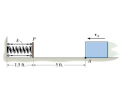 The spring bumper is used to
arrest the motion of the 8 lb block, which is sliding toward it at
5 ft/s . As shown, the spring is confined by the plate P and wall
using cables so that its length is 1.5 ft.
(Figure 1)
Part A
If the stiffness of the spring is k = 50 lb/ft, determine the
required unstretched length of the spring so that the plate is not
displaced more than 0.2 ft after the...
The spring bumper is used to
arrest the motion of the 8 lb block, which is sliding toward it at
5 ft/s . As shown, the spring is confined by the plate P and wall
using cables so that its length is 1.5 ft.
(Figure 1)
Part A
If the stiffness of the spring is k = 50 lb/ft, determine the
required unstretched length of the spring so that the plate is not
displaced more than 0.2 ft after the...
Review The spring bumper is used to arrest the motion of the 6 lb block, which...
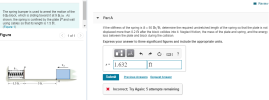 Review The spring bumper is used to arrest the motion of the 6 lb block, which is sliding toward it at 9 ft/s. As shown, the spring is confined by the plate P and wall using cables so that its length is 1.5 ft. (Figure 1) Part A Figure 1 of 1 > If the stiffness of the spring is k = 50 lb/ft, determine the required unstretched length of the spring so that the plate is not displaced more...
The spring bumper is used to arrest the motion of the 9 lb block, which is sliding toward it at 5...
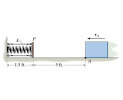 The spring bumper is used to arrest the motion of the 9 lb
block, which is sliding toward it at 5 ft/s . As shown, the spring
is confined by the plate P and wall using cables so that its length
is 1.5 ft.
If the stiffness of the spring is k = 50 lb/ft, determine the
required unstretched length of the spring so that the plate is not
displaced more than 0.2 ft after the block collides into it....
The spring bumper is used to arrest the motion of the 9 lb
block, which is sliding toward it at 5 ft/s . As shown, the spring
is confined by the plate P and wall using cables so that its length
is 1.5 ft.
If the stiffness of the spring is k = 50 lb/ft, determine the
required unstretched length of the spring so that the plate is not
displaced more than 0.2 ft after the block collides into it....
Problem 2: Determine the velocity of the 60-lb block A if the two blocks are released...
 Problem 2: Determine the velocity of the 60-lb block A if the two blocks are released from rest and the 40-lb block B moves 2 ft up the incline. The coefficient of kinetic friction between both blocks and the inclined planes is 0.10. 30r
Review Part A Determine the velocity of the 69-lb block A the two blocks are raleased from est and the 28-lb block...
 Review Part A Determine the velocity of the 69-lb block A the two blocks are raleased from est and the 28-lb block B moves 2 ft up the incline. The coelficient of kinetic friction between both blocks and the inclined planes is pG.10 (Figure 1) Express your answer with the appropriate units Figure 1 of 1 Value Units Request An Submit Provide Feedback Next
In the figure below, assume motion is in the vertical plane, incline makes an angle β...
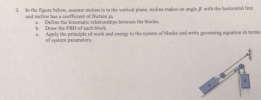 In the figure below, assume motion is in the vertical plane, incline makes an angle β with the horizontal line and incline has a coefficient of friction 3. . a. b. c. Define the kinematic relationships between the blocks. Draw the FBD of each block. Apply the principle of work and energy to the system of blocks and write governing equation in terms of system parameters.
Part A Determine the velocity of the 48-lb block A if the two blocks are released...
 Part A Determine the velocity of the 48-lb block A if the two blocks are released from rest and the 26-lb black B moves 2 ft up the incline. The coefficient of kinetic friction between both blocks and the inclined planes is pk .10. (Figure 1) Express your answer with the appropriate units. Figure 1 of 1 I Value Units Submit Request Answer Provide Feedback Next > 60
 Two blocks A and B have a weight of 9 lb and 6 lb, respectively, They are resting on the incline for which the coefficients of static friction are p = 0.16 and B = 0.26. Determine the angle which will cause motion of one of the blocks. What is the friction force under each of the blocks when this occurs? The spring has a stiffness of k = 2 lb/ft and is originally unstretched (Figure 1) Part A Determine...
 KHomework 6, Chapters 8, 9 Item 5 Two blocks A and B have a weight of 11 lb and 5 lb, respectively They are resting on the incline for which the coefficients of static friction are 0.14 and 025. Determine the angle e which will cause motion of one of the blocks. What is the friction force under each of the blocks when this occurs? The spring has a stiffness of k 2 lb/ft and is originally unstretched. (Figure 1)...
 *4-56. Two blocks A and B have a weight of 50 N and N, respectively. They are resting on the incline for which tiu coefficients of static friction are μΑ-0.15 and μΒ Determine the angle 0 which will cause motion of one of the blocks. What is the friction force under each of the blocks when this occurs? The spring has a stiffness of k 30 N and is originally unstretched. the k 30 N/m Probs. 4-55/56
 The spring bumper is used to
arrest the motion of the 8 lb block, which is sliding toward it at
5 ft/s . As shown, the spring is confined by the plate P and wall
using cables so that its length is 1.5 ft.
(Figure 1)
Part A
If the stiffness of the spring is k = 50 lb/ft, determine the
required unstretched length of the spring so that the plate is not
displaced more than 0.2 ft after the...
The spring bumper is used to
arrest the motion of the 8 lb block, which is sliding toward it at
5 ft/s . As shown, the spring is confined by the plate P and wall
using cables so that its length is 1.5 ft.
(Figure 1)
Part A
If the stiffness of the spring is k = 50 lb/ft, determine the
required unstretched length of the spring so that the plate is not
displaced more than 0.2 ft after the...
 Review The spring bumper is used to arrest the motion of the 6 lb block, which is sliding toward it at 9 ft/s. As shown, the spring is confined by the plate P and wall using cables so that its length is 1.5 ft. (Figure 1) Part A Figure 1 of 1 > If the stiffness of the spring is k = 50 lb/ft, determine the required unstretched length of the spring so that the plate is not displaced more...
 The spring bumper is used to arrest the motion of the 9 lb
block, which is sliding toward it at 5 ft/s . As shown, the spring
is confined by the plate P and wall using cables so that its length
is 1.5 ft.
If the stiffness of the spring is k = 50 lb/ft, determine the
required unstretched length of the spring so that the plate is not
displaced more than 0.2 ft after the block collides into it....
The spring bumper is used to arrest the motion of the 9 lb
block, which is sliding toward it at 5 ft/s . As shown, the spring
is confined by the plate P and wall using cables so that its length
is 1.5 ft.
If the stiffness of the spring is k = 50 lb/ft, determine the
required unstretched length of the spring so that the plate is not
displaced more than 0.2 ft after the block collides into it....
 Problem 2: Determine the velocity of the 60-lb block A if the two blocks are released from rest and the 40-lb block B moves 2 ft up the incline. The coefficient of kinetic friction between both blocks and the inclined planes is 0.10. 30r
 Review Part A Determine the velocity of the 69-lb block A the two blocks are raleased from est and the 28-lb block B moves 2 ft up the incline. The coelficient of kinetic friction between both blocks and the inclined planes is pG.10 (Figure 1) Express your answer with the appropriate units Figure 1 of 1 Value Units Request An Submit Provide Feedback Next
 In the figure below, assume motion is in the vertical plane, incline makes an angle β with the horizontal line and incline has a coefficient of friction 3. . a. b. c. Define the kinematic relationships between the blocks. Draw the FBD of each block. Apply the principle of work and energy to the system of blocks and write governing equation in terms of system parameters.
 Part A Determine the velocity of the 48-lb block A if the two blocks are released from rest and the 26-lb black B moves 2 ft up the incline. The coefficient of kinetic friction between both blocks and the inclined planes is pk .10. (Figure 1) Express your answer with the appropriate units. Figure 1 of 1 I Value Units Submit Request Answer Provide Feedback Next > 60
Most questions answered within 3 hours.
-
Where is the error in this code sequence?
String s1 = "Hello";
String s2 = "ello";...
asked 11 months ago -
Financial data for Joel de Paris, Inc., for last year
follow:
Joel de Paris, Inc.
Balance...
asked 11 months ago -
Consider this reaction:
Al2(SO4)3 (aq)+ BaCl3
(aq) Al2Cl6 (aq)- +
3BaSO4(s) . What is the...
asked 11 months ago -
Suppose that Savneet is considering increasing her
recent random sample from 20 car rentals to 40...
asked 11 months ago -
Trucks arrive at an unloading terminal at an average rate of 120
per hour.
Trucks arrive...
asked 11 months ago -
Why are methanol and ethanol completely soluble in water while
octanol is not very little soluble....
asked 11 months ago -
A facilities manager at a university reads in a research report
that the mean amount of...
asked 11 months ago -
When the CuSO4 is rehydrated by adding water to the anhydrous
compound, is this an endothermic...
asked 11 months ago -
A ray of sunlight is passing from diamond into crown glass; the
angle of incidence is...
asked 11 months ago -
A block of mass 0.249 kg is placed on top of a light, vertical
spring of...
asked 11 months ago -
how do the kidneys compensate in the presences of acidosis
a) trigger hyperventilate
b) reserve acid...
asked 11 months ago -
Question 501 pts
The rental rate of capital to the firm increases. Which of the
following...
asked 11 months ago