

Homework Answers
Add Answer to:
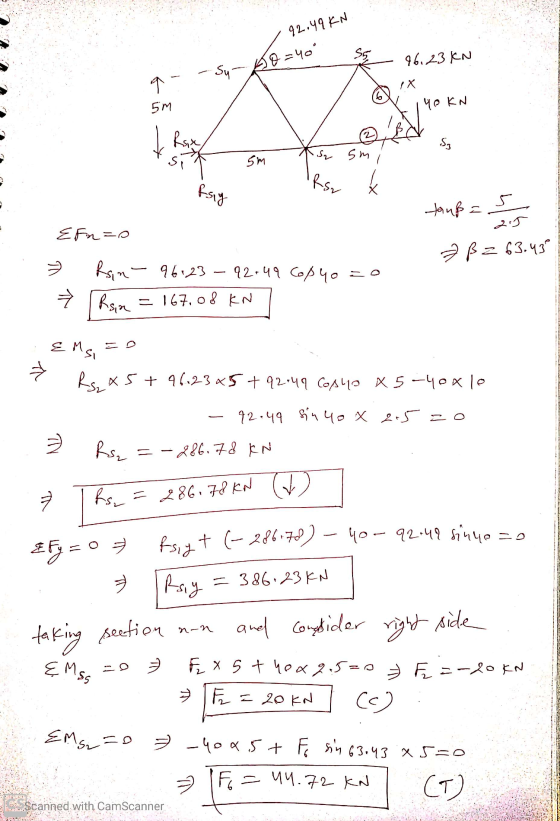
Question Three: For the truss shown below, find the the internal force in member No. 6...
Method of Sections Reference the truss shown below. Solve for the forces in the specified members...
 Method of Sections Reference the truss shown below. Solve for the forces in the specified members using the Method of Sections. Clearly indicate whether the members are in compression (C) or tension (T). P-10 kN, P, = 6 kN and P, -8 kN. Note: You will not get credit for your work if you do not use the Method of Sections. 3 m Question 21 (6 points) Solve for the reactions at the supports Indicate both the magnitude and direction...
QUESTION 3 The truss shown in the Figure 3 is having hinged supports at A and B, assuming that the EA is constant for a...
 QUESTION 3 The truss shown in the Figure 3 is having hinged supports at A and B, assuming that the EA is constant for all the members. Use a flexibility method to determine the forces in each member and reactions at the supports. 80 kN 5 m 5 m 5 m 5 m Figure 3 130 marks) Total Marks [100
QUESTION 3 The truss shown in the Figure 3 is having hinged supports at A and B, assuming that the...
QUESTION 3 The truss shown in the Figure 3 is having hinged supports at A and B, assuming that the EA is constant for all the members. Use a flexibility method to determine the forces in each member and reactions at the supports. 80 kN 5 m 5 m 5 m 5 m Figure 3 130 marks) Total Marks [100
QUESTION 3 The truss shown in the Figure 3 is having hinged supports at A and B, assuming that the...
Problem No. 2 (100 points) For the Baltimore bridge truss shown below answer the following questions:...
 Problem No. 2 (100 points) For the Baltimore bridge truss shown below answer the following questions: 1) Calculate Reaction Forces (FBD is already drawn assuming a pin support at A and a roller support at I) (10) 2) What is status of the Truss (determinate or indeterminate)? (10) 3) Obtain ALL the Zero force member (30) 4) Using method of Joints, find force in member PF and PG specify if these forces are in Tension or Compression? (25) 5) Using...
2) Calculate the internal forces in each member of the truss shown below, and indicate if they ar...
 2) Calculate the internal forces in each member of the truss shown below, and indicate if they are in tension (T) or compression (C). P1 4 kN and P2 4 kN 30° 3 m Im P2
2) Calculate the internal forces in each member of the truss shown below, and indicate if they are in tension (T) or compression (C). P1 4 kN and P2 4 kN 30° 3 m Im P2
2) Calculate the internal forces in each member of the truss shown below, and indicate if they are in tension (T) or compression (C). P1 4 kN and P2 4 kN 30° 3 m Im P2
Determine all of the member forces in the truss below( take zero force members into consideration):...
 Determine all of the member
forces in the truss below( take zero force members into
consideration):
Determine all of the member forces in the truss below: Question 1 11 points 5 kN 5 kN 8 m 5 kN A 4 m 4 m 4 m Use the strict tension positive sign convention for internal forces, accuracy 0.5kN Units Number Units FBC Number FAB = Number Units Units Number FCD FAG= Number Units Number Units FAF = FBF FCE Number Number...
Determine all of the member
forces in the truss below( take zero force members into
consideration):
Determine all of the member forces in the truss below: Question 1 11 points 5 kN 5 kN 8 m 5 kN A 4 m 4 m 4 m Use the strict tension positive sign convention for internal forces, accuracy 0.5kN Units Number Units FBC Number FAB = Number Units Units Number FCD FAG= Number Units Number Units FAF = FBF FCE Number Number...
Find the internal forces for the truss shown below in member BF D 4 M EL...
 Find the internal forces for the truss shown below in member BF D 4 M EL F 4 m 30KN - Select one: O a. 21.21 kN (T) b.21.21 KN (C) c. 15 kN (0) d. 15 kN (T) e. None of the above
SAN4701 JAN/FEB 2015 QUESTION 1 The truss shown in Figure 1 is hinged at C, B and D It is acted upon at node A by a ver...
 SAN4701 JAN/FEB 2015 QUESTION 1 The truss shown in Figure 1 is hinged at C, B and D It is acted upon at node A by a vertically downward force of 3 kN and a honzontal force of 5 kN as shown in Figure 1 Use the method of strffness matrix and analyse for the following (a) Displacement at node A (16) (b) Reaction at the supports (c) Member forces (15) EA 300 x 103 kN and is constant for...
3. Use method of Section and determine the force in member GF and GD of the...
 3. Use method of Section and determine the force in member GF and GD of the truss. State whether the members are in tension or compression. The reactions at the supports have been calculated. (Lec/Tute a half) 45 m m 40 B с D A, EN 6 kN 8 kN 2 EN E-7AN
Question 1: For the below truss, if 0=20°, calculate: → 5 kN 1.5 m 2 m...
 Question 1: For the below truss, if 0=20°, calculate: → 5 kN 1.5 m 2 m - 2 m — 9 KN a. The reactions at A and B (15 marks) b. The internal forces in members BD, DC and AB using section method (25 marks)
Final Exam 2. Analyze the truss shown below: (50 Points) a. Solve for the reactions at...
 Final Exam 2. Analyze the truss shown below: (50 Points) a. Solve for the reactions at supports A and D b. Determine the force developed in members FE, EB, and BC of the truss, and state if these members are in tension or compression. Use the method of sections, c. Draw a free body diagram (FBD) of: i. The entire truss, without its supports ii. The truss section after cutting it iii. Any joint that you solve. m 1 m...
 Method of Sections Reference the truss shown below. Solve for the forces in the specified members using the Method of Sections. Clearly indicate whether the members are in compression (C) or tension (T). P-10 kN, P, = 6 kN and P, -8 kN. Note: You will not get credit for your work if you do not use the Method of Sections. 3 m Question 21 (6 points) Solve for the reactions at the supports Indicate both the magnitude and direction...
 QUESTION 3 The truss shown in the Figure 3 is having hinged supports at A and B, assuming that the EA is constant for all the members. Use a flexibility method to determine the forces in each member and reactions at the supports. 80 kN 5 m 5 m 5 m 5 m Figure 3 130 marks) Total Marks [100
QUESTION 3 The truss shown in the Figure 3 is having hinged supports at A and B, assuming that the...
QUESTION 3 The truss shown in the Figure 3 is having hinged supports at A and B, assuming that the EA is constant for all the members. Use a flexibility method to determine the forces in each member and reactions at the supports. 80 kN 5 m 5 m 5 m 5 m Figure 3 130 marks) Total Marks [100
QUESTION 3 The truss shown in the Figure 3 is having hinged supports at A and B, assuming that the...
 Problem No. 2 (100 points) For the Baltimore bridge truss shown below answer the following questions: 1) Calculate Reaction Forces (FBD is already drawn assuming a pin support at A and a roller support at I) (10) 2) What is status of the Truss (determinate or indeterminate)? (10) 3) Obtain ALL the Zero force member (30) 4) Using method of Joints, find force in member PF and PG specify if these forces are in Tension or Compression? (25) 5) Using...
 2) Calculate the internal forces in each member of the truss shown below, and indicate if they are in tension (T) or compression (C). P1 4 kN and P2 4 kN 30° 3 m Im P2
2) Calculate the internal forces in each member of the truss shown below, and indicate if they are in tension (T) or compression (C). P1 4 kN and P2 4 kN 30° 3 m Im P2
2) Calculate the internal forces in each member of the truss shown below, and indicate if they are in tension (T) or compression (C). P1 4 kN and P2 4 kN 30° 3 m Im P2
 Determine all of the member
forces in the truss below( take zero force members into
consideration):
Determine all of the member forces in the truss below: Question 1 11 points 5 kN 5 kN 8 m 5 kN A 4 m 4 m 4 m Use the strict tension positive sign convention for internal forces, accuracy 0.5kN Units Number Units FBC Number FAB = Number Units Units Number FCD FAG= Number Units Number Units FAF = FBF FCE Number Number...
Determine all of the member
forces in the truss below( take zero force members into
consideration):
Determine all of the member forces in the truss below: Question 1 11 points 5 kN 5 kN 8 m 5 kN A 4 m 4 m 4 m Use the strict tension positive sign convention for internal forces, accuracy 0.5kN Units Number Units FBC Number FAB = Number Units Units Number FCD FAG= Number Units Number Units FAF = FBF FCE Number Number...
 Find the internal forces for the truss shown below in member BF D 4 M EL F 4 m 30KN - Select one: O a. 21.21 kN (T) b.21.21 KN (C) c. 15 kN (0) d. 15 kN (T) e. None of the above
 SAN4701 JAN/FEB 2015 QUESTION 1 The truss shown in Figure 1 is hinged at C, B and D It is acted upon at node A by a vertically downward force of 3 kN and a honzontal force of 5 kN as shown in Figure 1 Use the method of strffness matrix and analyse for the following (a) Displacement at node A (16) (b) Reaction at the supports (c) Member forces (15) EA 300 x 103 kN and is constant for...
 3. Use method of Section and determine the force in member GF and GD of the truss. State whether the members are in tension or compression. The reactions at the supports have been calculated. (Lec/Tute a half) 45 m m 40 B с D A, EN 6 kN 8 kN 2 EN E-7AN
 Question 1: For the below truss, if 0=20°, calculate: → 5 kN 1.5 m 2 m - 2 m — 9 KN a. The reactions at A and B (15 marks) b. The internal forces in members BD, DC and AB using section method (25 marks)
 Final Exam 2. Analyze the truss shown below: (50 Points) a. Solve for the reactions at supports A and D b. Determine the force developed in members FE, EB, and BC of the truss, and state if these members are in tension or compression. Use the method of sections, c. Draw a free body diagram (FBD) of: i. The entire truss, without its supports ii. The truss section after cutting it iii. Any joint that you solve. m 1 m...
Most questions answered within 3 hours.
-
Where is the error in this code sequence?
String s1 = "Hello";
String s2 = "ello";...
asked 10 months ago -
Financial data for Joel de Paris, Inc., for last year
follow:
Joel de Paris, Inc.
Balance...
asked 10 months ago -
Consider this reaction:
Al2(SO4)3 (aq)+ BaCl3
(aq) Al2Cl6 (aq)- +
3BaSO4(s) . What is the...
asked 10 months ago -
Suppose that Savneet is considering increasing her
recent random sample from 20 car rentals to 40...
asked 10 months ago -
Trucks arrive at an unloading terminal at an average rate of 120
per hour.
Trucks arrive...
asked 10 months ago -
Why are methanol and ethanol completely soluble in water while
octanol is not very little soluble....
asked 10 months ago -
A facilities manager at a university reads in a research report
that the mean amount of...
asked 10 months ago -
When the CuSO4 is rehydrated by adding water to the anhydrous
compound, is this an endothermic...
asked 10 months ago -
A ray of sunlight is passing from diamond into crown glass; the
angle of incidence is...
asked 10 months ago -
A block of mass 0.249 kg is placed on top of a light, vertical
spring of...
asked 10 months ago -
how do the kidneys compensate in the presences of acidosis
a) trigger hyperventilate
b) reserve acid...
asked 10 months ago -
Question 501 pts
The rental rate of capital to the firm increases. Which of the
following...
asked 10 months ago