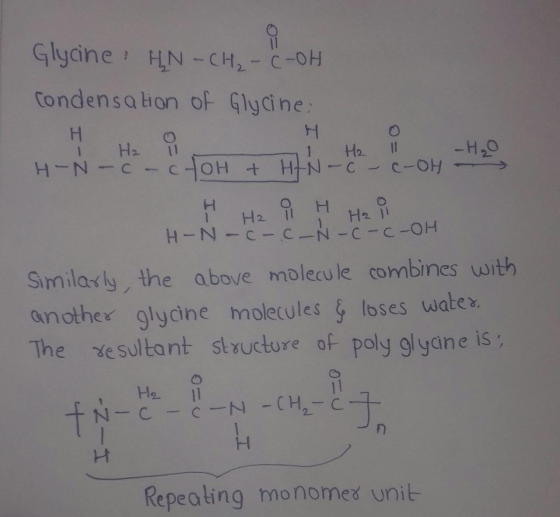
The amino acid glycine can be condensed to form a polymer called polyglycine. Draw the repeating...
The amino acid glycine can be condensed to form a polymer called polyglycine. Draw the repeating monomer unit.
Please answer with explanations and the steps for each part of the question.
Homework Answers
Add Answer to:
The amino acid glycine can be condensed to form a polymer called
polyglycine. Draw the repeating...
draw the monomer or monomers needed to produce the polymer shown. draw the repeating monomer unit...
 draw the monomer or monomers needed to produce the polymer
shown.
draw the repeating monomer unit for the polymer formed
from the following reaction.
1. For each of the following reactions, draw the monomer or monomers needed to produce the polymer shown. 2. Draw the repeating monomer unit for the polymer formed from the following reaction
draw the monomer or monomers needed to produce the polymer
shown.
draw the repeating monomer unit for the polymer formed
from the following reaction.
1. For each of the following reactions, draw the monomer or monomers needed to produce the polymer shown. 2. Draw the repeating monomer unit for the polymer formed from the following reaction
3. a) Draw the expected polymer that would form from the two monomer units below (draw...
 3. a) Draw the expected polymer that would form from the two monomer units below (draw the two repeating units): + H₂N - NH2
Draw the repeating unit of the step-growth polymer that will be formed from each of the...
 Draw the repeating unit of the step-growth polymer that will
be formed from each of the following pairs of monomer:
KChapter 27 Part 1 Problem 27.25 ▼ Part C (C6H5)3P=CH O + on the canvas by choosing buttons from the Tools (for bonds), Atoms, and Advanced Template toolbar Draw the m atom and choose +R-group attachement Ca Marvin JS Correct OCH CH CH2O HC-CH NH, + Draw the molecule on the canvas by choosing buttons from the Tools (for bonds)....
Draw the repeating unit of the step-growth polymer that will
be formed from each of the following pairs of monomer:
KChapter 27 Part 1 Problem 27.25 ▼ Part C (C6H5)3P=CH O + on the canvas by choosing buttons from the Tools (for bonds), Atoms, and Advanced Template toolbar Draw the m atom and choose +R-group attachement Ca Marvin JS Correct OCH CH CH2O HC-CH NH, + Draw the molecule on the canvas by choosing buttons from the Tools (for bonds)....
Can you draw repeating unit of the polymer Nylon 6,6 and circle and label functional groups...
Can you draw repeating unit of the polymer Nylon 6,6 and circle and label functional groups :)
Draw the structure of the polymer (the repeating unit) that results when the following molecule is...
 Draw the structure of the polymer (the repeating unit) that results when the following molecule is treated with peroxide (ROOR). 5. ROOR Polylethylene terephthalate) can be synthesized from terephthalic acid and ethylene Blycol in the presence of an acid catalyst and heat. 6. acid catalyst heat ??-?- (a) What are the two products of the reaction? (b) What is the acronym of Poly(ethylene terephthalate)?
The repeating unit of the common polymer PETE (poly(ethylene terephthalate)) is shown below. Draw the structures...
 The repeating unit of the common polymer PETE (poly(ethylene terephthalate)) is shown below. Draw the structures of the acid and alcohol used to produce PETE.
Draw the structure and indicate the repeating unit of Nylon-8,5, using the convention that the polymer...
Draw the structure and indicate the repeating unit of Nylon-8,5, using the convention that the polymer you prepared is called Nylon-6,10. Based on the reaction you performed, what are the names and structures of the reactants you would use to prepare Nylon-8,5. Use structures to describe three possible end-groups for a Nylon-8,5 polymer molecule that was prepared.
20. Properties of a Buffer The amino acid glycine is often used as the main ingredient...
 20. Properties of a Buffer The amino acid glycine is often used as the main ingredient of a buffer in biochemical experi- ments. The amino group of glycine, which has a pKa of 9.6, can exist either in the protonated form (-NH3 or as the free base (-NH2), because of the reversible equilibrium (a) In what pH range can glycine be used as an effective buffer due to its amino group? (b) In a 0.1 M solution of glycine at...
In Organic Chem for lab properties and identification of amino acids (aspartic acid,glycine, tyrosine, phenylalamine and...
 In Organic Chem for lab properties and identification of amino
acids (aspartic acid,glycine, tyrosine, phenylalamine and phenol)
please help answer the following questions. Also, please write
clear because it is very hard to read response a lot of the
times-thank you
4. Write a balanced chemical equation for the reaction of each amino acid in this experiment with ninhydrin. Draw Lewis structures; do not use molecular formulas.
In Organic Chem for lab properties and identification of amino
acids (aspartic acid,glycine, tyrosine, phenylalamine and phenol)
please help answer the following questions. Also, please write
clear because it is very hard to read response a lot of the
times-thank you
4. Write a balanced chemical equation for the reaction of each amino acid in this experiment with ninhydrin. Draw Lewis structures; do not use molecular formulas.
The amino acid glycine can react to form a dipeptide (glycylgycine) according to the following equation:...
 The amino acid glycine can react to form a dipeptide
(glycylgycine) according to the following equation:
2 glycine (s) -----> glycylgycine (s) +
H2O (s)
a) Use the data below (taken from standard reference tables) to
calculate deltaHdegree (in kJ), deltaSdegree
(in J/K), and deltaGdegree (in kJ) corresponding to this
reaction at 25 celcius (SHOW WORK)
deltaHdegree (in kJ)
deltaSdegree (in J/K)
deltaGdegree (in kJ)
b) Will the reaction be more spontaneous (in the forward
direction) at body temperature (37...
The amino acid glycine can react to form a dipeptide
(glycylgycine) according to the following equation:
2 glycine (s) -----> glycylgycine (s) +
H2O (s)
a) Use the data below (taken from standard reference tables) to
calculate deltaHdegree (in kJ), deltaSdegree
(in J/K), and deltaGdegree (in kJ) corresponding to this
reaction at 25 celcius (SHOW WORK)
deltaHdegree (in kJ)
deltaSdegree (in J/K)
deltaGdegree (in kJ)
b) Will the reaction be more spontaneous (in the forward
direction) at body temperature (37...
 draw the monomer or monomers needed to produce the polymer
shown.
draw the repeating monomer unit for the polymer formed
from the following reaction.
1. For each of the following reactions, draw the monomer or monomers needed to produce the polymer shown. 2. Draw the repeating monomer unit for the polymer formed from the following reaction
draw the monomer or monomers needed to produce the polymer
shown.
draw the repeating monomer unit for the polymer formed
from the following reaction.
1. For each of the following reactions, draw the monomer or monomers needed to produce the polymer shown. 2. Draw the repeating monomer unit for the polymer formed from the following reaction
 3. a) Draw the expected polymer that would form from the two monomer units below (draw the two repeating units): + H₂N - NH2
 Draw the repeating unit of the step-growth polymer that will
be formed from each of the following pairs of monomer:
KChapter 27 Part 1 Problem 27.25 ▼ Part C (C6H5)3P=CH O + on the canvas by choosing buttons from the Tools (for bonds), Atoms, and Advanced Template toolbar Draw the m atom and choose +R-group attachement Ca Marvin JS Correct OCH CH CH2O HC-CH NH, + Draw the molecule on the canvas by choosing buttons from the Tools (for bonds)....
Draw the repeating unit of the step-growth polymer that will
be formed from each of the following pairs of monomer:
KChapter 27 Part 1 Problem 27.25 ▼ Part C (C6H5)3P=CH O + on the canvas by choosing buttons from the Tools (for bonds), Atoms, and Advanced Template toolbar Draw the m atom and choose +R-group attachement Ca Marvin JS Correct OCH CH CH2O HC-CH NH, + Draw the molecule on the canvas by choosing buttons from the Tools (for bonds)....
 Draw the structure of the polymer (the repeating unit) that results when the following molecule is treated with peroxide (ROOR). 5. ROOR Polylethylene terephthalate) can be synthesized from terephthalic acid and ethylene Blycol in the presence of an acid catalyst and heat. 6. acid catalyst heat ??-?- (a) What are the two products of the reaction? (b) What is the acronym of Poly(ethylene terephthalate)?
 The repeating unit of the common polymer PETE (poly(ethylene terephthalate)) is shown below. Draw the structures of the acid and alcohol used to produce PETE.
 20. Properties of a Buffer The amino acid glycine is often used as the main ingredient of a buffer in biochemical experi- ments. The amino group of glycine, which has a pKa of 9.6, can exist either in the protonated form (-NH3 or as the free base (-NH2), because of the reversible equilibrium (a) In what pH range can glycine be used as an effective buffer due to its amino group? (b) In a 0.1 M solution of glycine at...
 In Organic Chem for lab properties and identification of amino
acids (aspartic acid,glycine, tyrosine, phenylalamine and phenol)
please help answer the following questions. Also, please write
clear because it is very hard to read response a lot of the
times-thank you
4. Write a balanced chemical equation for the reaction of each amino acid in this experiment with ninhydrin. Draw Lewis structures; do not use molecular formulas.
In Organic Chem for lab properties and identification of amino
acids (aspartic acid,glycine, tyrosine, phenylalamine and phenol)
please help answer the following questions. Also, please write
clear because it is very hard to read response a lot of the
times-thank you
4. Write a balanced chemical equation for the reaction of each amino acid in this experiment with ninhydrin. Draw Lewis structures; do not use molecular formulas.
 The amino acid glycine can react to form a dipeptide
(glycylgycine) according to the following equation:
2 glycine (s) -----> glycylgycine (s) +
H2O (s)
a) Use the data below (taken from standard reference tables) to
calculate deltaHdegree (in kJ), deltaSdegree
(in J/K), and deltaGdegree (in kJ) corresponding to this
reaction at 25 celcius (SHOW WORK)
deltaHdegree (in kJ)
deltaSdegree (in J/K)
deltaGdegree (in kJ)
b) Will the reaction be more spontaneous (in the forward
direction) at body temperature (37...
The amino acid glycine can react to form a dipeptide
(glycylgycine) according to the following equation:
2 glycine (s) -----> glycylgycine (s) +
H2O (s)
a) Use the data below (taken from standard reference tables) to
calculate deltaHdegree (in kJ), deltaSdegree
(in J/K), and deltaGdegree (in kJ) corresponding to this
reaction at 25 celcius (SHOW WORK)
deltaHdegree (in kJ)
deltaSdegree (in J/K)
deltaGdegree (in kJ)
b) Will the reaction be more spontaneous (in the forward
direction) at body temperature (37...
Most questions answered within 3 hours.
-
Where is the error in this code sequence?
String s1 = "Hello";
String s2 = "ello";...
asked 11 months ago -
Financial data for Joel de Paris, Inc., for last year
follow:
Joel de Paris, Inc.
Balance...
asked 11 months ago -
Consider this reaction:
Al2(SO4)3 (aq)+ BaCl3
(aq) Al2Cl6 (aq)- +
3BaSO4(s) . What is the...
asked 11 months ago -
Suppose that Savneet is considering increasing her
recent random sample from 20 car rentals to 40...
asked 11 months ago -
Trucks arrive at an unloading terminal at an average rate of 120
per hour.
Trucks arrive...
asked 11 months ago -
Why are methanol and ethanol completely soluble in water while
octanol is not very little soluble....
asked 11 months ago -
A facilities manager at a university reads in a research report
that the mean amount of...
asked 11 months ago -
When the CuSO4 is rehydrated by adding water to the anhydrous
compound, is this an endothermic...
asked 11 months ago -
A ray of sunlight is passing from diamond into crown glass; the
angle of incidence is...
asked 11 months ago -
A block of mass 0.249 kg is placed on top of a light, vertical
spring of...
asked 11 months ago -
how do the kidneys compensate in the presences of acidosis
a) trigger hyperventilate
b) reserve acid...
asked 11 months ago -
Question 501 pts
The rental rate of capital to the firm increases. Which of the
following...
asked 11 months ago