
Homework Answers
Add Answer to:
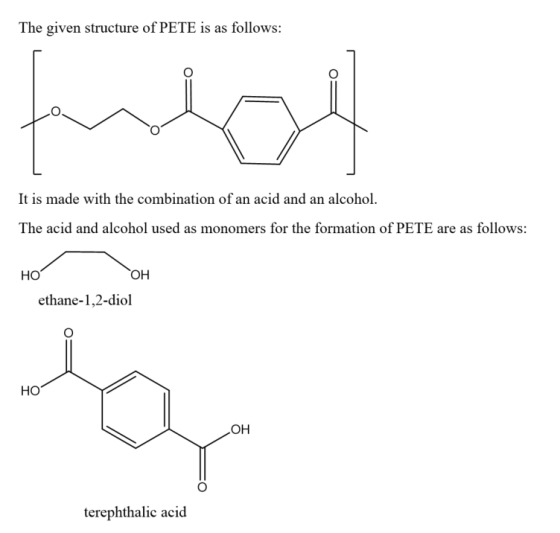
The repeating unit of the common polymer PETE (poly(ethylene terephthalate)) is shown below. Draw the structures...
Draw both the monomer and polymer structures of the following polymers Nylon 6,6 Poly(ethylene terephthalate)
Draw both the monomer and polymer structures of the following polymers Nylon 6,6 Poly(ethylene terephthalate)
Draw the structure of the polymer (the repeating unit) that results when the following molecule is...
 Draw the structure of the polymer (the repeating unit) that results when the following molecule is treated with peroxide (ROOR). 5. ROOR Polylethylene terephthalate) can be synthesized from terephthalic acid and ethylene Blycol in the presence of an acid catalyst and heat. 6. acid catalyst heat ??-?- (a) What are the two products of the reaction? (b) What is the acronym of Poly(ethylene terephthalate)?
draw the monomer or monomers needed to produce the polymer shown. draw the repeating monomer unit...
 draw the monomer or monomers needed to produce the polymer
shown.
draw the repeating monomer unit for the polymer formed
from the following reaction.
1. For each of the following reactions, draw the monomer or monomers needed to produce the polymer shown. 2. Draw the repeating monomer unit for the polymer formed from the following reaction
draw the monomer or monomers needed to produce the polymer
shown.
draw the repeating monomer unit for the polymer formed
from the following reaction.
1. For each of the following reactions, draw the monomer or monomers needed to produce the polymer shown. 2. Draw the repeating monomer unit for the polymer formed from the following reaction
Polymer Processing : Principles and Design (Baird). 4A.7 Poly(ethylene terephthalate) (PET) Pellet Drying. PET is a...
Polymer Processing : Principles and Design (Baird). 4A.7 Poly(ethylene terephthalate) (PET) Pellet Drying. PET is a relatively hydrophobic polymer, which still needs drying before processing. Calculate the temperature of the drying oven, so that the drying of spherical pellets, 3 mm in diameter, does not take more than 11 hours. Assume that the pellets were initially in equilibrium with air having 70% relative humidity. Thank you for any help with this!
Draw the structure and indicate the repeating unit of Nylon-8,5, using the convention that the polymer...
Draw the structure and indicate the repeating unit of Nylon-8,5, using the convention that the polymer you prepared is called Nylon-6,10. Based on the reaction you performed, what are the names and structures of the reactants you would use to prepare Nylon-8,5. Use structures to describe three possible end-groups for a Nylon-8,5 polymer molecule that was prepared.
MAKE-UP Question 2 PETE is the shorthand name for a polymer that is commonly used to...
 MAKE-UP Question 2 PETE is the shorthand name for a polymer that is commonly used to create plastic bottles for soda beverages. Examples of these bottles and the recycling symbol for PETE are shown in the photograph The two monomer units that are used to make PETE are given below (a) Draw a diagram to illustrate how these two monomers are joined by a condensation reaction (include the molecular structures of all the reactants and the products) type of chemical...
3 Match the following polymer with the common product in which it is used (see intro...
 3 Match the following polymer with the common product in which it is used (see intro for help). 1. polystyrene 2. nylon 3. polypropylene 4. low density polyethylene 5. polycarbonate a. Plastic Bags b. Water Pipes c. Cookware d. Egg containers e. Milk cartons 6. polyethylene f. Carpet and Knitted fabrics 7. polyvinylchloride 9. Automobile bumpers 8. polytetrafluoroethylene h. Rope 4. Shown below are monomers for common polymers that get made. Draw two repeating units of the polymer structure for...
Can you draw repeating unit of the polymer Nylon 6,6 and circle and label functional groups...
Can you draw repeating unit of the polymer Nylon 6,6 and circle and label functional groups :)
The amino acid glycine can be condensed to form a polymer called polyglycine. Draw the repeating...
The amino acid glycine can be condensed to form a polymer called polyglycine. Draw the repeating monomer unit. Please answer with explanations and the steps for each part of the question.
0. A fragment of the polymer, Dacron, is shown below. Dacron is made by condensation polymerization...
 0. A fragment of the polymer, Dacron, is shown below. Dacron is made by condensation polymerization of 2 monomers that combine in-A-B-A-B-A-B- structure similar to nylon. a. Draw brackets around one polymer unit in the structure below. b. Draw the structures of 2 difunctional monomers A and B that would underg polymerization to produce this polymer A= x-R-X and B-y-R,-y Identify the small molecule byproduct of condensation. 4 pts o condensation c. Ax-R-x B- y-R'-y Byproduct A fragment of the...
 Draw the structure of the polymer (the repeating unit) that results when the following molecule is treated with peroxide (ROOR). 5. ROOR Polylethylene terephthalate) can be synthesized from terephthalic acid and ethylene Blycol in the presence of an acid catalyst and heat. 6. acid catalyst heat ??-?- (a) What are the two products of the reaction? (b) What is the acronym of Poly(ethylene terephthalate)?
 draw the monomer or monomers needed to produce the polymer
shown.
draw the repeating monomer unit for the polymer formed
from the following reaction.
1. For each of the following reactions, draw the monomer or monomers needed to produce the polymer shown. 2. Draw the repeating monomer unit for the polymer formed from the following reaction
draw the monomer or monomers needed to produce the polymer
shown.
draw the repeating monomer unit for the polymer formed
from the following reaction.
1. For each of the following reactions, draw the monomer or monomers needed to produce the polymer shown. 2. Draw the repeating monomer unit for the polymer formed from the following reaction
 MAKE-UP Question 2 PETE is the shorthand name for a polymer that is commonly used to create plastic bottles for soda beverages. Examples of these bottles and the recycling symbol for PETE are shown in the photograph The two monomer units that are used to make PETE are given below (a) Draw a diagram to illustrate how these two monomers are joined by a condensation reaction (include the molecular structures of all the reactants and the products) type of chemical...
 3 Match the following polymer with the common product in which it is used (see intro for help). 1. polystyrene 2. nylon 3. polypropylene 4. low density polyethylene 5. polycarbonate a. Plastic Bags b. Water Pipes c. Cookware d. Egg containers e. Milk cartons 6. polyethylene f. Carpet and Knitted fabrics 7. polyvinylchloride 9. Automobile bumpers 8. polytetrafluoroethylene h. Rope 4. Shown below are monomers for common polymers that get made. Draw two repeating units of the polymer structure for...
 0. A fragment of the polymer, Dacron, is shown below. Dacron is made by condensation polymerization of 2 monomers that combine in-A-B-A-B-A-B- structure similar to nylon. a. Draw brackets around one polymer unit in the structure below. b. Draw the structures of 2 difunctional monomers A and B that would underg polymerization to produce this polymer A= x-R-X and B-y-R,-y Identify the small molecule byproduct of condensation. 4 pts o condensation c. Ax-R-x B- y-R'-y Byproduct A fragment of the...
Most questions answered within 3 hours.
-
Where is the error in this code sequence?
String s1 = "Hello";
String s2 = "ello";...
asked 10 months ago -
Financial data for Joel de Paris, Inc., for last year
follow:
Joel de Paris, Inc.
Balance...
asked 10 months ago -
Consider this reaction:
Al2(SO4)3 (aq)+ BaCl3
(aq) Al2Cl6 (aq)- +
3BaSO4(s) . What is the...
asked 10 months ago -
Suppose that Savneet is considering increasing her
recent random sample from 20 car rentals to 40...
asked 10 months ago -
Trucks arrive at an unloading terminal at an average rate of 120
per hour.
Trucks arrive...
asked 10 months ago -
Why are methanol and ethanol completely soluble in water while
octanol is not very little soluble....
asked 10 months ago -
A facilities manager at a university reads in a research report
that the mean amount of...
asked 10 months ago -
When the CuSO4 is rehydrated by adding water to the anhydrous
compound, is this an endothermic...
asked 10 months ago -
A ray of sunlight is passing from diamond into crown glass; the
angle of incidence is...
asked 10 months ago -
A block of mass 0.249 kg is placed on top of a light, vertical
spring of...
asked 10 months ago -
how do the kidneys compensate in the presences of acidosis
a) trigger hyperventilate
b) reserve acid...
asked 10 months ago -
Question 501 pts
The rental rate of capital to the firm increases. Which of the
following...
asked 10 months ago