________________ neurons are involved in ‘planning’ movements. Prefrontal cortex Primary motor cortex Primary somatosensory cortex Premotor...
________________ neurons are involved in ‘planning’ movements.
| Prefrontal cortex |
| Primary motor cortex |
| Primary somatosensory cortex |
| Premotor cortex |
Homework Answers
Prefrontal cortex is a part of the brain located in the front of the frontal lobe. it helps in planning movements and greatly contributes to personality development.
Add Answer to:
________________ neurons are involved in ‘planning’
movements.
Prefrontal cortex
Primary motor cortex
Primary somatosensory cortex
Premotor...
Question 56(4 points) This area of the brain allows you to identify and determine what an...
 Question 56(4 points) This area of the brain allows you to identify and determine what an object is by touch (such as car keys in your pocket). primary motor cortes primary somatosensory cortex somatosensory association cortex premotor cortex prefrontal cortex
A researcher wants to selectively stimulate (depolarize) serotonergic neurons that project to the prefrontal cortex. Using...
 A researcher wants to selectively stimulate (depolarize) serotonergic neurons that project to the prefrontal cortex. Using a mouse model, what technique should be used? O a. deep brain stimulation in the prefrontal cortex express an inhibitory receptor in serotonin neurons and then administer CNO directly into the prefrontal cortex O c. express Channelrhodopsin-2 in serotonin neurons and then administer CNO directly into the prefrontal cortex express Channelrhodopsin-2 in serotonin neurons and then deliver blue light (fiber optics) into the prefrontal...
Which statement about motor neurons is NOT correct? motor neuron pools innervating two different muscles, such...
 Which statement about motor neurons is NOT correct? motor neuron pools innervating two different muscles, such as biceps and triceps, have separate non- overlapping locations in the ventral gray matter arranged in longitudinal columns motoneurons in a motor pool are recruited (activated) in rank order according to their size, from small to large small a-motor neurons tepd to innervate a large number of thick, pale muscle fibers that generate large forces but fatigue quickly an equal synaptic current will elicit...
Label the functional areas of the brain by clicking and dragging the labels to the correct...
 Label the functional areas of the brain by clicking and dragging the labels to the correct location. Broca's area Prefrontal cortex Primary motor cortex Gustatory cortex (in insula Auditory association area Primary auditory cortex Olfactory association Visual association area area Primary somato- sensory cortex Cerebellum Lateral Motor association area sulcus Central sulcus Primary visual cortex Somatosensory association area Wernicke's area Reset Zoom
Compare and contrast the functional roles of the supplementary motor area and the premotor cortex.
Compare and contrast the functional roles of the supplementary motor area and the premotor cortex.
The primary motor cortex is not connected to the spinal cord, but instead information is passed...
The primary motor cortex is not connected to the spinal cord, but instead information is passed through many different areas in the brain. Discuss how commands are generated in cortex, including different areas involved, and how they are eventually relayed to the spinal cord to control the somatic system. To answer the question select a specified outcome behavior like riding a bike or driving a car and use that to discuss the generation of required activity and the pathway, including...
Question 3 0/0.75 pts Which of the following is LEAST involved in planning somatic motor output?...
 Question 3 0/0.75 pts Which of the following is LEAST involved in planning somatic motor output? precentral gyrus cerebellum basal ganglia mesencephalon hypothalamus Question 4 0/0.75 pts The lower neuron of a somatic motor tract that synapses in the spinal cord originates in: posterior gray horns primary motor cortex lateral gray horns anterior gray horns mesencephalon
I think he needs to answer this quetion by using these words 1) Describe how to reach out and scratch your nose Use the following Vocabulary words- Antagonistic muscles Central pattern generator...
 I
think he needs to answer this quetion by using these words
1) Describe how to reach out and scratch your nose Use the following Vocabulary words- Antagonistic muscles Central pattern generators Corticospinal tracts Golgi tendon organs Lateral corticospinal tract Medial corticospinal tract Mirror neurons Motor program Muscle spindle Nuclei of the cerebellum Posterior parietal cortex Premotor cortex Primary motor cortex Proprioceptor Substantia nigra Supplementary motor cortex Vestibular nucleus
1) Describe how to reach out and scratch your nose Use...
I
think he needs to answer this quetion by using these words
1) Describe how to reach out and scratch your nose Use the following Vocabulary words- Antagonistic muscles Central pattern generators Corticospinal tracts Golgi tendon organs Lateral corticospinal tract Medial corticospinal tract Mirror neurons Motor program Muscle spindle Nuclei of the cerebellum Posterior parietal cortex Premotor cortex Primary motor cortex Proprioceptor Substantia nigra Supplementary motor cortex Vestibular nucleus
1) Describe how to reach out and scratch your nose Use...
Regulation of muscle tone is a function of the motor association (premotor) area. the basal nuclei....
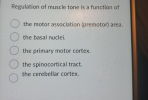 Regulation of muscle tone is a function of the motor association (premotor) area. the basal nuclei. the primary motor cortex. the spinocortical tract. the cerebellar cortex.
5) Which structure does not provide input to the amygdala? a. Orbital prefrontal cortex b. Medial...
 please help woth 5-10!!
5) Which structure does not provide input to the amygdala? a. Orbital prefrontal cortex b. Medial prefrontal cortex c. Olfactory cortex d. Thalamus e. Basal ganglia 6) The most mysterious aspect of emotional experience is a. the association of neutral stimuli with reward. b. the association of neutral stimuli with punishment. c. the highly subjective "feelings" that attend many emotional states d. innate fear responses. e. the ability to remember strong emotional stimuli. 7 An inability...
please help woth 5-10!!
5) Which structure does not provide input to the amygdala? a. Orbital prefrontal cortex b. Medial prefrontal cortex c. Olfactory cortex d. Thalamus e. Basal ganglia 6) The most mysterious aspect of emotional experience is a. the association of neutral stimuli with reward. b. the association of neutral stimuli with punishment. c. the highly subjective "feelings" that attend many emotional states d. innate fear responses. e. the ability to remember strong emotional stimuli. 7 An inability...
 Question 56(4 points) This area of the brain allows you to identify and determine what an object is by touch (such as car keys in your pocket). primary motor cortes primary somatosensory cortex somatosensory association cortex premotor cortex prefrontal cortex
 A researcher wants to selectively stimulate (depolarize) serotonergic neurons that project to the prefrontal cortex. Using a mouse model, what technique should be used? O a. deep brain stimulation in the prefrontal cortex express an inhibitory receptor in serotonin neurons and then administer CNO directly into the prefrontal cortex O c. express Channelrhodopsin-2 in serotonin neurons and then administer CNO directly into the prefrontal cortex express Channelrhodopsin-2 in serotonin neurons and then deliver blue light (fiber optics) into the prefrontal...
 Which statement about motor neurons is NOT correct? motor neuron pools innervating two different muscles, such as biceps and triceps, have separate non- overlapping locations in the ventral gray matter arranged in longitudinal columns motoneurons in a motor pool are recruited (activated) in rank order according to their size, from small to large small a-motor neurons tepd to innervate a large number of thick, pale muscle fibers that generate large forces but fatigue quickly an equal synaptic current will elicit...
 Label the functional areas of the brain by clicking and dragging the labels to the correct location. Broca's area Prefrontal cortex Primary motor cortex Gustatory cortex (in insula Auditory association area Primary auditory cortex Olfactory association Visual association area area Primary somato- sensory cortex Cerebellum Lateral Motor association area sulcus Central sulcus Primary visual cortex Somatosensory association area Wernicke's area Reset Zoom
 Question 3 0/0.75 pts Which of the following is LEAST involved in planning somatic motor output? precentral gyrus cerebellum basal ganglia mesencephalon hypothalamus Question 4 0/0.75 pts The lower neuron of a somatic motor tract that synapses in the spinal cord originates in: posterior gray horns primary motor cortex lateral gray horns anterior gray horns mesencephalon
 I
think he needs to answer this quetion by using these words
1) Describe how to reach out and scratch your nose Use the following Vocabulary words- Antagonistic muscles Central pattern generators Corticospinal tracts Golgi tendon organs Lateral corticospinal tract Medial corticospinal tract Mirror neurons Motor program Muscle spindle Nuclei of the cerebellum Posterior parietal cortex Premotor cortex Primary motor cortex Proprioceptor Substantia nigra Supplementary motor cortex Vestibular nucleus
1) Describe how to reach out and scratch your nose Use...
I
think he needs to answer this quetion by using these words
1) Describe how to reach out and scratch your nose Use the following Vocabulary words- Antagonistic muscles Central pattern generators Corticospinal tracts Golgi tendon organs Lateral corticospinal tract Medial corticospinal tract Mirror neurons Motor program Muscle spindle Nuclei of the cerebellum Posterior parietal cortex Premotor cortex Primary motor cortex Proprioceptor Substantia nigra Supplementary motor cortex Vestibular nucleus
1) Describe how to reach out and scratch your nose Use...
 Regulation of muscle tone is a function of the motor association (premotor) area. the basal nuclei. the primary motor cortex. the spinocortical tract. the cerebellar cortex.
 please help woth 5-10!!
5) Which structure does not provide input to the amygdala? a. Orbital prefrontal cortex b. Medial prefrontal cortex c. Olfactory cortex d. Thalamus e. Basal ganglia 6) The most mysterious aspect of emotional experience is a. the association of neutral stimuli with reward. b. the association of neutral stimuli with punishment. c. the highly subjective "feelings" that attend many emotional states d. innate fear responses. e. the ability to remember strong emotional stimuli. 7 An inability...
please help woth 5-10!!
5) Which structure does not provide input to the amygdala? a. Orbital prefrontal cortex b. Medial prefrontal cortex c. Olfactory cortex d. Thalamus e. Basal ganglia 6) The most mysterious aspect of emotional experience is a. the association of neutral stimuli with reward. b. the association of neutral stimuli with punishment. c. the highly subjective "feelings" that attend many emotional states d. innate fear responses. e. the ability to remember strong emotional stimuli. 7 An inability...
Most questions answered within 3 hours.
-
Where is the error in this code sequence?
String s1 = "Hello";
String s2 = "ello";...
asked 10 months ago -
Financial data for Joel de Paris, Inc., for last year
follow:
Joel de Paris, Inc.
Balance...
asked 10 months ago -
Consider this reaction:
Al2(SO4)3 (aq)+ BaCl3
(aq) Al2Cl6 (aq)- +
3BaSO4(s) . What is the...
asked 10 months ago -
Suppose that Savneet is considering increasing her
recent random sample from 20 car rentals to 40...
asked 10 months ago -
Trucks arrive at an unloading terminal at an average rate of 120
per hour.
Trucks arrive...
asked 10 months ago -
Why are methanol and ethanol completely soluble in water while
octanol is not very little soluble....
asked 10 months ago -
A facilities manager at a university reads in a research report
that the mean amount of...
asked 10 months ago -
When the CuSO4 is rehydrated by adding water to the anhydrous
compound, is this an endothermic...
asked 10 months ago -
A ray of sunlight is passing from diamond into crown glass; the
angle of incidence is...
asked 10 months ago -
A block of mass 0.249 kg is placed on top of a light, vertical
spring of...
asked 10 months ago -
how do the kidneys compensate in the presences of acidosis
a) trigger hyperventilate
b) reserve acid...
asked 10 months ago -
Question 501 pts
The rental rate of capital to the firm increases. Which of the
following...
asked 10 months ago